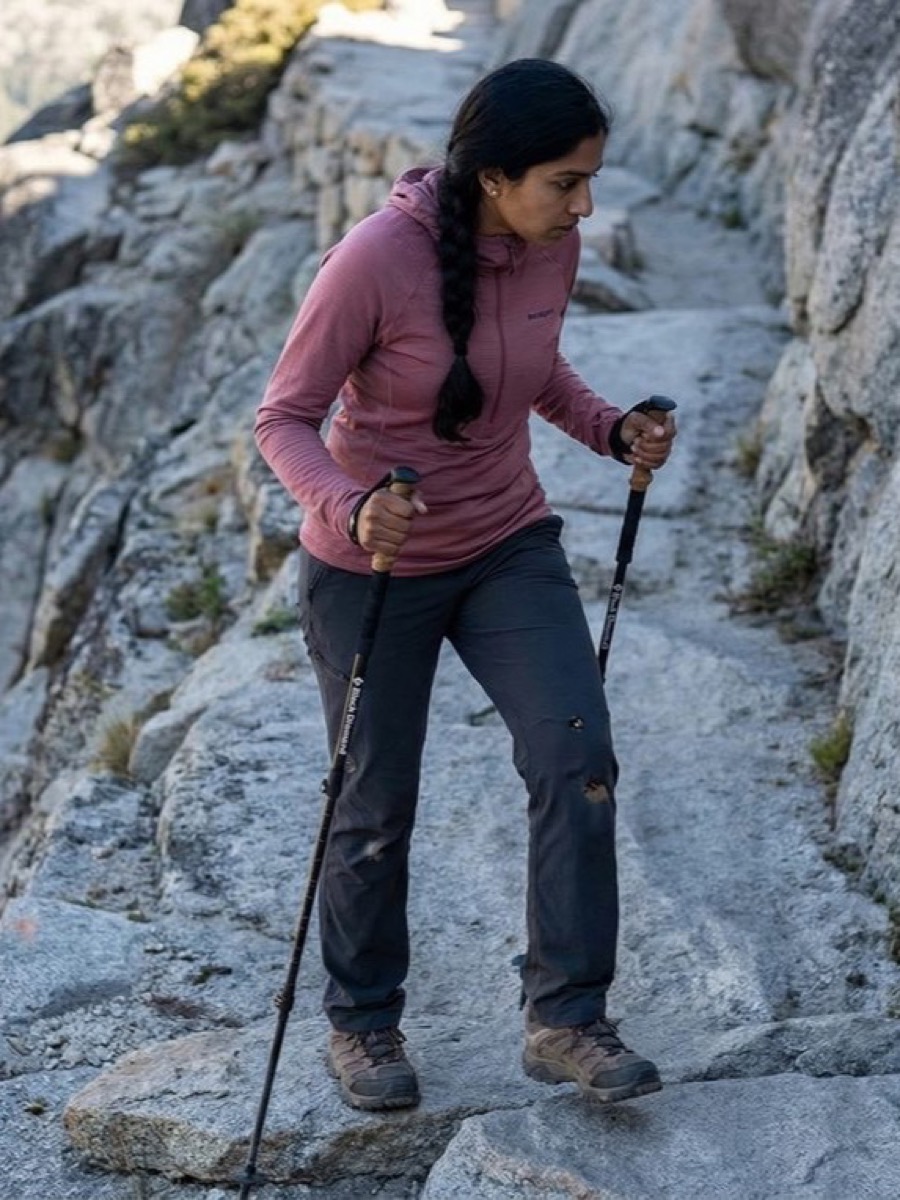
HIKING WITH FEAR OF HEIGHTS:
7 STEPS TO TRAIL CONFIDENCE
Carefully study trail reviews and elevation profiles beforehand. Choose wide, bench-cut trails carved into forested slopes rather than knife-edge ridgelines, sheer drop-offs, or exposed alpine scrambles.
Looking over cliffs or scanning distant horizons can trigger visual height vertigo as your brain loses spatial reference points. Keep your eyes anchored on the trail surface 6 to 10 feet directly in front of you.
Dual poles provide immediate physical feedback that you are securely anchored to the earth. Two poles plus two feet create continuous four-point stability, eliminating feelings of tipping or stumbling.
When adrenaline spikes on narrow trails, acute hyperventilation worsens dizziness. Inhale for 4 seconds, hold for 4 seconds, exhale for 4 seconds, and hold empty for 4 seconds to reset autonomic balance.
Turning around is never failure; every step taken on an unfamiliar trail builds neural tolerance. Conquering fear is an incremental journey—celebrate the distance achieved and return stronger next time.