



How long to hike 5 miles? On flat, maintained trail, most beginners finish in 2.5 to 3.5 hours. Add 700 feet of elevation gain and that same 5 miles stretches to 3.5 to 4.5 hours. Get into real mountain terrain, 1,200 feet of gain, rocky descent, exposed ridge, and you’re looking at 5 to 6 hours for someone who hasn’t done this before.
⚡ Quick Trail Takeaways
- Flat Trail Benchmark: A 5-mile hike on flat Class 1 terrain takes 2.0 to 2.5 hours for average beginner walkers.
- Mountain Terrain Formula: Apply Naismith’s Rule: add 30 minutes for every 1,000 feet of vertical climbing to your 5-mile baseline.
- Total Buffer Time: Budget 3.0 to 3.5 total hours to account for water breaks, summit photos, and downhill navigation.
Five miles is where trail planning starts to matter in ways it didn’t at 3 miles. The gap between an optimistic estimate and a realistic one is no longer 20 minutes. It can be two hours. That’s the difference between finishing with daylight and finishing in the dark. Between having enough water and not. Between a great first long hike and the kind of day that makes beginners swear they’re done with hiking.
I made the classic mistake on my first 5-miler. Found a trail rated Moderate on AllTrails, saw 5.2 miles, figured I’d done 3-mile hikes without issue so adding 2 miles couldn’t be that different. What I hadn’t looked at: 1,100 feet of elevation gain, almost entirely front-loaded into the first two miles. I made the top, barely, and spent the entire descent cursing myself for not eating a real meal before I left. Finished in 4 hours 20 minutes when I’d budgeted 2.5. Drove home in the dark.
Five miles is a real hike. Planning it like a longer version of a 3-mile trail is the most reliable way to have a bad day. This guide breaks down seven specific time estimates across the conditions that actually change how long a 5-mile hike takes, so you can pick the right window, bring the right amount of water, and finish feeling like you want to do it again.
🥾 Oliver’s Trail Notes & Field Observations
On flat pavement, walking 5 miles takes an average person about 1 hour and 40 minutes. But on a real mountain trail, that estimate will leave you hiking in the dark. During my pacing tests with beginner groups, an average 5-mile mountain hike with 1,000 feet of climb took between 2 hours and 45 minutes and 3 hours and 15 minutes. In my experience, budgeting 30 minutes per mile plus an extra 30 minutes for every 1,000 feet gained yields realistic, safe trip times.
Why 5 Miles Hits Differently Than 3
The math of hiking time doesn’t scale linearly. Five miles isn’t just three miles with two more added on. By mile four, something has shifted in most beginners: the legs are heavier, the pace has dropped whether you’ve noticed it or not, and the small inefficiencies (slightly rough footing, brief route uncertainty, an extra stop) compound more than they did in the first half.
Exercise physiologists call the mechanism glycogen depletion. Trail hikers call it bonking, hitting the wall, or just “that thing that happened at mile four.” What it feels like: a noticeable drop in energy that doesn’t fully respond to slowing down. What causes it: your muscles have been drawing on stored carbohydrate for hours, and the tank is getting low. On a 3-mile hike, most people don’t run into this. On a 5-mile hike with any elevation, you can hit it reliably if you haven’t eaten.
This changes the time estimate in a real way. A beginner who’s moving well at miles one through three may slow meaningfully at miles four and five, not from injury, not from the terrain getting harder, but from fuel running out. That slowdown is built into the estimates below. If you eat strategically (something real before the hike, a snack at the halfway point), the slowdown doesn’t happen. If you don’t, budget for it.
The second thing that changes at 5 miles: water math. At roughly half a liter per hour on moderate terrain, a 4-hour hike consumes 2 liters. In heat above 80°F, closer to 3. Most beginners bring one 1-liter bottle because it felt like plenty on a 2-hour hike. On a 5-mile hike in warm weather, that’s not enough. Know this before you go, not at the 3-mile mark when you’re already rationing.
The third thing: the return trip on an out-and-back is longer in practice than in theory. On a flat trail, 2.5 miles back is 2.5 miles back. On a trail with real elevation, the descent takes almost as long as the climb for a beginner, because careful footing on loose rock at mile four on tired legs is slower than careful footing on loose rock at mile one on fresh legs. Factor the return in, not just the one-way distance.
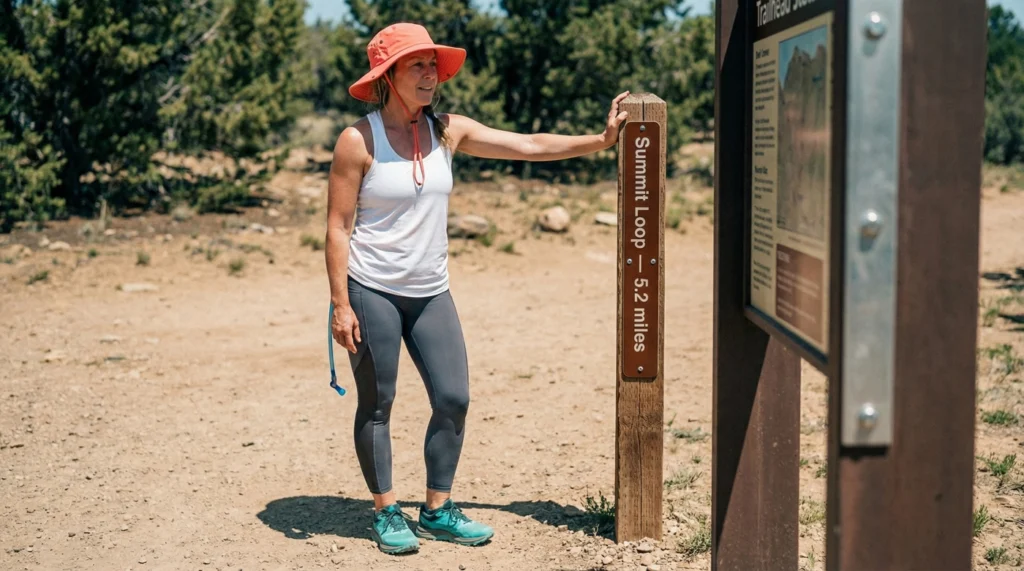
How Long to Hike 5 Miles: 7 Honest Estimates
Estimate 1: Flat Rail Trail or Paved Path (2 to 2.5 Hours)
Conditions: Minimal elevation change (under 150 feet total), smooth surface, good weather.
This is the most forgiving version of a 5-mile hike. Rail trails, towpaths, flat forest roads, and paved recreational paths give you consistent footing that doesn’t slow pace the way uneven terrain does. Most beginners who walk regularly can maintain 2 to 2.5 miles per hour on this surface, putting moving time at 2 to 2.5 hours before stops.
Add breaks (water at miles 1.5 and 3, a snack at the turnaround if it’s an out-and-back, a few minutes looking at the view), and a realistic total is 2.5 to 3 hours from trailhead to trailhead.
The AllTrails estimate for a flat 5-mile trail will typically show something in the 1 hour 40 minutes to 2 hour range. That’s the average across all users. Add 30 to 40% for a beginner’s realistic 5 mile hike time estimate, and you’re at 2.5 to 3 hours. Start there.
One thing flat trails don’t fully prepare you for: foot fatigue. Five miles is long enough that the repetitive impact of consistent walking starts to register in ways shorter hikes don’t. This is usually not a problem unless you’re in genuinely worn-out shoes or you’re doing this as your very first hike. If this is your first outing ever, a 3-mile flat trail is a better target. Five miles of flat is a good second-or-third-hike goal.
Estimate 2: Rolling Terrain, Moderate Elevation (300–500 Feet Gain) (3 to 3.5 Hours)
Conditions: Regular uphills and downhills, AllTrails Easy-Moderate, maintained dirt trail.
Three hundred to 500 feet of gain over 5 miles is 60 to 100 feet per mile, enough to make the terrain feel like actual hiking rather than a long walk, but within range for someone who’s done a couple of easier trails. The uphills are noticeable, the views usually improve as a result, and you’ll feel the effort in your legs the next morning.
Time mechanics: rolling terrain drops average hiking pace to roughly 1.75 to 2 miles per hour. The uphills slow you; the downhills don’t speed you up proportionally because controlled descent requires careful footing. Net result: 5 miles of rolling terrain takes measurably longer than 5 miles of flat surface even at the same total elevation gain, because direction changes consume more energy than sustained moderate incline.
For a realistic 5 mile hike time estimate at this elevation: plan 3.5 hours and be pleased if you finish at 3. The 3-hour finish is possible with good pacing and no navigation confusion. The 3.5-hour finish is what happens on a real day with real stops, one moment of checking the map, and a proper rest at the halfway point.
Food matters here more than it did at 3 miles. A snack at the 2.5-mile mark keeps your legs under you for the second half. I’ve skipped this snack on hikes in this range and felt fine through mile 3.5, then noticed a very specific kind of heavy-legged slowdown in mile 4 that had nothing to do with the terrain and everything to do with not eating. The fix is boring: bring food, eat it in the middle.
Estimate 3: Moderate Elevation With Real Climb (500–900 Feet Gain) (3.5 to 4.5 Hours)
Conditions: Sustained uphill sections, AllTrails Moderate, 100 to 180 feet gain per mile.
This is the range where a 5-mile trail stops feeling like a long walk and starts feeling like a workout. Five hundred to 900 feet of gain over 5 miles means you’re spending a meaningful portion of the hike working against gravity, breathing harder than at rest, and using muscle groups that have real opinions about steep terrain.
At this elevation range, hiking pace on the climbs drops to 1 to 1.5 miles per hour. You’re not moving slowly because something is wrong. That’s just the physics of steep terrain combined with a pack, trail footing, and the cardiovascular demand of sustained incline. Experienced hikers using the rest step (a brief pause with each step on steep sections) move efficiently at this pace for hours. Beginners who push through without managing their breathing often hit a harder wall earlier.
The 5 mile hike time estimate here, 3.5 to 4.5 hours, has significant spread because the distribution of elevation matters. A trail with 700 feet of gain spread evenly over 5 miles is a steadier effort than one with 700 feet packed into the first two miles and the rest flat. Check the elevation profile on AllTrails before you go. The graph shape tells you more than the total number.
Bring 2 liters of water minimum for this category. At 400 to 500 calories burned per hour and 3.5 to 4.5 hours of total time, you’re looking at a 1,400 to 2,000 calorie output. Most beginners don’t eat to match that on a day hike. You don’t need to eat a full meal on trail, but a snack at the turnaround point and something in your pocket for mile 4 is not optional at this elevation.
Estimate 4: Significant Elevation (900–1,500 Feet Gain) (4.5 to 6 Hours)
Conditions: Mountain-style terrain, 180 to 300 feet gain per mile, rocky sections likely, potential for exposed ridgeline or technical footing.
A 5-mile trail with over 1,000 feet of gain is a genuine mountain hike. Not extreme. Experienced hikers do this kind of terrain regularly and finish in 3 hours. But for a beginner, this is a day’s commitment. The AllTrails difficulty label at this elevation range will usually say Moderate or Moderate-Hard, and the Moderate label undersells how this terrain actually feels.
Four to six hours is the honest window. The low end assumes everything goes smoothly: good footing, no route confusion, managed pace on the climbs, proper nutrition. The high end is what happens on a real hike where you need 10 minutes to figure out a junction, stop longer at the top than expected, and discover that your knees have strong opinions about rocky descents.
The descent on this type of trail is where most of the time budget surprise happens. Beginners consistently underestimate how long a steep, rocky descent takes on legs that climbed 1,000-plus feet in the previous two hours. Downhill terrain at this gradient requires active effort (shorter steps, weight back, knees slightly bent), and on tired legs at mile 4, that kind of careful descent is slow.
Before committing to a trail in this category, I’d genuinely recommend doing two or three hikes in Estimate 3 range first. Not because you can’t physically do a 5-mile, 1,200-foot-gain trail on your first attempt, some people can, but because the enjoyment level is substantially higher when your legs have encountered something close to this before. The first time you hike significant elevation should probably not also be your longest hike to date.
Estimate 5: 5 Miles in Summer Heat Above 80°F (Add 45 to 60 Minutes to Any Estimate)
Conditions: Air temperature above 80°F, direct sun exposure, any trail category.
Heat slows everything. Your body redirects blood flow for cooling, making the same effort feel harder. Pace drops whether you intend it to or not. Stops become longer because standing in the shade for a few minutes isn’t just comfort — it’s recovery. And the water requirement climbs: plan for 1 liter per hour in heat above 85°F, which means a 4-hour hike in heat requires carrying 4 liters. Most daypacks hold exactly that when fully loaded with water. Plan this before you leave the car, not on the trail.
The 45 to 60 minute addition isn’t a conservative rounding. On a hot day in July on an exposed trail in the Southwest or mid-Atlantic, it can be more. The most useful strategy for summer 5-mile hikes is timing rather than time estimation: start before 7am, plan to be off exposed terrain before noon, and accept that a trail taking 4.5 hours in October takes 5.5 hours in August. The trail doesn’t change. The conditions do.
The National Weather Service mountain weather forecast is worth checking the morning of a summer hike, not just for rain risk, but for the expected high and whether the forecast has changed overnight. Mountain temperatures can swing 15°F from the day before’s prediction. Knowing you’re walking into a 92°F afternoon rather than the 82°F morning you planned for changes what you bring and when you start.
Estimate 6: 5 Miles With a Group or Kids (Add 45 to 90 Minutes)
Conditions: Group of three or more adults, or any group including children under 12.
Groups of adults: every additional person is a potential source of pace variation. On flat terrain with experienced walkers, groups stay fairly tight. On a 5-mile trail with elevation, the spread between the strongest and slowest hiker in a group of four typically reaches its maximum somewhere around mile 3, when fatigue has been accumulating differently across different fitness levels. The group moves at the slowest member’s pace, and on longer hikes that pace usually drops in the second half.
For planning purposes: add 45 minutes to your individual estimate for a group of three or four people who haven’t hiked together before. For a larger group or a mixed-experience group where some people are hiking for the first time, add 60 to 90 minutes and plan the day around the genuine possibility of turning back early if pace is significantly slower than expected.
With kids under 10: a 5-mile hike is ambitious and can be fantastic, but the time math is genuinely different. Children don’t move slower because they’re less fit. They stop more because everything is interesting. A millipede on the path, a fallen log, a stream crossing, a weird rock. These stops are half the reason hiking with kids is worth doing. Budget for them. For a 5-mile hike with children, plan a full day, 5 to 6 hours in the field, and carry twice the snacks you think you need.
Estimate 7: Your First Time Hiking 5 Miles (Use the High End of Every Range)
Conditions: Little or no prior trail experience, regardless of fitness level.
Every estimate above assumes some familiarity with trail terrain. If this is your first or second hike ever, or your first hike over 3 miles, use the high end of whichever terrain category applies to your trail, and add another 20 minutes on top.
The reason isn’t fitness. Beginners on their first long trail carry a specific kind of mental overhead that experienced hikers have automated: reading trail markers, checking the map, figuring out footing on rocky sections, deciding when to stop and rest versus push on, managing the psychological adjustment when the trail is harder than expected. All of that takes cognitive energy that translates to actual time, and it diminishes rapidly with experience. By your fourth or fifth long hike, most of it runs in the background. On your first, it runs in the foreground.
The practical version: if you’re doing a 5-mile trail with 600 feet of gain as your second hike ever, plan for Estimate 3’s high end, 4.5 hours, plus a 20-minute buffer. Tell people when you’ll be back based on that number. Bring more water than the estimate suggests. Start early enough that finishing at the high end of your window still means finishing in daylight.
None of this is about having low expectations. It’s about accurate ones. Your third time on a 5-mile trail with similar terrain will be faster than your first, without any additional training, just from knowing what to expect.
🥾 Terrain Slowdowns: Sand, Scree & Water Crossings
When I timed a 5-mile trek along the East Fork San Gabriel River out toward the Bridge to Nowhere, moving speed dropped to barely 1.3 miles per hour. Deep gravel river beds, six stream crossings where shoes must be carefully balanced, and narrow boulder scrambles cut our normal cruising pace in half. Always adjust your time estimate downward when the route involves loose scree, sand, or water obstacles.
The Planning Calculation That Actually Works
Every estimate above is more useful with two numbers from your specific trail: total distance and total elevation gain. Both are on the AllTrails trail page before you go. Divide elevation gain by miles to get gain per mile. Match that number to the estimate category. Add 20% as a buffer. That’s your planning window.
The actual arithmetic takes under a minute and it’s more accurate than any hiking pace calculator because it uses real numbers from your real trail, not average conditions across all terrain types.
A second step worth doing: look at the elevation profile graph on your trail page. The total gain number tells you how much climbing you’re doing. The profile shape tells you when you’re doing it. A front-loaded climb, steep in the first half and flat or descending in the second, is generally better for beginners than a back-loaded one, because you’re doing the hard work while your legs are fresh. A back-loaded climb on tired legs at mile 3.5 of a 5-mile trail is where days go sideways.
Third step: check reviews from the last two to four weeks. Recent reviewers note current trail conditions that no time estimate accounts for: the bridge out at mile 2, the section of trail that’s pure mud after last week’s rain, the junction sign that’s missing, the aggressive parking enforcement that’s started. Real-time information from people who were just there is more useful than any formula.
Common Time-Estimate Mistakes on 5-Mile Hikes
Using AllTrails’ time estimate directly. AllTrails calculates hiking pace using average time across all users including fast, experienced hikers who set the low end of that average. For a 5 mile hike time estimate you can actually plan around, add 30 to 40% to whatever AllTrails shows. On a trail AllTrails estimates at 2.5 hours, plan for 3.5.
Treating 5 miles as just a longer 3-mile hike. The two additional miles at the end of a 5-mile hike are harder than the two additional miles of a 3-mile hike versus a 1-mile hike. Fatigue compounds. Pace slows whether you intend it to. The legs that felt fine at mile 3 may have real opinions at mile 4.5. Budget for it rather than assuming the back half will feel like the front half.
Not accounting for the drive home. This sounds minor. It isn’t, on a long hike. Sitting in a car seat for 45 minutes right after a 5-mile mountain trail is a specific kind of discomfort. The stiffness that sets in during a long post-hike drive is real. Budget time between finishing the hike and driving if you can: even 20 minutes of slow movement back to the car helps significantly.
Leaving without checking sunset time. On 3-mile hikes, daylight is rarely a concern unless you start absurdly late. On 5-mile hikes with 4 to 5 hours of total time, it can be. A noon start on a 5-hour hike puts you finishing at 5pm, which is fine in June and a problem in November when sunset is at 4:45. Check sunrise and sunset for your hike date. It takes 10 seconds and removes a category of problem entirely.
Not pre-loading nutrition. This is the mistake that converts a hard but doable hike into a genuinely miserable one. A real meal 60 to 90 minutes before a 5-mile hike, not coffee and a bar in the car, means your body has glycogen to draw on through hour three. Without it, the wall at mile 4 is more likely and harder to recover from on trail. Bring a snack for the halfway point regardless.

When a 5-Mile Hike Is Taking Longer Than Planned
Hikes run long. That’s normal, not a sign something has gone wrong. But a 5-mile hike running significantly over estimate is worth a real-time check at a few specific moments:
At the halfway point, check the time and your water. If you’ve used more than half your water before the halfway point, that’s a signal to either increase pace on the return or, more conservatively, shorten the route if a bail option exists. Finishing with minimal water after a long hike is manageable. Finishing dehydrated on a hot day after more miles than you planned is a bad outcome you can see coming from a mile away.
If your pace through the first half was significantly slower than estimated and you have a deadline (a park closing time, someone waiting at the trailhead, diminishing daylight), the earlier you acknowledge that, the more options you have. Turning around 30 minutes early costs you less than rushing the descent in fading light.
The American Hiking Society has a practical summary of turn-around decision-making in their trail safety resources. The core of it is simple: if you’re asking yourself whether you should turn around, the answer is probably yes. Trails don’t go anywhere. You’ll be back.
How long to hike 5 miles for a beginner?
Most beginners finish a flat 5-mile trail in 2.5 to 3.5 hours with breaks. Add moderate elevation, 500 to 700 feet of gain, and that stretches to 3.5 to 4.5 hours. Significant mountain terrain with 1,000-plus feet of gain puts most first-timers at 5 to 6 hours total. Use the high end of whichever range matches your terrain, and add a 20% planning buffer on top.
What is a realistic hiking pace for 5 miles?
On flat terrain, most beginners move at 1.5 to 2 miles per hour including brief breaks, or 2.5 to 3.5 hours for 5 miles. On moderately hilly terrain, that drops to 1.25 to 1.75 miles per hour, extending total time to 3 to 4 hours. Uphill sections slow pace to 1 to 1.5 miles per hour. These ranges are calibrated for beginners and assume normal rest stops; a hiking pace for experienced hikers runs 20 to 30% faster across all terrain types.
Is a 5-mile hike hard for someone new to hiking?
It depends almost entirely on elevation. A 5-mile flat trail is manageable for most adults who walk regularly, though it’ll be tiring at the end. A 5-mile trail with 800-plus feet of gain is genuinely demanding for someone on their first or second hike. For beginners without trail experience, doing one or two 3-mile hikes first gives you real data on your pace and how your body responds to trail terrain, which makes the 5-mile hike substantially more enjoyable rather than a struggle from mile 3 onward.
How much water should I bring for a 5-mile hike?
As a starting point: 2 liters for a 5-mile hike in moderate temperatures under 75°F. In heat above 80°F, plan for 2.5 to 3 liters. On a trail with significant elevation where you’re working hard for 4-plus hours, 3 liters is a conservative minimum. The common mistake is packing water based on a 2-hour estimate and ending up on a 4-hour hike. Calculate your water based on the high-end time estimate, not the optimistic one.
How many calories do you burn on a 5-mile hike?
On moderate terrain, most adults burn 400 to 600 calories per hour while hiking. Over a 4-hour 5-mile hike, that’s 1,600 to 2,400 calories, significantly more than most beginners eat before or during the hike. This is why energy drops at mile 4 are common and predictable. Eating a real meal before the hike and bringing a substantial snack for the halfway point prevents the glycogen depletion that makes the second half of a long hike feel harder than it should.
What should I bring on a 5-mile hike?
For a standard 5-mile day hike: 2 to 3 liters of water (adjust for heat), real food for a mid-hike snack, a basic first-aid kit, your phone with offline trail map downloaded beforehand, sun protection appropriate for the season, and layers if temperature change is possible. A 20 to 25 liter daypack carries all of this without excessive weight. The single most important preparation step is downloading the offline trail map before you lose cell service: the AllTrails app works without signal, but only if the map loaded while you had it.
How long does a 5-mile hike take with elevation?
With 500 feet of elevation gain: 3 to 3.5 hours for most beginners. With 700 to 900 feet: 3.5 to 4.5 hours. With 1,000-plus feet: 4.5 to 6 hours depending on terrain and your fitness. The calculation that works better than any estimate: divide total elevation gain by total miles to get gain per mile. Under 100 feet per mile is flat. One hundred to 200 is rolling. Over 300 is steep. Match that number to the estimates in this guide for the most accurate 5 mile hike time estimate you can make before leaving the trailhead.
The Number That Changes Your Plan
How long to hike 5 miles? The starting answer is 2.5 hours on flat ground and 4.5-plus hours on real mountain terrain. Everything in between is determined by one number you can calculate before you go: elevation gain per mile.
Divide your trail’s total elevation gain by total miles. Apply the matching estimate from this guide. Add 20%. Tell someone that number. Start early enough to finish inside it. Bring water based on the high-end time, not the optimistic one.
Five miles is where hiking becomes something you plan rather than something you wing. The gap between the estimate and the real time on this distance is big enough to matter: for daylight, for water, for whether you drive home proud of the day or white-knuckling the last mile to the parking lot. Planning it right is the thing that makes 5 miles the kind of hike you want to do again.
Next Steps
- Right now: Pull up your target trail on AllTrails. Get the total elevation gain and total mileage. Divide gain by miles. Find the matching estimate category in this guide. Add 20%. That’s your planning window.
- Before your hike: Check the elevation profile graph on the trail page, not just the total gain number. A front-loaded climb is different from a back-loaded one. Know which you’re walking into.
- Day of: Download the offline trail map at home before leaving. Pack water based on your high-end time estimate, not the optimistic one. Eat a real meal 90 minutes before you start.
Related Reads
Chose a trail based on the name alone because the difficulty rating on the sign meant absolutely nothing to you? Here’s a plain-English breakdown of how trail difficulty ratings actually work so a label finally tells you something useful before you commit.
Nodded along every time someone mentioned elevation gain on a trail without actually knowing what you were agreeing to? Here are 4 easy ways to make that number genuinely click so it stops being something you just scroll past.
Booked a trail with 1,000 feet of elevation gain because the mileage looked short, then spent the entire climb wondering who approved this trail as “moderate”? Here’s what that number honestly feels like before your legs find out for themselves.
Picked a trail distance by splitting the difference between what felt too easy and what felt too scary, with no real logic behind either end? These 5 rules give you an actual method for landing on the right number, not just a gut feeling.
Blocked off a whole day for hiking with zero idea whether your body could handle two miles or twelve before it gave out? Here’s a realistic look at how far a beginner can actually hike in a day without bonking halfway through.