



Definition: Choosing a hiking trail involves selecting a route that matches your physical ability and current conditions. How to choose a hiking trail for beginners comes down to five specific checks: distance, elevation gain, trail surface, recent reviews, and trailhead logistics. Get those five right and the day goes well. Miss one and you spend the drive home figuring out what went sideways.
⚡ Quick Trail Takeaways
- Topographic Evaluation: Check both mileage and elevation profile; a 3-mile trail with 1,500 ft of climb is an advanced mountain route.
- Recent Trail Reports: Read verified trip reports logged within the last 72 hours on AllTrails or WTA to check for mud/blowdown.
- Daylight Planning: Add a 1-hour daylight safety cushion to your estimated trail completion time.
I found this out the wrong way. My first solo trail was one I picked because the photos looked good on AllTrails. Rock formations. Decent overall rating. I’d been walking 4-mile neighborhood loops regularly and figured a 3-mile trail would feel similar. I did not look at the elevation gain. That trail had 1,100 feet of it packed into 2.7 miles. I made it to the top because pride is a powerful motivator, but I wasn’t okay when I got there, and the descent was worse. My knees were gone by mile 4. I sat on a rock at the bottom eating all my remaining snacks just to delay getting back to the car.
The trail wasn’t wrong. My choice of it was. Knowing how to choose a hiking trail for beginners would have sent me to the flat 3-mile loop at the same park — which I found on the way out, looked perfect, and did the following weekend.
These five checks are the system I use now. Our beginner hiking guide covers the broader picture. This article is the specific trail-selection process, start to finish.
🥾 Oliver’s Trail Notes & Field Observations
In my eight years of trail testing across Southern California, the single most dangerous beginner mistake I see is picking a trail based solely on distance while ignoring total elevation gain. A five-mile hike around a flat lake is a gentle weekend walk; a five-mile hike up Mount Baldy with 3,000 feet of rocky elevation gain is a severe physical test. I consistently calculate vertical feet per mile before setting foot on any trail.
Why Most Beginners Pick the Wrong Trail
The default way beginners choose trails: look at a map, pick something that sounds like the right distance, check that it has good photos, and go. This works about half the time. The other half, something unexpected shows up at mile 2 and the day gets hard fast.
The problem isn’t that beginners are careless. It’s that distance is the only number that’s easy to find, and distance is also the least useful single piece of information for predicting how a trail will feel.
A 3-mile trail with 900 feet of elevation gain and loose rock surface will leave a first-timer wrecked by the turnaround point. A 5-mile trail with 150 feet of gain on wide, packed dirt feels manageable for the same person on the same day. Same two mileage numbers on the screen. Completely different experiences.
The American Hiking Society notes that trail selection is the most commonly skipped preparation step for new hikers, with most first-timers defaulting to distance alone when choosing where to go. That gap is exactly why beginners end up on trails that surprise them in ways that aren’t fun surprises.
The five checks below take about eight minutes on AllTrails before you commit to a trail. Eight minutes of actual research means you show up knowing what the trail asks for, not just how long it is. And knowing how to choose a hiking trail for beginners before you make that drive is the difference between a first hike you want to repeat and one you have to recover from.
One thing worth saying upfront: you don’t need a perfect trail. You need a trail that’s right for where you are right now. The best beginner trails aren’t necessarily the most scenic or the most popular. They’re the ones where your current fitness and the trail’s actual demands match each other. That’s the whole point of this system.
How to Choose a Hiking Trail for Beginners: 5 Checks
Check 1: Distance that fits your trail pace, not your walking pace
The first number to look at isn’t just the mileage. It’s the mileage relative to what trail pace actually means for a first-timer.
Trail pace runs 25 to 35% slower than pavement pace, even on flat terrain. If you walk 3 miles in an hour around your neighborhood, that same 3-mile trail will take 75 to 90 minutes. Add real elevation and the pace slows further. A 3-mile trail with 600 feet of gain takes most beginners 2 to 2.5 hours. That’s not a complaint — that’s what terrain does, and it’s worth building into your plan before you start.
https://www.alltrails.com/For a first hike, 2 to 4 miles is the range that works for most adults. Not because you can’t go further, but because this range gives you actual data on your trail pace without any downside risk. You finish. You feel capable. You come back with real numbers for planning the next one.
One thing to check on AllTrails before you commit: the listed mileage for an out-and-back trail is the round trip. A trail marked “4 miles” means 2 miles out and 2 miles back. If you’re choosing your first hike, aim for an out-and-back where the total is under 4 miles, or a loop under the same.
Our guide to how far a beginner should hike breaks this down with the elevation math included and is worth reading alongside this one for the full picture on distance planning.
Check 2: Elevation gain under 300 feet per mile
This is the check that would have saved my first solo hike, and it’s the one most beginners skip entirely.
Total elevation gain is the full vertical feet you climb across the entire trail, counting every uphill section, not just the difference between the trailhead elevation and the high point. A trail that climbs 400 feet, flattens, and then climbs another 400 feet has 800 feet of total gain, not 400.
The quick math: divide the total elevation gain by the trail distance. That’s your feet per mile.
Under 100 feet per mile is essentially flat. 100 to 200 is rolling terrain with noticeable but manageable hills. 200 to 300 is moderate climbing that you’ll feel but can sustain. Over 300 feet per mile is sustained steep terrain that asks for specific fitness to enjoy rather than endure.
For choosing first hiking trail options that actually work, aim for total gain under 400 feet on your first outing, and under 300 feet per mile wherever that gain is distributed. AllTrails shows the elevation gain number on every trail card — it’s listed right next to the distance. That number is more useful than the difficulty label for predicting how the trail will actually feel.
For a full breakdown of how elevation interacts with the Easy, Moderate, and Hard labels, our guide to what AllTrails difficulty ratings actually mean covers the gap between what the rating says and what the terrain delivers.
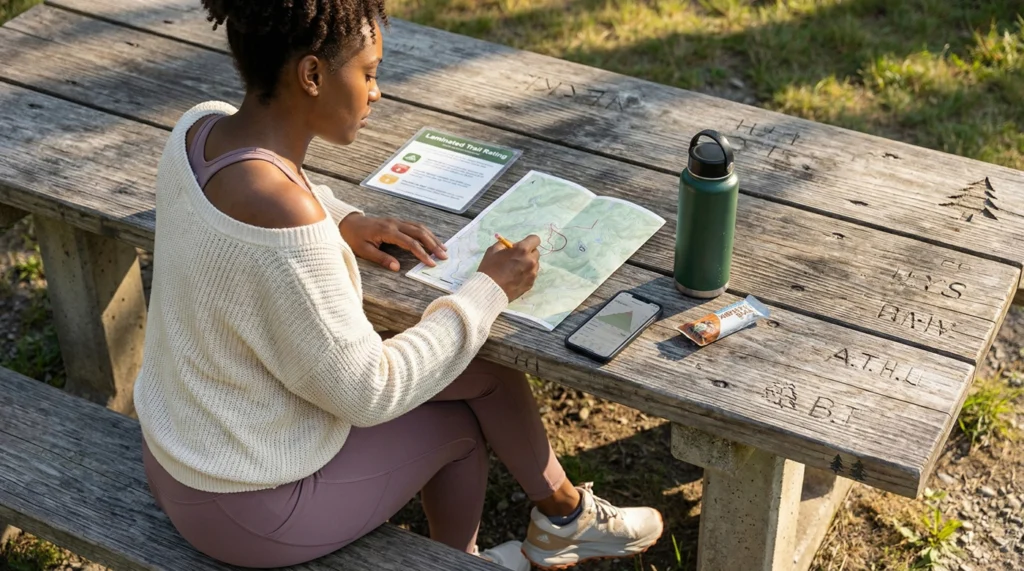
Check 3: Surface type and trail marking quality
Surface tells you what shoes you need and how much energy the terrain will cost. Marking quality tells you whether you’re likely to get confused.
For surface: packed dirt with some gravel is the ideal starting point for beginners. It offers solid grip, reasonable shock absorption, and doesn’t require the technical footing that rocky or heavily rooted terrain demands. On AllTrails, look for trails described as “well-packed,” “wide trail,” or “gravel path.” Avoid any trail with the following in the description: “rocky,” “technical,” “scrambling required,” or “route-finding needed.” Those phrases describe specific skills that take time and repetition to build. They’re not a reason to avoid the trail eventually — they’re a reason to do three easier hikes first.
For marking quality, don’t rely on the overall trail rating. Check the recent reviews. Look for phrases like “well-marked,” “easy to follow,” and “clear junctions.” Also look for the reverse: “we got turned around at the fork,” “the markers are faded in the upper section,” “confusing junction at mile 1.5.” If three or four recent reviews mention the same navigation problem, treat it as current information, not an isolated incident.
💡 Trail Tip: Download the AllTrails trail map at home, before you leave wifi. The app shows your GPS location even without cell service — but only if the map is fully loaded before you lose signal. Do this in your driveway or in the parking lot before you start walking, not a mile into the trail.
Check 4: Recent reviews from the last 30 days
Trail ratings almost never update when conditions change. A trail earns its difficulty label and keeps it regardless of whether it rained three days ago, a section washed out last week, or the junction sign blew over in a storm. The rating reflects the trail at its best. The recent reviews reflect the trail right now.
Spend five minutes reading the 5 to 10 most recent reviews on AllTrails before you commit to any trail. You’re looking for: current surface conditions, any closures or damage, parking situation, whether the junctions are clear, and anything that’s been consistently flagged by multiple recent hikers. A trail that looks ideal on the trail card might have three reviews from this month all mentioning the same muddy section or the same confusing fork.
AllTrails’ review system is one of the most reliable free tools available for real-time trail condition checking — the free version gives you everything you need for this step, including the ability to filter reviews by date so you’re seeing the most current reports.
💡 Trail Tip: Tell someone where you’re hiking before you leave. Not just “going hiking” — the specific trail name, the trailhead location, and when you expect to be back. If you’re not back by a certain time, they know to check in. This takes 60 seconds and is one of the most useful first hiking trail tips that most beginner guides don’t mention prominently enough.
Check 5: Trailhead logistics before you drive there
A well-chosen trail can still produce a frustrating day if the parking situation catches you off guard. For popular trails near urban areas, this check prevents a specific kind of bad experience: driving 45 minutes, finding the lot full, and turning around without hiking.
Things to confirm before you go: Does the trail require a parking reservation or timed entry permit? Some National Forest and state park trailheads moved to reservation systems in recent years and the requirement isn’t always obvious on AllTrails trail cards. Does parking have a fee, and does it require exact change or a card? Does the lot fill by 9am on weekends? How far is the parking area from the actual trailhead? On popular trails, overflow parking can be a quarter mile from the marked trail entrance — real walking that adds to your total time but doesn’t count in the AllTrails mileage.
Check the land manager’s website, not just AllTrails, for permit and fee information. AllTrails notes some of this, but it doesn’t always reflect seasonal changes. Two minutes on the park or forest service website tells you what you’re walking into.
For crowd level generally: for your first few hikes, choosing a well-trafficked trail is the smarter call even if you’d prefer solitude. Popular, frequently-maintained trails have better markers, more reliable recent reviews, and other hikers around if something comes up. Solitude is something to build toward once you have real trail experience behind you.
🥾 Recent Trip Report Vetting
When I planned early-season trips around Angeles Crest, trail apps frequently listed trails as open that were in reality blocked by winter mudslides or covered in hazardous hard snow. In my routine, I always read trip reports submitted within the last 48 hours and check with local Forest Service ranger stations to verify bridge conditions and active washouts.
First Hiking Trail Tips: What Beginners Get Wrong
Choosing a trail because the photos look good. AllTrails photos are taken at the best possible moment, usually at the summit, viewpoint, or most scenic section. They’re rarely representative of what the first mile feels like. Check the numbers first. Let the photos confirm you made a good choice, not drive the decision.
Not accounting for the return trip on out-and-back trails. Whatever you feel at the turnaround point, you still have to get back. If your legs feel questionable at mile 2 of a 4-mile out-and-back, the second half is going to be harder, not easier. A lot of first hiking trail tips focus on making it to the turnaround without saying clearly: the return trip is part of the hike, and your planning should reflect that. Set a phone timer for half your expected total time. When it goes off, turn around, even if you feel fine and the viewpoint is close.
Treating an AllTrails “Easy” rating as a universal standard. AllTrails ratings are averaged across all users, including experienced hikers who do this six times a week. Their Easy is not a first-timer’s Easy. An AllTrails Easy rating is a useful starting filter, not a guarantee. Verify it against the actual numbers: under 3 miles, under 300 feet of total gain, clear surface, recent positive reviews. The label opens the door. The numbers tell you whether to walk through it.
Skipping the permit and parking check. Some trailheads require timed entry permits or parking reservations, especially in California, Colorado, Utah, and the Pacific Northwest. This information changes seasonally. Showing up without a required permit means not hiking that day. Check the land manager’s site before you go.
Taking a friend’s recommendation without the specific numbers. “It’s easy” means something completely different depending on who’s saying it. A friend who regularly hikes 10 miles describes trails very differently than someone on their third outing. When a friend recommends a trail, ask for the distance and elevation gain. Those two numbers tell you more than their subjective rating does.
When to Change Your Plan Mid-Hike
Knowing how to choose a hiking trail for beginners reduces the chances of things going sideways. It doesn’t eliminate the need to reassess once you’re out there.
Turn around if: your water is more than half gone and you haven’t reached the halfway point; your legs feel unreliable on descent and you still have significant distance remaining; weather is changing in a direction you weren’t prepared for and you’re on an exposed section with no shelter option nearby.
Slow down and reassess if: you’re significantly behind your expected pace and still have most of the trail ahead; you’ve passed where a trail junction should have been and the path is less defined than the map suggested; the surface is more technical than the description indicated and you’re not comfortable with the footing.
You’re fine if: you’re tired but functional, your pace has settled into something sustainable, your water is roughly on track, and you can have a normal conversation. Being tired on a trail isn’t a warning sign. That’s the trail doing exactly what it’s supposed to do.
The general rule: if you’re asking yourself whether you should turn around, the answer is probably yes. The trail will be there next week. Turning back early is trail sense, not failure.

Frequently Asked Questions: How to Choose a Hiking Trail for Beginners
How do I choose a hiking trail for beginners on AllTrails?
When finding easy hikes on AllTrails, start with the filters: distance under 4 miles, difficulty set to Easy, and results sorted by highest rating. Then, check the actual numbers on each trail card—elevation gain matters as much as distance. Look for a total gain under 400 feet for your first outing. Read the five most recent reviews to check real-time conditions. The filter results give you options, but the reviews tell you whether a given option is actually what it says it is.
What makes the best beginner trails different from regular hiking trails?
The best beginner trails share specific, measurable characteristics: under 4 miles, under 300 feet of elevation gain per mile, a packed dirt or gravel surface, clearly marked junctions, and recent positive condition reviews. These aren’t subjective; they are the variables that determine whether a first-timer finishes feeling capable or exhausted. A trail can be scenic and still be the wrong choice for a first outing—the numbers are the deciding factor, not the aesthetics.
What are the most important first hiking trail tips for choosing the right distance?
The most critical first hiking trail tips regarding distance: trail miles and pavement miles are not the same. Plan for 1.5 to 2 miles per hour on a moderate beginner trail, not your standard walking speed. On an “out-and-back” trail, plan your turnaround by time, not distance. Set a phone timer for half your expected total time. When it goes off, turn around, even if you feel like you have more energy. You can always go further on the next hike with real data behind you.
When learning how to pick a hike, do I need to look at elevation gain or just distance?
Both, but elevation gain is the metric most beginners miss. Distance tells you how far; elevation tells you how hard. A 3-mile trail with 800 feet of gain is significantly harder than a 5-mile trail with 150 feet of gain. When figuring out how to pick a hike, divide the elevation gain by the trail distance. Under 150 feet per mile is manageable for most first-timers. Over 300 feet is serious climbing that should be worked up to.
How do I know if a trail is actually among the beginner friendly trails or just labeled that way?
To verify beginner friendly trails, read reviews from the last 30 days and calculate the elevation-per-mile number. If the trail page shows photos of exposed ridgelines, steep rocky sections, or scrambling, the trail is more technical than its label suggests. Phrases like “rocky,” “technical,” or “some scrambling” in the description indicate footing skills that take time to build. The numbers and recent reviews are far more reliable than a difficulty label for predicting the actual experience.
The First Trail You Pick Sets the Pattern
Knowing how to choose a hiking trail for beginners before you commit is what separates a first hike you’ll want to repeat from one you need a few days to recover from. Five checks, eight minutes: distance that fits trail pace, elevation gain under 300 feet per mile, surface and marking quality that match your current skill level, recent reviews from the last 30 days, and trailhead logistics confirmed before you drive there.
The best beginner trails are the ones where you finish and immediately think about which one to do next. That response — finishing tired but capable and already planning the next outing — is what builds the habit. And the habit is what makes hiking something you actually keep doing.
One trail this week, using the five checks. That’s the whole next step.
For understanding what the day will actually feel like once you’ve chosen the right trail, our guide to what to expect on your first hike walks through the experience from parking lot to finish — the things that don’t show up in trail ratings but that every first-timer should know going in.
Next Steps
- Right now: Open AllTrails. Filter for Easy trails under 3 miles within 15 miles of you. Find one with total elevation gain under 400 feet. Read the five most recent reviews. That’s your first trail.
- Before your first hike: Download the offline trail map while you’re still on wifi. Pack 1.5 liters of water. Eat a real meal 90 minutes before you leave. Tell one person the trail name and when you expect to be back.
- After your first hike: Write down your actual pace, how your legs felt at the halfway mark, and how much water you used. That’s the real data for choosing your next trail — more accurate than any estimate in any guide.
Related Reads
Stared at a map covered in national park dots and had zero idea which one would actually be friendly to a first-timer? Here are 5 steps to pick the right national park for your first visit, no overwhelm included.
Assumed strapping on a backpack and heading outside basically counted as the same workout as your usual evening stroll? These 5 differences explain why your body reacts so much harder once real terrain actually gets involved.
Saw “1,000 ft elevation gain” listed on a trail and genuinely couldn’t tell if that meant a gentle slope or a brutal climb? Here’s what 1,000 feet of elevation gain actually feels like on a real trail, broken down in plain terms.
Heard the term “elevation gain” thrown around constantly and just nodded along without ever actually understanding it? Here are 4 easy ways to finally master elevation gain, explained so it actually clicks.
Compared your planned distance to what a more experienced friend casually does on a random Tuesday and immediately felt behind? These 5 rules help you measure against your own fitness instead of theirs, no comparison required.