


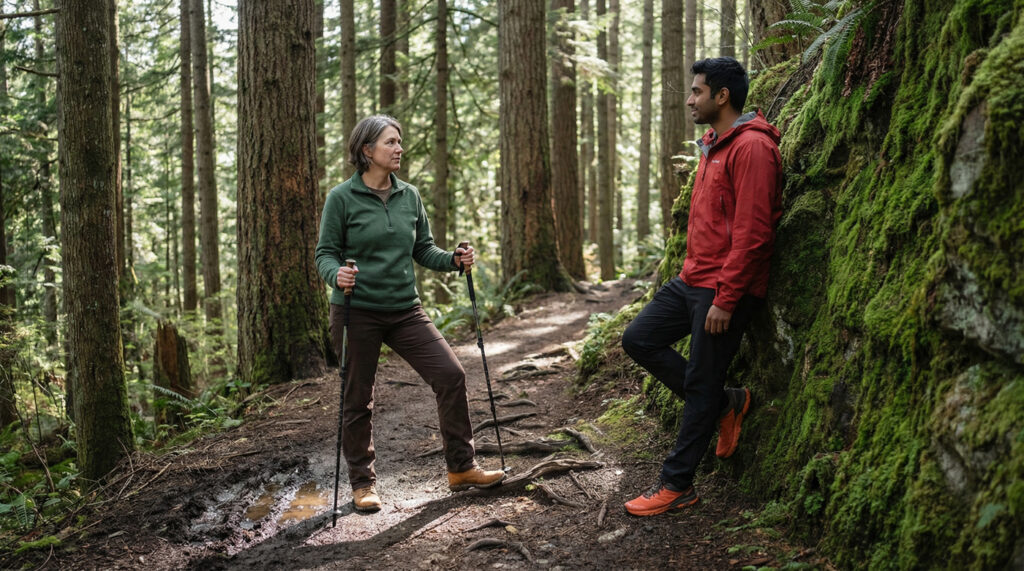
Hiking trail right of way has one rule that covers most situations you’ll actually encounter: uphill hikers have the right of way over hikers coming down. Everything else builds from that.
⚡ Quick Trail Takeaways
- Uphill Hiker Priority: Hikers climbing uphill have absolute right-of-way; descending hikers must step aside onto firm trail edges.
- Equine & Pack Animal Protocol: Always yield to horses and pack stock; step off the trail on the downhill side and speak calmly.
- Biker vs Hiker Rule: Mountain bikers are required to yield to hikers, but hikers should listen for bells on blind switchback corners.
Most beginners don’t know this. I didn’t for my first dozen hikes. I’d been stepping aside for every descending hiker on narrow sections, figuring that was the polite move, not realizing I was giving up right of way I actually had. A woman coming up behind me on a steep switchback said, very kindly, “You know you don’t have to step aside, right? We’ve got the right of way going up.” I had been on the wrong side of trail courtesy for months.
She was right. And once you understand the reason, the rule sticks: descending hikers can see the trail below them, slow down more easily, and have gravity doing some of the work. Uphill hikers are working harder, lose momentum when they stop mid-climb, and have a narrower view of what’s ahead. So they get the right of way. The rest of the hiking trail right of way system follows the same logic — whoever has less flexibility in a given encounter usually gets to keep moving.
All seven rules are in this article, in the order you’re most likely to need them on trail. Our beginner hiking guide covers the wider picture. This one is specifically the hiking trail right of way system, explained from the beginning.
Why Hiking Trail Right of Way Matters Beyond Politeness
How the system actually works on a crowded trail
Trail etiquette isn’t just social courtesy. It’s a practical system for keeping trails moving safely when hikers, cyclists, and horses with different speeds, directions, and needs share the same narrow path.
On a wide, empty trail, who has the right of way hiking doesn’t come up. But on a popular trail on a Saturday morning — a narrow section where two groups meet head-on, a steep switchback where a hiker and a horse are approaching from opposite directions — a clear shared system makes things faster and safer for everyone. Without it, you get the awkward standoff where both parties stop, wave each other through, nobody moves, and it’s somehow deeply uncomfortable for everyone involved.
The American Hiking Society at americanhiking.org has noted that trail conflicts are most common not between people who disagree about the rules, but between people who simply don’t know what the rules are. Most people who break hiking etiquette rules aren’t being rude. They never encountered the system.
Who has the right of way hiking — the quick version
As a beginner, knowing the hiking trail right of way rules before your first crowded trail encounter means you navigate those moments with confidence rather than guessing. It also means you model good trail behavior for people around you, which matters on popular trails where not everyone is working from the same page.
The seven rules below cover the encounter types you’ll actually face on a maintained day trail in the United States. They’re listed in order of priority. The first two apply absolutely. The rest apply in most situations with reasonable judgment built in.
The Hiking Trail Right of Way Hierarchy at a Glance
Before the seven rules, here’s the full system in one place so you can scan it before a hike.
Absolute priority — no exceptions: Horses and pack animals have the right of way over everyone on trail. Always.
Standard trail priority: Uphill hikers yield to no one. Descending hikers yield to ascending hikers.
Multi-use trail priority: Hikers yield to horses. Cyclists yield to hikers. Everyone yields to horses.
Situational courtesy: Faster hikers passing slower ones, large groups passing smaller groups, and audio awareness all follow the seven rules below.
The Leave No Trace Center for Outdoor Ethics at lnt.org publishes trail etiquette standards used by land managers across the country, and the hierarchy above reflects the convention that most national forests, state parks, and public trail systems operate on. Local variations exist — some trails post their own rules at the trailhead — but this is the baseline that applies on the overwhelming majority of maintained hiking trails in the United States.
The 7 Hiking Trail Right of Way Rules
Rule 1: Uphill hikers have the right of way
This is the uphill vs downhill hiking rule that surprises most beginners, because stepping aside for people coming downhill feels instinctively polite. The instinct is understandable. The etiquette runs the other way.
Why ascending hikers get priority
The uphill vs downhill hiking rules exist for three specific reasons. Ascending hikers are working harder, and losing momentum on a sustained climb carries a real physical cost — stopping mid-pitch and restarting uses more energy than most beginners expect. Uphill hikers also have a more limited view of what’s ahead: on steep terrain, you’re often watching your next few steps, not scanning for oncoming traffic. And descending hikers have more flexibility — they can see farther down the trail, stop more easily, and have gravity helping rather than working against them.
How this plays out in practice
If you’re heading down and an ascending hiker is approaching on a narrow section, you step aside. If you’re heading up and a descending hiker is coming toward you, you keep moving and let them work around you. Common sense applies here too — if you’re ascending and a brief pause feels welcome anyway, offering the descending hiker the trail costs you nothing. The rule defines who has to yield. It doesn’t prevent voluntary courtesy.
This is the single most important hiking trail right of way rule for beginners to learn, because it’s the one most commonly violated and the one that produces the most awkward trail encounters.
Rule 2: Everyone yields to horses and pack animals
No exceptions. No “but they can go around me.” No “I have the right of way as a hiker here.”
Horses and mules are large, flight-prone animals. When startled, they can bolt, buck, or push hard against trail edges in ways that injure the rider, the animal, and anyone nearby. On a narrow trail, a spooked horse is a genuine danger to everyone in the vicinity. The right of way rule for horses isn’t courtesy. It’s a safety protocol.
What to do when you encounter a horse
Step completely off trail to the downhill side if possible — if the horse is startled and moves sideways, it moves toward higher ground, and being on the uphill side puts you in its path. Speak calmly so the animal identifies you as human. Don’t make sudden movements, don’t approach from behind, and don’t assume the animal will stay calm because it looks calm now. Wait until the horse and rider have passed by a comfortable margin before returning to trail.
If a rider gives you a specific instruction — step to a certain side, move further back, talk to the horse — follow it. Riders know their animals. Their instruction is the right one in that moment.
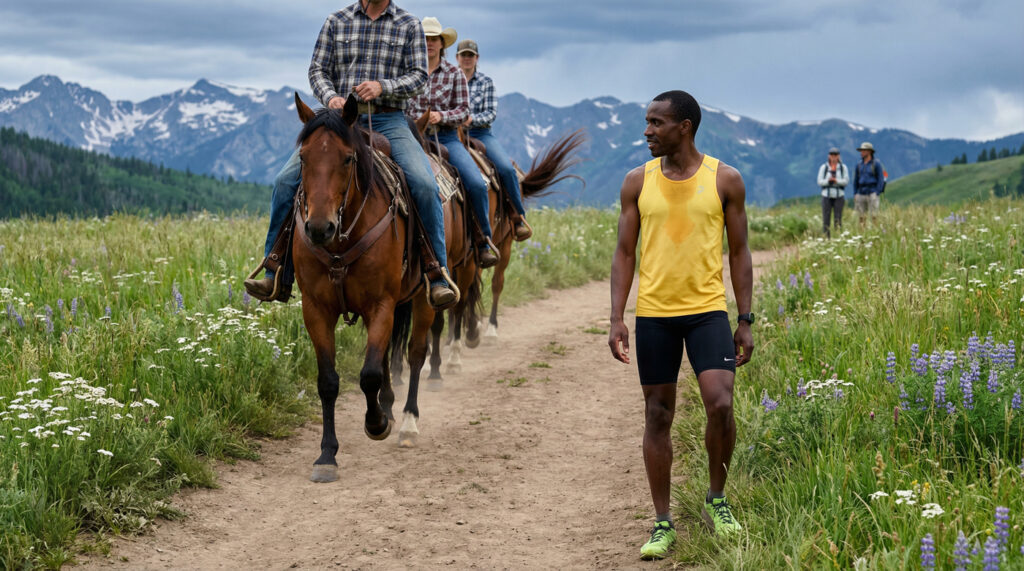
Rule 3: On multi-use trails, cyclists yield to hikers
Multi-use trails that permit both hikers and cyclists have their own internal hierarchy. Cyclists yield to hikers. Both yield to horses.
This applies to most paved and unpaved multi-use paths: river trails, rail trails, converted greenways, park loops that allow bikes. Yielding on a hiking trail is the cyclist’s responsibility when a hiker is ahead. If a cyclist is coming up from behind, they’re expected to slow down and announce themselves rather than blowing past.
A note on how this plays out: the rule is clear, but a meaningful number of cyclists don’t follow it — particularly faster riders treating the trail as a bike route with hikers in the way. If a cyclist is approaching at speed from behind and clearly isn’t slowing, step right and let them pass rather than holding your position on right of way grounds. Being correct doesn’t protect you from getting clipped by a handlebar.
💡 Trail Tip: Before starting any new trail, check AllTrails or the land manager’s site to confirm whether it’s hiking-only or multi-use. The user types permitted on a trail determine what encounters to expect and which right of way rules apply.
Rule 4: Step aside briefly for faster hikers
This rule is less about absolute right of way and more about the hiking etiquette rules that keep trails moving comfortably for everyone.
If you’re hiking at a comfortable pace and a faster hiker is coming up from behind on a narrow section, step briefly to the right and let them pass. You don’t have to stop, you don’t have to apologize for your pace, and you don’t have to engage in a conversation. A small step right, a nod, and they’re through in ten seconds.
What the faster hiker should do
The faster hiker’s job in this exchange: announce themselves before they’re directly behind you. “On your left” or “passing on your left” from about ten feet back gives you time to step right before they’re alongside you. If they don’t announce and you notice someone overtaking, stepping right briefly still solves it without requiring a conversation.
What doesn’t work: slowing down to match the pace of a hiker behind you instead of stepping aside; moving fully off trail when a narrow step-right would do; or feeling pressured to hike faster because someone is catching up. Your pace is your pace. The brief step-aside is trail courtesy. The rest is yours to manage.
Rule 5: Large groups yield to smaller groups and pass single file
Hiking etiquette rules for groups: walk single file on narrow sections. Not two-by-two, not spread loosely across the full trail width. Single file, trail width, until the narrow section is clear.
This keeps the trail passable for oncoming users and reduces vegetation trampling at trail edges, which compounds fast on popular trails.
How to manage this in your group
The second part of this rule: large groups yield to smaller groups and solo hikers at narrow passages rather than expecting two people to squeeze off trail for five. If your group of six meets a solo hiker coming the other direction, your group steps aside. They pass. You continue.
This requires active management. Someone in the group needs to be watching ahead and calling single file before reaching narrow sections, not after the groups are already face to face with nowhere to go. Mention it before you hit the trailhead — one sentence at the start sets the expectation and saves you from managing it on the fly every time.
💡 Trail Tip: Tell someone in the group at the trailhead: “We’ll go single file when people are coming the other way.” One sentence. It sets the expectation without making the hike feel like a briefing.
Rule 6: Stay to the right on wide two-way trails
On wide multi-directional trails where no immediate encounter is happening, stay to the right side of the trail. Same convention as driving and walking on sidewalks — it’s the default position that makes your direction predictable for everyone around you.
Staying right does three things: it keeps you on the correct side for oncoming hikers, it gives faster hikers and cyclists a clear left side to pass on, and it makes your movement predictable for anyone approaching from behind. It’s a low-effort rule that most people follow instinctively, but it’s worth making explicit as part of the full hiking trail right of way system.
Right side is the default. Left is for passing. When uncertain about position, move right.
Rule 7: Announce yourself before passing — trail courtesy for sound on trail
This is the hiking trail right of way rule that doesn’t involve positioning, but it matters just as much for trail courtesy and safety.
Announcing yourself before passing someone from behind is expected on trail, not optional. “On your left” from about ten feet back gives the person ahead time to step right before you’re alongside them. This matters most when they’re wearing earbuds — normal conversational volume won’t reach them. A slightly louder announcement from further back solves it.
Bluetooth speakers on trail: the hiking etiquette rules standard is to leave them at the trailhead. Most hikers are outside specifically for the ambient sound of the environment. A speaker audible from 50 feet away changes the experience for everyone near you in a way that earbuds don’t. Most land managers have moved toward discouraging speaker use on hiking trails specifically for this reason.
The practical audio rule for beginners: keep your awareness high enough that you can hear announcements from behind, notice when a horse is approaching before it’s on you, and track weather changes around you. One earbud out is the standard that works on most maintained trails.
Common Mistakes with Hiking Trail Right of Way
Stepping to the uphill side for horses
When you step off trail for a horse, move to the downhill side. If the horse is startled and moves laterally, it moves toward higher ground. Being on the uphill side puts you directly in the path of a spooked animal. Downhill side, calm voice, wait for full clearance before returning to trail.
Treating the uphill rule as something to enforce in every situation
The uphill vs downhill hiking rules are real and worth knowing. They don’t mean stopping every descending hiker you meet to assert your technical right of way. On flat sections, when the descending hiker has already stepped aside, or when a brief pause costs you nothing, common sense leads. The rule protects ascending hikers who would lose real momentum by stopping mid-climb. Where that cost isn’t real, flexibility is fine.
Passing without announcing yourself
Walking up behind someone at your pace and squeezing past without a heads-up is genuinely startling on a narrow trail. A verbal signal before you’re directly behind them is expected. Do it early enough that they have time to step right before you’re alongside them — not while you’re already passing them.
Spreading a group across the full trail width
Groups naturally spread out across available space. On a hiking trail, that spreading blocks oncoming hikers and forces them off the trail edge to pass. Active effort is required to maintain single file in a group, and someone has to take responsibility for calling it before the encounter, not during it.
Assuming hiking etiquette rules are identical on every trail type
Multi-use paths, equestrian trails, hiking-only trails, and mountain bike trails all have variations on the base hierarchy. The rules in this article apply broadly to hiking trails in the United States. On a designated mountain bike trail, the calculus shifts — check the trail type on AllTrails before you go and adjust accordingly.

When to Let the Rules Go and Use Judgment
Most hiking trail right of way situations resolve in two seconds if both parties are paying attention and neither is holding rigidly to position.
The rule tells you who yields. Judgment tells you how to make it go smoothly. If you’re coming down and an ascending hiker has already stepped aside for you, arguing that they didn’t have to is beside the point — thank them and keep moving. If a cyclist is grinding uphill on a multi-use trail and clearly working hard, yielding for five seconds costs you nothing and is genuinely kind even when your right of way says otherwise.
Trail courtesy at its best isn’t about knowing who technically has to move. It’s about making trail encounters feel easy and respectful for everyone involved. The hierarchy is the foundation. Common sense is the application.
What the hierarchy doesn’t resolve is genuine conflict — hikers who refuse to yield to horses, cyclists who don’t slow for anyone, groups that spread across the full trail width regardless of who’s coming. In those situations: move, don’t escalate, let it go. A brief encounter with someone who doesn’t know the rules doesn’t have to define the rest of the hike.
Frequently Asked Questions: Hiking Trail Right of Way
Who has the right of way hiking on a standard trail?
On any standard hiking trail, the hiking trail right of way hierarchy runs: horses and pack animals first (everyone yields, no exceptions), then uphill hikers over descending hikers, then hikers over cyclists on multi-use paths. For faster hikers overtaking slower ones, the slower hiker steps right and the faster hiker passes on the left. In all ambiguous situations, horses win every time.
What are the hiking etiquette rules for groups on narrow sections?
Hiking etiquette rules for groups on narrow sections: walk single file, not side by side. Large groups of three or more yield to smaller groups and solo hikers coming in the opposite direction. The person at the front of the group is responsible for calling single file before the encounter happens, not while you’re already face to face. Announce when passing from behind with a clear verbal signal.
What does trail courtesy look like when passing someone from behind?
Trail courtesy when overtaking: announce yourself verbally before you’re directly behind the hiker ahead. “On your left” from about ten feet back gives them time to step right before you’re alongside them. If they’re wearing earbuds, announce at a volume that actually reaches them. Pass on the left. A nod or brief “thanks” as you go keeps the exchange friendly. Don’t squeeze past without any signal — it’s startling and entirely avoidable.
What does yielding on a hiking trail actually mean in practice?
Yielding on a hiking trail means stepping to the right side and allowing the right-of-way party to pass without stopping or adjusting their pace. For ascending hikers, it means descending hikers step aside. For horses, it means stepping off trail to the downhill side, speaking calmly, and waiting until the animal has passed comfortably. Yielding on a hiking trail doesn’t require a conversation — a step right and a nod is enough in most situations.
What are the uphill vs downhill hiking rules on switchback trails?
The uphill vs downhill hiking rules apply on switchbacks exactly as they do on any trail section: descending hikers yield to ascending hikers. Switchbacks can make this feel less obvious because you’re sometimes briefly heading the same compass direction as a descending hiker before the turn. The rule applies to direction of travel on the trail itself, not compass direction — if they’re going down and you’re going up, you have the right of way regardless of which way the switchback is oriented.
Does hiking trail right of way change on equestrian-mixed trails?
The hierarchy doesn’t change — it just becomes more relevant more often. Horses have right of way over both hikers and cyclists on any trail type, including designated hiking trails that allow equestrian use. On equestrian-mixed trails specifically, expect more horse encounters and know the protocol before you start: downhill side, calm voice, wait for full clearance before returning to trail. Yielding on a hiking trail to horses is not optional on any trail type.
Knowing These Rules Changes How Crowded Trails Feel
Hiking trail right of way isn’t a test you pass before you’re allowed outside. It’s a system that makes trail encounters go faster and smoother for everyone — beginners included.
The seven rules cover the situations you’ll actually face on a maintained day trail in the United States. Horses over everyone, always. Uphill over downhill. Hikers over cyclists on multi-use paths. Faster hikers pass on the left with an announcement. Groups go single file. Stay right when not passing. Announce before overtaking. Those seven cover almost everything.
Knowing who has the right of way hiking before your first crowded trail encounter means you navigate those moments with confidence. Trail courtesy — the instinct to make it easy for the person you’re encountering — is what makes busy trails genuinely pleasant for everyone on them.
For understanding the trail itself before you show up, our guide to what AllTrails difficulty ratings actually mean helps you know what’s waiting before you arrive. And if you’re still choosing where to go, our trail selection guide for beginners walks through the five checks that make that decision straightforward.
Next Steps
- Right now: The next time you’re on a trail, run through the hierarchy mentally before your first narrow encounter. Who yields? Notice how it actually plays out. One real encounter ingrains the rule faster than reading about it three times.
- Before your next hike: Check whether the trail is hiking-only or multi-use. That changes which rules are most relevant to your day and what encounters to expect.
- After your first crowded trail: Note how many encounters involved a clear hiking trail right of way situation and whether the other people involved knew the rules. Most don’t yet. Now you do.
Related Reads
Stood at a loop trailhead with zero idea whether to take on the climb first or save it for the end? Here’s the real answer on hiking uphill or downhill first, and the logic isn’t as obvious as you’d think.
Ended up trailing the whole group, pretending you were “just enjoying the view” while secretly dying inside? Here are 5 rules that keep a group hike moving without leaving anyone behind, pace drama included.
Picked a start time at random and ended up either roasting in afternoon heat or racing the sunset back to your car? These 3 rules nail down exactly when you should be hitting the trail, no more guessing what time actually works.
Tired of scrolling through Facebook groups hoping someone local would respond to your “anyone want to hike?” post? Here are 6 methods for finding hiking partners near you that actually go somewhere.
Noticed a streak of paint on a tree trunk and wondered if the color meant something specific or was just random vandalism? Here’s what trail blaze colors actually mean for beginner hikers, so every mark on a tree stops being a mystery.