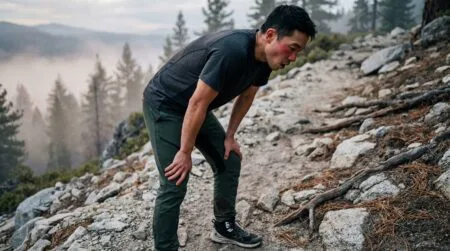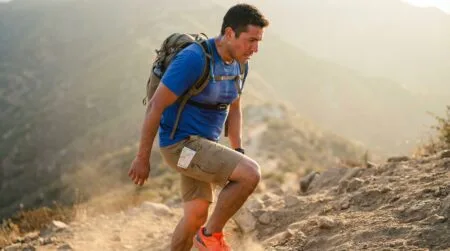



How to pace yourself hiking is something most beginners figure out the hard way: you start at what feels like a comfortable speed, you’re breathing hard by mile one, and you’re completely depleted by the turnaround. The distance wasn’t wrong. The pace was.
⚡ Quick Trail Takeaways
- The Rest Step: Lock your rear knee momentarily on each uphill step to transfer weight to bone structure and rest quadriceps.
- Talk Test Standard: You should be able to speak a full 5-word sentence without gasping for breath on moderate climbs.
- Consistent Cadence: Shorten stride length as the slope steepens to maintain the same steady heart rate and rhythm.
Pacing is not about going slow. It’s about going at a speed your body can sustain for the full trail, including the return trip and the elevation changes you haven’t hit yet. Most beginners burn their first third of energy in the first quarter of the trail, which is exactly backwards.
My first real test of this was a 4.5-mile out-and-back in the San Gabriel foothills. I set off at what felt like a brisk, capable walking pace. I was at my limit by mile 1.5. I reached the turnaround at mile 2.25 and had nothing left for the way back. The return trip took 40 minutes longer than the outbound leg. My legs were unreliable on the descent. I sat in the parking lot for twenty minutes before I trusted myself to drive. The distance was well within what I could have handled. The pacing made it a survival exercise.
Every technique in this article is one I now use before and during every hike. They’re not complicated. They work because they’re based on how your cardiovascular system and your muscles actually respond to sustained effort, not on how fast you feel like going at the trailhead. Our beginner hiking guide covers the wider picture. This one is specifically how to pace yourself hiking from the first step to the last.
🥾 Oliver’s Trail Notes & Field Observations
During my guided group treks up the lower flanks of Mt. Baldy, the most common beginner error is charging out of the parking lot at 3 miles per hour. Within twenty minutes, hikers are red-faced and hyperventilating. In my field trials, the gold standard is the talk test: if you cannot recite your home address out loud without taking a gasping breath between words, you are moving too fast for sustained endurance. Slowing down by just half a mile per hour preserves energy for the entire day.
Why Knowing How to Pace Yourself Hiking Changes Everything
The problem with starting at trail-head energy
The trailhead is where pacing goes wrong for most beginners. You’ve driven to the parking lot, you’re excited, your legs feel fresh, and the trail in front of you looks completely manageable. So you start at a speed that reflects how you feel right now, which is great, rather than a speed that reflects what the next two hours actually asks of your body.
Trail terrain doesn’t stay consistent. The first mile of most trails is often the gentlest section, which means starting fast burns through glycogen and elevates your heart rate before the harder sections arrive. By mile two on a trail with real elevation, the person who started too fast is working at maximum effort. The person who started conservatively is working at moderate effort and has capacity in reserve.
The American Hiking Society onsistently notes that pacing is among the top three factors distinguishing beginner hikers who build the habit from those who don’t return after their first few outings. Finishing consistently beats finishing fast.
What hiking without getting tired actually requires
Hiking without getting tired completely is not a realistic goal on longer or harder trails. Productive tiredness at the end of a good hike is normal and expected. Hiking without getting tired in the sense that matters, which is not depleting your energy reserves so early that the back half of the trail becomes a struggle, is entirely achievable with specific pacing habits.
The two physiological facts that underpin all seven techniques: first, aerobic exercise, the zone where you can maintain effort indefinitely, requires staying below about 75 to 80% of your maximum heart rate. Above that threshold, you’re drawing on anaerobic systems that have a limited fuel supply. Second, glycogen depletion, running out of carbohydrate fuel stores, produces a sudden and marked energy drop that feels worse than ordinary tiredness and is largely preventable with pacing and fueling. Knowing how to pace yourself hiking addresses both of those variables simultaneously.
How to Pace Yourself Hiking: 7 Techniques
Technique 1: Start at 60% of what feels comfortable
Why the first 20 minutes are the most important
The first 20 minutes of any hike determine the rest of it. Your muscles and cardiovascular system need time to warm up, increase circulation, and find their sustainable rhythm. Starting at full pace from the first step means you’re demanding full performance from a cold system, which produces early fatigue and elevated heart rate that takes miles to recover from.
For hiking pace for beginners, the practical instruction is: find the speed that feels comfortable at the trailhead, then back off from it deliberately. If your instinctive starting pace is a 20-minute mile, start at a 24 or 25-minute mile for the first 20 minutes. Let your body warm up. Let your heart rate settle. After 20 minutes, your breathing will have normalized and you’ll have a much more accurate read on what a sustainable pace for the full trail actually is.
This technique feels frustratingly slow in the first few minutes. By mile two, it’s the reason you still have energy.
How to calibrate your starting pace on any trail
Check three things before you start: the total distance, the total elevation gain, and whether the trail is out-and-back or a loop. If it’s out-and-back, the return trip happens on tired legs, which means your sustainable pace for the full outing is slower than your sustainable pace for the outbound leg alone. If there’s significant elevation gain in the second half of the trail, you need energy reserves for it. Starting at 60% accounts for both.
Technique 2: Use the talk test instead of pace targets
Why hiking pace for beginners shouldn’t come from an app
Apps and fitness trackers report pace in minutes per mile and compare it to averages. For how to pace yourself hiking, that comparison is not useful for two reasons: trail terrain varies constantly so your pace varies constantly, and the average hiker in the database is not you on this specific trail on this specific day.
The talk test is more reliable than any pace target: if you can speak in complete sentences without stopping for breath, you’re in the aerobic zone. If you can’t finish a sentence, you’re above it. Slow down until you can. That simple check tells you more about your actual sustainable effort level than any number on a watch.
Understanding average hiking speed on real terrain
Average hiking speed on maintained trails runs 1.5 to 2.5 miles per hour for most hikers. On trails with significant elevation gain, add 30 minutes per 1,000 feet of gain to your time estimate. These numbers describe average hiking speed, not target pace. They’re useful for planning how long a trail will take. They’re not a measure of how well you’re hiking.
A beginner moving at 1.5 miles per hour on a trail with 600 feet of elevation gain, consistently, comfortably, and without bonking at mile three, is hiking better than an experienced hiker who covers the same ground at 2.5 miles per hour but arrives at the turnaround depleted. The goal is sustainable effort for the full distance. Average hiking speed is an output of that effort, not an input to it.
Technique 3: Use the rest step on every sustained climb
What the rest step is and why it works
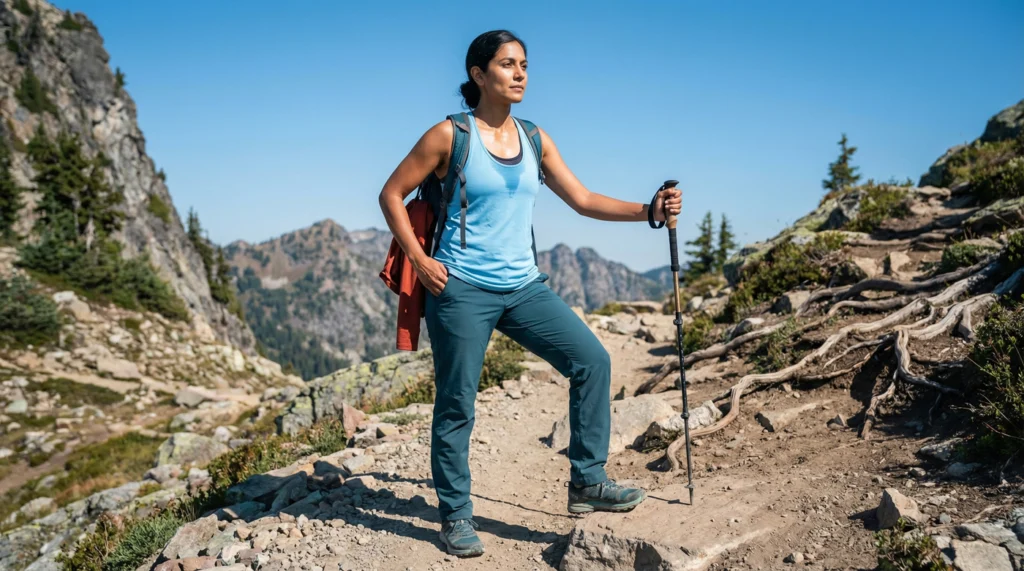
The rest step is a technique used by mountaineers on long ascents and it works equally well for a beginner on any trail with real climbing. The mechanics: with each uphill step, pause for one beat with your weight fully on your rear, straight leg before taking the next step. Your rear leg acts as a momentary rest point, bone-on-bone support rather than active muscle contraction, which lets your working muscles recover for one second before the next step.
That one-second recovery adds up across hundreds of steps. On a sustained 400-foot climb, the rest step reduces the total cardiovascular and muscular demand of the ascent by roughly 15 to 20% compared to a continuous stride. It looks slow. It produces hikers who arrive at the top with energy left rather than arriving gasping and needing five minutes before they can speak normally.
How to practice the rest step before you need it
Learn the rest step on flat ground before you try it on a climb. Take a walking step, place all your weight on the rear foot with that leg straight, pause for one beat, then step forward. Get comfortable with the rhythm before elevation demands your attention simultaneously. On trail, start using it at the first sign that a climb is sustained, which usually means anything over 200 feet of gain in under a mile.
Technique 4: Control your breathing on climbs
Breathing techniques for hiking that reduce fatigue
Breathing techniques for hiking are consistently underrated as a pacing tool. Most beginners breathe shallowly and reactively when climbing, which means they’re always slightly oxygen-deficient, which means every step costs more effort than it needs to.
The two breathing patterns worth knowing: rhythmic breathing, which means coordinating your breath with your steps (inhale for two steps, exhale for two steps on moderate terrain; inhale for one step, exhale for one step on steep sections), and nasal breathing on easy terrain to regulate effort level. If you can’t breathe through your nose, you’ve exceeded aerobic pace. That’s a useful real-time pacing signal.
Before a climb starts, take three slow, full breaths. This oxygenates your blood before the demand increases, which delays the point at which your breathing becomes ragged. It’s a small action with a disproportionate effect on how the first minute of a climb feels.
When to stop and breathe rather than push through
If your breathing becomes ragged and doesn’t settle within 30 to 45 seconds of slowing down, stop completely, find a steady surface, and take 60 seconds of deliberate slow breathing before continuing. This is not a sign of poor fitness. It’s smart energy management. A 60-second breathing stop costs you 60 seconds. Pushing through ragged breathing for five minutes costs you proportionally more energy and puts you in a deficit that affects the next mile.
Technique 5: Fuel before you feel it
How glycogen depletion undermines your pace
Glycogen depletion is the most underestimated cause of pacing failure on longer trails. Your muscles run on glycogen, stored glucose from carbohydrates, and most adults have enough stored for 60 to 90 minutes of moderate exercise. On a three-hour hike with no refueling, the final 45 minutes happen on effectively empty fuel stores. Pace collapses. Legs get heavy. What was a comfortable speed becomes unsustainable.
The fix is eating before you feel hungry. On any hike over 90 minutes, bring a snack with carbohydrates and protein and eat it at the halfway point, regardless of whether you feel hungry. Your body burns fuel consistently whether it sends hunger signals or not during exercise. Eating at the halfway point means your fuel stores don’t empty completely before you return to the trailhead.
Hydration and its direct effect on hiking pace
Mild dehydration, losing 1 to 2% of body weight in fluids, reduces blood volume and forces your heart to work harder to circulate oxygen. The result looks exactly like pace collapse: heavy legs, slower breathing recovery, higher perceived effort on the same terrain you handled fine an hour ago. It’s not that you’re less fit at mile two than at mile one. You’re mildly dehydrated and your cardiovascular system is compensating.
REI’s beginner hiking resources cover the hydration-performance relationship in detail. The practical version: drink 0.5 liters per hour on moderate terrain and don’t wait for thirst to trigger it. Set a reminder if needed.
Technique 6: Plan your turnaround before you start
Why out-and-back trails require two-directional pacing
Knowing how to pace yourself hiking on an out-and-back trail requires accounting for the return trip from the beginning, not after you reach the turnaround. Whatever you feel at the halfway point, you have the same distance back on tired legs, often with downhill terrain that is harder on your knees and quadriceps than the uphill was.
The practical rule: set your sustainable pace based on the full distance, not the outbound half. If the trail is 4 miles total, your pace should be one that you could sustain for 4 miles, not one that’s comfortable for 2. Many beginners hit the turnaround feeling okay and discover in mile three that they were running on first-half reserves rather than a sustainable pace.
How to set a turnaround time rather than a turnaround point
A more reliable method than a mileage-based turnaround: set a time-based one. Calculate your expected total hiking time and divide it in half. Set a phone timer for that amount. When it goes off, turn around regardless of whether you’ve reached the geographic endpoint. This accounts for the slower pace most people naturally drift into as a hike progresses, and it means you’re never in the situation of being at the turnaround point with less time and energy for the return than the outbound required.
Technique 7: Read the terrain ahead and adjust before the change, not after
Pacing on a hike by anticipating what’s coming
The biggest difference between experienced hikers and beginners in terms of pacing on a hike is anticipation. Experienced hikers slow down before a climb starts, not after it’s already elevated their heart rate. They know a steep section is coming from the trail shape, the change in vegetation, or the trail profile they checked before starting, and they let their pace settle before the demand increases.
Beginners typically maintain a fast pace until the terrain forces them to slow down, which means they’re already at elevated heart rate when the hard section starts. That’s the worst position to begin a climb from.
Before you start any trail, look at the elevation profile graph on AllTrails. Note where the climbs are. Note whether the descent comes before or after the most demanding section. On trail, watch the terrain ahead. When you see the path starting to angle upward, reduce your pace proactively, take three deliberate breaths, and start the rest step before the grade demands it.
Using flat sections as recovery windows
Flat trail sections between climbs are recovery windows, not opportunities to make up pace. If you’re hiking without getting tired through the full trail, flat sections after a climb are where you let your heart rate settle and your muscles recover before the next demand. Walking at a comfortable pace on flat terrain after a climb is productive rest. Speeding up on flat sections to compensate for slow climbing is how you arrive at the next climb with nothing left.
💡 Trail Tip: On trails with multiple climbs, plan your water and snack timing around the flat recovery sections, not the climbs. Drinking and eating while walking at a comfortable flat pace is easier and more effective than trying to fuel mid-climb.

🥾 Cadence Matching on Rocky Switchbacks
On rocky ascents like the Vivian Creek trail on San Gorgonio, I match my breathing directly to my footfalls: inhale for two steps, exhale for two steps. When the trail steepens past 15% grade, I shift to one step per breath. Establishing a rhythmic metronome in your stride eliminates erratic accelerations that pump your leg muscles full of burning lactic acid.
What Your Body Is Telling You: Pacing Signals Worth Knowing
Signals that your pace is right
Your pace is in the right zone when: you can speak in full sentences on flat sections, your breathing settles within 30 to 60 seconds after finishing a climb, your legs feel tired but functional at the halfway point, and you’re finishing the trail with something left rather than finishing at your absolute limit. These are the signs of sustained aerobic effort at a level your body can manage for the full distance.
Signals that you’re moving too fast
You’re above your sustainable pace when: you can’t complete a sentence without stopping for breath on flat terrain, your heart rate hasn’t settled 90 seconds after finishing a climb, your legs feel genuinely heavy before the halfway point, or your perceived effort is at maximum before you’re at the hardest section of the trail. Any one of these is a signal to slow down before a pace-breaking problem develops rather than after.
For how to pace yourself hiking on your first several outings, err on the side of too slow. The cost of starting too slow is a comfortable hike. The cost of starting too fast is collapsing in the third mile.
Common Pacing Mistakes Beginners Make
Matching the pace of faster hikers
When a faster hiker passes you on trail or is in your group, the instinct to match their pace is real and almost always counterproductive. Their sustainable pace is built on their fitness level, not yours. The gap between their pace and yours will close as your trail fitness builds. Right now, your pace is your pace. The rest step, the talk test, and the 60% start are calibrated to you, not to the person ahead.
Treating the trailhead as the start of maximum effort
The trailhead is where you begin, not where you perform. A lot of beginners bring trailhead energy to the first mile and trail fatigue to the second. The first 20 minutes are a warm-up. Pace accordingly.
Skipping the elevation profile check
Not knowing whether the climb is front-loaded, back-loaded, or evenly distributed across the trail is the single biggest information gap in beginner pacing decisions. A trail where the hardest climb comes in miles three and four of a four-mile hike requires completely different pacing than one where the climb is in miles one and two. The elevation profile graph on AllTrails shows this in 30 seconds. Check it before you start.
Waiting until you’re depleted to fuel and hydrate
By the time you feel genuinely hungry or thirsty on a hike, you’re already slightly depleted and your pace is already affected. Eating and drinking on a schedule, not on demand, is how to pace yourself hiking in a way that sustains energy across the full trail rather than managing a deficit in the final third.
Frequently Asked Questions: Pace Yourself Hiking
How do I pace myself hiking so I don’t burn out early?
Knowing how to pace yourself hiking starts before you take the first step. Start at 60% of your comfortable pace for the first 20 minutes. Use the talk test throughout: if you can speak in full sentences, you’re in the right zone. On climbs, use the rest step and pre-emptively reduce pace before the terrain forces you to. The combination of a conservative start, a reliable real-time check, and anticipatory pace adjustment covers the most common burnout scenarios.
What is a good hiking pace for beginners?
A good hiking pace for beginners on moderate terrain runs 1.5 to 2 miles per hour, accounting for elevation gain, terrain quality, and stops. The specific number matters less than whether your breathing is controlled and sustainable throughout. The talk test is a more accurate guide than a target minutes-per-mile figure, because trail conditions vary too much for a single pace number to be consistently meaningful. Use average hiking speed estimates to plan your total time, not to set your moment-to-moment pace.
What are the best breathing techniques for hiking on steep climbs?
Breathing techniques for hiking on climbs: coordinate breath with steps (two steps in, two steps out on moderate grades; one step in, one step out on steep sections). Before a sustained climb starts, take three full deep breaths to pre-oxygenate. If your breathing becomes ragged, slow to rest-step pace and take 60 deliberate seconds of controlled breathing before continuing. Nasal breathing on flat sections is a useful pace check: if you can’t breathe through your nose, you’re above aerobic pace.
What is average hiking speed and how should I use it?
Average hiking speed for most hikers on maintained trails runs 1.5 to 2.5 miles per hour on flat terrain, with 30 minutes added per 1,000 feet of elevation gain. Use these numbers to estimate how long a trail will take, not as targets to match. Pacing on a hike is about sustainable effort for the full distance, and average hiking speed is the output of good pacing, not the input. Focus on the talk test and the rest step. The pace takes care of itself.
How do I pace on a hike when hiking with a group?
Pacing on a hike with a group means setting pace to the slowest hiker in the group, not to the fastest or the average. The fastest hiker can slow down; the slowest hiker cannot speed up indefinitely without breaking their sustainable effort. Agree on the turnaround time before starting, not the turnaround point. The same time-based method that works for solo hikers works for groups: set a timer for half the expected total time and turn around when it goes off, regardless of where you are on the trail.
How can I hike longer without getting tired?
Hiking without getting tired across longer distances requires four things working together: a conservative starting pace that doesn’t deplete glycogen early, consistent hydration before thirst signals, fueling at the halfway point regardless of hunger, and using flat sections as recovery windows rather than speed opportunities. The rest step and controlled breathing handle the climbing. The hydration and fueling handle the fuel side. Put together, this combination extends the comfortable range significantly compared to hiking at perceived-comfortable pace with no fueling or pacing structure.
Pacing Is What Separates a Good Hike From a Miserable One
How to pace yourself hiking is not a skill that takes years to develop. It’s seven specific habits that change how your body responds to sustained effort on trail. Start at 60%, use the talk test, rest-step every sustained climb, breathe before you need to, fuel and hydrate on a schedule, plan your turnaround by time, and read the terrain ahead. Those seven things cover the full picture.
The difference between the 4.5-mile hike I described in the opening and how I hike the same trail now is almost entirely pacing. Same distance, same elevation, same fitness level in terms of years of consistent hiking. The first time I hit it wrong, the second time I used the techniques in this article. Pacing on a hike is the skill that makes every other aspect of a trail more manageable. Build it early and it pays for every hike after this one.
For knowing how to choose the right trail for where your pacing skills are right now, our guide to how to choose a hiking trail for beginners walks through the five checks that match trail difficulty to your actual current level.
Next Steps
- Right now: On your next hike, set a phone timer for 20 minutes at the start. Walk at a pace that feels slightly slower than comfortable until it goes off. Notice how your breathing and legs feel differently at mile two compared to previous hikes.
- Before your next hike: Check the elevation profile graph on AllTrails. Note where the main climbs are. Plan which technique to use on each one before you start, not while you’re already on it.
- After your next hike: Note whether you had energy left at the finish or hit a wall before the end. That single data point tells you whether your starting pace needs to come down further.
Related Reads
Took off way too fast feeling great, then watched that energy completely vanish before you even hit the halfway point? These 7 pacing techniques fix that imbalance so you’ve actually got something left for the second half.
Froze halfway across an exposed ridge with your heart pounding and your legs refusing to take another step? Here are 7 steps for hiking with a fear of heights, the kind that actually help in the moment, not just in theory.
Opened a dozen browser tabs trying to plan your first hiking trip and somehow still walked away with zero actual plan? Here are 9 steps that actually work for planning a beginner hiking trip, cutting straight through the tab chaos.
Held off on hitting the trail because you weren’t sure your lungs could actually keep up with the terrain? Here’s what actually works for hiking with asthma, beyond just “remember your inhaler.”
Talked yourself into pushing one more mile even though your knees were sending a pretty clear signal to stop? Here’s how to actually know when to turn back, before that signal turns into something you can’t walk off.