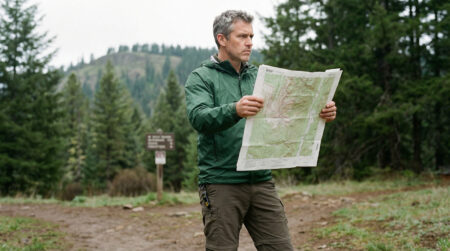

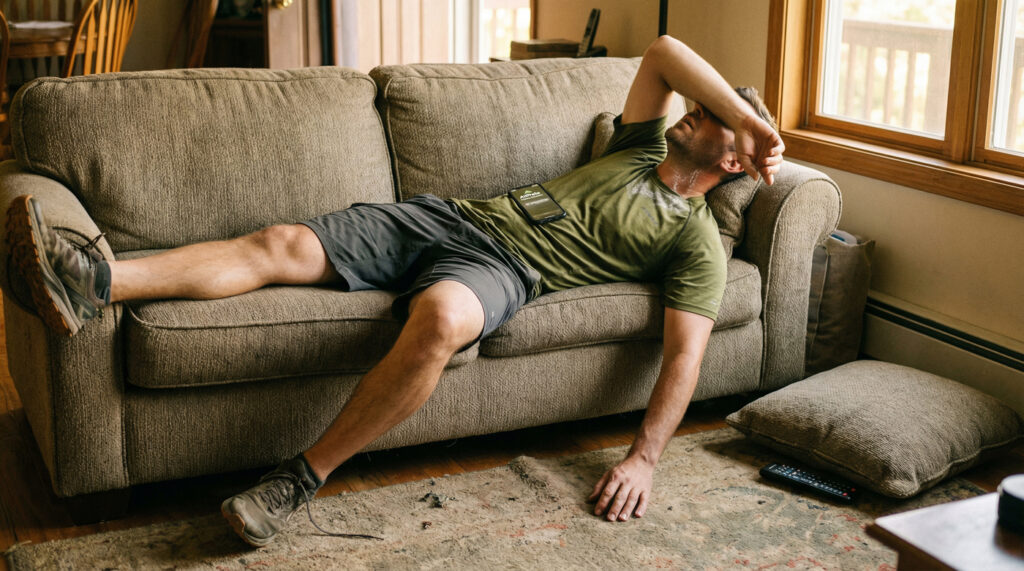

Why am I so tired after hiking: that question hits every beginner from the couch, legs aching, surprised by how completely wrecked they feel after what the app called an “easy” 3-mile loop.
The short answer: hiking uses your body in ways almost no other exercise does. Not just your legs. Your stabilizer muscles, your cardiovascular system, your thermoregulation, and your brain are all working simultaneously. Do all of that for two hours on uneven terrain in the sun, and the tiredness afterward is not a sign something went wrong. It’s a sign the trail did exactly what it was supposed to do. If you’re asking why am I so tired after hiking on what felt like a manageable outing, the distance on the app wasn’t the problem. The effort was just higher than the number suggested.
My second hike was a 4.1-mile loop with 550 feet of elevation gain near San Gabriel Canyon. I’d been walking 4 miles most mornings and figured I was ready. I was not ready. I ate dinner at 6pm and was asleep by 7:30. My calves hurt in places I didn’t know calves had. The next morning, stairs were a project. I wasn’t injured. I wasn’t unfit. I had just encountered trail fitness for the first time and it had introduced itself firmly.
Understanding exactly why am I so tired after hiking (the seven specific causes) means you can prepare better, recover faster, and stop being surprised by how the body responds to trail. Our [beginner hiking guide] covers what to expect more broadly. This article is specifically about the fatigue: what’s causing it and what actually helps.
Table of Contents
Why Am I So Tired After Hiking? The Honest Answer
What makes hiking different from other exercise
Most people walk into their first hike with a reasonable baseline of fitness and walk out wondering why am I so tired after hiking when the app said it was easy. The reason isn’t that they were secretly unfit. It’s that hiking is a genuinely different physical activity from anything most people do regularly, and the body’s response reflects that.
Walking on pavement uses a predictable set of muscles in a predictable pattern. Your quads, hamstrings, and calves do most of the work. The surface is consistent and flat, your foot strikes the same way on every step, and your stabilizing muscles spend most of the time doing very little.
Trail terrain is the opposite. Every step on uneven ground activates muscles your regular exercise never reaches, particularly the stabilizer muscles in your ankles, knees, and hips that fire constantly to keep you balanced on shifting surfaces. Add real elevation gain and your cardiovascular system works at a sustained level that flat walking rarely demands. Add sun, heat, and a pack and the energy cost climbs further still.
The result is post hike exhaustion that feels disproportionate to the distance. It isn’t. The distance on the app is accurate. The effort it took is just higher than the number suggests.
Why hiking fatigue catches beginners off guard
Trail fatigue is specific, which means it doesn’t transfer from other fitness. A person who runs 5 miles regularly will still feel the specific tiredness of trail hiking on their first few outings. Their stabilizer muscles, their uphill cardiovascular system, and their downhill deceleration muscles have never been trained in this particular way. That’s a large part of the answer to why am I so tired after hiking even when you’re otherwise fit.
The American Hiking Society notes that trail-specific fitness builds significantly within the first four to six hikes for most beginners, which means the level of post hike exhaustion you feel on hike one is not the level you’ll feel on hike six. The trail gets easier not because you’ve become a different person, but because the specific muscles involved have caught up.
The 7 Reasons You’re So Tired After Hiking
Cause 1: More muscles are working than you realize
The stabilizer muscles pavement never trains
The biggest single contributor to why am I so tired after hiking isn’t your quads or your cardiovascular system. It’s the stabilizer muscles throughout your lower body that have spent most of your adult life doing almost nothing.
Every step on uneven trail surface activates the peroneals (outside of your lower leg), the tibialis anterior (front of your shin), the glute medius (outside of your hip), and dozens of smaller muscles around your ankle and knee that fire constantly to keep you balanced. These muscles are underdeveloped in most adults who spend their time on flat, predictable surfaces.
Working muscles you’ve never systematically trained is why you can complete a 3-mile hike that felt manageable on trail and still feel genuinely wrecked the next morning. The distance was fine. The muscle recruitment wasn’t what your body was used to.
What muscle fatigue after hike actually means for recovery
This soreness is concentrated in exactly these stabilizer muscles, which is why beginners often feel it in unexpected places: the outside of their calves, the front of their shins, the sides of their hips, rather than just the standard quad burn of going uphill. This is normal and resolves within 48 to 72 hours as your body adapts.
Cause 2: Elevation gain multiplies the effort
How the 300-foot rule explains your legs
Distance is the number everyone looks at. Elevation gain is the number that actually explains why am I so tired after hiking after what felt like a perfectly reasonable trail.
A rough but reliable rule: for every 300 feet of elevation gain, your body does the equivalent of an extra mile of flat hiking. A 3-mile trail with 900 feet of gain is physically closer to a 6-mile flat walk in cardiovascular and muscular demand. The AllTrails app shows you the distance. The elevation gain tells you the effort.
Why downhill is harder than it looks
Going uphill is the obvious effort. Going downhill is the hidden one. Descending on trail requires sustained eccentric muscle contractions. Your quads fire to control your descent rather than propel your ascent, which is actually more damaging to muscle tissue than the uphill work. The muscle fatigue after hike many beginners feel most acutely in the 24 to 48 hours afterward is in the front of their thighs, from exactly this downhill braking work.
Our guide to [how far a beginner should hike] covers the elevation math in more detail and is worth reading before you choose your next trail.
Cause 3: Dehydration compounds faster than you expect
Why hiking fatigue and dehydration feel identical
Mild dehydration produces symptoms that are indistinguishable from general exhaustion after a trail: heavy legs, mental fog, reduced energy, headache. This overlap is part of why so many beginners finish a hike feeling worse than the distance seems to warrant. They’re dealing with both actual physical exertion and the compounding effect of being under-hydrated throughout.
The mechanism: even mild dehydration, losing just 1 to 2% of body weight in fluids, reduces blood volume. That means your heart works harder to circulate oxygen to working muscles, your muscles fatigue faster, and your perceived effort is higher. Everything feels harder than it would if you were properly hydrated. If you’re asking why am I so tired after hiking a trail that seemed well within your ability, check how much water you actually drank during it.
The math on hiking water
Half a liter per hour is the standard starting point on a moderate trail in comfortable temperatures. In heat above 75°F, that becomes a minimum of 750ml to 1 liter per hour. Most beginners bring the amount of water they’d drink on a neighborhood walk and discover halfway through a hike that they’re already running low.
💡 Trail Tip: Drink before you’re thirsty. By the time you feel thirst on trail, you’re already mildly dehydrated and the fatigue is already compounding. Set a phone reminder to drink every 20 minutes on your first few hikes until it becomes automatic.

Cause 4: Glycogen depletion hits beginners harder
What running out of fuel actually feels like
Your muscles run on glycogen, stored glucose from carbohydrates. Most adults have enough glycogen stored for 60 to 90 minutes of moderate exercise. A 3-hour hike that goes further than that without refueling triggers what endurance athletes call “bonking” or “hitting the wall”: a sudden, marked drop in energy, mood, and cognitive function that feels completely out of proportion to the remaining distance.
For beginners who don’t eat before or during a hike, this often happens in the final third of the trail and explains the experience of feeling completely fine at mile 2 and completely depleted at mile 3. It’s one of the reasons why am I so tired after hiking is a question that hits hardest on outings where the first hour felt almost too easy.
The simple fix
Eat a real meal 90 minutes before you hike. Bring a snack for any hike over 90 minutes: something with both carbohydrates and protein, like a bar, some nuts and dried fruit, or a sandwich. Eat it at the halfway point whether you feel hungry or not. Your body is using fuel even when it doesn’t send clear hunger signals during exercise.
Cause 5: Sun and heat exposure drain energy
The hidden energy cost of thermoregulation
Your body spends a significant amount of energy maintaining its core temperature in the heat. On a trail with limited shade, even at moderate temperatures, your thermoregulation system is working continuously, directing blood flow to your skin, producing sweat, managing the cooling process. All of that costs energy on top of the muscular work of hiking.
This is why the same 3-mile trail in 85°F feels dramatically harder than the same trail at 65°F. The distance is identical. The total energy expenditure is not. Sun exposure amplifies this further: direct sun on your skin raises the thermoregulatory load even when the air temperature seems manageable. It’s one of the main reasons why am I so tired after hiking is a question that spikes hardest after summer morning trails on exposed ridges.
For hiking recovery purposes, a hike done in heat requires more rest, more fluid replacement, and more food replacement than the same hike done in cooler conditions.
Cause 6: The mental load of navigation
Trail navigation uses sustained cognitive resources in a way that a familiar neighborhood walk doesn’t. Watching your footing on uneven ground, checking trail markers, monitoring distance and time remaining, making decisions at junctions, tracking your own physical state. All of this runs continuously for the duration of a hike. By the end, your mental fatigue is real and measurable even if you weren’t aware of doing any of it consciously.
This is one of the underreported answers to why does hiking make you tired, and it’s part of why the post hike exhaustion on your first few trail outings is greater than it will be once navigation becomes more automatic. As trail reading becomes instinctive, the cognitive load drops and the fatigue profile shifts. It also explains why am I so tired after hiking short trails that didn’t involve much elevation: the cognitive tax runs whether the trail climbs hard or not.
That’s hiking fatigue working through a channel most beginners never think to account for.
Cause 7: Pack weight changes the equation
What extra pounds actually cost you
Hiking with a loaded pack multiplies the physical demand of every step. Research from the Army Research Institute of Environmental Medicine found that each additional pound on your back increases energy expenditure by roughly 1% per mile. A 15-pound pack on a 5-mile hike increases your total energy output by about 15% compared to hiking with no pack.
For beginners, this matters because most people start with heavier packs than they need: multiple layers they won’t use, too much food, oversized water bottles, items that cover every theoretical scenario. Keep your base pack weight under 15 pounds for day hikes. The muscle fatigue after hike from an unnecessarily heavy pack is real and completely avoidable.
💡 Trail Tip: Weigh your loaded pack before your next hike. Most beginners are surprised by the number. For a day hike under 5 miles, target 10 to 12 pounds total including water. Every item in your pack should have a specific job for that specific trail.
5 Hiking Recovery Strategies That Actually Work
Recovery 1: The first 30 minutes after you finish matter most
What to do before you shower
The window immediately after a hike is when your body is most receptive to recovery inputs. Most beginners collapse in the car, drive home, shower, and eat whatever’s in the fridge, missing the window when those inputs would do the most good. If you’ve been asking why am I so tired after hiking for days afterward, skipping this window is often a significant part of why.
Within 30 minutes of finishing: drink 16 to 24 ounces of water, eat something with both protein and carbohydrates (a peanut butter sandwich, chocolate milk, or a protein bar with some fruit), and take a brief 5-minute walk before sitting down for a long period. Stopping dead after prolonged exercise stiffens muscles faster. The short walk keeps circulation moving while your body starts the repair process.
Recovery 2: Protein within 45 minutes
How much and what kind
Your muscles repair the micro-damage from hiking using protein. The research on post-exercise protein timing consistently points to a 30 to 45-minute window after exercise as the most effective point for protein intake to support muscle repair.
Target 20 to 30 grams within that window. For reference: two eggs have about 12 grams, a chicken breast has 25 to 30 grams, and Greek yogurt has 15 to 20 grams. You don’t need a protein supplement. Real food works fine. The specific source matters less than getting enough of it within the window.
This applies to hiking recovery exactly as it does to gym recovery. The fact that hiking doesn’t feel like a gym workout doesn’t change the muscle repair equation.
Recovery 3: Active recovery beats complete rest
Why a short walk the next morning helps
The instinct after a hard hike is to rest completely the next day. For moderate soreness, a short 15 to 20-minute flat walk the morning after a hike actually accelerates recovery faster than lying still. Light movement increases blood flow to sore muscles, clears metabolic waste products, and reduces stiffness without creating additional damage.
This is why experienced hikers often describe feeling worse on the second day when they rested completely. The movement isn’t re-injuring tired muscles. It’s flushing them.
Recovery 4: Sleep is the non-negotiable
What happens to muscle repair during sleep
The tiredness you feel after a hike isn’t just a signal to rest. It’s your body requesting the specific conditions it needs to repair. Muscle protein synthesis peaks during deep sleep. Growth hormone release, which drives tissue repair, occurs primarily in the first two to three hours of sleep.
Going to bed early after a hard hike isn’t weakness. It’s accurate. The 7:30pm bedtime after my second hike was my body doing exactly what it needed to do. Sleep is the honest answer to why am I so tired after hiking: the fatigue is a repair request, not a failure signal.
Recovery 5: Understanding DOMS so you don’t panic
Distinguishing normal soreness from injury
Delayed onset muscle soreness (DOMS) is the specific deep muscle ache that peaks 24 to 48 hours after exercise that used unfamiliar muscle groups. It’s caused by micro-tears in muscle fibers, a normal part of how muscles adapt and get stronger, and it resolves on its own within 72 hours in most cases.
DOMS feels like deep, diffuse soreness across a muscle group. It’s worst on stairs and when sitting down or standing up. It responds to movement better than to rest. The muscle fatigue after hike that follows this pattern is normal and resolves without any treatment beyond the recovery steps above.
What to watch for instead: sharp, localized pain in a specific joint rather than a muscle, pain that gets worse rather than better over 72 hours, or swelling around a specific joint. Those warrant medical attention. Diffuse muscle soreness that peaks at 48 hours and fades by 72 does not.

Why Does Hiking Make You Tired Compared to Other Exercise?
How hiking compares to running and gym work
Why does hiking make you tired in a way that seems different from other exercise? Because it is different. Running on pavement is repetitive and predictable. Your body gets efficient at it fast. The gym is controlled: specific muscles, specific loads, defined rest intervals.
Hiking is none of those things. The terrain is unpredictable, the muscle recruitment changes constantly, there are no rest intervals, and the duration is typically longer than most people’s gym sessions. Research from the Journal of Strength and Conditioning Research found that hiking produces significantly higher levels of muscle activation in stabilizer muscles compared to treadmill walking at equivalent speeds. The terrain variability is the key variable, not the speed or the distance. That’s the core answer to why am I so tired after hiking when a gym session of the same duration leaves you feeling fine.
Trail fitness is specific and builds fast
The good news: that fatigue diminishes quickly. Most beginners report a dramatic reduction after four to six hikes on comparable terrain. The muscles involved aren’t weak. They’re untrained for this specific demand. Once they’ve been introduced to trail terrain repeatedly, their capacity increases and the recovery time shortens.
REI’s beginner hiking resources cover the physical adaptation process in more detail and are worth reading if the tiredness from hike one felt unexpectedly significant.
Common Mistakes That Make Hiking Fatigue Worse
Not eating before you go
Leaving for a hike on coffee and an empty stomach is the single most reliable way to engineer a miserable third mile. Your muscles need glycogen to work. If you haven’t topped up your stores before you start, you’re beginning the trail already behind on fuel. Eat a real meal 90 minutes before hiking: something with carbohydrates, protein, and a bit of fat to slow digestion and sustain energy. Skipping pre-hike food is the single most controllable reason why am I so tired after hiking becomes the loudest question in the final mile.
Underestimating the elevation
Choosing a trail based on distance alone and ignoring the elevation gain is how easy 3-mile hikes become unexpectedly hard 3-mile hikes. Look at the elevation gain number on every trail card before you commit. Divide it by the distance. Over 300 feet per mile is real climbing that multiplies your energy expenditure significantly. Our [trail selection guide for beginners] covers exactly how to use this number when planning. Elevation explains more about why am I so tired after hiking than any other single variable.
Pushing through dehydration signals
Mild headache, heavy legs, mental fog. These are dehydration signals that most beginners attribute to general tiredness and push through. They’re also reversible within 20 minutes if you stop, drink 16 ounces of water, find shade, and rest briefly. Pushing through them doesn’t make you tougher. It makes the final mile harder and the next day worse.
Starting too fast
Beginning a hike at a pace that feels comfortable and then fading hard in the second half is a pacing mistake that makes the fatigue afterward significantly worse than it needs to be. Start at 70% of what feels easy. Conserve energy in the first third. The trail rewards patience.
When Post-Hike Tiredness Is Worth Paying Attention To
Most tiredness after hiking resolves within 48 to 72 hours for moderate beginner hikes. If you’re still asking why am I so tired after hiking four or five days after a trail that wasn’t extreme, look at your nutrition and hydration in the post-hike window first. But some signals are worth distinguishing from standard fatigue regardless.
Signs this is more than normal soreness
Sharp, localized pain in a specific joint, particularly the knee, ankle, or hip, that gets worse rather than better over 48 hours is worth having looked at. So is visible swelling around a joint, muscle soreness that intensifies rather than fades after 72 hours, or a persistent headache that doesn’t resolve with water, food, and rest within a few hours of finishing the hike. Confusion, extreme dizziness, or nausea that persists well after you’ve finished can indicate heat exhaustion and warrants medical attention.
Signs you’re recovering normally
Deep muscle soreness across both legs that peaks at 24 to 48 hours and resolves by 72 is normal DOMS. Wanting to sleep early the night of the hike is normal. Stiff legs on stairs the morning after, improving with light movement, is normal. Higher-than-usual hunger for 24 hours post-hike is normal. All of those are your body responding exactly as it should to trail-specific exercise.
If you’re unsure whether what you’re feeling is normal soreness or something worth addressing, the rule is simple: if the discomfort is improving over 72 hours, you’re on track. If it’s getting worse, get it checked.
Frequently Asked Questions: Tired After Hiking
Why am I so tired after hiking even on a short trail?
Why am I so tired after hiking short distances is almost always explained by terrain rather than distance. A 2-mile trail with 500 feet of elevation gain and rocky footing uses far more energy than a 2-mile walk on pavement. The stabilizer muscles, the cardiovascular load of climbing, the deceleration work on descents, and the dehydration that compounds throughout all add up independently of how far you went. Short doesn’t mean easy when the terrain is real trail.
What causes hiking fatigue the day after a hike?
The soreness you feel the day after, particularly the deep ache that peaks at 24 to 48 hours, is delayed onset muscle soreness from micro-tears in the stabilizer muscles and quad fibers from downhill work. This is a normal adaptation response. It resolves within 72 hours and decreases significantly as trail-specific fitness builds over your first four to six hikes. Light movement the morning after accelerates recovery better than complete rest.
How long should post hike exhaustion last?
That exhaustion typically resolves within 24 to 72 hours for moderate beginner hikes. The general tiredness and desire to sleep early usually clears after a full night of sleep. Muscle soreness peaks at 48 hours and fades by 72. If fatigue persists beyond four days after a hike that wasn’t extreme in length or difficulty, look at your sleep, hydration, and nutrition in the recovery window. One of those is usually the gap. And if you’re still asking why am I so tired after hiking several days later, the 30-minute post-hike nutrition window is almost always what got skipped.
Why does hiking make you tired more than the gym?
Why does hiking make you tired more than equivalent gym time comes down to three things: unfamiliar muscle groups (stabilizers that gym work doesn’t reach), duration (most hikes run longer than most gym sessions), and the absence of rest intervals. A gym workout is structured with recovery built in between sets. A hike runs continuously for hours. Add terrain variability, sun exposure, and the cognitive load of navigation and the total demand is genuinely higher than the gym for most beginners.
What helps with muscle fatigue after hike?
Here’s what consistently helps: protein within 45 minutes of finishing (20 to 30 grams), 16 to 24 ounces of water immediately after, a short 5-minute walk before sitting for a long period, a full night of sleep, and a light 15 to 20-minute flat walk the following morning. Anti-inflammatory foods like tart cherry juice, blueberries, and salmon have some evidence supporting faster recovery. The basics above are more consistently useful and considerably more practical.
How do I improve hiking recovery over time?
Recovery improves fastest by hiking consistently. Trail-specific fitness, particularly in the stabilizer muscles, builds over the first four to six hikes at a pace that noticeably reduces fatigue. Between hikes, single-leg exercises like lunges, step-ups, and single-leg deadlifts train the stabilizer muscles that trail terrain demands. Adequate sleep, consistent hydration before and during hikes, and eating before you go are the three controllable variables that most beginners under-invest in early on.
The Tiredness Means It’s Working
Why am I so tired after hiking has a straightforward answer: you used your body in a specific, demanding way that most exercise doesn’t reach, and it responded accordingly.
Post hike exhaustion on your first few outings is not a sign that hiking is too hard for you. It’s a sign that trail fitness is specific and your body hasn’t built it yet. The adaptation is fast. Most beginners feel the difference clearly by their fourth or fifth hike on comparable terrain. The tiredness decreases. The enjoyment, usually, does not.
The five hiking recovery strategies in this article cover the 30-minute post-hike window, protein timing, active recovery, sleep, and understanding DOMS. Apply them consistently and you’ll show up to each hike less depleted than the last. For knowing how to choose a trail that matches where your fitness actually is right now, our guide to [what AllTrails difficulty ratings actually mean] keeps the difficulty numbers honest.
Next Steps
- Right now: Before your next hike, check the elevation gain on your trail card and divide it by the distance. That number predicts your energy expenditure more accurately than distance alone.
- Before your next hike: Eat a real meal 90 minutes before you leave. Pack a snack for the halfway point and 1.5 liters of water minimum. Weigh your pack and target under 15 pounds.
- After your next hike: Drink 16 to 24 ounces of water and eat something with protein within 30 minutes of finishing. Take a short 5-minute walk before sitting down for the rest of the evening.