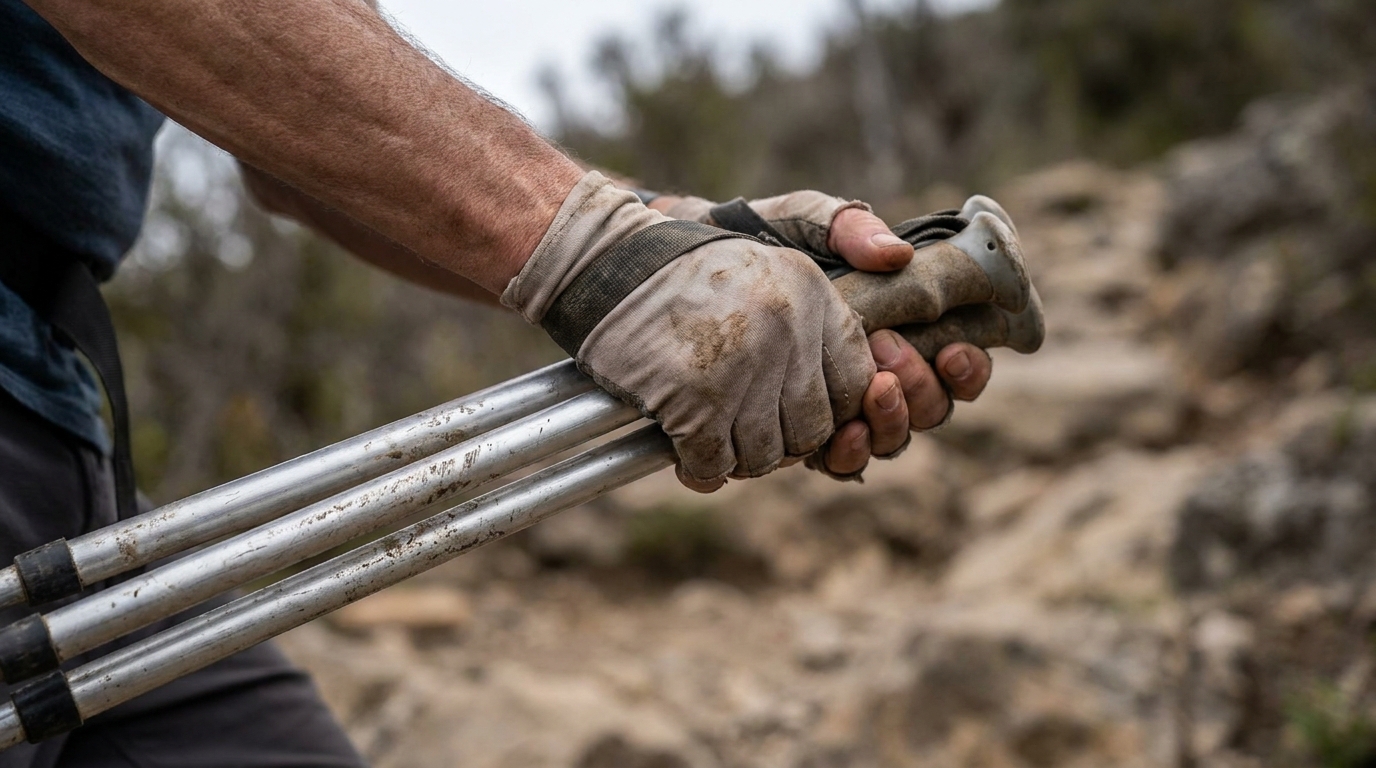
Trekking Poles for Beginners
GEAR & LOAD MASTERY

TREKKING POLES
FOR BEGINNERS
ESSENTIALS

⚡ Direct Trail Answer

Set pole length to create a 90-degree elbow bend on flat ground; shorten 5–10 cm when hiking uphill, and lengthen 5–10 cm when descending to protect knees.

Published by Fama Blog
STEP 01 • PRIMARY TRAIL RULE
THE 90° RULE
ERGONOMICS • BASELINE POSTURE

Stand on level ground wearing trail boots. Adjust pole height until forearms rest parallel to the ground at an exact 90-degree angle.

🏛️ Verified Standard: American Hiking Society trail standards confirm a 90-degree elbow posture maximizes core leverage and prevents rotator cuff fatigue.
Published by Fama Blog
STEP 02 • PHYSIOLOGY & HYDRATION
UPHILL ADJUSTMENT
CLIMBING MECHANICS • LEVERAGE

Shorten both poles by 5 to 10 cm on sustained ascents so you push downward rather than lifting your arms above heart level.

🏛️ Verified Standard: Mountaineering biomechanics data indicates pushing down from shortened poles conserves cardiovascular energy and eases bicep strain.
Published by Fama Blog
STEP 03 • GEAR & MECHANICS
DOWNHILL BRAKING
JOINT DEFENSE • DECELERATION

Lengthen poles by 5 to 10 cm on descents, planting tips slightly ahead to brake descent speed and cushion knee cartilage.

🏛️ Verified Standard: Journal of Applied Physiology studies show trekking poles absorb up to 25% of downward compressive force off the lumbar and knee joints.
Published by Fama Blog
STEP 04 • SAFETY & NAVIGATION
STRAP TECHNIQUE
GRIP EFFICIENCY • WRIST SUPPORT

Feed your hand upward through the bottom of the loop, then grip down over the strap to support wrist weight without a white-knuckle squeeze.

🏛️ Verified Standard: Wilderness Medical Society safety advisories warn against resting thumbs across pole grips during steep drops to prevent skier's thumb sprains.
Published by Fama Blog
STEP 05 • PRO RECOMMENDATION
ACTION PLAN

Choose external lever-cam flick locks over internal twist locks for dependable slip-free performance in grit and freezing rain.

⚡ PRO RULE: Stow rubber tips for pavement and rock slabs; use bare carbide tips on dirt, gravel, mud, and snow.
Published by Fama Blog