



How long does it take to hike 3 miles? On a flat, maintained trail, most beginners finish in 1.5 to 2 hours (for longer distances, see our estimates on how long it takes to hike 5 miles). Add real elevation, say 500 feet of gain, and that same 3 miles becomes 2.5 to 3 hours. Add summer heat, a group, or terrain that makes you watch your footing, and you’re closer to 3.5.
⚡ Quick Trail Takeaways
- Baseline Duration: A 3-mile loop takes 60 to 90 minutes for beginner hikers on easy, well-maintained dirt trails.
- Elevation Grade Factor: Gains over 500 feet will extend a 3-mile hike to 1 hour and 45 minutes minimum.
- Pacing Strategy: Aim for a sustainable 20-minute-per-mile pace on flat sections to avoid gasping on short climbs.
The number matters more than most people realize before their first hike. Parks have closing times. Parking lots charge by the hour. If you’re meeting someone at the trailhead, “I’ll be back in an hour” needs to be a real estimate, not a guess based on how fast you walk to the coffee shop. Trail pace and sidewalk pace are different things, and the gap between them surprises almost everyone the first time.
My first hike was a 3.1-mile loop that AllTrails estimated at 1 hour 30 minutes. I budgeted two hours to be safe, figured that was plenty, and told my partner I’d be back by noon. I got back at 1:15pm. I’d stopped to figure out a junction, slowed way down on the rocky descent, and taken two breaks I hadn’t factored in. Nothing went wrong. I just had no real sense of what 3 trail miles actually costs in time.
This guide gives you five specific time estimates for hiking 3 miles under different real conditions, not the average across all hikers, but calibrated for someone who’s new to this. You’ll also find the one planning rule that makes these estimates more useful than any calculator.
| Trail Surface & Profile | Elevation Gain | Average Pace | Total Hike Duration | Break Allowance Included |
|---|---|---|---|---|
| Flat Paved Path or Rail Trail | 0 – 150 ft | 2.5 – 3.0 mph | 1 hr 00 min – 1 hr 15 min | 5 min water stop |
| Maintained Packed Dirt (Rolling) | 150 – 400 ft | 1.8 – 2.2 mph | 1 hr 25 min – 1 hr 45 min | 10 min view & water |
| Moderate Forest Single-Track | 400 – 800 ft | 1.3 – 1.6 mph | 1 hr 55 min – 2 hr 20 min | 15 min snack & rest |
| Steep Rocky Ridge or Scramble | 800 – 1,400 ft | 0.9 – 1.2 mph | 2 hr 30 min – 3 hr 20 min | 25 min recovery pauses |
Why the Average Hiking Time for 3 Miles Varies So Much
Terrain steepness changes everything; read what elevation gain is and why it matters to calculate vertical pace.
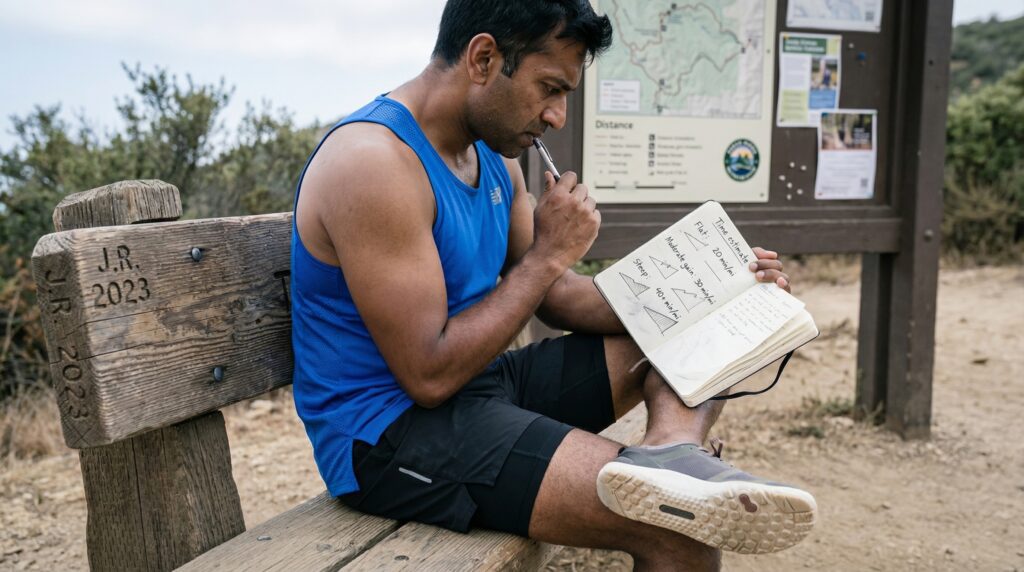
Look up “how long does it take to hike 3 miles” and you’ll find answers ranging from 45 minutes to 4 hours. That range isn’t vague. It reflects real differences in conditions that drastically change the time. Understanding what drives the variation is more useful than any single number.
Elevation gain is the biggest variable. A 3-mile trail with 800 feet of elevation gain takes nearly twice as long as a 3-mile trail with 50 feet of gain. Uphill walking is slower, meaningfully slower, and the slowdown is steeper than most people expect. On a 10% grade, pace drops by roughly a third compared to flat walking. On a 20% grade, you might be moving at half your flat speed or less.
Trail surface changes everything. Three miles on a paved rail trail takes about the same time as 3 miles on a city sidewalk. Three miles on loose rocky terrain, with scrambling sections, river crossings, or root-tangled forest floor, can take twice as long. Average hiking time per mile stretches from 20 minutes on smooth surface to 45 minutes or more on genuinely technical ground.
Beginner pace is slower than most estimates assume. Most hiking time calculators, including the baseline on AllTrails, use Naismith’s Rule as their foundation: 1 hour per 3 miles of distance, plus 30 minutes for every 1,000 feet of elevation gain. That formula was developed for fit, experienced walkers moving efficiently. For someone on their first or second hike, still learning their pace and making the micro-adjustments that trail terrain demands, Naismith’s estimates are consistently optimistic. Add 25 to 40% for a more accurate beginner projection.
Breaks add up faster than expected. Stopping to check the map, drink water, eat a snack, take a photo, figure out a junction, or just rest your legs: these pauses don’t register as significant in advance and add 20 to 40 minutes to most hikes in aggregate. The estimates in this guide include reasonable breaks. Pure moving time would be shorter. Don’t plan for pure moving time.
All of this is why the question “how long does it take to hike 3 miles” doesn’t have a single answer, but it does have five useful ones.
5 Time Estimates for Hiking 3 Miles
To avoid burning out in the first mile, apply our pacing techniques that work.
Estimate 1: Flat Trail, Decently Active Beginner (1.5 to 2 Hours)
Conditions: Maintained dirt or gravel trail, minimal elevation (under 150 feet total gain), good weather, solo or small group moving at your own pace.
This is the baseline. A flat 3-mile trail is the most forgiving version of the question, and 1.5 to 2 hours is a reliable window for someone who walks regularly but has never specifically hiked before.
Breaking that down: most beginners on flat trail move at about 1.5 to 2 miles per hour. That puts the moving time at 90 minutes to 2 hours before any stops. Factor in a few water breaks, a moment at a viewpoint, and the general novelty of being on a trail for the first time (slow pace at the start, checking the map once), and 2 hours is a realistic total.
The AllTrails estimate for a flat 3-mile trail tends to come in around 1 hour to 1 hour 20 minutes. That’s based on average hiking time across all users. As a beginner, add 30 to 45 minutes to whatever AllTrails shows you. Not because you’re slow. Because their average includes the regulars who do this loop before work.
For planning purposes: if your trail closes at 5pm, you want to be starting no later than 3pm. Build in the full 2 hours plus a 20-minute buffer for parking, gear, and the walk from the car to the actual trailhead.
Estimate 2: 3 Miles with Moderate Elevation (300–500 Feet of Gain) (2 to 2.5 Hours)
Conditions: Rolling terrain with noticeable uphills, average hiking time stretched by climb sections, well-maintained trail.
This is the range most beginners encounter when they pick an AllTrails “Easy-Moderate” trail for their first few hikes. Three hundred to 500 feet of elevation gain over 3 miles is real work, and you’ll feel the uphills and harder breathing on the steeper sections, but it’s achievable and the terrain rewards it with better views or more varied ground.
Time estimate mechanics: moderate elevation adds roughly 20 to 40 minutes to a flat 3-mile baseline. Uphill pace slows to 1 to 1.5 miles per hour on climb sections. The descent adds its own slowdown. Not because you’re tired (though you may be), but because downhill terrain requires more careful footing than flat ground. On an out-and-back with a real climb, first-timers consistently overestimate how fast the return trip will go.
The 2 to 2.5 hour window assumes reasonable weather, a manageable pack, and not getting turned around. If you hit a confusing junction and lose 10 minutes figuring it out, you’re at the top end of that range. Plan for 2.5 hours and be pleasantly surprised if you finish earlier.
One practical note for this elevation range: bring more food than you think you need. At 400 calories burned per hour on moderate terrain, two-plus hours of hiking creates real hunger. The mid-hike energy dip that beginners often attribute to the trail being “harder than expected” is frequently just blood sugar responding to the caloric demand. A snack at the halfway point is not optional at this elevation.
Estimate 3: 3 Miles with Significant Elevation (500–900 Feet of Gain) (2.5 to 3.5 Hours)
Conditions: Sustained climb sections, AllTrails Moderate or Moderate-Hard, some rocky or uneven footing, beginners working noticeably harder than on a flat trail.
This is where the average hiking time calculation really starts diverging from beginners’ expectations. Five hundred feet of gain over 3 miles is roughly 167 feet per mile, enough to make the uphill sections feel genuinely hard. Nine hundred feet over 3 miles is 300 feet per mile, which is steep by any definition. The trail is probably well-marked and maintained, but the physical demand is real.
At this level, the time estimate is driven almost entirely by how you manage the climbs. Experienced hikers use a technique called the rest step (a brief pause with each uphill step to let heart rate settle) that makes sustained elevation gain much more manageable. Beginners who push through steep sections without managing their breathing often hit a wall around the halfway point and slow dramatically for the second half of the climb.
The practical version: if the trail has over 500 feet of gain, plan 3 hours minimum for your 3-mile hike. Check the elevation profile on AllTrails before you go. If the gain is front-loaded (the climb is in the first half), you’ll be working hardest when your legs are freshest, which is actually the better scenario. A back-loaded climb on tired legs is harder than the same climb fresh.
At this range, check current conditions before going. A 3-mile trail with 700 feet of gain that’s dry and well-groomed in September might be a different experience in March after recent rain. The American Hiking Society’s trail conditions guidance is a good reference for what to check before heading out in shoulder seasons.
Estimate 4: 3 Miles in Summer Heat Above 80°F (Add 30 to 45 Minutes to Any Estimate)
Conditions: Temperature above 80°F, exposed trail sections with direct sun, any elevation.
Heat changes everything. Not just comfort — actual pace. Your body redirects blood flow to the skin for cooling, which means less blood available to working muscles. Your perceived exertion climbs faster. You need more water, which means more stops. You slow down whether you mean to or not.
For average hiking time purposes: any temperature above 80°F adds 30 to 45 minutes to the estimates above. A flat 3-mile trail that takes 2 hours in 65°F weather takes 2.5 hours at 85°F, even at the same fitness level and trail surface. The sun matters too: a trail with continuous shade runs significantly cooler than an exposed ridgeline at the same air temperature.
This estimate is the one that catches people most off-guard. Summer hiking in many parts of the United States means desert trails that are 95°F by 10am, or east coast humidity that makes 80°F feel like 90°F. The standard advice is to start early. On hot-weather days, beginning a trail at 7am versus 10am is genuinely different in terms of how long it takes to hike 3 miles and how you feel when you finish.
For any summer day hike above 80°F: add at least a liter of water to your standard carry, plan for the high-end time estimate, and note where the shaded sections are on your trail map before you start. Shade is rest you don’t have to stop for.
Estimate 5: Hiking with a Group, Kids, or a Dog (Add 30 to 60 Minutes)
Conditions: Group larger than two people, children under 12, or a dog that hasn’t hiked this trail before.
Group dynamics change pace in ways that solo planning doesn’t anticipate. The group moves at the speed of its slowest member, which on a trail with any elevation is almost always slower than you’d go alone. Kids stop more, not from fatigue but from genuine curiosity about insects, rocks, water, and everything else, and those stops are part of what makes hiking with children worth doing. But they add time.
Dogs require their own category because trail dogs and first-time trail dogs behave completely differently. A dog that’s new to trail terrain moves unpredictably, needs more water breaks than you’d expect, and on an out-and-back, often slows significantly on the return because they’re doing a second hard effort after their legs are already worked. Add a water bowl, expect more stops, and use the high end of whichever time estimate applies to your terrain.
For groups of more than four people: at least one person will need an equipment adjustment, have a shoelace issue, or need an unexpected stop at some point in the hike. Budget for it. A 3-mile flat trail with a group of six people who’ve never hiked together before should be planned as a 2.5-hour outing even if the terrain says 1.5 hours. Groups rarely move at their theoretical pace.
The Planning Rule That Makes These Estimates Actually Useful
Every estimate above assumes you’ll do two things before the hike:
Look up the specific numbers. Distance and total elevation gain for your exact trail. Not the category. The actual numbers. A 3-mile hike with 200 feet of gain and a 3-mile hike with 700 feet of gain belong in different estimate categories. AllTrails lists both on every trail page. Pull them up, calculate gain per mile (divide total gain by total miles), then pick the estimate that matches.
Add a 20% buffer to whatever you get. If you calculate 2 hours, plan for 2.5. Tell anyone you’re meeting that you’ll be back in 2.5 hours, not 2. That 20% covers the junction you have to think about, the shoelace stop, the moment you actually look at the view instead of walking past it, and the post-hike time getting back to the car. It also means you never feel rushed on trail, and feeling rushed on trail is the single fastest way to turn a good hike into a stressful one.
A hiking pace calculator can give you a rough estimate, but no calculator accounts for your specific fitness, your specific terrain conditions today, or your tendency to stop at viewpoints. The estimates in this guide, applied with a 20% buffer, are more useful than any formula for a beginner planning a real hike.
Common Mistakes That Blow the Time Estimate
Using AllTrails’ estimate directly. AllTrails bases its time calculations on average hiking time across all users, including the regulars who knock out 3 miles in 55 minutes and post their Strava results. Those times pull the average down. For beginner hiking purposes, add 30 to 40% to whatever time AllTrails shows.
Not counting the approach. The trailhead marker is not always where you park. On popular trails, parking can be a quarter mile to a full mile from where the actual marked trail begins. If AllTrails says the hike is 3 miles but you’re parking at the overflow lot 0.4 miles from the trailhead, your hike is effectively 3.8 miles. Pull up the satellite view on the parking situation before you go. It takes 60 seconds and prevents the surprise.
Planning for one-way time on an out-and-back. An out-and-back trail is the full round-trip distance: 3 miles out-and-back means 1.5 miles to the end and 1.5 miles back, total 3 miles. This is how AllTrails lists distances. But some beginners plan their day thinking “I’ll get there in an hour” and don’t account for the return. On an out-and-back, the turnaround point is the halfway mark in time, not the endpoint. Plan the full loop.
Ignoring time of year and daylight. A 3-mile hike that comfortably fits inside daylight hours in July looks different in November when sunset is at 4:45pm. Average hiking time doesn’t change with the season, but your available window of daylight does. In fall and winter, always check sunrise and sunset times and build your start time around finishing well before dark.
Underestimating how long breaks take in aggregate. This one surprises people consistently. A 5-minute water break, a 3-minute map check, a 4-minute stop at the viewpoint, a 7-minute snack break at the turnaround, and you’re at 20 minutes of stopped time on a hike where you only took “quick breaks.” On a 2-hour hike, 20 minutes of stops is a 17% time addition. It’s in the estimates above. Don’t plan it out.
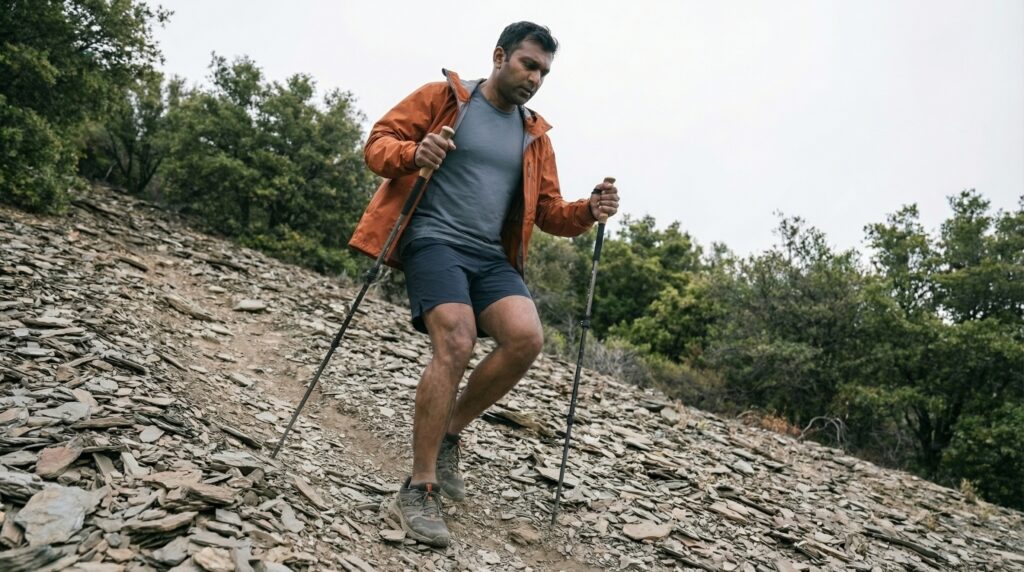
When Your 3-Mile Hike Takes Longer Than Planned
Most of the time, a hike running long is just the estimates working out on the generous end: you’re fine, you’re moving, you’ll be at the trailhead in 20 more minutes. But a few situations deserve a real-time recalibration:
You’ve used more than half your water before you’ve reached the halfway point, and there’s no water source on the route. That’s a signal to increase pace on the return, not to slow down and extend the hike. Dehydration is the most reliable way to make the last mile feel much harder than the first.
Weather is changing: cloud building on a previously clear ridge, temperature dropping faster than expected in fall, a wind shift that suggests incoming weather. Trail weather changes faster than forecast weather. If the sky is doing something unexpected, checking current conditions via the National Weather Service mountain forecast page before you head deeper makes sense.
Your group has been moving significantly slower than the estimate for the first half, and there isn’t enough daylight buffer to finish at that pace. This is a better-before-the-turnaround-point conversation than an after one. Better to agree to a shorter loop or earlier turnaround while you have time than to rush the return trip in fading light.
None of these situations is an emergency. They’re just moments where adjusting the plan based on real conditions, rather than the original estimate, is the smarter call.
How long does it take to hike 3 miles for a beginner?
Most beginners complete a flat 3-mile trail in 1.5 to 2 hours, including reasonable breaks. Add elevation, say 400 to 600 feet of gain, and that stretches to 2.5 to 3 hours. The AllTrails time estimate for any trail is based on average hiking time across all users, which runs faster than a first-timer’s realistic pace. Add 30 to 40% to AllTrails’ estimate as your planning baseline.
What is the average hiking time per mile for a beginner?
On flat terrain, most beginners move at about 1.5 to 2 miles per hour, which works out to 30 to 40 minutes per mile including brief breaks. On uphill sections, that slows to 1 to 1.5 miles per hour, or 40 to 60 minutes per mile. A practical beginner hiking pace calculator: 40 minutes per flat mile, 55 minutes per mile with moderate elevation, 70-plus minutes per mile on steep terrain.
Is 3 miles a good beginner hike distance?
Yes. Three miles on a trail with under 300 feet of elevation gain is a solid first or second hike for most adults. It’s long enough to feel like a real hike without pushing into fatigue territory. At 2 miles per hour on flat trail, 3 miles means about 1.5 to 2 hours outside, which is enough to experience trail hiking properly. For someone mostly sedentary, starting at 1.5 to 2 miles makes more sense. For someone moderately active, 3 miles is the right starting range.
How do I estimate hiking time more accurately?
Use this process: find the total elevation gain and total distance for your specific trail. Divide gain by miles to get gain per mile. Apply the estimate from this guide that matches your gain-per-mile range. Then add 20% to that estimate as a planning buffer. This is more accurate than any hiking pace calculator because it accounts for your specific trail, not an average across all terrain types.
How long does it take to hike 3 miles with kids?
Plan for at least 3 to 3.5 hours for a flat 3-mile hike with children under 10, regardless of how active your kids are. Trail pace with children is slower than most parents anticipate, not from inability but from engagement. Kids stop constantly to investigate things. That’s the best part of hiking with them. Budget for it. Bring more snacks than you think you need and keep the elevation low on early hikes.
Does fitness level significantly change hiking time?
Yes, but less than most people expect, and in a specific direction. Cardiovascular fitness shortens time on climbs. Trail-specific fitness (the stabilizer muscles in ankles and hips, foot strength, balance on uneven ground) affects everything else. A very fit person who’s never hiked may still be slower than their gym performance suggests, because trail terrain uses specific muscles that regular exercise doesn’t train. Experienced trail hikers are faster because of trail-specific adaptation, not general fitness alone.
What’s Naismith’s Rule and should I use it?
Naismith’s Rule (1 hour per 3 miles of distance plus 30 minutes per 1,000 feet of elevation gain) is the most commonly cited hiking pace formula. It’s a reasonable baseline for fit, experienced walkers. For beginners, it consistently underestimates time because it doesn’t account for beginner pace on uneven terrain, stops, or unfamiliarity with the route. Use the estimates in this guide instead, which are calibrated for first-timers, and add 20% to whatever you calculate. That’s a more useful planning tool than Naismith’s for anyone who isn’t already hiking regularly.
The Number Worth Writing Down
How long does it take to hike 3 miles? For most beginners: 2 hours on flat terrain, 2.5 to 3 hours with real elevation, and always plan for more than you calculate. That buffer isn’t for when things go wrong. It’s for when things go right and you want to sit at the top a little longer.
The average hiking time for 3 miles tells you what’s typical. Your hike will be specific: to your terrain, your pace, your company, and the weather on the day you go. Use the estimates in this guide as a starting framework, apply the 20% buffer, and check the actual numbers on your trail before you leave. Distance plus elevation gain per mile, not the AllTrails label, is the accurate input.
Next Steps
Ready to plan your next distance milestone? Read our guide on how far a beginner can hike in a day.
- Right now: Find your next trail on AllTrails. Get the total elevation gain and total mileage. Divide gain by miles. Match it to the estimate category in this guide. Add 20%.
- Before your hike: Check the AllTrails estimate on the trail page, then add 30 to 40% for your personal planning window. That’s your real start time anchor.
- On the trail: Note the time when you reach the halfway point. If you’re already at the high end of your estimate, consider that your turnaround signal regardless of how you feel.