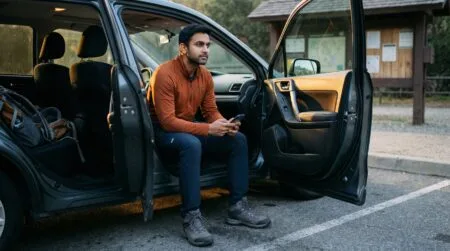



While hiking and walking share the same fundamental movement, what lies beneath your feet completely changes how your body works. Walking typically takes place on paved sidewalks or groomed roads, whereas hiking takes you onto unpaved, natural terrain with rocks, roots, and elevation changes that challenge your balance and engage dozens of stabilizer muscles with every step.
⚡ Quick Trail Takeaways
- Terrain Variability: Hiking involves uneven roots, loose talus, and shifting grades that engage 30% more stabilizer muscle fibers.
- Calorie Burn Comparison: Moderate trail hiking burns 400-550 kcal/hr compared to 200-300 kcal/hr for flat urban walking.
- Footwear Requirements: Trail surfaces require stiff torsional outsoles, protective toe randing, and deep lug traction.
Most articles bury this and jump straight to gear lists. I want it in the first paragraph, because once you understand it, every other question answers itself.
My first mistake was assuming the two were interchangeable. I’d done a few paved loops through local parks and figured I was comfortable enough to join a friend on a “moderate” trail with 700 feet of elevation gain. My running shoes slipped twice on rocky sections. My knees registered the descent in a way flat ground never asks for. I drank through all my water by mile 2. I made it back, but barely — same effort level I thought I was used to, completely different experience.
The hiking vs walking difference isn’t just vocabulary. It determines your footwear, your water, your pacing, and whether the day goes how you pictured it. Understanding the difference between hiking and walking before you choose your first real trail is what makes everything else easier. Our full beginner hiking guide covers the wider picture. This article covers the five specific differences that matter most.
🥾 Oliver’s Trail Notes & Field Observations
When I transitioned from neighborhood fitness walking to foothill trails in the San Gabriels, my calf muscles and ankle tendons were sore for days. In my experience, walking happens on engineered, level concrete where each stride is uniform. Hiking forces every step onto shifting granite, loose scree, and angled roots, constantly working small stabilizer muscles that stay dormant on city sidewalks.
Why the Hiking vs Walking Difference Isn’t About Difficulty
The biggest misconception beginners bring to this topic: hiking is just harder walking. It isn’t. You can have an easy hike on a gentle dirt trail and a brutal walk up a steep paved hill. Difficulty is a function of fitness, grade, and distance. The hiking vs walking difference is purely about surface.
Unpaved natural terrain asks something of your body that pavement never does. Your foot strikes differently on loose gravel than on concrete. Your ankles correct for small lateral shifts on every step. On a rocky descent, your toes press forward into the front of your shoe in a way flat walking never reproduces. Your stabilizing muscles — calves, hip flexors, the small muscles around your ankles — work constantly on trail in ways that even regular walkers haven’t been training for.
This matters because a 3-mile hike and a 3-mile walk feel genuinely different at the end, even if you’re equally fit. It’s not that the hike was harder. It’s that the terrain used different things. The morning after your first hike, you’ll know exactly which muscles I mean.
What counts as hiking — practically, not technically — is any time you’re on an unpaved natural surface: dirt, gravel, rock, or a combination. A paved path through a national park is a walk, even if the scenery is stunning. A flat dirt trail through a city park is a hike, even if it’s less than a mile. The surface is the answer, every time.
The American Hiking Society flags terrain type as the preparation variable beginners most consistently overlook — most focus on distance and miss the surface question entirely. That gap is how beginners end up on trails that surprise them.
The 5 Hiking vs Walking Differences That Change What You Need
1. What counts as hiking vs walking starts with the surface
Pavement is consistent and forgiving. It absorbs shock evenly, offers reliable grip, and your foot strikes in roughly the same pattern with every step. Your walking shoes are built around this predictability.
Natural trail terrain is the opposite. Dirt paths shift. Rocks move underfoot. Roots cross the trail at angles that force your foot into positions pavement never creates. Loose gravel on a descent offers a completely different grip challenge than a sidewalk on a rainy day. Even a flat, well-maintained dirt trail has enough variation that your body is processing new information with every step.
This surface difference is where the hiking vs walking difference actually lives. Not in how hard you’re breathing, not in how far you’ve gone. The surface is the variable that drives every other difference on this list.
A simple test for what counts as hiking: look at the ground. Paved or sealed? That’s a walk. Dirt, gravel, rock, or any natural surface? That’s a hike. It doesn’t matter whether you’re inside a national park, behind a strip mall, or on a trail that’s technically flat. The surface answers the question.
The gray areas — fine crushed limestone rail trails, boardwalks, compressed decomposed granite paths — sit at the boundary of trail walking vs hiking in terms of footing demand. Use judgment. If the surface would benefit from trail-specific shoes, treat it as a hike and prepare accordingly.
2. Footwear stops being interchangeable
On pavement, almost any athletic shoe works. The surface is uniform and grippy enough that your walking sneakers handle it without issue.
On natural trail terrain, three things change that your walking shoes weren’t designed for — and all three show up on the same hike.
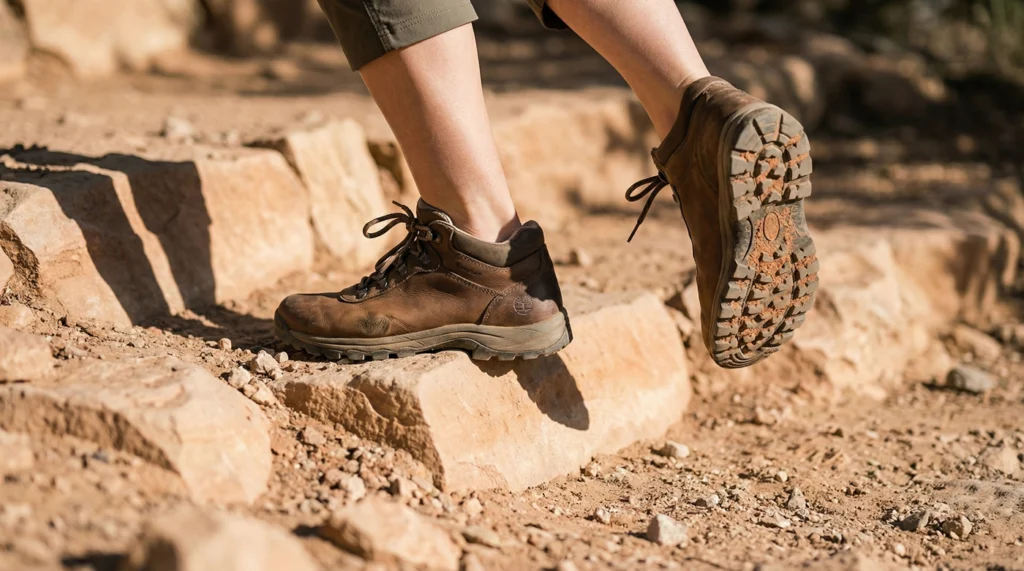
Lateral grip. Every step on uneven ground involves small side-to-side shifts. Trail-specific footwear — whether trail runners or hiking boots — has aggressive rubber lugs designed to bite into dirt and resist those lateral movements. Walking shoes have smooth or mildly textured soles built for flat, even surfaces. On a wet root or a section of loose rock, the difference between trail grip and walking-shoe grip is the difference between stable footing and sliding.
Toe room on descents. On flat pavement, your foot strikes in a neutral position. On trail downhills, your toes press into the front of your shoe with every step. After a mile of descent in shoes without enough toe room, that pressure accumulates into real pain. Trail shoes build in a thumb’s width of space at the front specifically for this. Walking shoes don’t, because pavement never creates the same demand.
Sole stiffness. Trail shoes have stiffer midsoles to protect your foot from rocks and root edges. Walking shoes flex easily underfoot — comfortable on pavement, but after two miles of rocky trail, that flexibility stops being a feature.
For most beginners on maintained trails under 5 miles, trail runners are the right call. They break in immediately with no painful adjustment period, they weigh less than boots, and they handle 90% of the trails beginners actually start on. REI’s beginner footwear guide explains the distinction between trail runners and hiking boots clearly — trail runners win for anything up to moderate maintained terrain. Boots make more sense when you’re carrying over 30 lbs, going off-trail, or on genuinely technical rocky terrain. For a state park day hike as a first or second outing? Trail runners.
3. Trail miles and pavement miles are not the same thing
Three miles on flat pavement takes most people about an hour. Three miles of hiking takes 90 minutes to 2.5 hours — and sometimes more. Same distance on the app. Different experience in your body and on your clock.
The hiking vs walking difference in pace isn’t about fitness. It’s about what the terrain requires. Your body moves slower on uneven ground because it’s doing more work: stabilizing, correcting, climbing, descending carefully. Even a trail with minimal elevation gain runs slower than the equivalent mileage on pavement, because your attention and muscle engagement are higher the entire time.
This is also where hiking vs walking workout results diverge more than most beginners expect. Trail walking vs hiking isn’t just a pace gap — it’s a different muscular load. The stabilizing work on uneven ground means your body recovers differently the next day, even if your heart rate looked similar on paper.
The planning adjustment that actually helps: add 30 minutes for every 1,000 feet of elevation gain, on top of your flat walking pace. A 4-mile trail with 800 feet of gain isn’t a 90-minute walk. Budget 2.5 to 3 hours. That changes your water math, your food, and your turnaround time.
This matters most when you’re working around sunset or a parking window. Beginners who underestimate trail pace are the ones rushing the back half of a hike, which is when footing mistakes happen. Slow down at the start. Your time estimate will thank you.
4. Navigation becomes something you’re responsible for
On a walk, getting lost is unlikely. Roads have signs. Sidewalks connect. If you’re disoriented, you look around and orient yourself against landmarks you recognize.
Trail hiking introduces navigation as a real variable. On well-marked maintained trails, this is minimal — the path is obvious and junctions are signed. But on trails with confusing intersections, faded trail blazes, or sections where the AllTrails map and the physical markers don’t quite agree, it’s a genuine consideration.
The practical gap between walking and hiking here isn’t danger. It’s two minutes of preparation that walking never asks for. Download your trail map on AllTrails before you leave wifi. Save it offline. Know the total distance and the general direction of your route. That’s it. Those two minutes mean you won’t be standing at a junction with no cell signal trying to remember which fork you came from.
The free version of AllTrails handles this perfectly for beginner trails. You don’t need a compass or a dedicated GPS device for a maintained day trail near a city. You need the map saved, the distance known, and the trail name written down somewhere. Walking requires none of this. Trail hiking requires a brief, specific version of it.
5. The preparation floor is meaningfully higher
Walking out your front door for a neighborhood walk: shoes on, phone in pocket, go.
For a hike — even a short, easy one on a well-maintained trail — the minimum preparation is different. Not dramatically so. Not a multi-day logistics exercise. But different in three specific ways that matter.
Water. On a walk, you can skip it or buy something if you need it. On a trail, you can’t refill and there’s no store. Bring at least half a liter per hour of hiking on a cool day. Double that in summer. Running out of water at mile 2.5 on a 4-mile trail is completely preventable and genuinely miserable.
Trail research. Five minutes of reading recent AllTrails reviews tells you whether the junction markings are clear, whether the trail is muddy from recent rain, whether the parking lot fills by 8am on weekends. Walking never requires this. Trail hiking is better with it.
Telling someone where you’re going. On a familiar neighborhood walk, this doesn’t apply. On a trail — especially solo, especially somewhere new — tell someone the trail name, your starting time, and when you expect to be back. This takes 30 seconds and ensures you’re findable if something goes wrong. Not because something will. Because being findable costs nothing.
None of this is complicated. It’s just a different category of activity with a different preparation floor, and knowing that upfront means you show up ready rather than finding out what you missed at mile 2.
🥾 Essential Gear Transition
On city sidewalks, stepping out with just a set of keys and a smartphone is fine. But when I head out even for a three-mile mountain trail like Millard Falls, changing environmental factors require readiness. In my pack, the Ten Essentials—including extra water, a headlamp, and offline mapping—go with me on every outing, because a twisted ankle on an isolated dirt path turns a simple stroll into an evacuation.
Is Walking a Hike? The Honest Answer
“Is walking a hike” usually comes up when someone has done something long and tiring on a paved or near-paved path and isn’t sure what to call it — a boardwalk loop through a state park, a long paved path at a national monument, an afternoon on a flat sealed scenic trail.
Call it whatever feels accurate. The label doesn’t have a governing body. But for practical purposes, what matters isn’t the name — it’s whether the terrain requires trail-specific preparation.
A 6-mile walk on a paved path through a national park is still a walk. Your walking shoes will be fine. The challenge is time on your feet and distance, not footing or terrain variation. You don’t need to navigate. You don’t need trail shoes. You need water, because 6 miles is 6 miles, but the rest of hiking preparation doesn’t apply.
A 2-mile trail on rocky unpaved terrain is a hike. Your shoes matter. Your water matters. The footing requires attention. The hiking vs walking difference applies even when the distance is short.
Long and tiring doesn’t make something a hike. Natural unpaved terrain does. That’s the whole answer — and it’s more useful than any word count.
Common Beginner Mistakes at the Hiking vs Walking Boundary
All of these mistakes trace back to the same gap: not accounting for the hiking vs walking difference before you leave the trailhead.
Treating trail miles like road miles. The most consistent planning mistake: comparing a trail distance to how long the same mileage takes on flat pavement. A 4-mile trail with real elevation is not a 90-minute outing. Beginner hiking pace on moderate terrain runs closer to 1.5 miles per hour. Build that into your plan before you start.
Wearing walking shoes on real trail. Regular sneakers on a maintained flat trail might work fine. On anything rocky, rooted, or with real descent, they won’t grip the way you need them to. The first time your shoe slides on a wet rock, you’ll understand immediately why trail-specific footwear exists. Get trail runners before your first hike on natural terrain.
Underestimating water. Hikers consistently underestimate hydration because they’re comparing it to a walk, where they may not drink anything. On trail, you’re burning more calories, often in sun exposure, and farther from anywhere to refill. More than you think. Every time.
Not downloading the offline map. Cell service on trails is inconsistent. AllTrails shows you your location even without cell service, but only if you downloaded the map while you had wifi. This takes 30 seconds and eliminates a category of problem that beginners encounter more than they expect.
Skipping recent trail reviews. Trail ratings don’t update when conditions change. A trail rated Easy might currently be muddy, have a washed-out section, or have confusing junction signage that three recent reviewers already flagged. Reading the five most recent reviews on AllTrails takes three minutes and often saves the day.
When to Adjust Your Plan on Trail
Most beginner hikers don’t give themselves clear permission to turn around before the marked endpoint. Turning around isn’t failure. It’s trail sense.
These are the signals worth paying attention to:
Your water is more than half gone before you’ve reached the halfway point. This means you’ll run out before you get back. Turn around, or slow down and ration carefully on a familiar trail.
Your pace has slowed significantly and you still have more than half the distance remaining. On a first hike, this is information — not a personal failing. Trail fitness is specific and builds over time. What you discover on your first hike is your actual starting point, not a ceiling.
Weather is changing in a direction you didn’t plan for. Cloud cover rolling in, temperature dropping faster than expected, wind picking up on an exposed section. Mountain weather changes faster than forecast apps suggest. When in doubt, earlier is better.
Legs feel unreliable on descent. Shaky legs on rocky downhills are a sign that your stabilizing muscles are close to done. This is when footing mistakes happen. Slow down significantly, use smaller steps, and consider whether the remaining distance is worth the increased risk. The trail will be there next weekend.
Frequently Asked Questions: Hiking vs Walking
What is the hiking vs walking difference for a complete beginner?
The hiking vs walking difference is terrain. Hiking happens on natural, unpaved surfaces — dirt, gravel, rock, or a combination of all three. Walking happens on pavement or sealed surfaces. That distinction determines your footwear, your water, your pace estimate, and whether you need to download a navigation map before you leave. Difficulty, distance, and location don’t separate the two. The surface does.
What counts as hiking if the trail is inside a city park?
What counts as hiking in any location is the surface, not the setting. A paved path in a national park is a walk. A dirt trail in a city park is a hike. The word “trail” on a sign doesn’t automatically mean unpaved. Look at what’s under your feet. If it’s natural, unpaved terrain — dirt, gravel, roots, rock — that’s a hike, regardless of where the trailhead is or how short the route is.
Is walking a hike if it’s long and tiring?
Not if the surface is paved. A long, exhausting walk on a sealed path is a hard walk — is walking a hike just because it was difficult? No. The difference between hiking and walking is terrain, not intensity or duration. A gentle 2-mile trail on dirt is a hike. A 6-mile boardwalk is a long walk. Both can be tiring. Only one is hiking.
Do I need different shoes for beginner hiking vs walking?
Yes, in most cases. Walking shoes are designed for pavement — consistent, flat, and forgiving. Trail terrain needs lugged soles for grip on dirt and rock, more space at the toe box for downhill pressure, and a stiffer midsole to protect your foot from sharp rock edges. Trail runners ($85 to $130) handle most beginner hiking on maintained trails without the break-in time or weight of hiking boots. You don’t need to spend $200. You do need something with actual trail grip before you get on unpaved terrain.
How much harder is beginner hiking than walking the same distance?
Meaningfully harder, even on gentle terrain. The hiking vs walking workout difference is real: trail surfaces engage muscle groups that pavement doesn’t — stabilizers in your ankles, calves, and hip flexors work constantly on uneven ground. Add any real elevation and the effort compounds further. A 3-mile flat trail typically takes beginners 75 to 90 minutes. A 3-mile trail with 600 feet of elevation gain takes 2 to 2.5 hours. Budget for trail pace, not walking pace, and bring more water than you’d think a 3-mile walk would require.
How much water do I need for hiking vs walking?
More than you expect. On a walk, many people bring nothing, or a small bottle they barely touch. For beginner hiking, the standard starting point is 0.5 liters per hour in mild temperatures — about 1.5 liters for a 3-mile hike at a comfortable pace. In summer heat above 75°F, bring 2 liters minimum. Above 85°F or for any hike over 4 miles, carry 2.5 liters. The hiking vs walking difference in hydration is real: trail terrain burns more calories, sun exposure is often higher, and you can’t stop at a store when you run dry.
What is trail walking vs hiking?
Trail walking vs hiking comes down to surface and intent. If you’re on a designated trail with natural, unpaved terrain — dirt, gravel, rock — it’s hiking, regardless of difficulty. “Trail walking” usually describes flat or paved paths within parks that follow a trail corridor but don’t require trail footwear or trail preparation. The same surface test applies: natural and unpaved equals hiking; sealed or paved equals walking, even on a named trail.
Understanding the Hiking vs Walking Difference Changes Your First Hike
The hiking vs walking difference isn’t a small technical point. It’s the thing that separates a first hike that goes well from one that surprises you in a bad way.
Surface is the answer. Everything else — footwear, pace, water, navigation, preparation — follows from knowing whether you’re on pavement or unpaved terrain. Once you understand what counts as hiking versus a walk, every other decision gets easier.
For beginner hiking, 2 to 4 miles on a well-maintained dirt trail with under 300 feet of elevation is the right range to start. Not because that’s all you can handle, but because it gives you real data on your actual trail pace without any downside. You finish. You know your numbers. You go again.
For picking a specific trail that matches that range, our breakdown of what AllTrails difficulty ratings actually mean makes the app’s labels dramatically more useful. For figuring out how long that first hike will actually take, our guide to beginner hiking pace and time estimates walks through the math in honest terms.
Next Steps
- Right now: Open AllTrails and search for trails within 15 miles of you. Filter for Easy, under 3 miles, and check the surface description. If it says dirt or gravel, that’s a hike. If it says paved, it’s a walk. Note what the preparation difference would be for each.
- Before your first hike: Download the offline trail map while you’re still on wifi. Pack 1.5 liters of water. Wear shoes with trail grip — not running shoes built for pavement. Tell someone your trail name and expected return time.
- After your first hike: Write down your actual pace and how your legs felt at the end. That data is more useful for planning your second hike than any estimate in any guide, including this one.
Related Reads
Figured strapping on a backpack and heading outside basically made it the same workout as your usual evening walk? These 5 differences explain why your body reacts so much harder once real terrain and elevation actually get involved.
Felt like you needed six months of gym work before you could even think about hitting a trail? This effortless 8-week plan gets your body ready for hiking without turning into a workout you dread.
Held off on hiking for weeks because you didn’t own “real” hiking boots yet and figured your sneakers wouldn’t cut it? Here are 5 truths about hiking in running shoes that beginners need to hear, no gear-shaming involved.
Scrolled through a dozen trail options and had no real way to tell which one actually fit your skill level? Here’s how to choose a hiking trail as a beginner without just guessing and hoping for the best.
Heard someone use “trekking” and “hiking” like they meant the exact same thing and wondered what you were missing? Here’s the actual difference between hiking and trekking, and it’s not just a fancier word for the same activity.