



A wilderness area is not a harder version of regular trail hiking. It is a legally distinct land classification under the 1964 Wilderness Act, and it removes nearly every system that makes standard trails navigable for unprepared hikers: marked trails, maintained tread, trail signs, rangers on patrol, and in most sections, cell service.
⚡ Quick Trail Takeaways
- Zero Cell Coverage: Federally designated Wilderness areas prohibit cell towers; carry a 2-way satellite communicator (Garmin inReach/ZOLEO).
- Strict Leave No Trace: Pack out all solid waste, food scraps, and used toilet paper; camp at least 200 feet from all water sources.
- Self-Rescue Expectation: Search & Rescue response times in designated wilderness regularly exceed 4 to 12 hours.
Wilderness area hiking for beginners requires specific preparation that regular trail experience does not automatically provide. The three things that matter most: offline navigation skills, emergency communication equipment, and an honest assessment of your group’s ability to self-rescue if something goes wrong 4 miles from the trailhead with no phone signal.
I learned the gap between “experienced trail hiker” and “prepared for wilderness” on a trip into the Inyo National Forest near Bishop, California three years ago. Two miles past the wilderness boundary, I looked up from the trail and realized there was no trail. No worn tread, no markers, no other footprints. The terrain looked identical in every direction except for the GPS track on my phone. My experienced hiking partner knew where we were. I did not. If the phone had died, I could not have navigated out alone. That specific realization sent me to a two-day navigation course before I went back, and the second trip felt like a completely different activity.
This article covers what wilderness designation actually means, the five skills that wilderness area hiking for beginners requires before crossing the boundary, and the honest decision framework for whether you are ready.
🟠 A Note Before You Head Out:
Wilderness areas have no cell service in most sections. If you are currently in an emergency: activate a PLB or satellite communicator, signal with three whistle blasts (universal distress signal), and stay put unless in immediate danger.
This guide is for preparation before you go. Read on.
Table of Contents
What Is a Wilderness Area? The Reality Beginners Miss
What wilderness designation actually means on the ground
The Wilderness Act of 1964 established the National Wilderness Preservation System and defined what wilderness designation means in law: federally protected land managed to remain in its natural state, with no roads, no motorized equipment, no permanent structures, and no mechanical transport. Mountain bikes are prohibited. Chain saws are prohibited. Maintained trails are not required and in many wilderness areas do not exist.
The United States currently has 803 designated wilderness areas totaling about 111 million acres. The USDA Forest Service manages the largest share at fs.usda.gov, followed by the National Park Service, Bureau of Land Management, and US Fish and Wildlife Service. What is wilderness designation in practice: the agency managing the land deliberately keeps it wild, which means removing the infrastructure that makes standard trails accessible for beginners.
The result on the ground is consistent. A wilderness boundary marker at a trailhead means: beyond this point, the trail may end. Signs may disappear. The ranger who patrols the managed trail section does not patrol past this marker. You are responsible for your navigation, your safety decisions, and your ability to get yourself out.
How designated wilderness areas differ from regular trails
Regular trails in state parks and national forests operate as managed systems. Maintained tread, periodic trail markers, posted signs at junctions, and ranger presence create infrastructure that an unprepared hiker can rely on when something goes wrong. A beginner who gets confused on a managed trail can stop, wait, and expect that another hiker or ranger will appear within a reasonable time.
Designated wilderness areas strip that safety net. Use trails (informal paths created by foot traffic over time) exist in many wilderness areas and look like regular trails for the first mile or two. They fade. They branch unpredictably. They dead-end at terrain features with no indication of which direction the route continues. The beginner who enters a wilderness area expecting a maintained trail and finds a use trail has not yet discovered the actual problem; the problem arrives when the use trail ends.
💡 Trail Tip: Look up the specific wilderness designation you plan to visit at fs.usda.gov or nps.gov before making any plans.
Some wilderness areas have established use trails that function like maintained trails for the majority of their length. Others have no trails at all. The name “wilderness area” does not tell you which type you are entering. The land manager’s site does.
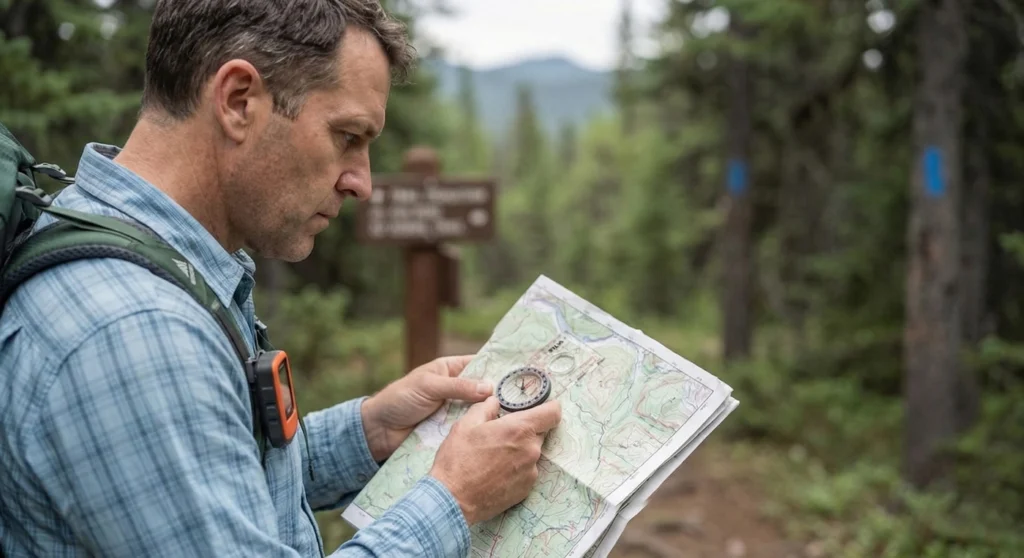
Wilderness Area Hiking for Beginners: 5 Skills to Build First
My opinion on this is direct: wilderness area hiking for beginners requires deliberate preparation that cannot be shortcut by enthusiasm. Most beginners who get into serious trouble in wilderness areas are not inexperienced trail hikers. They are experienced trail hikers who treated wilderness as a trail with fewer signs. The skills below are not a checklist to complete the morning of your trip. They are capabilities to build over months of practice before the trip.
Skill 1: Offline navigation before you need it
What offline navigation actually requires
Navigation in a wilderness area has two non-negotiable components: a GPS-enabled device with an offline topographic map downloaded before leaving cell range, and the ability to read that map well enough to verify your position against visible terrain features without relying entirely on the device.
The device requirement is specific. Do not enter a wilderness area relying on cell service for map access. Download the relevant trail section in your app (Gaia GPS is the standard for wilderness navigation) at home, not in the parking lot at the trailhead. A phone that runs out of battery, gets wet, or is dropped on rock is no longer a navigation tool. A paper topographic map is the backup, and paper maps require a separate skill to read effectively.
The map-reading skill takes time to develop. Practice it on trails you already know before testing it in unfamiliar terrain without markers. Navigate a familiar 3-mile loop using only your map and compass, no trail markers. If you cannot do this reliably, you are not ready to navigate wilderness.
Skill 2: Water sourcing and purification
Why every water source in wilderness needs treatment
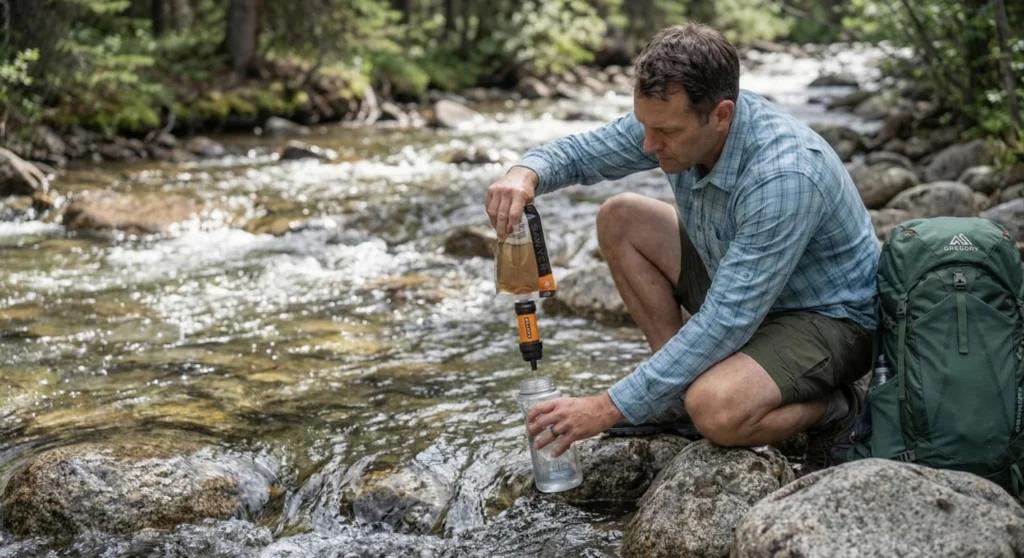
No open water source in wilderness areas is safe to drink without treatment, regardless of how clear, cold, or remote the water looks. Giardia lamblia and Cryptosporidium parvum are both present in pristine mountain streams at elevations where no human impact is visible. Both cause serious gastrointestinal illness beginning 1 to 3 weeks after exposure, and both require medical treatment.
A water filter rated for protozoa and bacteria is non-optional equipment for hiking in wilderness. A Sawyer Squeeze filter handles both for under $35 and weighs 3 ounces. Chlorine dioxide purification tablets (Aquatabs or Katadyn Micropur) are the backup for when the filter is wet or has frozen. Carry both on any overnight trip.
Water quantity: plan at minimum half a liter per hour of activity in mild conditions. In temperatures above 80 degrees or on routes with significant elevation gain, plan for one liter per hour. Know your planned water sources in advance using your topo map and confirm them with recent trip reports on AllTrails before departure.
Skill 3: Leave No Trace in designated wilderness
When LNT shifts from guidelines to federal regulations
Leave No Trace principles apply everywhere outdoors. In wilderness areas, several of them become federal regulations with specific enforcement.
Human waste: in most wilderness areas, waste must be buried in a cat hole 6 to 8 inches deep and at least 200 feet from water sources, trails, and camp. In high-use areas above treeline where soil decomposition is extremely slow, the USDA Forest Service and many land managers now require packing out all human waste using a WAG bag system. The Leave No Trace Center publishes wilderness-specific guidance at lnt.org, and their cat hole standards are the baseline that land managers reference.
Group size: most wilderness areas impose a maximum group size of 10 to 15 people. Some high-use areas limit groups to 8. Check the specific designation.
Campfires: many wilderness areas prohibit campfires above certain elevations or during fire season. Check the specific land manager’s current fire restrictions before your trip. A campfire in a prohibited zone is a federal violation, not a Leave No Trace suggestion.
Skill 4: Self-rescue basics and emergency signaling
What to do when cell service is gone and something goes wrong
In wilderness, “call for help” is an incomplete plan. Most wilderness areas have no cell service. The actual emergency plan requires specific equipment and a specific sequence.
A personal locator beacon (PLB) or satellite communicator is the only reliable way to call for help from deep wilderness. Basic PLBs that send a one-way distress signal to search and rescue start around $200. Satellite communicators with two-way messaging capability (Garmin inReach Mini, Zoleo, SPOT X) start around $350 plus a monthly subscription. For any overnight wilderness trip or any solo wilderness trip, one of these is required equipment, not optional gear.
If you do not have a satellite device: three whistle blasts is the universal distress signal. Stop moving if you are lost; moving when disoriented significantly reduces the probability of being found. Local search and rescue operations in most US jurisdictions are coordinated through the county sheriff. The National Outdoor Leadership School offers wilderness first aid training that covers emergency response protocols specifically for remote terrain.
Skill 5: Trip planning and communication protocols
The pre-trip checklist that changes outcomes
Before any wilderness area hiking trip, file a trip plan with someone who is not going.
The trip plan includes: the specific trailhead name and parking area, your planned entry point and intended route with GPS coordinates if possible, the full name and contact information of everyone in your group, your expected return date and time, and a specific instruction stating who to call and when if you are not back as planned.
“Tell someone where you’re going” is not this. The trip plan is a document someone else can hand to a search and rescue coordinator. It takes 10 minutes to write and does more to ensure you are found quickly than any single piece of gear you carry.
Check permit requirements for the specific designation through the relevant land manager at least 3 weeks before your trip. High-traffic wilderness areas including the John Muir Wilderness, Ansel Adams Wilderness, and Mount Whitney Trail require permits that fill within minutes of release dates for peak season. Check the National Weather Service mountain forecast at weather.gov the morning of your departure, not the night before. Mountain weather changes faster than lowland forecasts reflect.
Common Mistakes Beginners Make Before Their First Wilderness Trip
Treating wilderness boundary rules like trail etiquette
Wilderness boundary rules are federal regulations. Campfire restrictions, waste disposal requirements, group size limits, and permit requirements are not suggestions that experienced hikers follow and beginners can skip until they know better. Violations carry fines and, in serious cases, criminal liability.
The common version of this mistake: a beginner who knows Leave No Trace principles from managed trail hiking assumes those principles cover everything in wilderness. They do not. Wilderness adds a regulatory layer on top of LNT, and the specifics vary by designation. Read the specific regulations for your destination before you cross the boundary.
Relying on a smartphone as the only navigation system
A smartphone is an excellent navigation tool. It is also a glass rectangle that runs on a battery, gets dropped in creek crossings, and fails in cold temperatures faster than users expect. In wilderness, navigation failure does not mean inconvenience. It means being unable to find your way out.
For beginner backcountry hiking, the rule is two independent navigation resources minimum: a downloaded offline map on your phone plus a paper topographic map of the area. If one fails, you have the other. Practice using both before you need either.
Skipping the experience-building sequence
Beginner backcountry hiking skills do not transfer from enthusiasm. They come from deliberate practice in progressively challenging terrain. Beginners who go directly from managed trail hiking to overnight wilderness trips regularly discover the gaps in their skill set at exactly the wrong moment.
The practical sequence: 3 to 6 months of regular trail experience, then day trips into wilderness areas with an experienced partner, then overnight wilderness trips with an experienced group, then solo wilderness day trips after completing a wilderness first aid course. Each step adds a specific skill set. Skipping steps removes the safety margin that makes mistakes recoverable.
When to Change Your Plan
🔴 Turn Around Now
- You have been unable to confirm your GPS position against a visible terrain feature for more than 20 minutes and cannot identify your location on the map
- A member of your group cannot continue under their own power
- Weather is actively deteriorating and you are more than 45 minutes from the trailhead or known shelter
- You have used more than 60% of your water with no confirmed water source within the next hour of travel
- Less than 2 hours of daylight remain and you are not equipped for unplanned overnight camping
🟡 Slow Down and Reassess
- You have not seen a recognizable terrain feature that matches your map in the last 15 minutes
- Your GPS position shows movement but the terrain around you does not match the expected route
- One person in the group is notably slower or less energetic than at the start
- You are at the 50% point of your water supply and the next source is more than one hour away
- Weather is worsening in the direction you are traveling
✅ You’re Fine, Keep Going
- Your GPS position matches a visible terrain feature confirmed within the last 15 to 20 minutes
- All group members are moving at or close to the planned pace
- You are in the first half of your planned route with normal water and energy levels
- Weather matches the forecast you checked that morning and shows no significant change aheadOne rule: when unsure which tier applies, treat it as the higher one. Leaving a wilderness area an hour early is an inconvenience. Staying past a yellow flag that turns red is a rescue operation.
Is wilderness area hiking safe for beginners?
Wilderness area hiking for beginners is safe with specific preparation and not safe without it. The main requirements: navigation skill with offline maps, emergency communication equipment (a PLB or satellite communicator), and company from at least one experienced wilderness hiker on your first trips. Day trips in wilderness areas on short routes close to the trailhead are more accessible than overnight trips. The realistic answer: most beginners need 3 to 6 months of regular trail experience plus specific skill-building before wilderness hiking is an appropriate next step.
What is wilderness designation and why does it change things for hikers?
Wilderness designation under the 1964 Wilderness Act is a federal classification prohibiting roads, motorized equipment, and permanent structures. For hikers, what is wilderness designation means in practice: no maintained trails, no trail markers, no facilities, and typically no cell service. The protections that keep wilderness wild remove the infrastructure that makes standard trails navigable for beginners. Understanding this before you cross the boundary is the difference between prepared wilderness entry and an unplanned rescue situation.
What are the main wilderness boundary rules hikers need to follow?
Core wilderness boundary rules applying to most wilderness areas: no motorized equipment including mountain bikes, group size limits typically between 8 and 15 people, campfire restrictions that vary by elevation and season, 200-foot setbacks from water sources for camping and waste disposal, pack-out requirements for human waste in high-use or above-treeline areas, and permit requirements in many popular areas. These are federal regulations. Check the specific land manager’s site for the exact designation you plan to visit.
What is the difference between hiking in wilderness and regular trail hiking?
Hiking in wilderness on designated wilderness land means navigating without maintained trails, trail markers, or regular ranger presence. Regular trail hiking on managed routes provides maintained tread, periodic markers, and infrastructure you can rely on when something goes wrong. Beginner backcountry hiking more broadly covers non-developed terrain outside formal wilderness designation, such as dispersed camping areas and roadless backcountry. Both require similar skills, but designated wilderness adds the regulatory layer and typically more demanding terrain. Regular trail experience is the foundation; wilderness-specific skills are the next layer.
Do I need a permit to enter a designated wilderness area?
Some designated wilderness areas require permits and many do not. Areas requiring permits due to high use consistently include: John Muir Wilderness, Ansel Adams Wilderness, Grand Canyon wilderness, Olympic Wilderness in Washington State, and the Mount Whitney Trail in California. Permits for peak season in these areas fill within minutes of release dates, often months in advance. Less-trafficked wilderness areas generally have no permit requirement. Check the specific managing agency’s website (fs.usda.gov for Forest Service, nps.gov for national parks, blm.gov for BLM land) before making plans.
What equipment is non-negotiable for wilderness area hiking?
Beyond standard day hiking gear, the non-negotiable additions for wilderness area hiking: a satellite communicator or PLB for emergency communication where there is no cell service, offline topographic maps on your device plus a paper map backup, a water filter rated for protozoa and bacteria plus purification tablet backup, a fire starter for emergency warmth (subject to fire restrictions), and a first aid kit appropriate for remote response. For overnight trips, add a bear canister or approved food hang system, which is required in some wilderness areas.
The Real Answer on Wilderness Area Hiking for Beginners
Wilderness area hiking for beginners is worth building toward. The experience of remote terrain with no infrastructure between you and the landscape is genuinely different from anything managed trails provide, and it becomes accessible once you have built the specific skills that make it safe.
Honestly, I cannot tell you that a specific number of trail hikes makes you ready. I know what made me ready: a navigation course, five wilderness day trips with an experienced partner, and finally completing a wilderness first aid certification before going alone. That sequence took about nine months of intentional practice. The beginner backcountry hiking skills it produced turned what had been a disorienting near-miss into an activity I now plan my year around.
The single next step: check the wilderness areas nearest to you using the USDA Forest Service wilderness finder at fs.usda.gov. Find one with a short, established entry route. Go on a day trip with someone who has been there. That first experience, done right, teaches more than any article can.
Next Steps
- Right now: Look up wilderness areas within a 2-hour drive of your location at fs.usda.gov. Check permit requirements and any current fire or access restrictions for the one that interests you most.
- Before your first wilderness trip: Practice offline navigation on a trail you already know. Download your trail app map offline, turn off cell data, and navigate the route using only the downloaded map. Do this at least twice before attempting unfamiliar terrain.
- Before going overnight or solo: Complete a wilderness first aid course (NOLS WFA is the standard) and complete at least 5 wilderness day trips with an experienced partner before attempting either.
Frequently Asked Questions
Is wilderness area hiking safe for beginners?
Wilderness area hiking for beginners is safe with specific preparation and not safe without it. The main requirements: navigation skill with offline maps, emergency communication equipment (a PLB or satellite communicator), and company from at least one experienced wilderness hiker on your first trips. Day trips in wilderness areas on short routes close to the trailhead are more accessible than overnight trips. The realistic answer: most beginners need 3 to 6 months of regular trail experience plus specific skill-building before wilderness hiking is an appropriate next step.
What is wilderness designation and why does it change things for hikers?
Wilderness designation under the 1964 Wilderness Act is a federal classification prohibiting roads, motorized equipment, and permanent structures. For hikers, what is wilderness designation means in practice: no maintained trails, no trail markers, no facilities, and typically no cell service. The protections that keep wilderness wild remove the infrastructure that makes standard trails navigable for beginners. Understanding this before you cross the boundary is the difference between prepared wilderness entry and an unplanned rescue situation.
What are the main wilderness boundary rules hikers need to follow?
Core wilderness boundary rules applying to most wilderness areas: no motorized equipment including mountain bikes, group size limits typically between 8 and 15 people, campfire restrictions that vary by elevation and season, 200-foot setbacks from water sources for camping and waste disposal, pack-out requirements for human waste in high-use or above-treeline areas, and permit requirements in many popular areas. These are federal regulations. Check the specific land manager's site for the exact designation you plan to visit.
What is the difference between hiking in wilderness and regular trail hiking?
Hiking in wilderness on designated wilderness land means navigating without maintained trails, trail markers, or regular ranger presence. Regular trail hiking on managed routes provides maintained tread, periodic markers, and infrastructure you can rely on when something goes wrong. Beginner backcountry hiking more broadly covers non-developed terrain outside formal wilderness designation, such as dispersed camping areas and roadless backcountry. Both require similar skills, but designated wilderness adds the regulatory layer and typically more demanding terrain. Regular trail experience is the foundation; wilderness-specific skills are the next layer.
Do I need a permit to enter a designated wilderness area?
Some designated wilderness areas require permits and many do not. Areas requiring permits due to high use consistently include: John Muir Wilderness, Ansel Adams Wilderness, Grand Canyon wilderness, Olympic Wilderness in Washington State, and the Mount Whitney Trail in California. Permits for peak season in these areas fill within minutes of release dates, often months in advance. Less-trafficked wilderness areas generally have no permit requirement. Check the specific managing agency's website (fs.usda.gov for Forest Service, nps.gov for national parks, blm.gov for BLM land) before making plans.
What equipment is non-negotiable for wilderness area hiking?
Beyond standard day hiking gear, the non-negotiable additions for wilderness area hiking: a satellite communicator or PLB for emergency communication where there is no cell service, offline topographic maps on your device plus a paper map backup, a water filter rated for protozoa and bacteria plus purification tablet backup, a fire starter for emergency warmth (subject to fire restrictions), and a first aid kit appropriate for remote response. For overnight trips, add a bear canister or approved food hang system, which is required in some wilderness areas.
Related Reads
Opened a dozen browser tabs trying to plan your first hiking trip and somehow still ended up with zero actual plan? Here are 9 steps that actually work for planning a beginner hiking trip, cutting straight through the tab chaos.
Watched your phone signal vanish at the exact moment you actually needed your map most? Here’s why downloading offline trail maps before you go matters so much, so a dead signal never leaves you guessing.
Finished your first few hikes and started wishing someone had just told you the obvious stuff beforehand? Here are 10 things beginners wish they’d known before their first hike, the kind of advice that usually only comes after you’ve already learned it the hard way.
Heard someone use “trekking” and “hiking” interchangeably and wondered if you were missing some distinction everyone else already knew? Here’s the actual difference between hiking and trekking, and it’s not just a fancier word for the same thing.
Felt that gut-drop moment when the trail in front of you stopped matching anything on your map? Here are 5 steps to actually follow if you get lost hiking, the kind that keep a stressful moment from spiraling into a worse one.