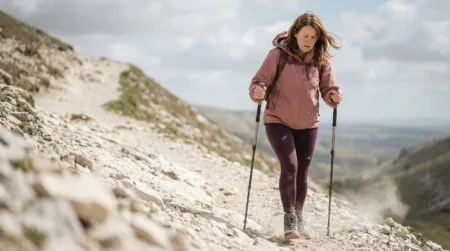



Hiking with fear of heights is more common on trail than most hiking content acknowledges. Studies in anxiety research consistently place clinical acrophobia among the more prevalent specific phobias in the general population, and a far larger group experiences significant height-related caution that stops short of clinical diagnosis. On exposed trails, the numbers feel even higher than that.
⚡ Quick Trail Takeaways
- Visual Grounding: Keep eyes focused 3-5 feet in front of your boots on the trail surface; avoid scanning wide cliff drop-offs.
- Trekking Pole Stability: Plant two trekking poles slightly wider than shoulder-width to create 4 points of physical contact.
- Box Breathing Technique: Inhale for 4 seconds, hold 4 seconds, exhale 4 seconds, hold 4 seconds to lower panic heart rates instantly.
The first time I understood what that actually felt like mid-trail, I was standing at the start of a ridge traverse in the San Gabriel Mountains. The drop on the right side was maybe 150 feet. The path was solid granite, two feet wide, heavily worn. I knew the risk was low. My legs went to something close to concrete anyway. I stood there for about 30 seconds before deciding to move forward, and when I did, I fixed my eyes on a flat rock 12 feet ahead and walked to it. Then I picked the next point.
Hiking with fear of heights doesn’t require eliminating the fear before you reach the section that triggers it. It requires having a specific protocol for what you do when it shows up.
This guide covers what physiologically happens during an acrophobia hiking response, seven techniques that change how you navigate exposed terrain, common mistakes that make the experience worse, and the specific conditions that mean it’s time to turn back.
🟠 A Note Before You Head Out:
This guide covers preparation and management strategies, not emergency rescue. If someone freezes completely on an exposed section and cannot move safely: call 911. In areas without cell service, activate your PLB or satellite communicator and stay put unless in immediate danger. Read this before your hike, not while standing at the section.
🥾 Oliver’s Trail Notes & Field Observations
The first time I crossed the Devil’s Backbone ridge on Mt. Baldy—with steep 1,000-foot drops falling away on both sides—my chest tightened, my vision tunneled, and my feet felt glued to the rock. Trail vertigo is a natural physiological reaction to sudden exposure. I learned to stop, widen my stance, drop my center of gravity slightly, and plant both trekking poles firmly into the gravel to provide solid tactile reference points for my brain.
What Happens During Hiking with Fear of Heights
The physiological response behind hiking with fear of heights
Hiking with fear of heights, at the physiological level, is your threat-detection system activating at intensity levels that exceed the actual risk of the terrain. The visual and spatial cues of a significant drop trigger the same autonomic nervous system response as any genuine threat: cortisol and adrenaline release, elevated heart rate, muscle tension, and attentional narrowing toward the hazard. This is the response that exists to keep you alive. The problem is that on a well-maintained trail with solid footing and a clear path, it activates at a level that makes movement harder than the terrain requires.
The practical consequences: legs feel heavier than usual, hands look for something to grip even on solid rock, visual focus narrows, pace drops. None of those are signs that something is wrong. They’re signs that your nervous system is doing its job. The goal of every technique in this guide is not to override the response. It’s to work within it.
How acrophobia hiking differs from normal caution
Acrophobia hiking, in the clinical sense, describes a phobia: a fear response disproportionate to actual risk that significantly impairs daily functioning. Most hikers who experience fear on exposed sections are not dealing with clinical acrophobia. They’re dealing with a heightened caution response that is appropriate for terrain with real consequences.
The practical line: if you can move through exposed sections slowly and deliberately, even if you’re uncomfortable, your response is manageable on trail with preparation and technique. If you physically cannot move in either direction, if panic symptoms overwhelm your ability to function, or if the response affects your daily life in non-hiking contexts, a therapist specializing in anxiety disorders is the right resource. That’s the honest answer, and this guide doesn’t work around it.
I don’t know whether hikers who walk onto exposed ridges without slowing down have simply done it enough times that their physiological response quieted, or whether their nervous systems are calibrated differently. The techniques below changed the experience for me on that San Gabriel traverse, and on exposed sections since.
Seven Techniques for Hiking with Fear of Heights
Technique 1: Scout before committing
Before stepping onto any exposed section, stop at a point where you can see the full section ahead. Look at the path width, the footing quality, the length of the traverse, and whether you can see the far end from where you’re standing.
This does two specific things that matter for hiking with fear of heights. First, it gives your nervous system accurate information instead of letting it fill the unknown with worst-case projections. A section you can see in full is almost always less demanding than the imagined version. Second, it creates a genuine go/no-go decision point before you’re halfway across and making decisions from a worse position.
A section worth committing to: you can see the full length, path width is at least 18 inches, footing is solid, and the far end is visible. A section worth reconsidering: it curves out of sight and you cannot assess the full length before you’re on it.
Before stepping on, ask yourself whether you could safely reverse if you stop mid-traverse and want to turn back. On narrow ridge traverses with a drop on both sides, reversing requires more spatial confidence than continuing forward. Knowing the answer before you commit changes the decision.
Technique 2: Use focal point navigation
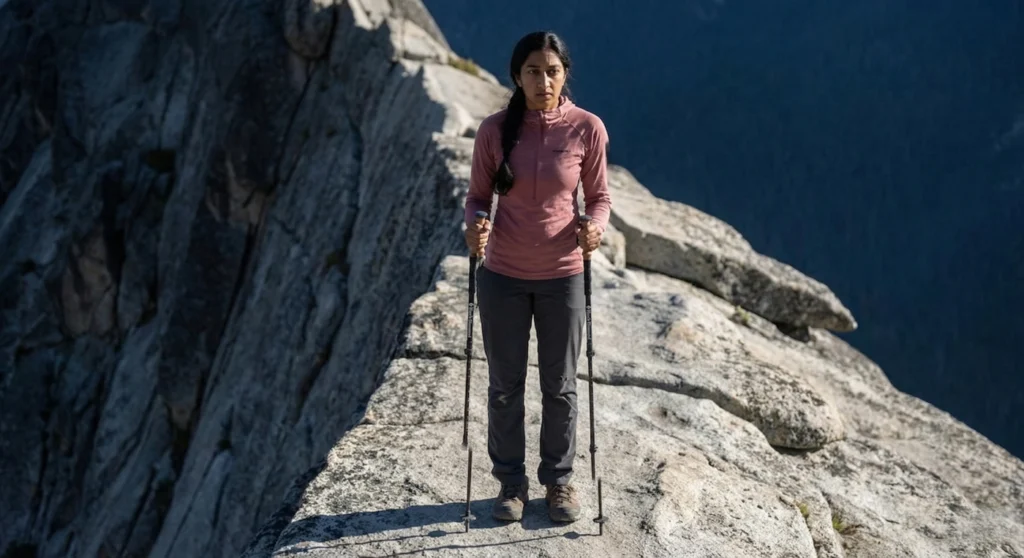
On any exposed section, pick a fixed point on the trail 10 to 15 feet ahead and walk toward it. When you reach it, pick the next one. Move section by section rather than thinking about the full traverse.
This works because it keeps your visual attention on the trail surface rather than the drop, which is where exposed trails anxiety directs it. It also breaks a long traverse into a series of short, achievable segments. You are not hiking a 200-foot ridge. You are walking 12 feet to the flat rock, then 10 feet to the trail marker, then 15 feet to where the path bends.
The most common mistake with focal point navigation: picking a point on the skyline or the far ridge rather than a specific point on your actual walking surface. The focal point has to be on the trail itself, a specific rock, a painted blaze, or a visible feature at ground level.
Technique 3: Control your breathing before you move
Controlled breathing is the most underused technique for managing exposed trails anxiety on trail. Before stepping onto an exposed section, take three complete breath cycles: inhale for four counts, exhale for six counts. The extended exhale activates the parasympathetic nervous system, which partially counteracts the fight-or-flight activation behind the height response.
This is not about relaxing on a ridge traverse. You will not be relaxed. It’s about reducing physiological intensity enough to shift from frozen to moving. Dropping the response from intensity level 9 to level 7 is often sufficient.
Maintain slow, deliberate breathing through the section. If you notice you’re holding your breath, exhale deliberately before your next step.
Technique 4: Set your own pace before the group sets it for you
A reliable way to make hiking with fear of heights harder than it needs to be: trying to match the pace of hikers who don’t experience your caution response. Tell your hiking partner before the section starts: “I’m going to take this slowly, go ahead and meet me at the far end.” A partner who understands the plan before you reach the section is more useful than one waiting mid-traverse making you feel like you should be faster.
Technique 5: Position on the uphill side when possible
On a trail with a significant drop on one side, move to the uphill side of the path when width allows. The visual cue of having solid terrain on one side significantly reduces the height anxiety response compared to open space on both sides.
This isn’t always an option. On narrow ridge traverses, both sides drop. But on a trail cutting across a hillside with a slope above and a drop below, the uphill position is consistently more comfortable. On switchbacks, you’ll naturally alternate sides with each leg, which breaks the sustained exposure response rather than holding it at a constant level.
Technique 6: Count steps through the hardest section
If a section feels too long to navigate with focal points alone, count each step aloud or internally through the hardest stretch. You are not thinking about the drop. You are counting to 40.
This works because your fear response competes for attentional resources. Give your conscious attention a demanding task and you reduce the mental space available for worst-case projection. The counting has to require enough concentration to be occupying. Counting backward from 50, or counting in a language you’re less fluent in, forces more cognitive engagement than simple automatic counting.
💡 Trail Tip: Before stepping onto any exposed section, say your plan aloud to your hiking partner or to yourself: “Walk to the boulder, pick the next focal point, count my steps, keep breathing.” Saying the protocol out loud makes it concrete. It also gives you something specific to return to if the fear intensifies mid-section.
Technique 7: Build with safe hikes for fear of heights intentionally
Overcoming fear of heights outdoors through hiking happens through intentional, gradual exposure. Avoiding exposed terrain entirely maintains the fear at its current level. Going directly to highly exposed routes risks a bad experience that can set the threshold back significantly.
The approach that builds genuine comfort: use safe hikes for fear of heights as a deliberate progression. Start with trails that have optional viewpoints where you choose how close to the edge you go, not mandatory traverses. Once you’re comfortable at that level, move to a trail with one short exposed section and a clearly visible endpoint. Then a longer traverse. Then routes with sustained exposure.
AllTrails user reviews often note specific exposed sections by name, length, and path width. That detail is more useful for progression planning than the overall trail rating.
💡 Trail Tip: Keep a brief log after each hike with exposed sections. Three lines: what section created the most anxiety, what technique you used, and what helped or didn’t. After 8 to 10 hikes, the patterns in that log are worth more than any general guidance about overcoming fear of heights outdoors.
🥾 The Ten-Foot Focus Box Technique
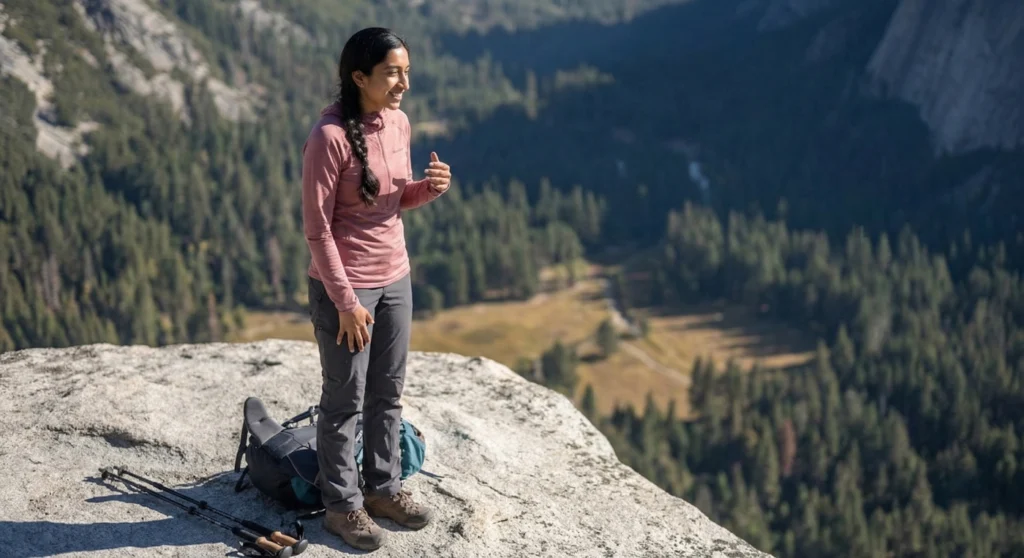
When navigating exposed narrow shelves like the high cliffside sections of the Strawberry Peak trail, looking out over the distant valley triggers acute dizziness. I instruct anxious hikers to shrink their visual field to a ‘ten-foot box’: look only at the dirt path three to five steps directly ahead. Focusing strictly on immediate footing prevents your visual vestibular system from getting overwhelmed by sheer drop-offs.
Common Mistakes That Make Managing Trail Vertigo Harder
Looking at the drop while moving
The strongest trigger for managing trail vertigo badly is looking directly down the drop at the moment your weight is most committed to the exposed section. That’s when your nervous system is already activated and visual confirmation of the height adds maximum intensity.
The fix is not to never look down. Looking down is appropriate from a stable position before you start or after you’ve crossed. The fix is to look ahead while actively moving. Focal point navigation handles this automatically, which is part of why it works beyond just focusing attention: it points your gaze in the direction that least reinforces the fear response.
Stopping without a plan for what comes next
Stopping mid-section is sometimes right: trail traffic ahead, a footing question, a moment to reassess. Stopping without a specific plan for what you do next is where height anxiety on trail escalates into real difficulty. When you stop, the fear response has space to intensify. If you stop, give yourself an immediate task: three deliberate breaths, identify your next focal point, check your footing, then move. Three specific actions, then forward.
An unplanned stop in the middle of a traverse is where most hikers have their worst experiences with managing trail vertigo, not because stopping is dangerous but because the fear escalates faster than they can manage it without a structure.
Choosing routes by difficulty rating instead of exposure profile
For hiking with fear of heights, route selection is more important than any technique. A “moderate” trail can include a 50-foot traverse on a 12-inch path with a 300-foot drop. A “difficult” trail can have sustained rocky terrain with minimal actual drop. The overall difficulty rating measures effort and technical demand. It does not measure exposure specifically.
For acrophobia hiking, read AllTrails reviews and search the comments for “exposed” or “drop” before choosing a route. You want to know what the trail actually feels like, not what its overall rating suggests. The American Hiking Society also maintains resources on trail planning that can help identify the right starting point in your exposure progression.
When to Change Your Plan
🔴 Turn Around Now
- You’ve frozen on the section and cannot move safely in either direction
- A member of your group is in full panic: hyperventilation, loss of coordination, or inability to respond to instructions
- The section extends beyond what you can see and you cannot assess the full length before you’re on it
- Weather has reduced visibility or made footing wet on an exposed section you haven’t crossed before
- Daylight is dropping and you have not yet completed the exposed section
🟡 Slow Down and Reassess
- Your response is significantly stronger than expected but you can still move deliberately
- You’ve stopped mid-section: move to the most stable position available, take three to five full breaths, identify your next focal point before moving
- You’re past the halfway point and turning back feels harder than continuing: move forward at a deliberate pace rather than reversing on the most exposed part of the section
- A hiking partner is visibly struggling and needs you to slow to their pace
✅ You’re Fine, Keep Going
- You’re moving slowly and deliberately, watching your feet, using focal points one at a time
- Your heart rate is elevated but your legs are responding to your instructions
- You’re uncomfortable but not frozen, and the far end of the section is visible
- You’ve crossed sections with comparable exposure before and managed them
One rule: When unsure which tier applies, treat it as the higher one. Getting off trail 30 minutes early is an inconvenience. Getting stuck mid-traverse is a situation that requires rescue.
Frequently Asked Questions: Hiking with Fear of Heights
What does hiking with fear of heights feel like physiologically?
Hiking with fear of heights triggers an autonomic nervous system response: elevated heart rate, muscle tension, visual narrowing, and slowed pace. Your legs may feel heavier than usual, your hands may look for something to grip, and your breath may quicken or stop. This is your threat-detection system activating at intensity levels that exceed the actual risk of maintained trail terrain. The techniques in this guide work with this response running, not after it stops. The goal is not to feel calm. The goal is to move deliberately while the response runs its course.
Is acrophobia hiking a clinical condition or just normal caution on exposed terrain?
Clinical acrophobia is a diagnosed phobia: a fear response disproportionate to actual risk that impairs daily functioning. Most hikers who experience fear on exposed sections are dealing with a heightened caution response that’s appropriate for terrain with real drop-offs. The practical line: if you can move slowly and deliberately through exposed sections, your response is manageable on trail. If you physically cannot move in either direction or panic symptoms overwhelm your ability to function, a therapist specializing in anxiety disorders is the right resource.
What are the best safe hikes for fear of heights to start building confidence?
The best safe hikes for fear of heights share one specific characteristic: optional viewpoints where you choose how close to the edge you go rather than mandatory traverses. State park trails near ridge viewpoints often fit this structure. The National Park Service trail descriptions specify exposure level for most trails in parks with alpine terrain, which is more useful for hiking with fear of heights progression planning than an overall difficulty rating alone.
How does managing trail vertigo differ from general pre-hike anxiety?
Managing trail vertigo is a specific challenge within trail anxiety broadly. It refers to the spatial disorientation response triggered by a height cue or drop, with a specific visual trigger and physiological cascade. The techniques that address it, focal point navigation, breathing protocols, pace control, target that specific trigger. General pre-hike anxiety responds better to preparation and progressive familiarity. The two can co-exist, and the techniques in this guide address the exposure-specific piece.
Can overcoming fear of heights outdoors happen through hiking alone?
Overcoming fear of heights outdoors through hiking works for most people dealing with manageable caution, if the progression is genuinely gradual and you’re building specific techniques alongside the exposure rather than just white-knuckling through the same intensity repeatedly. Track what’s helping after each hike. For clinical acrophobia, exposure therapy with a trained professional is the evidence-based treatment. Hiking-based exposure can support that treatment but is not a substitute.
When should I turn back on an exposed trail because of fear?
Turn back immediately if you freeze and cannot move safely in either direction, if a group member enters full panic with loss of coordination or inability to respond, if the section extends beyond what you can see before committing, or if conditions have changed since you started the approach. Slow down and reassess if your response is stronger than expected but you can still move deliberately. The rule: when uncertain which tier applies, treat it as the higher one. Most trail content will tell you to push through. This article won’t. Turning back is the right call more often than the trail culture around you will suggest.
Hiking with Fear of Heights Belongs on the Trail
Hiking with fear of heights means you need a specific protocol. It doesn’t mean the routes that trigger that fear are permanently out of reach.
The seven techniques work because none of them require the fear to be gone before they do. Scout the section before committing. Use focal points. Control your breathing before you step on the section. Set your own pace. Position on the uphill side when possible. Count steps through the hardest part. Build up gradually with safe hikes for fear of heights that match where your threshold actually is right now.
Some trails will remain genuinely outside your comfortable range for a long time. That’s accurate information about the route relative to your current threshold, not a personal failure. The threshold moves through repetition, and it moves slowly. Choose routes that give you something to practice with.
Next Steps
- Right now: Look up your next planned trail on AllTrails and search the user reviews for “exposed” or “drop.” Identify where specific sections are and how long they last before you go.
- Before your hike: Practice the breathing protocol at home. Four-count inhale, six-count exhale, three cycles. It needs to be a reflex before you’re at the section, not something you’re figuring out while standing at it.
- On the trail: Start focal point navigation on any section with more than 100 feet of drop. Pick a point 10 to 15 feet ahead on the trail surface, walk to it, pick the next one.
Related Reads
Read “exposed trail” in a description and pictured open views, not realizing it meant something a lot more serious? Here’s what exposed trail actually means and why it changes how carefully you should plan around it.
Burned through all your energy in the first mile and limped through the rest just trying to finish? These 7 pacing techniques fix that imbalance so you’ve got something left for the back half.
Stood at a crowded trailhead surrounded by people who all looked like they belonged there way more than you did? Here’s how to build hiking confidence when you feel completely out of place, because almost everyone there once felt the exact same way.
Looked at photos of a ridgeline trail and pictured an easy, scenic stroll along the top? Here are 4 harsh realities about ridgeline trails beginners always miss until they’re actually up there facing them.
Spent the night before your first hike running through every worst-case scenario instead of getting any real sleep? Here’s exactly what to expect so you walk in feeling ready, not anxious.