



How to make a hiking habit is not a motivation problem. It feels like one. The first few hikes go well, the next few weekends go well, and then a work deadline eats one Saturday, a minor cold eats the next, and by the time the gap shows up clearly it has been six weeks since you were last on a trail.
⚡ Quick Trail Takeaways
- Habit Stacking: Anchor hikes to recurring calendar blocks (e.g. Saturday 8:00 AM) to remove decision fatigue.
- Micro-Milestones: Log each hike in an app or notebook; track cumulative elevation gain rather than just flat mileage.
- Low Friction Setup: Keep your daypack pre-packed by the front door with essentials so departure takes under 5 minutes.
I did exactly this. I hiked every weekend for ten weeks when I first started, including one rainy November Saturday on a trail I had done twice already, just because it was close and I had committed to not skipping. Then a work trip took me out of town for two weeks. After that, December felt like the wrong time to restart. I did not hike again until late February. Four months gone without a single dramatic decision to stop. Just a series of reasonable-seeming skips that accumulated into quitting.
The rebuild took three weeks. But I had to learn the difference between liking hiking and having a hiking practice. This guide covers the 5 steps that build how to make a hiking habit that runs past month one, what kills new hiking routines before 90 days, and the one behavioral rule that determines whether a missed week becomes a missed month.
🥾 Oliver’s Trail Notes & Field Observations
In my experience coaching beginners, the number one reason people quit hiking by week six is lack of routine scheduling. If you wait until Saturday morning to decide if and where you want to hike, chores and fatigue will win every time. I built my 8-year backcountry habit by anchoring a non-negotiable Sunday 7:00 AM calendar block, laying out my wool socks, pack, and water bottles the night before.
How to Make a Hiking Habit When Motivation Runs Out
Why the first month feels easy and the second doesn’t
The first month of any new physical activity runs on novelty. Every trail is unfamiliar. Every mile feels like measurable progress. The newness itself generates motivation without effort.
Month two is different. The trail you liked is now familiar. The muscle soreness that marked early improvement has mostly disappeared. Nothing feels dramatically different from the week before. And the worst part: you now have a reference point for how it feels to skip a hike, which is fine, comfortable, and not immediately consequential.
This is where most new hiking habits end. Not in injury or dramatic failure. In a quiet accumulation of reasonable skips that eventually becomes a stopped practice. The person who quits hiking after two months usually enjoyed every hike they went on. They stopped because they never converted the enjoyment into architecture.
What separates starting hiking consistently from just going a few times
The difference between hiking and having a hiking habit is decision structure. A habit does not ask you whether you feel like doing it. It runs on when, not if.
If every Saturday morning hike depends on you feeling motivated enough to commit, then every Saturday morning is a negotiation you can lose. If the hike is already on your calendar at 8am, the trail is downloaded, and your pack is by the door, the negotiation is over before it starts.
Starting hiking consistently requires removing the decision from the morning of. That is the core mechanism. You are not trying to feel motivated to hike. You are trying to make hiking require less mental effort than not hiking.
5 Steps to Build a Hiking Habit That Holds
Step 1: Schedule the hike before you feel like it
How to block hiking time that actually holds through the week
Schedule next week’s hike on Sunday, not on the morning of. Specific time. Specific trail. Specific parking location. Put it in your calendar with a reminder the night before.
This sounds simple. It is also the step most people skip, which is why they end up renegotiating the hike every week. When hiking is a confirmed appointment rather than a standing intention, the decision is made in advance. The Saturday morning version of you only has to wake up and go, not decide whether to go.
For the first 8 weeks: hike at least once every 7 days without exception. Not “most weeks.” Every 7 days. This is the non-negotiable frequency for building a hiking routine that does not require re-motivation every week. Miss one week and the gap resets the habit trigger faster than most people expect.
One practical tool: block 90-minute windows for the next 8 Saturdays or Sundays. Treat them the same way you treat a dentist appointment. They move only for genuine conflicts, not for competing preferences.
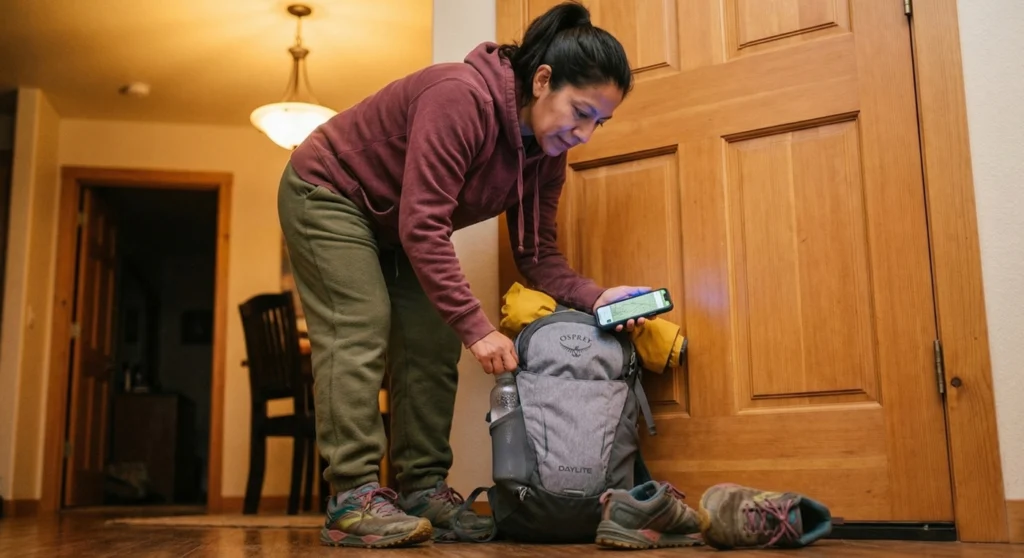
Trail Tip: Set a “hike prep” reminder for Friday evening. That is when you download the offline trail map, confirm the weather forecast for Saturday morning, and make sure your pack already has water and a spare layer.
Five minutes of Friday prep removes every logistical barrier on Saturday morning. No searching for your headlamp at 7am. No realizing your AllTrails map will not download at the trailhead with one bar of signal.
Step 2: Start shorter than feels right
The distance rule for building a hiking routine in the first 6 weeks
The instinct in month one is to hike as far as you can while enthusiasm is high. This instinct works against habit formation.
The hike that builds how to make a hiking habit is not the longest or most impressive one you have done. It is the one you do consistently enough that the decision stops feeling effortful. For the first 6 weeks of building a hiking routine, stay under 4 miles per outing. Not because you cannot handle more, but because a hike under 4 miles is short enough to complete even on a tired day, a gray day, or a day with only a morning window.
A hike that takes 90 minutes fits inside any morning. A hike that takes 4 hours requires the whole day to cooperate. The habit you build on consistent 3-mile Saturdays is more durable than the one you attempt on 7-mile epics that require perfect conditions to happen.
After 8 consecutive weeks of weekly hiking, extend distance whenever the trail or day calls for it. The first 8 weeks are not for testing limits. They are for anchoring the behavior.
One recovery note: keep at least 2 days between hikes in the first 6 weeks. Trail terrain loads muscles differently than pavement. Your knees and ankles need that gap, particularly on elevation gain. Two days of rest between hikes is not a limitation. It is what makes the next hike feel worthwhile rather than obligatory.
Step 3: Repeat one trail for the first 6 outings
Why trail repetition beats variety for starting hiking consistently
New hikers feel constant pressure to find new trails. More variety, more interesting, more worthy of the effort. This pressure works directly against habit formation.
Repeating the same trail for 6 consecutive hikes does something variety cannot: it builds calibration. You learn what pace gets you to the high point before the heat builds. You know where the rocky section is that slows your stride. You know how your legs feel at mile two, and what that predicts about mile three. That calibration converts every future hike on that trail from a fresh challenge into a known quantity, and known quantities are easier to show up for than unknown ones.
I ran the same 3.2-mile loop near a local reservoir every Saturday for 7 weeks when I was rebuilding my hiking practice. By week five, I had stopped checking the AllTrails map at junctions. The trail became the default, and defaults are how habits operate.
Starting hiking consistently is harder when every weekend requires picking a new trail, navigating unfamiliar terrain, and managing fresh uncertainty. Same trail, reduced friction. Reduced friction, more consistent attendance.
After 6 outings on the same trail, you have earned the variety. Add new trails gradually, and keep the familiar one as the fallback for low-motivation weeks.
Step 4: Track consecutive weeks, not miles
What to count when you are working toward a daily hiking habit
Miles and elevation gain are the metrics experienced hikers track. Neither is the right metric for how to make a hiking habit. The metric that builds the habit is consecutive weeks without a gap.
A simple system: a column in your notes app, a line on a paper calendar, a mark in a journal. Every week you hike: one check. Every week you skip: a visible gap. The goal is not to hit a mileage target. It is to not create gaps.
This works because streaks introduce loss aversion into the habit. Once you have gone 5 or 6 consecutive weeks, breaking the streak requires an active decision to stop rather than a passive drift into not going. The gap becomes the thing that requires justification, not the hike.
A daily hiking habit is a different commitment from a weekly hiking practice, and most beginners do not need the former to build a real outdoor routine. A full trail hike with pack and gear every day burns out faster than a well-maintained weekly practice for most people. If a daily hiking habit is the goal, build the weekly practice first. Eight consecutive weeks of weekly hiking, then add a second day. Never jump from zero to daily in month one.
Step 5: Make one concrete decision every Sunday
The Sunday rule for weekend warrior hiking
Most weekend warrior hiking fails not because people lose interest, but because they fail to make the logistics decision before the week starts. Sunday becomes a passive intention. Monday through Friday erode it. Saturday arrives and the decision has not been made.
The Sunday rule: every Sunday, make one specific hiking decision for the coming week. Which trail. Which day. What time. Write it on the calendar. If you hike on weekends, Sunday is the decision day for the upcoming Saturday. If you hike midweek, Sunday is still the decision day for whichever morning is clearest.
The decision needs to be specific enough that Thursday, after a hard week, cannot undo it. “I’m hiking Saturday” is not a decision. “I’m hiking the Quarry Trail on Saturday at 8am, trail downloaded, parking at the main lot” is a decision. The specificity removes the renegotiation window.
For weekend warrior hiking: two structured hikes per month is a solid target for the first 3 months. Not every weekend unless that genuinely fits your schedule without friction. Two specific, calendared hikes per month builds more habit durability than four optimistic intentions that produce two actual hikes. Once two-per-month is automatic for 6 weeks, add a third.

🥾 The Benchmark Trail Progress Tracker
To stay motivated when progress feels invisible, I chose one specific local trail—the 3.5-mile loop up to Echo Mountain—as my monthly benchmark. Tracking my elapsed time, average heart rate, and perceived exertion on that exact route month after month provided concrete, undeniable proof that my aerobic engine and leg strength were leveling up, keeping me hooked for the long haul.
What Kills a Hiking Habit in the First 90 Days
Three patterns that end new hiking routines before they hold
The perfectionism trap. People stop building a hiking routine because conditions are never quite right. Too cold. Too warm. A minor muscle twinge. The trail they wanted has a full parking lot. Every condition-based objection is technically defensible. Accumulated over weeks, they add up to not hiking. The fix is a specific rule: define one condition that genuinely cancels a hike (active lightning, real injury, genuine illness) and treat everything else as a “go anyway” situation. Discomfort is different from danger. Gray skies and tired legs are discomfort.
The recovery gap becoming a restart gap. One missed week turns into two because “I already broke the streak, so I might as well wait until next month and start clean.” This reasoning is the most reliable way to turn a temporary pause into a stopped practice. The rule: if you miss a scheduled hike, hike within 48 hours of your original planned time. Not next weekend. Within 48 hours. A Tuesday evening hike that substitutes for a missed Saturday keeps the habit momentum running. A missed Saturday followed by “I’ll restart in January” usually means April.
Intensity escalation followed by forced rest. Some beginners skip quitting entirely and do the opposite: longer trails, higher elevation, back-to-back weekends. They push through early warning signs of overuse. Then their knees push back, or their IT band does, and they stop completely for four to six weeks. Integrating hiking into lifestyle requires the same principle as any other physical practice: progressive load. One additional mile per week maximum. Elevation gain added only after 4 flat hikes at the new distance. Distance and elevation never added in the same week.
Frequently Asked Questions: Make a Hiking Habit
How long does it actually take for how to make a hiking habit to work?
Research from University College London puts the average habit formation window at 66 days, with a range of 18 to 254 days depending on behavior complexity and the individual. For how to make a hiking habit, 8 consecutive weeks of weekly hiking is a practical working target. At that point, the logistical decisions (what to pack, which trail, when to leave) become automatic rather than effortful. The hiking itself never becomes fully automatic because conditions always vary, but the decision to go stops requiring motivation most of the time.
What is the minimum I need to do each week for building a hiking routine that actually holds?
One hike per week is the minimum for building a hiking routine that holds. It does not need to be long. A 2-mile flat trail on a Wednesday evening counts the same as a 6-mile ridge hike on Saturday for habit formation purposes. The variable being tracked in the first 8 weeks is frequency, not volume. One hike per week, no gaps, is the baseline. Distance and elevation are personal preference layered on top of a functioning habit.
Can I work toward a daily hiking habit if I am starting from zero?
Building toward a daily hiking habit works better in two phases. Phase one: one hike per week for 8 weeks, building logistical and physical baseline. Phase two: add a second day per week for 4 weeks, then a third if the schedule supports it. Jumping directly to daily hiking from zero strains the musculoskeletal system faster than most beginners expect, because trail terrain loads tendons and joints differently than pavement. Build the weekly practice first. Add frequency after the body has adapted and the logistics have become automatic.
How do I keep a hiking routine going through winter?
Keeping a hiking routine through winter requires specific adjustments: shorter hikes, lower elevation gain, earlier start windows to use available daylight, and a defined threshold for what actually cancels a hike. The hikers who maintain a winter practice generally do it by choosing familiar trails, scaling distance down by 30 percent (cold-weather hiking burns more energy), and making the cancellation decision on Sunday rather than Saturday morning. The day-of decision in January almost always loses to staying inside. The advance Sunday decision holds more often.
What does integrating hiking into lifestyle look like for someone with a full work schedule?
Integrating hiking into lifestyle for a full work week takes one of two forms. The weekend-only model: one structured hike on Saturday or Sunday, scheduled by Sunday the prior week. This requires a 3 to 4-hour block, which most schedules can accommodate once per week. The hybrid model: one longer weekend hike plus one shorter weekday trail walk near work or home. The model that fits your actual schedule, not the idealized version, is the one that sticks.
Is weekend warrior hiking enough to build real trail fitness over time?
Weekend warrior hiking, defined as one structured trail hike per week, is enough to build genuine trail fitness within 3 to 6 months. The progression is slower than hiking three or four times per week, but habit durability is often higher because the schedule is realistic for working adults. What weekend warrior hiking cannot build efficiently: altitude acclimatization for high-elevation destinations, or technical trail skills requiring repeated weekly exposure. For general trail endurance and comfort with varied terrain, one quality hike per week compounds meaningfully over 6 months.
The Practice That Outlasts the First Burst of Motivation
How to make a hiking habit is not about finding more motivation. Motivation is the wrong variable. It fluctuates without notice, takes days off when you can least afford it, and is rarely available on the specific Saturday morning when you need it.
The variable that works is architecture. A scheduled time that does not depend on how you feel. A trail short enough that tired-day compliance is possible. A repeated route that removes navigation friction. A streak that converts the question from “should I go” into “I am going.”
My honest take, after enough failed restarts and one rebuild that actually held: the hike you do when you do not want to go is the most important hike of the month. Not because it is physically impressive. Because it proves to the part of your brain that manages routines that hiking does not require feeling ready. Once that is established, the habit runs on something more reliable than motivation.
Pick a specific day. Stay under 4 miles. Repeat the same trail. Block the Sunday before each hike to confirm logistics. Track consecutive weeks, not miles.
That is how to make a hiking habit. Everything after that is refinement on a foundation that already holds.
Next Steps
- Right now: Open your calendar and block 90-minute windows for the next 8 Saturdays or Sundays. Write a specific trail name next to the first one before closing this tab.
- This week: Download the offline trail map for your chosen trail at home, while you still have wi-fi. Check the weather Thursday evening, not Saturday morning.
- After each hike: Mark a check on your calendar. Eight consecutive marks is the first milestone, not a mileage number.
Related Reads
Went on one great hike, had an amazing time, then somehow let two months slip by before lacing up again? Here’s a clear answer on how often beginners should actually be hiking to build real momentum instead of starting from zero each time.
Hit that point mid-trail where quitting suddenly sounded way more appealing than finishing? Here are 6 mental tricks for pushing through when hiking gets hard, the kind that work even when your motivation’s completely gone.
Picked a start time at random and ended up either melting in afternoon heat or racing the sunset back to your car? These 3 rules nail down exactly when you should be hitting the trail, no more guessing what time works best.
Felt your gut quietly telling you to stop while your pride kept pushing you to keep going anyway? Here’s how to actually know when to turn back on a hike, before stubbornness turns into a real emergency out there.
Took off way too fast at the trailhead, full of energy, then watched that energy completely vanish by mile two? These 7 pacing techniques fix that imbalance so you’ve actually got something left in the tank for the second half.