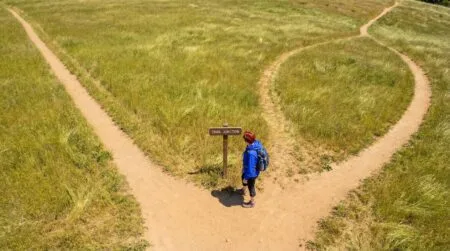



Primitive trail meaning in hiking is simple on paper: a trail that receives little to no official maintenance, has few or no marked signs, and puts navigation, route-finding, and self-rescue responsibility entirely on you. In practice, that single definition changes almost every assumption a beginner brings to trail planning.
⚡ Quick Trail Takeaways
- Minimal Trail Markings: Primitive trails lack regular blazes, bridges, and boardwalks; navigation requires active offline GPS tracking.
- Obstacle Frequency: Expect unbridged stream crossings, fallen blowdown trees, and overgrown brush that reduces average pace to 1 mph.
- First-Aid Preparedness: Carry a comprehensive wilderness trauma kit with SAM splint, compression wrap, and water purification tablets.
The first time I encountered a primitive trail listing on AllTrails, I treated it like any other green-dot easy rating. The trail was listed as 3.2 miles with modest elevation gain. What the listing did not say: the blazes stopped at mile 0.8, the path narrowed to a faint line through chest-high brush, and the one trail junction visible had no signage of any kind. I spent 40 minutes moving slowly and deliberately, phone GPS in hand, before I found the route again. I was not in danger. But I was genuinely uncertain for the first time on trail, and that uncertainty had a texture I was not ready for.
This article covers what primitive trail meaning actually signals, how these routes differ from what most beginners have walked, and what you need in place before setting foot on one.
🟠 A Note Before You Head Out:
This guide covers preparation for primitive trails. If you are currently lost on an unmaintained trail: stop moving, stay calm, and call 911 or text 911 (available in many US counties). If there is no cell service: stay in place if it is safe, use three whistle blasts as a distress signal, and activate any emergency device you carry.
Read on for everything you need to prevent this situation entirely.
🥾 Oliver’s Trail Notes & Field Observations
When I tested navigation through the unmaintained upper stretches of the East Fork San Gabriel River, the route repeatedly vanished into boulder fields and downed cedar timber. In my experience, a primitive trail designation means zero cleared tread, no footbridges over rushing water, and no mileage markers. Your hiking speed drops from three miles per hour to barely one mile per hour when scrambling over deadfall.
Primitive Trail Meaning in Hiking: The Actual Definition
Most trail systems in the United States fall somewhere on a spectrum between fully developed and completely primitive. The USDA Forest Service uses a formal classification system for trails. At one end: developed trails with regular tread maintenance, signed junctions, cleared overhead brush, and drainage structures. At the other end: primitive trails that may exist only as a historical route or a line on a map with no physical presence on the ground. The National Forest System Trail Accessibility Guidelines define the lowest maintenance level as trails where “users can expect to find minimum facilities, and tread may be faint or not continuous.”
Tread may not be continuous. That is the official definition of a trail category that shows up in AllTrails with the same distance and difficulty labels as a fully maintained park path.
How primitive trails differ from maintained trails
On a maintained trail, the land manager has cleared downed trees, installed drainage, posted signs at junctions, and marked the route with blazes at regular intervals. You can move confidently because the trail tells you where it goes.
On a primitive trail, none of that infrastructure is guaranteed. Trees stay across the path. Junction signs go missing and do not get replaced. Blazes fade or were never painted. The maintained vs unmaintained trail distinction is not about difficulty rating. It is about who is responsible for keeping you on route. On a maintained trail, the land manager shares that responsibility. On a primitive trail, it belongs entirely to you.
The maintained vs unmaintained trail spectrum in practice
Fully maintained: Signed junctions, blazes every 100 to 200 feet, obstacle-free path. Most state and national park trails.
Lightly maintained: Junctions may be signed, blazes present but sometimes faded, occasional downed trees. Many national forest trails in high-traffic areas.
Minimally maintained: Tread identifiable but narrow, blazes sparse in sections, junctions may have no signage. Expect to stop and confirm your route regularly.
Primitive (unmaintained): Tread may disappear entirely. No blazes, no signs, no cleared obstacles. Backcountry trail conditions are your entire operating environment.
What to Expect on a Primitive Hiking Trail
Trail surface and navigation on primitive routes
On a maintained trail, you follow the path. On a primitive route, you interpret it. The difference sounds minor. It is not.
A primitive trail might be wide and obvious for 200 yards, then narrow to a barely-visible game path, then disappear entirely at a rocky section where you must look ahead to find where the route picks up again. Every time that happens, you stop, check your GPS or map, and make a decision. That cognitive load accumulates across a full day in a way that flat-trail mileage does not capture.
Blazes, when they exist at all, are often older painted marks that have faded over years. Some are obscured by brush. In dense forest with low light, a faded blaze on dark bark is nearly invisible. Do not assume you will see them without actively looking.
Backcountry trail conditions beginners do not expect
Overgrown trail sections. Brush can reduce a 3-foot-wide path to a 6-inch line through vegetation. On wet mornings, walking through it soaks your lower body within the first mile. This is normal on primitive routes. It is not a sign that you are off route.
Water crossings with no infrastructure. Maintained trails include bridges or stepping stones at stream crossings. Primitive trails often have neither. You assess depth and current, then decide whether to ford or find an alternative crossing point. The American Hiking Society’s hiking safety guidance notes that water crossings are among the most common causes of hiker incidents on remote trails. Thigh-deep water with any current is a real hazard.
Navigation anchor loss. On a maintained trail, signs and blazes confirm your position at regular intervals. On a primitive route, you can go 30 minutes without a single confirmation. That absence of confirmation creates a specific low-level unease that is different from physical trail fatigue.
💡 Trail Tip: Screenshot your GPS track before you leave cell range, not just the overview map.
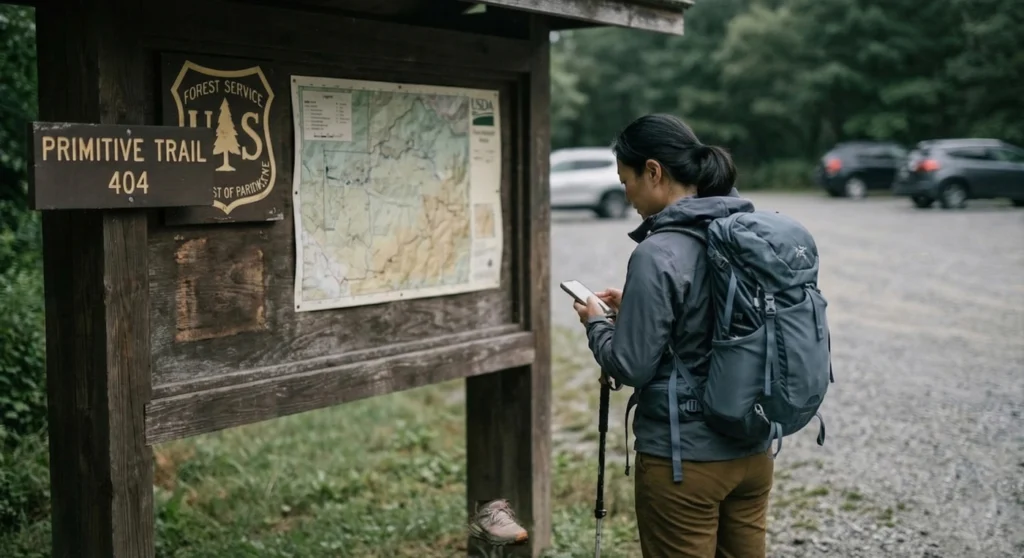
Most navigation apps including Gaia GPS and AllTrails can save maps offline, but only if they fully download before you lose signal. Do this in the trailhead parking lot. If your downloaded map fails mid-route, a screenshot of the zoomed-in track is your backup.
🥾 Heavy-Duty Brush Protection
In my pack on primitive routes, durable ripstop pants and full-length gaiters are non-negotiable gear. Without maintained trail corridors, you will be pushing through thick catclaw briars and poison oak while kicking hidden granite boulders buried under leaf litter. I learned never to rely on a smartphone screen alone without a printed topographic backup on unmaintained wilderness routes.
Primitive Trail Meaning Hiking: Know Before You Go
Five things separate a safe primitive trail outing from one that becomes a problem.
Navigation: the skill that replaces signage
On a maintained trail, navigation is mostly automatic. On a primitive trail, it is a continuous active task. You need two things working simultaneously: a downloaded GPS track on your phone and the ability to read it correctly.
Download your trail route on AllTrails or Gaia GPS before leaving home. At the trailhead, open the map and walk 50 feet down the trail while watching your position dot move on screen. Confirm the app is tracking you live. This 3-minute check has prevented more primitive trail incidents than any gear upgrade.
The skill most beginners skip: learning to match map features to physical landmarks. A trail that crosses a creek and climbs a ridge shows those features on every map. When you can look at your GPS and say “I am at the creek crossing,” you have a position anchor. When you are unsure whether the path ahead is the trail or a deer track, you check the map, see the route climbing left, and check whether the faint line ahead does the same.
What is an unmaintained trail listing actually telling you
When a trail is listed as unmaintained or primitive, it is not a warning about difficulty. It is a statement about infrastructure. Two things change:
Recent user reviews matter more than the official listing. Check AllTrails reviews from the last 30 days. Three people describing clear tread and visible blazes gives you current information. A most-recent review from eight months ago saying “some routefinding needed” gives you a data gap.
Listed mileage may not reflect actual travel time. What is an unmaintained trail in late fall is a different experience than the same route in July with full-growth brush. Add 45 minutes of buffer per 3 miles of primitive terrain.
Primitive trail safety gear you actually need
Primitive trail safety does not require a full expedition kit. Four items make the difference on a day hike within 5 miles of a trailhead.
The non-negotiables
Navigation: A downloaded offline GPS track is the floor. Gaia GPS and AllTrails both support offline maps. Know how to use yours before the trailhead, not at it.
Communication: A fully charged phone is minimum. For routes with known dead zones, a personal locator beacon (PLB) or a satellite communicator like a Garmin inReach costs around $350 and sends your coordinates to emergency services with one button press.
Water: Carry more than your estimate. A 5-mile primitive route may take the same time as an 8-mile maintained trail. Plan a minimum of half a liter per hour on moderate terrain, more in heat.
Headlamp: Routefinding stops extend your time on trail. If your planned 4-hour day becomes 5.5 hours, you need to reach the trailhead after sunset. A headlamp weighs 2 ounces.
How to read backcountry trail conditions before you commit
Two sources matter for primitive trail research. The land manager’s website: the USDA Forest Service and National Park Service post current trail conditions, closures, and alerts by trail name. A primitive trail with a recent flood, landslide, or fire closure will appear on those pages before anywhere else. Check fs.usda.gov or nps.gov for the specific land unit before every outing.
AllTrails user reviews sorted by recent. Read the last 5 in order, specifically for mentions of trail surface, blaze condition, or navigation difficulty. One review describing “heavy brush on the south section” tells you more than the trail’s official difficulty rating.
Knowing when a primitive trail is not the right choice yet
My standing opinion on primitive trails for beginners: the right time to attempt a primitive route is after you have completed at least 8 to 10 maintained trail hikes totaling 30 or more miles, with GPS navigation used actively on at least 3 of those hikes. Not because primitive trails require special physical ability, but because they require a baseline of trail awareness that accumulates through maintained trail experience first.
You learn what a real trail junction looks like. You learn how tread changes on different surface types. You learn your actual pace. Those reference points matter on a primitive trail, where every ambiguous moment requires a confident decision.
Common Mistakes on First Primitive Trail Outings
Treating the mileage as equivalent to a maintained trail
A 4-mile primitive trail is not the same time commitment as a 4-mile maintained trail. Plan for 30 to 50 percent more time on any primitive route. If your estimate for the maintained version is 2 hours, plan 2.5 to 3 hours for the primitive one. This buffer covers routefinding stops, obstacle navigation, and the slower pace that dense vegetation forces.
Following social trails off the primitive route
Social trails are unofficial paths created by hikers who left the main route and walked the same line repeatedly. On a primitive trail, a well-worn social path can look more defined than the actual route. This is how experienced hikers get off-route too. The fix: when a path looks clear but your GPS shows it diverging from your downloaded track, stop before you go more than 20 feet. Turn around. Return to the last confirmed waypoint. This is not a failure. It is the correct procedure.
Relying on cell service for navigation mid-hike
Primitive trails frequently run through areas with no reliable cell signal. If your navigation plan involves opening Google Maps when you are unsure, that plan will fail you in the moment you most need it. Download your map before you go. Confirm it loaded while you still have signal. This is a pre-hike check, not a mid-hike recovery option.
Underestimating early turnaround discipline
The most common reason primitive trail outings extend dangerously into darkness or bad weather: hikers pushing past their planned turnaround time because the trail feels manageable. Primitive hiking often feels manageable right up until it does not. Set a turnaround time before you leave the trailhead and treat it as a rule, not a suggestion.

When to Change Your Plan
On a primitive trail, the decision to turn around is rarely obvious. The signals are gradual, not sudden. Here is how to read them clearly.
Turn Around Now
- You have been off the GPS track for more than 10 minutes without locating the correct route
- Less than 2 hours of daylight remain and you do not know your exact position on the route
- Any member of your group is showing confusion, extreme fatigue, or is unable to continue moving
- A water crossing ahead is above mid-thigh depth with visible current: do not attempt it, turn back and report conditions to the land manager
- You have no cell service, no emergency device, and have lost confidence in your position
Slow Down and Reassess
- You have not confirmed your position with a blaze, cairn, or GPS waypoint in the last 20 minutes: stop, open your map, and match your surroundings to a feature before continuing
- Trail tread has become unclear for 50 or more continuous feet: the route likely continues but you need to confirm before moving forward
- You are more than 30 minutes behind your planned timeline: recalculate your turnaround time immediately and adjust it if needed
You’re Fine: Keep Going
- You can see your position on your downloaded GPS track and it matches your surroundings
- You have confirmed a blaze or route marker within the last 15 minutes
- You have sufficient water, daylight, and time buffer to reach the trailhead before darkThe rule for all three tiers: when you are not sure which applies, treat it as the higher one.
Frequently Asked Questions: Primitive Trail Meaning
What does primitive trail meaning hiking actually refer to?
Primitive trail meaning in hiking refers to a trail that receives little to no official maintenance. There are no guaranteed signs, blazes, cleared obstacles, or drainage structures. The tread may be faint or missing in sections. Navigation and routefinding responsibility fall entirely on the hiker. Primitive trails appear on AllTrails with normal labels, but what is an unmaintained trail in practice looks and feels substantially different from a developed trail of equal mileage.
What is the difference between maintained vs unmaintained trails?
Maintained trails are actively serviced: tread is cleared, junctions signed, blazes repainted, fallen trees removed. Unmaintained or primitive trails receive none of that. The maintained vs unmaintained trail distinction is not about difficulty. It is about infrastructure. On a maintained trail, the land manager shares navigation responsibility with you. On a primitive trail, that responsibility is entirely yours.
Is primitive hiking appropriate for a beginner?
A beginner who has completed 8 to 10 maintained trail hikes with active GPS navigation use on at least 3 of them is ready for a short, low-mileage primitive route. Without that foundation, the routefinding demands escalate faster than a new hiker can manage. Starting on maintained trails is not about fitness. It is about trail literacy that accumulates through experience.
What backcountry trail conditions should I check before a primitive hike?
Check three sources: the land manager’s website (fs.usda.gov or nps.gov) for current closures and alerts; AllTrails user reviews from the last 30 days for actual tread and blaze conditions; and the National Weather Service forecast for the elevation range of your route. Backcountry trail conditions change significantly after rain, snow, or wind. A trail that was navigable two weeks ago may look completely different after a storm.
What primitive trail safety gear is non-negotiable on a first outing?
Four items cover primitive trail safety on a day hike within 5 miles of a trailhead: a downloaded offline GPS track (Gaia GPS or AllTrails with offline maps confirmed loaded), a fully charged phone, more water than your estimated consumption, and a headlamp. For routes with known dead zones, a personal locator beacon adds a layer that no other item matches.
How do I find the right primitive trail for a first outing?
Search AllTrails using the “primitive” or “off trail” filter with a distance of 3 to 5 miles and elevation gain under 500 feet. Read reviews for mentions of blaze condition and routefinding difficulty. Look for a route with a defined endpoint rather than a vague loop. Hike with at least one other person who also has a downloaded map. Our guide to finding trails near you covers the specific filters that narrow 200 results to a usable short list.
What a Primitive Trail Actually Means for Your Prep
Primitive trail meaning hiking signals a different category of outdoor experience, not a more dangerous one. The five things that determine whether a primitive trail outing goes well: a downloaded GPS track confirmed before you leave cell range, a turnaround time set and treated as a rule, water planned for a slower pace than the mileage suggests, a headlamp regardless of your expected finish time, and the baseline trail literacy that comes from 8 to 10 maintained trail hikes first.
Primitive trail safety is about understanding what the trail stops doing for you when it stops being maintained, and filling that gap with specific preparation. That preparation is entirely learnable. Build the maintained trail baseline, build your navigation confidence, and the primitive routes open up in a way that makes the extra prep worth it.
Next Steps
- Right now: Open AllTrails and search trails near you. Filter for “primitive” or check any trail you have been considering for the words “unmaintained” or “minimal maintenance” in the description. That tells you whether the prep in this article applies.
- Before your first primitive hike: Download Gaia GPS or enable AllTrails offline maps. Download the specific route map at home with full Wi-Fi. Confirm it loads without signal by switching to airplane mode and reopening it.
- Before you leave the trailhead: Check your GPS track is actively updating your position. Set a turnaround time and write it in your phone notes. Tell someone the trail name, trailhead location, and your expected return time.
Related Reads
Hit a fork in the trail with a faded splotch of paint and had zero clue which direction it was actually pointing? Here are 8 trail marker blazes worth knowing before you guess wrong and end up way off course.
Watched your phone signal disappear at the exact moment you needed your map the most? Here’s why downloading offline trail maps before you go matters so much, so a dead signal never leaves you stranded on a guess.
Read “exposed trail” in a description and figured it just meant nice views, only to find out it meant something a lot more serious? Here’s what exposed trail actually means and why it should change how you plan around it.
Opened a dozen browser tabs trying to plan your first hiking trip and somehow still walked away with zero actual plan? Here are 9 steps that actually work for planning a beginner hiking trip, cutting straight through the tab chaos.
Noticed a streak of paint on a tree trunk and wondered if the color actually meant something or was just random vandalism? Here’s what trail blaze colors actually mean for beginner hikers, so every mark on a tree stops being a mystery.