


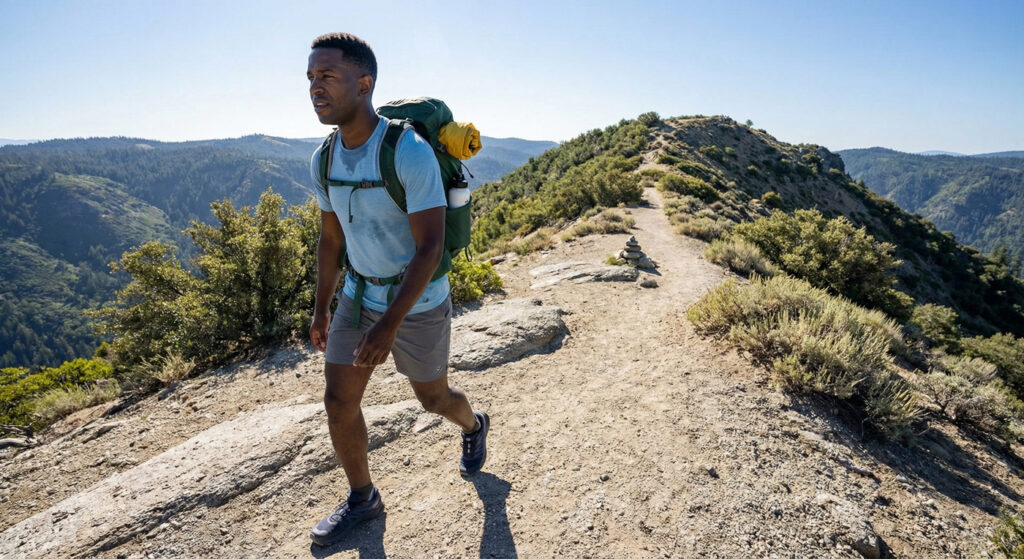
A ridgeline trail for beginners is easy to underestimate. The trail description reads something like “moderate, 5.2 miles, 900 feet elevation gain, great views.” None of that tells you the climb is front-loaded into the first 1.8 miles, that the wind at the ridge crest is 30 mph when it’s calm in the parking lot, or why three separate groups turned around on the section I hiked last August before 11 AM.
⚡ Quick Trail Takeaways
- Core Takeaway: Essential insights and actionable trail advice for ridgeline trail: 4 harsh realities every beginner misses.
- Safety & Preparation: Key preparation steps to ensure safety, pacing, and proper gear selection.
- Best Practice: Proven trail methods to improve your hiking experience and minimize environmental impact.
I picked that trail because the AllTrails rating said moderate and the photos showed open sky and wide path. Both were accurate. I still hit 94°F on the exposed section by 11:15 AM with 2.1 miles still to go, no shade anywhere on the ridge, and a weather forecast that read “partly cloudy” three hours earlier at home. I finished. But I was the last person off that ridge before the dark clouds showed up from the west, and I knew it was too close.
This guide covers what is a ridgeline hike, the four difficulty variables most trail descriptions leave out, how to read a ridge trail description for what it is not telling you, and the specific decisions that keep a ridgeline trail for beginners safe rather than just memorable.
Table of Contents
For ridgeline trail: 4 harsh realities every beginner misses, proper planning, moisture-wicking gear, and steady pacing are essential. Always check trail conditions in advance, carry adequate hydration, and adhere to Leave No Trace principles to ensure a safe and enjoyable hiking experience.
🟠 Before You Head Out:
Ridgeline trails carry weather exposure and fall risk. This guide covers preparation and decision-making. If lightning is active on the ridge right now: descend below treeline immediately. If someone falls on exposed terrain, call 911. No cell service? Activate a PLB or satellite communicator and stay put. Read on for everything you need before your next ridgeline hike.
| Topic Spec | Recommended Action | Key Benefit |
|---|---|---|
| Preparation Phase | Check trail conditions & forecast | Prevents unexpected delays |
| Trail Execution | Pace according to terrain difficulty | Saves energy & prevents injury |
| Post-Hike Protocol | Hydrate & inspect gear | Accelerates muscle recovery |
What a Ridgeline Trail for Beginners Actually Means
What is a ridgeline hike
A ridgeline hike is a trail that follows the spine of a ridge, the elevated crest where two slopes meet at the top. What is a ridgeline hike in practical terms: you are walking at or near the highest point of the terrain, with land sloping away on at least one side and usually both.
The word “ridgeline” in a trail name is not a difficulty rating. It is a terrain descriptor. A ridgeline trail for beginners can be manageable or genuinely demanding depending on four variables that most trail descriptions do not quantify. Those four variables are what this guide covers.
Ridge trail explained: the terrain you will actually face
Ridge trail explained for someone who has not walked one: the path sits at the top. There is no canopy above you. The wind behaves differently up there than it does in a canyon or under tree cover. It comes from multiple directions and is almost always stronger than the valley forecast suggests. The views are wide and clear, which is why most people want to hike a ridgeline trail for beginners in the first place, and also why the weather exposure is real.
The ground underfoot is usually rockier than a standard dirt trail. On maintained ridgeline routes, the path is graded and signed. On less-maintained routes, the trail can become indistinct where the ridge widens and markers are spaced farther apart. Both types exist. Check AllTrails reviews sorted by newest first before you go so you know which one you are dealing with.
The 4 Ridgeline Hiking Difficulty Facts Most Trail Descriptions Skip
A trail description gives you distance, elevation gain, and a star rating. None of those three numbers captures what actually defines ridgeline hiking difficulty. Here are the four things they leave out.
Fact 1: Elevation gain is almost never distributed evenly on a ridgeline trail for beginners
The elevation gain number tells you the total. It does not tell you where the gain happens. On ridge hikes, the climb is typically front-loaded into the approach, the ascent from the trailhead up to the ridge crest, and the remaining miles travel the ridge itself with minor ups and downs.
1,100 feet of elevation gain on a 6-mile ridgeline trail for beginners might mean 950 feet in the first 2 miles, then 150 feet scattered across the next 4. That is a very different physical experience from the same total gain spread evenly. Your legs do most of the work in the first third of the trail, not the last, which changes how you plan your water and food timing.
The practical check: on AllTrails, open the trail page and look at the elevation profile graph, not just the gain number at the top. If the line rises steeply early and then flattens, budget your hardest effort for the start and carry your snack somewhere you can reach it without stopping.
💡 Trail Tip: On ridgeline trails with front-loaded gain, eat something before you leave the trailhead parking lot, not at the top.
Your body processes fuel more efficiently when it is already in your system. Waiting until you reach the ridge to eat means you are fueling the descent, not the steepest section. A bar or handful of trail mix before you start takes 90 seconds.
Fact 2: Weather changes faster on a ridge than valley forecasts suggest
This is where ridgeline hiking difficulty separates most clearly from difficulty on a forested path. Under tree cover, weather reaches you slowly. On an exposed ridge, it reaches you immediately.
The National Weather Service notes that thunderstorm development on mountain ridges and elevated terrain can occur in under 30 minutes during summer months, and that conditions at elevation may differ significantly from valley floor forecasts. “Partly cloudy” in the parking lot is not a forecast for the ridge 1,200 feet above you.
Exposed ridge hiking, specifically a ridge above treeline with no tree cover, is the condition that makes weather a real variable rather than background noise. On an exposed ridge hiking a trail with no nearby shelter, your only response when weather arrives is to descend. There is no other option.
The rule that keeps you off the wrong side of this: if the 10 AM forecast shows any afternoon storm probability, plan to be off the ridge by noon. On ridgeline trail for beginners routes in the Rocky Mountain West and Appalachians, this is not overcaution. It is the default operating standard of people who hike ridgelines more than once.
Fact 3: Path width and fall risk are not the same variable
Trail descriptions almost never quantify path width. AllTrails photos show the view. They rarely show the actual ground you will walk on.
On ridgeline trail for beginners descriptions, the exposed character of the trail and the path width are two different variables. A trail can be wide and still feel exposed because of the elevation drop. It can be narrow and feel manageable because the slope falls gradually rather than sharply. Both combinations exist on real trails, and neither is captured in the star rating.
The honest fact about narrow sections on exposed ridge hiking: your perception of path width changes with height. A 4-foot-wide path on flat ground feels like plenty of room. That same path on a ridge with a 300-foot drop to the right feels different. That reaction is not irrational. It is your nervous system doing exactly what it is supposed to do. The issue arises when that response escalates into freezing, which creates danger on sections where steady forward movement is safer than stopping.
Before committing to any ridgeline trail for beginners with exposed sections, search specifically for photos labeled “narrow section” or “exposed section” on the AllTrails photo tab. Trip reports from the last 60 days show the actual footing conditions rather than just the panorama from the summit.
Fact 4: There is no shade on a ridgeline, and sun exposure is a real variable
Exposed ridge hiking by definition means no significant tree canopy. In summer and in the desert Southwest, this has a specific consequence most beginner guides mention briefly and then move past: ultraviolet exposure and radiant heat on an open ridgeline are more intense than on a shaded forest trail at the same air temperature.
Sweat rate increases in direct sun at elevation. Water needs on a ridgeline trail for beginners are higher than the standard half-liter-per-hour guidance accounts for. The American Hiking Society recommends carrying at least one liter per hour of hiking time for exposed, sun-intensive conditions. In July above 6,000 feet on a clear day with a full ridgeline exposed to sun, plan for that figure before you leave the trailhead.
How to Read Trail Descriptions for Ridge Hike Safety
What the description is actually telling you
Ridge hike safety starts with reading trail descriptions correctly. Here is a direct translation of the phrases you will encounter most often on ridgeline trail for beginners write-ups.
“Exposed sections” on a maintained ridgeline trail means the trail leaves tree cover and runs along the ridge crest. On most maintained beginner-appropriate trails, this refers primarily to elemental exposure: sun, wind, and weather. Check the photos before deciding whether vertical drop is also a factor.
“Some scrambling required” means brief hands-on-rock sections. If you see this phrase and have never scrambled before, do an easier trail first. One scrambling section will not ruin a hike for someone prepared for it. It will stop someone who was not.
“Expansive views” means you are above treeline. That is the complete translation. Wide views and weather exposure are the same terrain condition described from two different emotional states.
What the description is not telling you
No trail description tells you the afternoon thunderstorm development pattern for that specific ridge. No AllTrails rating accounts for what the trail feels like when wet, which changes ridgeline hiking difficulty meaningfully. Rock slabs that are straightforward in dry conditions become genuinely slippery when wet.
The gap in trail descriptions is conditions. The star rating reflects historical average difficulty. What you are hiking is specific conditions on a specific day. Your pre-hike check should include the AllTrails trail page for activity within the last 7 days, reading what the recent trip reports actually say rather than relying on the star average from two years ago.
💡 Trail Tip: Screenshot your AllTrails trail map at full zoom before you leave cell range. Not the overview. The actual trail map close enough to see junctions and splits.
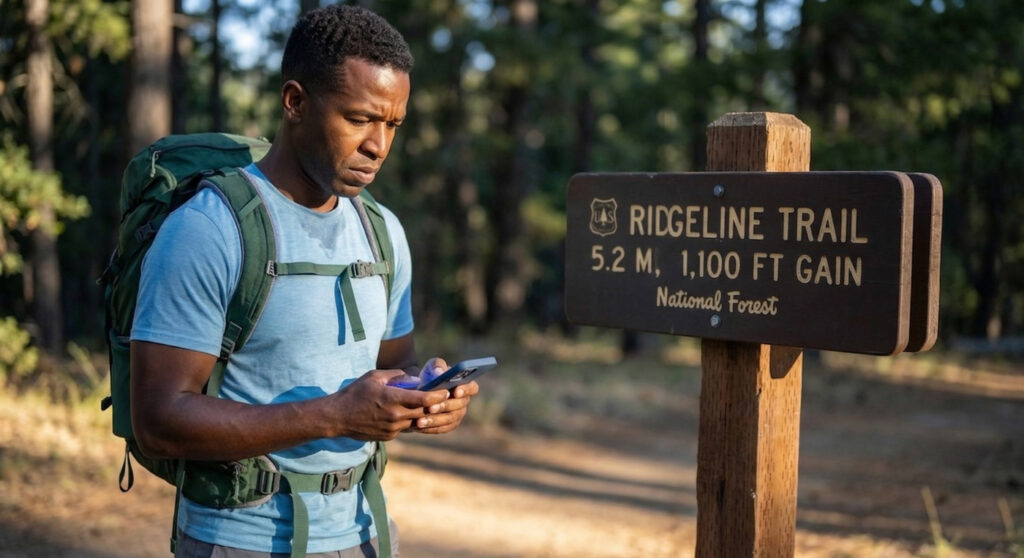
On ridgeline trails, cell service is intermittent. The app works offline only if the map fully loaded first. Do this in the trailhead parking lot before you start walking. The zoomed-out overview will not help you at a confusing junction 3 miles in.
When to Change Your Plan
🔴 Turn Around Now
- Lightning is visible, or thunder follows a flash by less than 30 seconds (30 seconds equals roughly 6 miles; less than 30 means the storm is significantly closer)
- Wind is sustained above 35 mph and you are working to maintain balance on the path
- You have been on the exposed ridge section for more than 90 minutes and afternoon clouds are actively building directly above the ridge line
- Any member of your group is frozen in place, in visible panic, or physically unable to continue forward or back on a narrow section
- Rain has started and the trail surface is becoming slick underfoot
🟡 Slow Down and Reassess
- Wind has increased noticeably in the last 30 minutes: stop, check the weather.gov forecast, look downwind at the cloud development before continuing
- The trail has become indistinct and you are not certain of the correct path: stop and verify your AllTrails location against a visible landmark before taking another step forward
- Your pace is significantly slower than planned and you are not confident about clearing the exposed section before 1 PM in regions with afternoon storm risk
- You are past the halfway point of your water supply with less than half the trail completed
✅ You Are Fine, Keep Going
- You started before 8 AM and expect to be off the exposed ridge section by 11:30 AM
- The National Weather Service mountain forecast, verified that morning, shows no afternoon storm development
- You have GPS showing your position relative to the trail and have verified it against a marker within the last 30 minutes
- Water is on pace: roughly half your supply at the halfway point of the trail
One rule: If you are genuinely unsure which category your situation falls into, treat it as the higher tier. Being off a ridgeline trail for beginners two hours early is an inconvenience. Getting caught in a lightning storm on an exposed ridge is a problem in a different category.
How to Prepare for Your First Ridgeline Trail for Beginners
The four adjustments a ridgeline requires
Ridge hike safety preparation looks nearly identical to standard day hike prep with four specific adjustments. Get these right and ridgeline hiking difficulty is manageable. Skip them and you are setting up the exact situation that ends with people turning around at mile 3.
Start earlier than you would for a forest trail. On ridgeline trail for beginners routes in the Rocky Mountain West, Appalachians, and the Southwest, afternoon thunderstorm development is the most common and most avoidable weather risk. Most experienced ridge hikers plan to be on the exposed section before 10 AM and off it by noon on any day with afternoon storm probability in the forecast. That is not a preference. That is what the terrain requires.
Carry more water than the mileage suggests. The sun-to-water calculation changes on an exposed ridgeline. For exposed ridge hiking in temperatures above 75°F, the American Hiking Society recommends planning for 1 liter per hour of active hiking time, not 0.5 liters. Carry more than you think you will need. You can carry out extra water. You cannot add water mid-ridge.
Check the specific mountain forecast, not the city forecast. The National Weather Service has mountain-specific zone forecasts for named peaks and ridge systems across the US. Search for the specific area you are hiking, not the nearest town. The valley forecast and the ridge forecast are not the same reading, especially in summer.
Know your bail route before you need it. On most ridgeline trail for beginners routes, the trail is an out-and-back or a loop. Know which direction descends fastest from your planned turnaround point and study it on the AllTrails map in the parking lot. If you need to get off the ridge quickly, you want to already have that answer.

What the gear list changes on a ridgeline trail for beginners
Two gear items matter more on a ridgeline than on a standard trail.
Sun protection. A hat with a full brim, not a running cap, along with SPF 50 sunscreen applied before you leave the car and a lightweight long-sleeve shirt if you are above treeline for more than two hours. Exposed ridge hiking sun exposure accumulates faster than you expect, particularly above 5,000 feet where UV intensity increases noticeably.
A packable rain jacket. Not a poncho. An actual packable rain layer that fits inside your daypack. On a ridgeline trail for beginners, that jacket is not for the weather you started in. It is for the weather that builds while you are on the ridge. If the jacket is in your pack, the worst case is you carry it all day. If it is in the car, you stand on an exposed ridge in a thunderstorm in a cotton shirt.
Frequently Asked Questions: Ridgeline Trail
What is a ridgeline trail and how is it different from a regular hiking trail?
A ridgeline trail follows the spine of a ridge, the elevated crest where two slopes meet, instead of traveling through a valley, canyon, or forested path. What is a ridgeline hike in practical terms: you are on top of the terrain rather than below it, with land falling away on at least one side. The key differences for beginners are weather exposure with no tree cover, wind that is stronger and less predictable than valley conditions, faster-changing sky conditions than the valley forecast reflects, and trail sections that can narrow at elevation. Most maintained ridgeline trail for beginners routes are graded and well-signed. The difficulty comes from the exposure variables, not technical terrain.
Is ridgeline hiking difficulty actually harder than a standard moderate trail?
Ridgeline hiking difficulty is not a higher category than moderate. It is a different set of variables. A ridge trail can carry an AllTrails moderate rating and still feel harder than other moderate trails because of full sun exposure, sustained wind, and the psychological effect of height on narrow sections. The factors that trail ratings do not capture: front-loaded elevation gain, no shade, wind speed at the crest, and path width at height. Use the elevation profile graph to assess how the gain is distributed, and read trip reports from the last 7 days for specific condition notes before you commit.
What does exposed ridge hiking actually mean for path conditions?
Exposed ridge hiking means the trail runs above treeline or along a ridge crest with no significant tree cover. It describes two overlapping conditions: elemental exposure, meaning sun, wind, and lightning risk, and on narrower sections, some degree of fall risk from the terrain drop. For ridgeline trail for beginners routes on maintained trails, the elemental exposure is the more consistently relevant factor. Severe vertical drop is specific to certain trails and will appear in AllTrails photos and recent trip reports. Check photos from the last 30 days specifically for path-width context before committing to any ridge section described as narrow.
How does ridge hike safety differ from safety on a forested trail?
Ridge hike safety has one critical structural difference from safety on a forested trail: weather response time. Under tree cover you have both shelter and advance warning when a storm builds. On an exposed ridge you have neither. The National Weather Service protocol is direct: if you can see lightning or hear thunder, you are within striking range. Descend below treeline immediately and do not wait for rain to start. Beyond weather, ridge hike safety follows the same framework as any day hike but with stricter application: earlier start, more water per hour, a pre-verified bail route, and a noon turnaround standard on any day with afternoon storm probability.
How do I know if a ridgeline trail for beginners is the right starting point for me?
Check three things before committing. First: the elevation profile on AllTrails to see how the gain is distributed, not just the total number. Second: weather.gov for the specific mountain area forecast the morning of the hike, not the night before. Third: AllTrails trip reports from the last 7 days for any current condition issues, such as loose terrain, unmarked sections, or wet rock. A ridgeline trail for beginners that starts before 8 AM, keeps the exposed section under 3 miles, and has a clear weather forecast is within range for someone who has completed 3 to 4 shorter day hikes first. A ridge trail with 1,800 feet of gain and afternoon storm history in the trip reports is not a first-hike choice.
A Ridgeline Trail for Beginners Is Worth It. Know What You Are Agreeing To.
A ridgeline trail for beginners done right is some of the best hiking available. The views are real. Looking out at 40 miles of terrain from a clear ridge crest on a calm morning is not something a forested canyon delivers. The people who have poor experiences on ridgeline trail for beginners routes are almost never classically unprepared, wrong shoes or no water. They are unprepared for the specific variables that define ridgeline hiking difficulty: weather that moved faster than the forecast suggested, sun they did not account for, a narrow section that appeared without warning at mile 3.5.
My opinion on this: the morning start time is the single decision that prevents most of what goes wrong on a ridge. Not the trail selection. Not the gear. Start early enough that you are off the exposed section before noon, and almost every weather-related risk shrinks significantly. Everything else in this guide is secondary to that one call.
Check the elevation profile before you pick the trail. Verify the mountain forecast the morning of the hike, not the night before. Carry 1 liter per hour for exposed conditions. Know the bail route before you start. Those four steps cover the gap between what the trail description says and what the terrain actually is.
Next Steps
- Right now: Pull up any ridgeline trail you are considering on AllTrails, open the elevation profile, and look at where the gain is concentrated. If 80% of the climb is in the first 2 miles, plan your hardest effort for the start, not the finish.
- Before your first ridgeline hike: Bookmark weather.gov and search your specific trail area using the mountain zone forecast. Check it the morning of the hike, not the night before.
- On trail: Decide your turnaround time at the trailhead, not mid-ridge. Write it in your phone: “Off the exposed section by 11:30 AM regardless.” That decision is easier to make in a parking lot than with a darkening sky overhead.
Related Reads
Read “exposed trail” in a trail description and assumed it just meant good views, only to find out it meant something a lot more serious? Here’s what exposed trail actually means and why it should change how you plan the hike.
Downloaded a trail thinking the green “easy” label meant you could basically show up with zero prep? Here’s how AllTrails actually calculates those difficulty ratings, and why two trails marked “easy” can feel like completely different hikes.
Watched dark clouds roll in halfway through a hike and froze, unsure if it was still worth pushing on or time to head back? Here’s what to actually do when hiking in the rain, including the exact point where turning back stops being a judgment call and starts being the obvious move.
Stood at a trailhead staring at a rating system that meant absolutely nothing to you and just figured you’d wing it? Here’s what those difficulty ratings genuinely mean for someone brand new to hiking, no confusing jargon attached.
Two trails on the map showed the exact same mileage, yet one left your legs fine and the other left them screaming? This explains what elevation gain is actually doing, the part the distance number conveniently leaves out.