


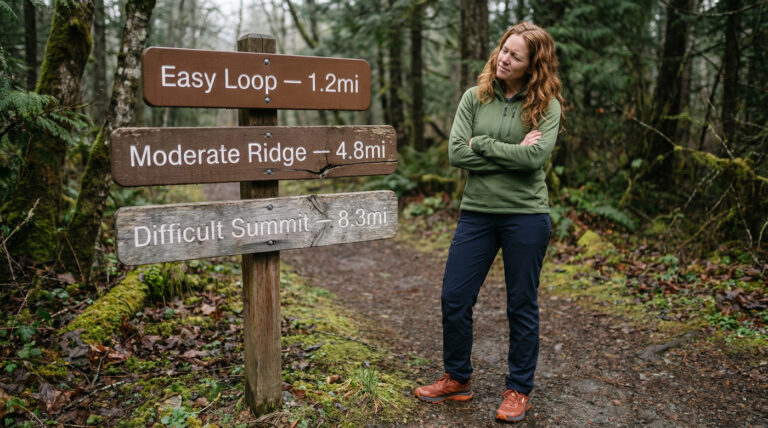
Trail difficulty ratings explained in one sentence: they’re relative, inconsistent across platforms, and almost always measured against the average of all hikers — not the first-timer standing at the trailhead wondering if they made a poor life decision.
“Moderate” on AllTrails can mean a breezy 3-mile loop with 200 feet of gain. It can also mean a 6-mile ridge climb with 1,400 feet of elevation that’ll have experienced hikers stopping to catch their breath on the exposed sections. Both get the same label. Neither comes with a footnote explaining which one you’re looking at.
I found this out the hard way. My third hike, I picked a trail rated Moderate on AllTrails because I’d done two Easy trails and figured I was ready to step up. The app said 5.2 miles. What the app didn’t say was that those 5.2 miles included 1,100 feet of gain packed almost entirely into the first two miles, a loose-rock section halfway up, and zero shade on a 78°F morning in May. I made it. I was not okay at the top. I sat next to a couple who were clearly regulars, eating sandwiches and looking completely relaxed, while I catalogued the muscles I’d discovered for the first time.
Trail difficulty ratings aren’t useless. But they’re not what most beginners think they are either. This guide breaks down what Easy, Moderate, and Hard actually describe, what AllTrails and other trail platforms are measuring when they assign those labels, and (most usefully) three real trail examples that show exactly why the same rating can mean completely different things.
Table of Contents
Why Trail Difficulty Ratings Don’t Mean What You Think
The first thing to understand about trail difficulty ratings: no single standard exists.
AllTrails uses its own formula. State and national parks often use a different one: sometimes based on a numeric system, sometimes on pure staff judgment, sometimes on what the rating was when the sign was posted in 1987 and nobody updated it since. The USDA Forest Service has guidelines; individual ranger districts interpret them differently. REI’s trail descriptions use a separate framework. You can be looking at five different “Moderate” ratings and reading five genuinely different assessments of five completely different physical experiences.
What most ratings do try to measure, in some combination: total distance, elevation gain, elevation gain per mile (grade), trail surface quality, and exposure to hazard. The problem is the weighting. AllTrails’ algorithm, for instance, weights distance and elevation together, which is a reasonable approach, but it averages the rating across all reviewers, including the ultrarunners and the retired park rangers who do this six times a week. Their “Moderate” and your “Moderate” are not the same experience.
The National Park Service ratings are more conservative than AllTrails across the board, because they’re designed for the full population of park visitors including people who’ve never hiked before. An NPS “Moderate” trail tends to be an AllTrails “Easy-Moderate” or “Moderate.” The gap matters.
Here’s the practical version of trail difficulty ratings explained: treat the label as a starting point, then read the actual numbers (distance, elevation gain, elevation gain per mile) and make your own call. The label is a summary. The numbers are the truth.
What Easy, Moderate, and Hard Actually Describe
Most rating systems are trying to capture the same few variables. Once you know what they’re measuring, you can decode any trail’s difficulty more accurately than the label alone tells you.
Distance and Total Elevation Gain
These are the two numbers that matter most for figuring out how hard a trail is going to feel. Total elevation gain is how many vertical feet you climb over the whole hike, counting every uphill section, not just the net difference between trailhead and summit. A trail that goes up 400 feet, drops 200, then goes up 400 more has 800 feet of total gain. Not 400.
For trail difficulty ratings explained in plain terms: elevation gain hits your body harder than distance. A 6-mile flat trail is not harder than a 3-mile trail with 1,500 feet of gain. It isn’t even close.
Elevation Gain Per Mile
This is the number most beginner guides skip, and it’s the most useful single figure for predicting how a trail will feel. Divide total elevation gain by total trail miles. That gives you gain per mile.
Under 100 feet per mile: genuinely flat. Easy for almost anyone. 100 to 300 feet per mile: rolling terrain. Noticeable but manageable. 300 to 500 feet per mile: sustained climb on the steeper sections. Moderate for experienced hikers, challenging for beginners. Over 500 feet per mile: steep. Demanding for any fitness level.
A trail rated Moderate with 450 feet per mile gain is a different animal than one rated Moderate with 120 feet per mile gain. Same label. Radically different experience.
Trail Surface and Technical Difficulty
Trail difficulty ratings often try to factor in how challenging the footing is: loose rock, scrambling, narrow ridgeline, river crossings. This is where the ratings get least reliable, because surface conditions change seasonally and rarely get updated. A trail that’s perfectly graded dirt in August might be treacherous mud in March. AllTrails reviewers catch this faster than official ratings do, which is exactly why reading recent reviews matters.
For beginner hiking purposes, anything described as having “Class 3 scrambling,” “exposed ridgeline,” or “route-finding required” is beyond a first- or second-time hiker regardless of the overall difficulty label. Those descriptions mean specific technical skills that take time to build.

Three Real Trails That Expose How Meaningless “Moderate” Is
This is where trail difficulty ratings explained moves from theory into something you can actually use. The same “Moderate” label on AllTrails describes all three of these trails, and the physical experience of hiking each one is genuinely different.
Trail 1: San Elijo Lagoon Trail, San Diego, CA
AllTrails Rating: Moderate Distance: 5.0 miles Elevation Gain: 125 feet Gain Per Mile: 25 feet
This trail is flat. Almost entirely flat, following a coastal lagoon with minimal grade change. The Moderate rating comes mostly from the distance: 5 miles is longer than most Easy-rated trails. But 25 feet of gain per mile is essentially a paved park walk in terms of cardiovascular demand.
A first-timer with a baseline of regular walking could complete this trail comfortably. The challenge is time and foot endurance, not climb. Pace it at 2 miles per hour, bring 1.5 liters of water, eat something at the halfway mark, and most people finish feeling good.
If AllTrails called this Easy, it would be a more accurate label for beginner hiking purposes. The Moderate rating is technically defensible based on distance. The practical reality is that this is a completely different experience from Trail 2.
Trail 2: Temescal Canyon Loop, Pacific Palisades, CA
AllTrails Rating: Moderate Distance: 3.8 miles Elevation Gain: 871 feet Gain Per Mile: 229 feet
Now we’re in different territory. Shorter than Trail 1 by more than a mile, but with seven times the elevation gain per mile. Temescal climbs steeply for most of the first 1.5 miles, eases on a ridge section with partial shade, then descends through a canyon back to the trailhead.
This is a meaningful workout for a beginner. The uphill section is sustained and exposed in spots. On a warm day, the first mile will have most first-timers breathing harder than expected. The footing is mostly good, compacted dirt and some rocky patches, but the incline is real and you feel all 871 feet of it.
What does moderate trail mean in this case? It means something you can finish on your second or third hike if you start slow, manage your water, and don’t go out at 11am in July. It’s not hard. It’s genuinely Moderate. But it’s nowhere near the same physical experience as Trail 1, and knowing that difference before you drive to the trailhead matters.
Trail 3: Mount Baldy via Backbone Ridge, San Bernardino, CA
AllTrails Rating: Moderate Distance: 7.7 miles Elevation Gain: 2,289 feet Gain Per Mile: 297 feet
This one makes me want to have a conversation with whoever set the AllTrails algorithm.
Mount Baldy via Backbone Ridge gains nearly 2,300 feet over 7.7 miles, with sections that hit 400-plus feet per mile on the steeper pitches. The trail reaches 10,064 feet of elevation, which means altitude becomes a real factor for anyone coming from sea level. The exposure on the upper ridge is genuine: loose rock, no shade, temperature swings. Experienced hikers treat this as a full-day commitment.
For a first-timer? This is not a Moderate trail. This is a trail that will end a first-timer’s day before the summit and send them back down with a very specific opinion about trail ratings.
The AllTrails rating reflects how experienced hikers perform on this trail relative to other trails in the system. Against that population, the numbers land in the Moderate band. Against a beginner’s capacity, it’s categorically different.
This is why trail difficulty ratings explained through real examples matters more than abstract definitions. The label “Moderate” doesn’t mean “appropriate for beginners who’ve done one Easy hike.” It means “moderately challenging for the average AllTrails user,” which is a very different sentence.
The Fama Method for Reading Any Trail Rating
Here’s how I actually evaluate a trail now before committing to it. The official rating is the last thing I look at.
Step 1: Get the actual numbers. Distance, total elevation gain, and gain per mile. AllTrails shows all three on every trail page. If gain per mile isn’t listed directly, divide the total gain by the total miles. That number tells me more than any label.
Step 2: Check reviews from the last 30 days. Recent reviewers describe what the trail is actually like right now, not when the rating was assigned. They mention the mud on the switchbacks after rain, the section of trail that washed out, the aggressive rocky descent that the official description glosses over. Official trail difficulty ratings don’t update; recent reviewers do.
Step 3: Look for red flag phrases. Certain words in trail descriptions signal technical difficulty beyond what a beginner should approach: “exposed ridgeline,” “Class 2” or “Class 3,” “loose rock above treeline,” “route-finding required,” “use trail,” “not recommended after rain.” Any of these in the description means the trail is more technical than the overall rating suggests.
Step 4: Apply the Fama difficulty calibration. For beginner hiking, I use these internal translations:
AllTrails Easy = genuinely accessible for most first-timers on flat terrain AllTrails Easy-Moderate = good second or third hike target AllTrails Moderate, under 200 feet gain per mile = appropriate for a beginner with a few hikes under their belt AllTrails Moderate, over 300 feet gain per mile = better as a goal than a starting point AllTrails Hard = build up to this; not for the first few outings
The National Park Service rates more conservatively. An NPS “Moderate” is roughly equivalent to AllTrails “Easy-Moderate” for most visitors.

Common Mistakes Beginners Make Reading Trail Ratings
Taking the single-word label as the whole answer. The category label (Easy, Moderate, Hard) is a compression of multiple variables into one word. It loses information in the process. The numbers behind the label are always more useful than the label itself.
Comparing the trail to their regular fitness. “I run 5 miles three times a week, so a 5-mile Moderate trail should be fine.” Trail miles aren’t running miles. Trail fitness is specific. The calves, hip stabilizers, and foot muscles doing constant micro-adjustments on uneven terrain aren’t the same ones your running route trains. I’ve seen regular runners crater on a moderate climb. I’ve seen relatively sedentary people finish the same trail just fine because they started slow and managed their pace.
Ignoring the elevation profile. A trail can have 800 feet of total gain spread evenly over 5 miles (manageable) or concentrated into the first 1.5 miles with the rest flat. Same total gain. Completely different experience. AllTrails shows an elevation profile graph on every trail page. Take 10 seconds to look at it. If the line shoots straight up in the first third of the trail, you’re looking at a front-loaded climb, not a gradual one.
Not reading who left the reviews. An AllTrails review from someone who just ran 12 miles in trail shoes, calling a trail “a nice moderate workout,” is useful information, but it’s not information for a first-timer. Filter mentally for reviews from people who mention it was their first or second hike, or who describe themselves as casual walkers. Those reviews are calibrated to your actual situation.
When a Trail Is Beyond Your Current Level
You don’t have to be in trouble to figure this out. A few honest signals that a trail is ahead of where you are right now:
The gain per mile is over 400 feet and you haven’t done a trail over 250 feet per mile yet. That’s a jump that your legs aren’t ready for, even if the overall mileage is short.
The trail description includes technical language (scrambling, exposed sections, route-finding) and you’ve never done anything like that before. Technique matters more than fitness for those sections, and technique comes from experience.
The AllTrails reviews from the last 30 days consistently mention that the trail was harder than expected, had significant navigation challenges, or recommend prior experience on similar trails.
None of this means don’t ever do that trail. It means do it third or fourth, not first. The AllTrails difficulty description page explains their exact methodology. Worth a read so you understand what the algorithm is actually weighting when it generates a rating.
What does moderate trail mean when you’re genuinely ready for it? It means a trail that pushes you without breaking you. A trail where you’re working for it, making the top, and coming home tired in the best way. That’s a real target worth building toward. The gap between where you are on your first hike and where you need to be for a real Moderate is a few outings of honest Easy-to-Moderate trail work. Not months. A few hikes.
Frequently Asked Questions: Trail Difficulty Ratings
What does “Moderate” mean on AllTrails?
AllTrails generates difficulty ratings using a formula that weighs total distance and total elevation gain together. “Moderate” falls in a band between their Easy and Hard ratings, but crucially, the ratings are calibrated against the full AllTrails user base, including experienced hikers and trail runners. For beginner hiking, an AllTrails “Moderate” trail with over 300 feet of gain per mile is better treated as a goal to work toward than a starting point.
Are trail difficulty ratings the same on all hiking apps?
No, and this is one of the most useful things for beginners to know about trail difficulty ratings explained. AllTrails, Gaia GPS, and official park service ratings all use different methodologies. National Park Service ratings are generally more conservative and designed for the full range of park visitors. AllTrails skews toward active hikers. Always check the actual distance and elevation gain numbers rather than trusting the label across platforms.
How do I know if a Moderate trail is right for me as a beginner?
Check gain per mile first: under 200 feet per mile is manageable for most beginners who’ve completed a couple of Easy trails. Then read reviews from the last 30 days, looking specifically for descriptions from casual or first-time hikers rather than experienced ones. If recent reviewers mention it was harder than expected, or if the gain is front-loaded in the first third of the trail, treat it as a target for your third or fourth hike rather than your second.
What does an Easy trail rating actually mean?
On AllTrails, Easy trails are generally shorter (under 4 miles) and have low elevation gain, typically under 100 to 200 feet total. They’re usually the right starting point for first-timers, though even Easy-rated trails can have sections that surprise new hikers. Check gain per mile regardless of the Easy label — some Easy trails still have brief steep pitches that feel harder than the overall rating suggests.
Why does the same Moderate trail feel completely different to different hikers?
Because trail difficulty ratings aggregate across all users and don’t account for fitness level, trail experience, conditions on the day, temperature, pack weight, or a dozen other variables that affect how a trail actually feels. A trail that’s a warm-up for a regular hiker can be a genuine challenge for someone on their third outing. The label stays constant; the experience doesn’t. This is exactly why the numbers behind the rating matter more than the word.
What’s the most important number to check before a hike?
Elevation gain per mile. It’s a better predictor of how hard a trail will feel than total distance or even total elevation gain alone. Under 100 feet per mile is flat. 200 to 300 feet per mile is noticeably hilly. Over 400 feet per mile is steep by any definition. You can calculate it yourself: divide total elevation gain by total trail miles. AllTrails lists both numbers on every trail page.
Should beginners use AllTrails ratings as a guide?
Yes, but as a starting point, not a final answer. AllTrails’ trail difficulty ratings are useful for filtering and comparison, but they’re calibrated against all users. For beginner hiking, apply your own translation: check the actual numbers, read recent reviews from hikers at your level, and add a buffer. An AllTrails Easy that reviews well from casual hikers is a more reliable beginner recommendation than an AllTrails Moderate that experienced hikers call “not too bad.”
The One Number That Changes Everything
Trail difficulty ratings explained at their most useful: stop reading the label, start reading the elevation gain per mile. That single number, which you can calculate in 30 seconds from the stats on any trail page, tells you more about how a trail will actually feel than the Easy/Moderate/Hard label ever will.
“Moderate” doesn’t mean anything consistent. Two hundred feet of gain per mile means something real. Once you start reading trails that way, the ratings stop being mysterious and start being navigable. And the difference between a trail that breaks you and one that challenges you in exactly the right way stops being luck.
Next Steps
- Right now: Pull up a trail you’ve been thinking about on AllTrails. Find the total elevation gain and total distance. Divide gain by miles. Is that number under 200? You’re probably ready. Over 300? Do an easier trail first and come back to this one.
- Before your next hike: Read the five most recent AllTrails reviews on your target trail. Look specifically for anyone who describes it as harder than expected, or who sounds like a beginner, as their calibration is closest to yours.
- After your next hike: Note the actual gain per mile you completed. That’s your current benchmark. Use it to pick your next trail.