

What to expect on your first hike: you’ll be slower than you think, your legs will find muscles they’ve been ignoring for years, and you’ll probably finish wondering why you waited this long. That last part surprises almost everyone.
Most beginner hiking guides focus on gear checklists and trail ratings. Those things matter, but they don’t answer the questions that actually run through your head the night before your first trail: Will I keep up? What if I’m embarrassingly out of breath? What does it actually feel like to do this for the first time? The physical side is covered elsewhere — see our guide to what happens to your body on your first hike. This article is about the experience. The stuff that doesn’t make it into any hiking for beginners checklist.
My first real hike was a 2.8-mile loop in the hills above Pasadena. I’d been putting it off for two years, mostly because I didn’t know what I didn’t know: what to wear, whether I was fit enough, what “moderate difficulty” actually meant, whether I’d look like an idiot. I drove to the trailhead, sat in the parking lot for ten minutes working up the nerve, and then walked. Finished in about 90 minutes. Ate a granola bar on a rock at the high point and looked out over the whole basin. Drove home and immediately started looking up other trails.
What follows is what I wish someone had told me before that day: specific, honest, and in the order you’ll actually encounter it.
Table of Contents
What to Expect on Your First Hike Before You Even Start: The Trailhead
The first thing most beginners notice at a popular trailhead on a weekend morning: it’s busy. Not traffic-jam busy, but busier than the idea of “going for a hike alone in nature” suggests. Families unpacking gear from minivans, trail runners stretching, dogs pulling in four directions, rangers answering the same three questions from different people every five minutes.
This is worth knowing because the mental image most people arrive with, quiet and solitary and immersive, often doesn’t match parking lot reality on a Saturday. That gap can throw people before they’ve even started.
The fix is easy: go early or go on a weekday. Trailheads before 8am feel completely different from trailheads at 10am. Smaller crowd, cooler air, better light, and the trail itself thins out quickly. If your schedule forces a weekend midmorning start, know what you’re walking into. The first half mile past the trailhead, things quiet down fast.
One logistics note that nobody includes in a standard beginner hiking guide: the walk from the parking lot to the actual trailhead start is often longer than you think. On popular trails, overflow parking can be a quarter mile from the marked trail entrance. Factor that into your time estimate and don’t count it as part of your mileage. It’s real walking that adds up but isn’t what AllTrails measured.
The First 15 Minutes Feel Wrong in a Good Way
For hiking for beginners, the first few minutes on trail are a calibration experience: the terrain immediately feels different from any surface you’ve walked on before. Not worse. Different. More variable. More demanding of attention.
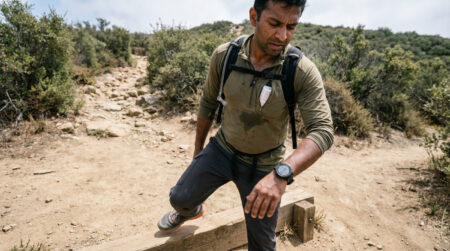
Your eyes drop to the ground more than you expect. Not from anxiety, but from the sensible instinct to watch your footing on a surface that shifts every few steps. Roots, loose rocks, a sudden dip, a section where the trail narrows around a tree root. This attentiveness is right and will become automatic by your third or fourth hike. On the first, it’s conscious and slightly exhausting in a way that has nothing to do with fitness.
Your pace will be slower than you planned. Not because you’re struggling, but because trail terrain is slower than pavement and your body is calibrating in real time. Most beginners plan for their normal walking pace and end up moving 25 to 30% slower on actual trail. This is normal. It means you’re hiking, not walking on a sidewalk with nicer scenery.
The thing that surprises people most in the first 15 minutes: the silence that exists just a quarter mile past the trailhead. Even on busy trails, the crowd disperses quickly with distance. You’ll hear wind, birds, your own footsteps. The ambient noise of parking lots and roads fades fast. This is the part that converts people. Not the views, not the fitness, but the quiet that shows up that quickly and stays for the rest of the hike.
The Uphill Section Will Arrive Before You Think You’re Ready
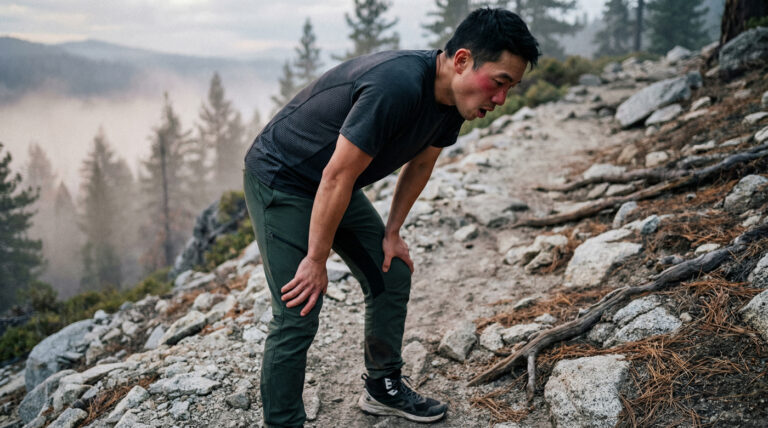
On any trail with real elevation, there’s a point in the first third of the hike where the terrain steepens and the effort jumps. Your breathing gets harder. Your pace drops. Your legs register the change in demand.
This is where most beginners make the classic mistake: pushing through at the same pace, trying to maintain speed on the climb. Don’t. Slow down to whatever pace lets you speak in full sentences without gasping. That’s the right pace for a beginner on a sustained climb. Not because of any rule, but because it’s the pace your cardiovascular system can sustain without creating the kind of debt that makes the back half of the hike miserable.
If the climb is steep and sustained, try the rest step: with each uphill step, pause for one beat with your weight on your back foot before taking the next. It sounds tedious. It’s not. Experienced hikers use it to cover thousands of vertical feet without blowing up their legs, and it works on the first day as well as it does after years of trail time.
The climb will end. Trails that go up have flat sections, then descents. The top of a climb resets how you feel about the hike. You’ll catch your breath in a minute. The view improves. Your legs stop complaining. Nobody finishes a hard climb and immediately regrets the attempt. That’s something every hiking for beginners resource eventually gets to, and it’s true every time.
You Will Not Look Like a Beginner (This Concern Is Real and Also Pointless)
A large number of people delay their first hike specifically because they’re worried about looking out of place. Wrong gear, wrong pace, not knowing trail etiquette, being spotted by experienced hikers who can immediately tell they have no idea what they’re doing.
The honest version: nobody on trail is thinking about you. Not in a dismissive way, but in the specific way that people doing their own physical activity in their own heads are not monitoring other hikers for competence signals. The experienced trail runner who passes you on the uphill section is focused on their breathing and their footing, not your gear.
What’s actually true about trail etiquette, the hiking basics for beginners that actually matter in practice: say hello when you pass people. Step aside for faster hikers coming up behind you on narrow sections. Yield to uphill hikers on two-way trails, partly because stopping and restarting a climb is harder than a descent. Those three things cover 95% of trail social situations and require no experience to execute.
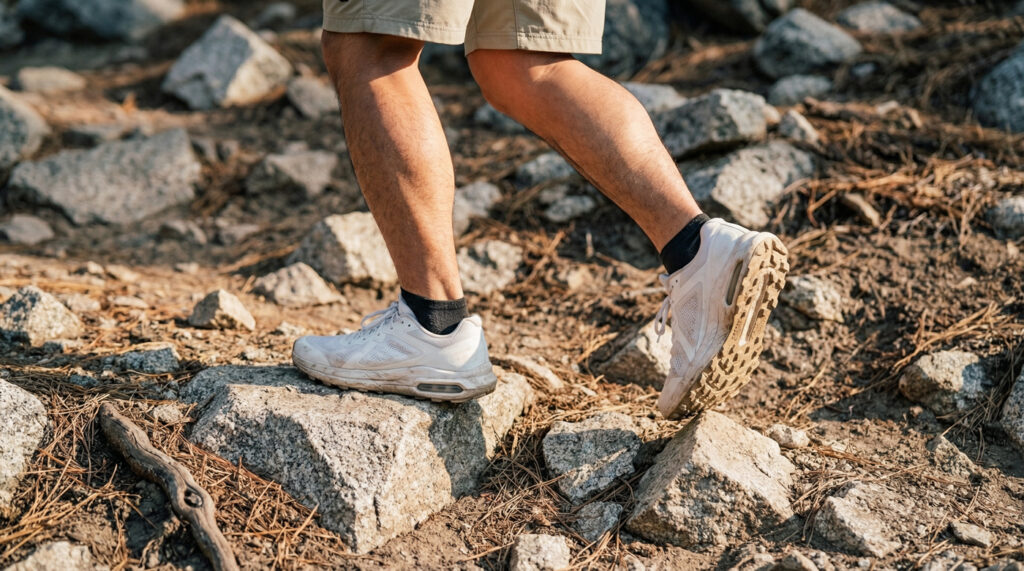
On gear: you don’t need expensive or branded equipment for a beginner trail. Athletic clothes you already own, non-cotton socks, and shoes with decent grip are enough for most easy to moderate terrain. You’ll see people in full technical gear. You’ll also see people in jeans and Converse. The trail doesn’t check credentials.
The Halfway Point Feels Different Than You Expected: Usually Better
Most beginners anticipate feeling depleted at the midpoint. What they actually feel, on a trail chosen appropriately for their fitness level, is something more like satisfied. Tired in the legs, maybe a bit winded, but functional and glad they came.
This is the snack moment. Eating something at the halfway point isn’t optional on a hike over 2 miles. It’s the thing that makes the second half feel like the first half rather than a survival march. Bring something real: trail mix, a sandwich, crackers and peanut butter, an energy bar with actual substance. Sit down for five minutes. Drink a few good gulps of water. Let your legs settle. Then look at where you are.
The halfway point is often the high point of the trail: a viewpoint, a ridgeline, a summit. That’s not always true, but it’s common enough on out-and-back trails that it shapes the experience in a specific way. The hardest part is behind you, the reward is in front of you, and the return trip is gravity-assisted. Finishing a hike always looks better from the top than it did from the parking lot.
The Return Trip Is Longer in Feel Than in Distance
This is the part of what to expect on your first hike that most guides skip entirely: the return trip, even on an identical trail, feels longer than the outbound leg. Not dramatically longer, but noticeably.
Two things cause this. First, the outbound leg was new. Every section had something to see and figure out for the first time. The return leg is familiar, and familiarity makes time feel slower. Second, your legs are more tired than you realized while you were moving. The fatigue that accumulated on the climb doesn’t announce itself loudly. It just makes each step slightly heavier. By mile 3 of a 4-mile out-and-back, most beginners are hiking at 70 to 80% of their outbound pace without noticing.
Neither of these things means anything went wrong. Both diminish quickly with trail time. By your fourth hike, the return trip feels proportional. On the first, give it a slightly longer time estimate.
The descent also requires more active attention than beginners expect. Going downhill on uneven terrain puts different demand on your knees and quads, specifically eccentric muscle contraction, which is harder on tissue than climbing. On a rocky descent, foot placement matters as much as it did on the way up. Slow your pace on steep downhills. A sprained ankle on the last half mile of a hike you’ve otherwise nailed is a bad ending to a good day.
Other Hikers Are Friendlier Than Most Non-Hikers Expect
Trail culture in the United States is genuinely warm, warmer in most people’s experience than daily life in cities. People nod and say hello. Someone will ask how far you went if you cross them near the trailhead. If you’re standing at a junction looking uncertain, a passing hiker will almost always stop and point you the right way without being asked.
This isn’t performative outdoorsy niceness. It’s the genuine byproduct of shared physical effort and being outside in the same place. Trail interactions are brief and pleasant in a way that’s hard to replicate elsewhere.
For beginners: ask for trail directions without embarrassment. Say hello. The hiking community is genuinely welcoming of new people. Nobody cares if you bought your pack at Target or whether you know the difference between merino and polyester.
Post-Hike: The Next Few Hours Have a Specific Arc
The physical experience after your first hike follows a predictable pattern, and knowing it in advance makes the rest of your day easier to plan.
In the car: relief, satisfaction, and a hunger that appears suddenly and intensely. Bring real food for the drive back, not just a protein bar. Something that counts as a meal. The hunger after a 2- to 3-hour hike on moderate terrain is not casual post-workout hunger. It’s the product of burning 800 to 1,200 calories while outside, and it deserves a real response.
That evening: a pleasant, specific kind of tiredness in your legs that’s different from gym soreness or running fatigue. Heavier than usual. Sitting down feels particularly good. This is normal.
The next morning: this is where what to expect on your first hike gets honest in a way that most guides avoid. You will probably be sore. Not injured. Sore, in specific places: glutes, calves, the outside of your hips, sometimes the tibialis anterior (the muscle along the front of your shin). The soreness peaks at 24 to 48 hours, which means Tuesday morning after a Sunday hike is often the worst of it. It fades completely by 72 hours in most cases.
The most useful thing to do with that soreness: take a short flat walk. Not a rest day. Movement. Ten to fifteen minutes of easy walking helps flush the inflammation that causes DOMS and genuinely speeds recovery. It also reinforces the message your nervous system received from the hike: this is a thing we do now.
The Mental Shift That Happens When You Finish
This is the part nobody quantifies, but it’s consistent enough across first-hike experiences to say plainly.
You’ll probably feel different at the trailhead on the way out than you did on the way in. Not dramatically. Not a transformation. But different in a specific and concrete way: you did something physically hard outside, you didn’t quit, and you finished. That combination produces a particular kind of quiet confidence that doesn’t show up the same way from completing a workout indoors.
Part of it is setting. Stanford researchers found measurable reductions in rumination and stress hormones after 90 minutes in nature, and most first hikes are at least that long. Part of it is the physical accomplishment. Part of it is just being outside and away from screens for a few hours, which most people don’t do enough of.
I don’t want to over-promise this. Not every first hike is revelatory. Some are just hard and hot and your feet hurt. But most first-hike experiences that end without a real problem leave beginners with a specific thought at the trailhead on the return: I want to do that again. Soon.
That impulse is worth following quickly. The momentum from a good first hike fades faster than most people expect. The best thing to do with it is book the second one before the soreness from the first has fully cleared.

What to Bring on a First Hike: Mistakes That Are Entirely Preventable
Your first hike checklist doesn’t need to be long, but the items that belong on it are non-negotiable. These are the mistakes that turn an otherwise good day into a hard one.
Starting too fast. The excitement of being on trail pushes almost everyone into a pace they can’t sustain. The first mile feels fine. Mile two is where you pay for it. Start deliberately slow, slower than feels necessary, and let the trail set the pace, not your enthusiasm.
Not bringing enough water. One 500ml bottle is not enough for a 2-hour hike above 65°F. Bring at least 1.5 liters for any hike over 2 miles, more in heat. The dehydration headache that appears at mile 2.5 ruins what was otherwise a good day, and it’s entirely preventable. If you’re building your own first hike checklist, water is the first line item.
Wearing cotton socks. Cotton holds moisture, folds under sustained use, and causes hot spots that become blisters. A pair of wool or synthetic hiking socks costs $20 and is the single highest-return item on any what to bring on a first hike list. The difference is not subtle.
Skipping the offline map download. Cell service disappears on more trails than people expect. AllTrails works without signal, but the map has to have fully loaded while you still had connectivity. Download it at home, not in the parking lot.
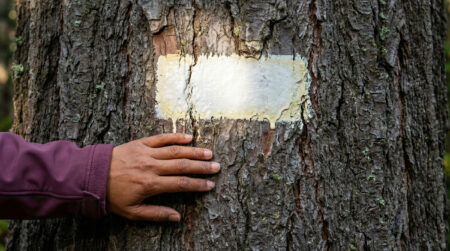
Planning to “figure it out on the trail.” Trail junctions can be confusing. Blaze colors matter. Spending five minutes before the hike looking at the map, noting the blaze color, and understanding where the turnaround is: that five minutes is worth more than any piece of gear.
When to Turn Around (And Feel Good About It)
One of the most practical hiking basics for beginners is also the one that feels counterintuitive: turning around early is not failure. It’s good judgment.
If you reach the halfway point and realize your water is almost gone, or your legs are more tired than expected, or the weather is changing in a direction you’re not prepared for, turn around. That’s the right call. The trail will be there next weekend.
The specific threshold experienced hikers use: if you’ve used a third of your water and you’re not yet a third of the way through the hike, turn back. The math doesn’t work. Apply the same logic to energy: genuinely depleted before the halfway point means the second half on tired legs and low fuel is a recipe for a bad day, not a redemption arc.
For planning your specific first hike, the National Park Service has a trail planning and safety overview covering responsible day hiking. It’s written for the full range of park visitors, which means it’s calibrated for real beginners.
Turning around once makes the next attempt smarter. You learn your actual pace, your actual water consumption rate, your actual energy arc over distance. That data is more useful for planning your second hike than anything you could read beforehand. I’ve turned around twice on trails I later completed. Both times I came back better prepared.
Frequently Asked Questions: What to Expect on Your First Hike
What should I expect on my first hike?
Expect slower pace than walking on flat ground, harder breathing on any uphill sections, and a satisfaction at the finish that most people don’t predict from the parking lot. The physical demands are real but manageable on a well-chosen beginner trail. Post-hike soreness is normal and fades within 72 hours. The most common concern about what to expect on your first hike is whether you can do it. The answer is almost always yes, on the right trail with the right preparation.
How hard is a beginner hiking trail really?
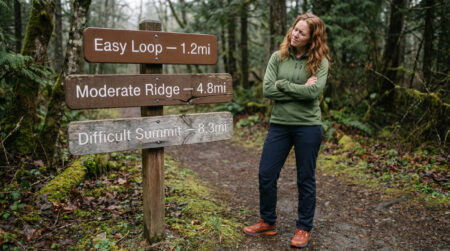
An Easy-rated trail with under 200 feet of elevation gain over 2 to 3 miles is genuinely accessible for most adults who walk regularly. The terrain is harder than pavement, more variable and more demanding of ankle stability, but the cardiovascular challenge on flat or gently rolling terrain is mild to moderate. Uphills are where first-timers feel the difference most. Going slowly on climbs, more slowly than feels necessary, makes almost any trail in any beginner hiking guide finishable.
What should I wear on my first hike?
Athletic clothes you already own work fine. The one non-negotiable: non-cotton socks. Wool or synthetic hiking socks prevent the blisters that cotton causes, and that $20 investment makes more difference to your first hike experience than any other gear purchase. Shoes with grip and support (trail runners, light hiking shoes, or any athletic shoe with a grippy sole) beat casual sneakers on rocky terrain. A light layer in your pack is worth having even on warm days, since temperatures drop quickly when you stop moving.
How much water do I need for a first hike?
At minimum: 1.5 liters for a hike under 3 miles in moderate temperatures. In summer heat above 75°F, bring 2 liters. In heat above 85°F or for any hike over 3 miles, carry 2.5 to 3 liters. The common mistake is calibrating water to a 2-hour walk rather than a 2-hour trail hike, which burns more calories and produces more sweat than most beginners expect. This is the most-skipped item on any first hike checklist. Carrying extra weight is a minor inconvenience. Running out in the second half in heat is a real problem.
Will I be embarrassingly slow on my first hike?
No. Trail pace is slower than pavement pace for everyone, including experienced hikers. Most beginners on a well-chosen first hike move at roughly 1.5 to 2 miles per hour on flat sections and slower on climbs. That’s a normal, sustainable pace. Other hikers on trail are not watching your pace. They’re focused on their own effort. Slow on your first hike means you’re hiking, not racing. Both are correct.
What if I can’t finish the trail?
Turn around. There is no obligation to complete any trail, at any point, for any reason. If you reach a point where finishing feels unsafe, uncomfortable beyond normal exertion, or where your water or energy won’t support the return, turning around is the smart call. The trail exists tomorrow. Your second hike, with the knowledge from the first, will go further. What to expect on your first hike includes the very real possibility that you’ll turn around before the marked endpoint. That’s hiking, not failure.
How sore will I be after my first hike?
Expect noticeable soreness in your glutes, calves, and the outside of your hips 24 to 48 hours after your first hike. It peaks at 48 hours and fades by 72. This is delayed onset muscle soreness (DOMS): normal, not injury, from muscles that trail terrain uses in ways your regular activity doesn’t. Stairs feel different for a day or two. A short flat walk the day after speeds recovery faster than rest. If the soreness is sharp, localized in a joint rather than a muscle, or gets worse rather than better over 72 hours, that’s worth having looked at.
You Already Know Enough to Start
What to expect on your first hike has a short answer: harder and better than you’re picturing, and the gap between both of those and what you imagined closes fast.
You’ll go slower than planned. Your legs will find something to say around mile two. The quiet that appears within 15 minutes of the trailhead will surprise you every time until it doesn’t. The parking lot will be louder than your mental image. The top will be worth the climb. The drive home will involve an unreasonable amount of hunger.
This beginner hiking guide covers the experience, not just the gear list, because knowing what’s coming is what makes the first hike actually enjoyable rather than just survivable. The second hike is easier than the first in every way that matters. Not because you’re suddenly fitter, but because you know what’s coming. Book it before the soreness fades.
Next Steps
- Right now: Pick a specific trail, not a category of trail but an actual named trail with a starting point within 30 minutes of you. Look up the distance, elevation gain, and one recent AllTrails review. That’s the research. The decision takes two minutes.
- Before your first hike: Download the offline map at home. Pack 1.5 to 2 liters of water. Wear non-cotton socks. Eat a real meal 90 minutes before you leave, not just coffee in the car.
- After your first hike: Write down your actual pace and how your legs felt at the finish. That data makes your second hike’s planning more accurate than any estimate in any guide.