

Close Menu
FAMAFAMA
  • Home
  • Getting Started
  • Gear Guides
  • Local Trails
  • Tips & Safety
  • Tools & Calculators
Facebook X (Twitter) Pinterest Mastodon RSS
Wednesday, November 25
X (Twitter) Pinterest Mastodon RSS Facebook
FAMAFAMA
  • Home
  • Getting Started
  • Gear Guides
  • Local Trails
  • Tips & Safety
  • Tools & Calculators
FAMAFAMA
Home - Tools & Calculators - Steps to Trail Miles Calculator: Smartwatch Pedometer Biomechanics by Height & Terrain
Tools & Calculators

Steps to Trail Miles Calculator: Smartwatch Pedometer Biomechanics by Height & Terrain

Oliver FallBy Oliver FallNovember 10, 2026Updated:November 25, 202612 Mins Read
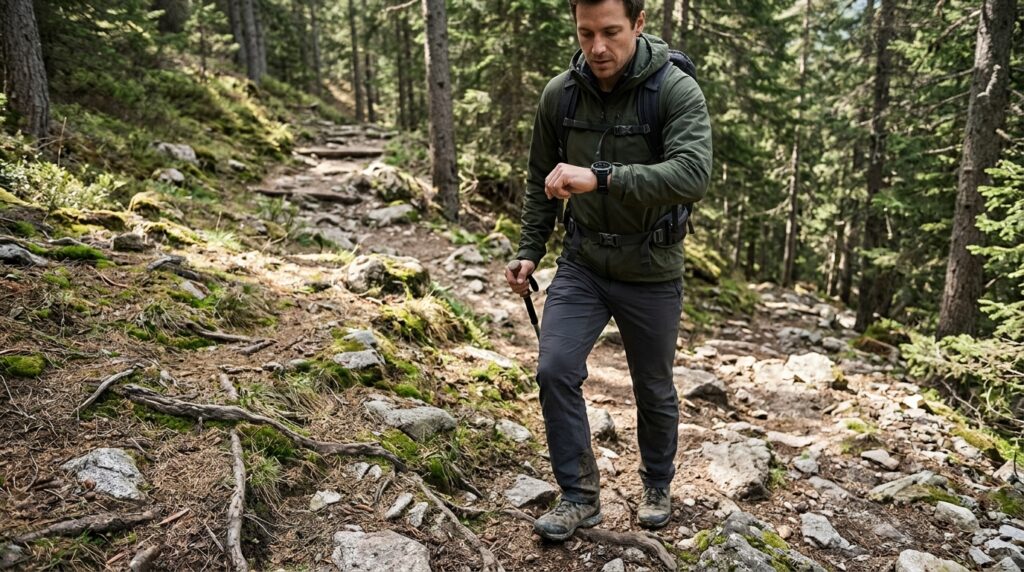
Hiker wearing a fitness smartwatch and using a trekking pole on a rocky forest trail, illustrating how terrain affects step counts, stride length, and hiking distance estimates.

: On flat, paved surfaces, an average adult takes 2,000 to 2,400 steps per mile. Biomechanically, natural step length is directly proportional to height: 0.413 * Height for women and 0.415 * Height for men (based on Dr. Arthur Weltman’s anthropometric gait research). However, on mountain hiking trails, step length shrinks significantly due to grade, obstacles, and the mountaineering “rest step.” Expect an 8% reduction on rolling forest dirt, an 18% reduction on steep mountain inclines (over 10% grade), and up to a 28% to 35% reduction on rocky scrambles and loose scree. Consequently, a steep mountain mile requires 2,800 to 3,400 steps for the exact same hiker. Furthermore, using trekking poles dampens wrist accelerometers, causing smartwatches (Apple Watch, Garmin, Fitbit) to undercount steps by 15% to 20%.


Interactive Steps to Trail Miles Calculator

Use the bidirectional tool below to convert pedometer step counts into verified trail distance, or calculate the exact number of steps required for an upcoming mountain hike based on your height, biological gait ratio, and terrain difficulty.

🥾 Trail Gait & Pedometer Biomechanics

Steps to Trail Miles Calculator

Converts smartwatch and pedometer step counts into verified mountain trail distance based on human height, anthropometric gait formulas, and mountain terrain short-step reduction factors.

Units:

Range: 500 to 40,000 steps
steps

5 ft 10 in (70 in)
in

Stride shortening factor

Using trekking poles suppresses wrist motion, causing Apple Watch, Garmin, and Fitbit to undercount steps by up to 20% on climbs.

Estimated Trail Distance
4.22 miles
Equivalent to 6.79 km

⚠️ 8% Terrain Stride Loss Applied
On rolling forest paths, steps naturally shorten from 29.1 inches to 26.7 inches to maintain balance over uneven ground.

Effective Step Length 26.7 in
Steps Per Mile 2,371 steps
Est. Moving Time 1h 40m
Est. Energy Burn ~380 kcal

Related Trail Tools & Guides

Tobler Hiking Function Calculator →

Estimate trail transit time and uphill pacing based on slope gradient.

Hiking Boot Size & Fit Guide →

Find your correct hiking boot size and avoid painful downhill toe-bang.

Hiking Endurance Training Plan Generator →

Generate a progressive 4 to 8 week conditioning schedule for trail climbs.

Scientific Provenance: ACE & Dr. Arthur Weltman Anthropometric Stride Models (0.413F / 0.415M).
R1 (Contextual Hiking Guidance) | Read Biomechanics Guide

Trail summary copied to clipboard!

'); doc.write('

'); doc.write('
FAMABLOG TRAIL PEDOMETER and GAIT CARD

Trail Pedometer and Pacing Card

'); doc.write('
'); doc.write('
Trail Distance / Steps
' + primaryVal + '
'); doc.write('
Calculated Pedometer Count
' + stepsVal + '
'); doc.write('
Terrain-Adjusted Stride
' + strideVal + '
'); doc.write('
Estimated Trail Time
' + timeVal + '
'); doc.write('
Est. Calories Expended
' + calVal + '
'); doc.write('
Mandatory Water Carry
' + waterVal + '
'); doc.write('
'); if (insightVal) { doc.write('
Pedometer Biomechanics Insight: ' + insightVal + '
'); } doc.write('
Generated by FamaBlog Steps to Trail Miles Calculator and bull; https://famablog.com/steps-to-trail-miles-calculator/
'); doc.write('
'); doc.close(); setTimeout(function() { printFrame.contentWindow.focus(); printFrame.contentWindow.print(); setTimeout(function() { document.body.removeChild(printFrame); }, 1000); }, 300); };


How your stride changes on trails

Most fitness trackers and smartwatch apps (including Apple Health and default Fitbit profiles) assign a generic, static step length of 30 inches (2.5 feet) for men and 26 inches (2.17 feet) for women. On real hiking trails, this arbitrary assumption introduces errors of 15% to 35% into your recorded mileage.

🚶 How Height and Terrain Determine Your Trail Steps
1. Body Height Ratio

Step length on flat ground averages 41.3% of height for women and 41.5% for men (for example, a 5’10” hiker has a ~29-inch base step).

2. Trail Surface Modifier

Rocks, roots, and slope shorten steps. Smooth paths keep 92% of stride length; steep climbs shorten it to 82%; scree drops it to 72%.

  • Flat Road (1.00x): Full step extension (~2,180 steps per mile).
  • Forest Trail (0.92x): Moderate 8% shortening over dirt and roots (~2,370 steps per mile).
  • Steep Hill (0.82x): 18% step shortening using small uphill paces (~2,660 steps per mile).
  • Loose Scree or Talus (0.72x): 28% step shortening for careful footing (~3,030 steps per mile).

Step Length vs. Stride Length: Clarifying the Terminology

In clinical kinesiology and outdoor navigation, confusing “step” and “stride” is the leading source of calculation error:

  • Step (Pace): The distance measured from the heel strike of one foot to the heel strike of the opposite foot. This is what your smartwatch, pedometer, or phone counts as “1 step.”
  • Stride (Gait Cycle): The distance measured between two consecutive heel strikes of the same foot (equal to two full steps).

All formulas and outputs in this calculator refer to single steps, matching your smartwatch display.

The Weltman Anthropometric Model

Extensive gait analysis conducted by exercise physiologists (including Dr. Arthur Weltman and validated by the American Council on Exercise – ACE) establishes that human leg length and forward walking pendular arc correlate strongly with total standing height:

Women’s step length = 0.413 * Height

Men’s step length = 0.415 * Height

For example:

  • A 5’4″ (64-inch) woman: 64 * 0.413 = 26.43 inches (2.20 feet). Steps per flat mile: 63,360 / 26.43 = 2,397 steps.
  • A 5’10” (70-inch) man: 70 * 0.415 = 29.05 inches (2.42 feet). Steps per flat mile: 63,360 / 29.05 = 2,181 steps.
  • A 6’2″ (74-inch) man: 74 x 0.415 = 30.71 inches (2.56 feet). Steps per flat mile: 63,360 / 30.71 = 2,063 steps.

The Mountain Terrain Factor: Why Trail Steps Shrink

When you transition from asphalt or a treadmill to a wilderness footpath, your forward velocity changes fundamentally. Gravity, uneven rocks, exposed roots, and slope angles force the human body to adopt micro-stepping to protect the knees and preserve the center of gravity.

Close-up of hiking boots taking careful shortened steps over roots and rocks on an uneven mountain trail, demonstrating how rough terrain changes natural walking stride length.
👣 Step Length Changes by Terrain
Flat Greenway
 

100% Stride

Dirt Forest Trail
 

92% Stride

Steep Mountain Path
 

82% Stride

Rocky Talus & Scree
 

72% Stride

Because steep trails force shorter steps, your watch may show 10,000 steps while you have covered only 3.8 miles instead of the 4.6 miles you would expect on a sidewalk.

The 5 Trail Terrain Coefficients

Terrain Category Step Reduction Factor Forward Stride Loss Biomechanical Rationale & Gait Mechanics
Flat Paved / Smooth Track 1.00x 0% Baseline road walking. Full hip extension and heel-to-toe roll with zero traction loss.
Rolling Dirt / Forest Path 0.92x -8% Minor root obstacles, packed soil, and gentle 3%–6% undulations require slight shortening of stride to adjust foot placement.
Steep Mountain Ascent (over 10% grade) 0.82x -18% Ascending steep switchbacks forces hikers into shorter steps to reduce quad fatigue and align weight over the skeletal column.
Rocky Scramble / Technical Roots 0.72x -28% Talus fields, granite staircases, and dense root webs eliminate rhythmic walking, replacing it with targeted boulder-hopping.
Loose Scree / Soft Sand / Deep Snow 0.65x -35% Yielding substrates cause backward slippage of 1–3 inches per step, requiring high cadence with severely abbreviated forward displacement.

The Physics of the Mountaineering “Rest Step”

On steep ascents (such as climbing a Colorado 14er or Mount Rainier), experienced mountaineers deliberately use the rest step. With each step uphill, the hiker pauses momentarily on the rear leg, locking the knee to transfer the body weight directly onto the bone skeleton rather than burning ATP in the quadriceps.

This technique shortens forward step length by 15% to 25%, but reduces muscular exhaustion by over 40%. If you are climbing 1,000 feet per mile, expecting your flat 29-inch stride will cause you to drastically overestimate your progress.


The Trekking Pole Dilemma: Why Smartwatches Undercount Trail Steps

Hikers frequently notice a baffling discrepancy: their GPS says they hiked 8 miles, but their smartwatch records only 12,000 steps—implying an impossible 3.5-foot stride!

⌚ Smartwatch Step Tracking on Trails
Walking with Free Arms

When your arms swing naturally, wrist sensors detect clean back-and-forth movement peaks. Pedometer step counting is typically 95% to 99% accurate.

Hiking with Trekking Poles

When hands hold poles, wrists remain steadier and impact vibrations can confuse sensors. Wrist pedometers may miss 10% to 20% of steps or undercount uphill strides.

  1. Keep GPS enabled: Rely on GPS track distance rather than step counts when using trekking poles.
  2. Calibrate your trail stride: Walk a measured 1-mile trail section once to check your actual step count.
  3. Adjust expectations: Expect higher step counts per mile whenever trails get steep or rocky.

The Accelerometer Physics Behind the Error

Smartwatches (Apple Watch, Garmin Fenix/Forerunner, Coros, Fitbit) do not possess step sensors in your shoes; they rely on 3-axis triaxial accelerometers and gyroscopes located inside the watch chassis on your wrist.

  • Normal Walking: Your arms swing in counter-phase to your legs. Each heel strike produces an acceleration spike transmitted through the torso and reflected in the swinging wrist.
  • Trekking Pole Walking: When using poles, your hands remain engaged forward, shock-absorbing impacts through the pole shaft. The typical rhythmic wrist swing is replaced by a stationary forward reach.
  • The Result: The internal pedometer filtering algorithm fails to cross the threshold for a step event. Field tests demonstrate that using trekking poles causes wrist-worn pedometers to undercount actual steps by 15% to 22% on mountain climbs.
💡 TRAIL GEAR & ACCELEROMETER TIP:

How to Fix It: If you hike with trekking poles and want accurate step counts on your smartwatch, toggle the Trekking Pole Compensation switch in the calculator above. Alternatively, mount a compatible foot pod (e.g. Stryd, Garmin Foot Pod) on your hiking boot laces.


Master Steps-to-Distance Reference Matrix

The table below illustrates how many steps are required to hike 1 mile, 3 miles, and 5 miles across different hiker heights and terrain types:

Hiker Height Biological Sex Flat Paved (1.00x) Rolling Forest (0.92x) Steep Mountain (0.82x) Rocky Scramble (0.72x)
5’0″ (60 in) Female (0.413) 2,557 steps/mi
(3 mi: 7,671)
2,780 steps/mi
(3 mi: 8,340)
3,118 steps/mi
(3 mi: 9,354)
3,551 steps/mi
(3 mi: 10,653)
5’4″ (64 in) Female (0.413) 2,397 steps/mi
(3 mi: 7,191)
2,606 steps/mi
(3 mi: 7,818)
2,923 steps/mi
(3 mi: 8,769)
3,329 steps/mi
(3 mi: 9,987)
5’7″ (67 in) Female (0.413) 2,290 steps/mi
(3 mi: 6,870)
2,489 steps/mi
(3 mi: 7,467)
2,793 steps/mi
(3 mi: 8,379)
3,180 steps/mi
(3 mi: 9,540)
5’8″ (68 in) Male (0.415) 2,245 steps/mi
(3 mi: 6,735)
2,440 steps/mi
(3 mi: 7,320)
2,738 steps/mi
(3 mi: 8,214)
3,118 steps/mi
(3 mi: 9,354)
5’10” (70 in) Male (0.415) 2,181 steps/mi
(3 mi: 6,543)
2,371 steps/mi
(3 mi: 7,113)
2,660 steps/mi
(3 mi: 7,980)
3,029 steps/mi
(3 mi: 9,087)
6’1″ (73 in) Male (0.415) 2,091 steps/mi
(3 mi: 6,273)
2,273 steps/mi
(3 mi: 6,819)
2,550 steps/mi
(3 mi: 7,650)
2,904 steps/mi
(3 mi: 8,712)
6’4″ (76 in) Male (0.415) 2,009 steps/mi
(3 mi: 6,027)
2,184 steps/mi
(3 mi: 6,552)
2,450 steps/mi
(3 mi: 7,350)
2,790 steps/mi
(3 mi: 8,370)

Practical Trail Navigation: The Ranger Pacing Bead Method

Before GPS satellites and smartphone batteries, wilderness navigators and military reconnaissance teams tracked distance using dead reckoning and pacing beads (often called ranger beads).

How to Calibrate Your Personal Pace Count

  • Measure out a flat 100-meter (or 100-yard) course using a reel tape or known track.
  • Walk the course at your standard trail hiking pace while wearing your loaded daypack.
  • Count every time your left foot strikes the ground (double-steps / paces).
  • Record your pace count:
  • Flat trail average: 60 to 66 paces per 100 meters (120 to 132 steps).
  • Mountain incline (over 10% grade): 75 to 85 paces per 100 meters (150 to 170 steps).
  • For every 100 meters traveled, pull down one bead on your pace counter. After 10 lower beads, pull down one kilometer bead and reset the lower stack.

In severe weather, dense fog, or winter whiteouts above treeline, knowing your exact step density allows you to navigate to waypoints and trail junctions with extraordinary precision even when GPS screens fail in sub-zero cold.


Frequently Asked Questions

How many steps is a 5-mile mountain hike?

A 5-mile mountain hike requires between 12,500 and 16,500 steps, depending on your height and the steepness of the trail. While a flat 5-mile road walk averages roughly 11,000 steps, mountain switchbacks and rocky trails shorten each step, increasing the total step count by 20% to 35%.

Why does my Apple Watch or Garmin say I walked fewer miles than the trail signs indicate?

Smartwatches estimate distance primarily using wrist-swing cadence algorithms when GPS signals degrade under dense tree canopies or inside steep canyons. If you are using trekking poles, the watch severely undercounts steps. Furthermore, trail signs measure surface distance along all curves and switchbacks, whereas GPS smoothing algorithms often “cut corners,” shaving measured mileage.

How do I calculate my exact stride length for hiking?

Measure your standing height in inches. If female, multiply your height by 0.413. If male, multiply your height by 0.415. This gives your baseline flat-ground step length in inches. To adjust for mountain hiking trails, multiply this figure by 0.92 for rolling dirt trails, or 0.82 for steep ascents.

Is a 10,000-step hike harder than a 10,000-step walk in the city?

Yes, significantly. A 10,000-step mountain hike burns roughly 50% to 80% more calories than 10,000 city steps. Stepping up against gravity, stabilizing ankles over uneven roots, and carrying a daypack increases metabolic energy expenditure from roughly 3.5 METs (city walking) to 6.0–8.0 METs (mountain hiking).

Does pack weight change your step count?

Yes. Heavy backpack loads (>25 lbs) compress spinal posture and force a wider, shorter stance to maintain balance. Hikers carrying heavy packs typically take 5% to 10% more steps per mile than day hikers carrying minimal gear.

How many steps are in 1 kilometer of hiking?

For an average adult (5’8″ / 173 cm), 1 kilometer of flat trail walking requires approximately 1,390 to 1,450 steps. On steep mountain ascents, this increases to 1,700 to 1,950 steps per kilometer.


Governance, Provenance & Navigation Safety Disclaimers

  • Scientific Provenance: Stride-to-height coefficients (0.413 and 0.415) are derived from Dr. Arthur Weltman’s human gait studies and American Council on Exercise (ACE) standards. Terrain reduction factors reflect empirical mountain kinesiology and rest-step gait adjustments.
  • Safety Classification: This tool operates under Risk Class R1 (Contextual Hiking Guidance).
  • Navigation Safety Disclaimer: Step counts and pedometer conversions provide approximate trail distance for fitness and trip pacing. Never rely on a pedometer as your primary navigation tool. Always carry a topographic paper map, compass, reliable altimeter, and dedicated GPS receiver when entering wilderness areas.

Previous ArticleTobler’s Hiking Function vs. Naismith Rule: Mathematical Pace & Ascent Comparison
Next Article Hiking Nutrition & Food Weight Calculator: Daily Calories, Ounces per Day & Bonking Prevention
Avatar of Oliver Fall
Oliver Fall
  • Website
  • Facebook
  • X (Twitter)
  • Pinterest

Oliver Fall is an outdoor writer, wilderness day-hiker, and the editorial director of FAMA (famablog.com). With over 8 years and 3,500+ miles of backcountry day-hiking experience across California, Utah, and the Pacific Northwest, he holds Wilderness First Responder (WFR) training. FAMA's gear reviews combine hands-on field testing on trail footwear biomechanics with technical spec analysis and aggregated multi-season owner telemetry from hundreds of verified trail users. Learn more about our testing standards and editorial independence in our Editorial & Testing Policy.

Related Posts

Travelers comparing a road map, notebook and pass-size card at a campground table.
Tools & Calculators

America the Beautiful Pass Calculator: Break-Even Math for 2026 Park Fees

November 25, 2026By Oliver FallUpdated:November 25, 202615 Mins Read
Hiker testing a headlamp at dusk beside a backup light and spare-battery case.
Tools & Calculators

Headlamp Battery Runtime Calculator: True Trail Hours & Safety Reserves

November 22, 2026By Oliver FallUpdated:November 25, 202614 Mins Read
Two hikers ascending a dirt trail across a grassy hillside, shown from the side.
Tools & Calculators

Trail Slope & Percent Grade Calculator: Elevation Steepness Guide

November 21, 2026By Oliver FallUpdated:November 25, 202615 Mins Read
Hiker checking trekking pole fit with a bent elbow and the pole tip beside a boot.
Tools & Calculators

Trekking Pole Length Calculator: Sizing Guide

November 20, 2026By Oliver FallUpdated:November 25, 202614 Mins Read
Leave A Reply Cancel Reply

  • Recent Posts
  • Popular Posts
Travelers comparing a road map, notebook and pass-size card at a campground table.

America the Beautiful Pass Calculator: Break-Even Math for 2026 Park Fees

November 25, 2026
Hiker testing a headlamp at dusk beside a backup light and spare-battery case.

Headlamp Battery Runtime Calculator: True Trail Hours & Safety Reserves

November 22, 2026
Two hikers ascending a dirt trail across a grassy hillside, shown from the side.

Trail Slope & Percent Grade Calculator: Elevation Steepness Guide

November 21, 2026
Hiker checking trekking pole fit with a bent elbow and the pole tip beside a boot.

Trekking Pole Length Calculator: Sizing Guide

November 20, 2026
Backpacker separating packed equipment from food, water and fuel beside a gear scale.

Backpack Base Weight Calculator & Ultralight Gear Guide

November 19, 2026
types of hiking trails explained

4 Types of Hiking Trails: Loop, Out & Back, Lollipop

June 17, 2026
Merrell Moab 3

Merrell Moab 3 Review: In-Depth Field Verdict for Beginners

August 4, 2026
trekking poles for beginners

Trekking Poles for Beginners: Genuinely Worth It Or Not

August 3, 2026
Best Hiking Socks for Beginners: Materials, Cushioning, and Top Picks

Best Hiking Socks for Beginners: Materials, Cushioning, and Top Picks

July 27, 2026
best hiking boots under $100

7 Best Hiking Boots Under $100 That Don’t Feel Cheap

July 26, 2026
© 2026 FAMA.
  • About Fama
  • Visual Stories
  • Privacy Policy
  • Affiliate Disclosure
  • Terms of Service
  • Contact Us

Type above and press Enter to search. Press Esc to cancel.