

Definition: Leave No Trace (LNT) is a standardized set of seven ethical wilderness conservation guidelines designed to minimize human ecological impact on outdoor trails. Leave no trace principles for beginners come down to one idea: your presence on a trail should be invisible to the next hiker who walks it. No litter, no shortcuts across vegetation, no fire rings in the wrong place, no wildlife disturbed by your lunch leftovers. Seven specific principles cover everything, and learning them before your first hike costs about ten minutes. Most beginners assume they already follow these rules because they don’t litter. Litter is…
Author: Oliver Fall

Oliver Fall
Oliver Fall is an outdoor enthusiast with over 8 years of trail and backcountry hiking experience across Southern California. Two years ago, he founded Fama to break down real-world gear advice, practical trail skills, and honest beginner mistakes to help newcomers explore the outdoors with confidence.
Definition: Hiking endurance is the physical stamina and cardiovascular efficiency required to maintain a sustainable walking pace over multi-mile ascents without exhaustion. How to build hiking endurance isn’t complicated, but most beginners go about it wrong. They either try to do too much too soon and end up sore for days, or they train on flat surfaces and then hit their first real climb and wonder what happened to all the fitness they thought they’d built. I made the second mistake myself. A group of friends invited me on a 10-mile trail about a month after I’d started hiking. I…

What size backpack for day hiking do you actually need? For most people: 20 to 25 liters. That’s enough room for water, food, the 10 essentials for day hiking, and one extra layer, without leftover space that tempts you to carry things you will not use. Go smaller for short, flat, warm weather hikes. Go bigger only for cold shoulder seasons, longer mileage, or carrying gear for someone besides yourself. My first hiking backpack was 35 liters, bought on sale for $40 off, for a 4-mile loop with maybe 400 feet of gain. I filled every inch of it: a…

What to wear hiking in summer comes down to three things, in order: fabric, fit, and coverage. Synthetic or merino wool instead of cotton (learn how much water to bring hiking in summer heat). Loose instead of tight. More skin covered by thin, UPF-rated fabric than left bare under direct sun. Color matters less than people assume. Done right, this combination keeps you cooler than shorts and a tank top, not hotter. My first serious summer hike was a 6-mile loop outside Moab in July, in a cotton t-shirt and running shorts because they were clean that morning. By mile…
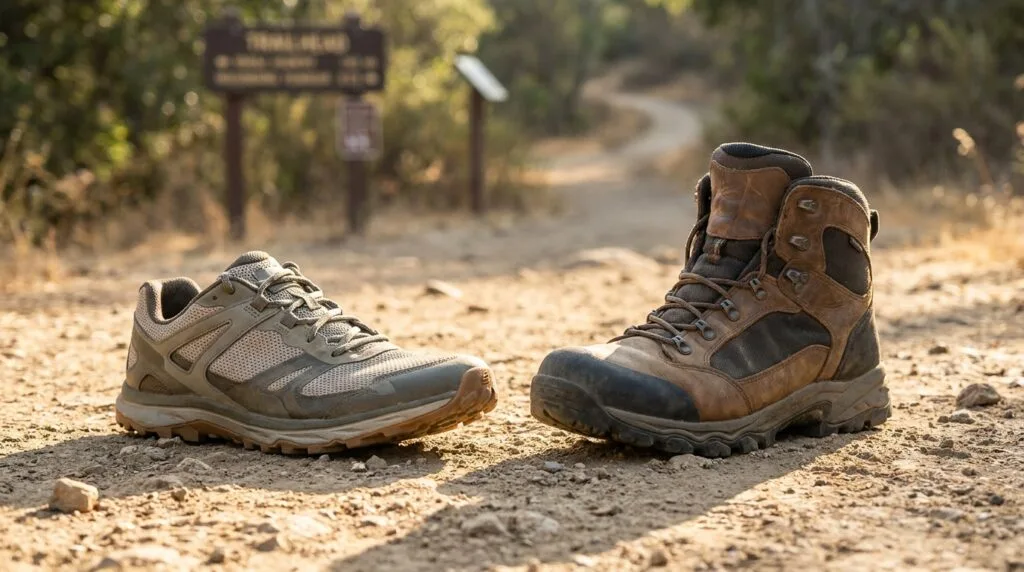
FAMA is reader-supported. When you buy through links on our site, we may earn an affiliate commission at no extra cost to you. Learn more. The honest answer on trail runners vs hiking boots: for most beginners on maintained trails under about 8 miles, trail runners win. They weigh roughly half as much, need zero break-in, and won’t leave you limping through your first three hikes while your feet adjust. Boots earn their keep once you’re off-trail, carrying real weight, or gaining serious elevation. That’s the gear industry’s least favorite sentence, because boots carry better margins and trail runners are…

If you wanted to know about breaking in hiking boots fast, the honest answer is 7 to 10 days of layered, progressive wear for most boots (if you prefer zero break-in time, compare trail runners vs hiking boots). Not a weekend trick, not one long walk the day before you leave. Nothing skips that timeline without raising your blister risk once you’re actually on trail. The boots that feel fine standing in the store are exactly the ones that fail six miles in if you skip this part. What you can control is making those 7 to 10 days count…
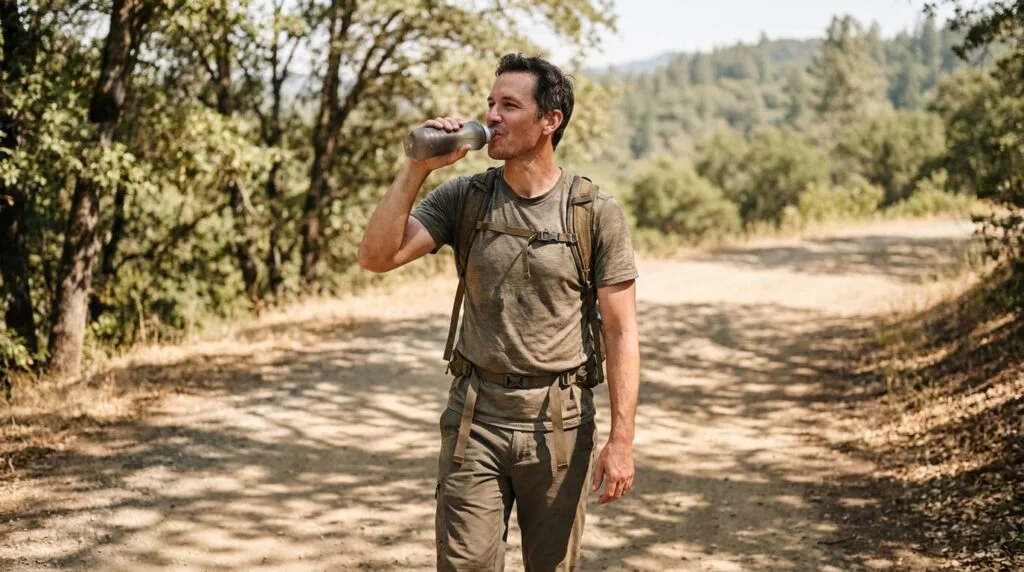
How much water to bring hiking comes down to one number most people get wrong in both directions: too little, because they planned around miles instead of hours and heat, or too much, because they’re carrying for a hike that isn’t the one they’re actually doing. The fast answer: about half a liter per hour on a moderate day hike, closer to a full liter per hour once it’s hot or the trail turns into real climbing. That’s the number worth memorizing tonight. Two years back, in July, me and my friend packed the same 2.5 liter tumbler each (see…

FAMA is reader-supported. When you buy through links on our site, we may earn an affiliate commission at no extra cost to you. Learn more. Water bottle vs hydration bladder for hiking: most hikers actually pick the bottle, especially when they’re just starting out. A SectionHiker survey of 485 day hikers found 63% preferred bottles over bladders, and the reasons were practical, not nostalgic. Bottles cost less upfront, usually under fifteen dollars for something durable, versus thirty or forty for a decent bladder setup. There’s less to clean too, just one opening you can scrub in ten seconds, instead of…

FAMA is reader-supported. When you buy through links on our site, we may earn an affiliate commission at no extra cost to you. Learn more. The Merrell Moab 3 is the pick if you’ve already decided you want a boot instead of a trail runner. It’s comfortable within the first half mile, priced fairly for a first pair, and it doesn’t demand three weeks of painful breaking in before your feet stop hating it. This review covers exactly where that holds up and where it doesn’t. That “if” at the start matters more than most gear reviews admit. Most beginners…

FAMA is reader-supported. When you buy through links on our site, we may earn an affiliate commission at no extra cost to you. Learn more. Most beginners don’t need trekking poles for their first several hikes. That changes once elevation and distance climb: if your knees ache on the way down, or your hikes are creeping past 6 miles with real elevation gain, trekking poles for beginners stop being optional gear and start being the thing that gets you back to the car comfortably. I went without poles for two full seasons of short trails and never missed them. Then…

FAMA is reader-supported. When you buy through links on our site, we may earn an affiliate commission at no extra cost to you. Learn more. The best hiking socks for beginners aren’t the priciest pair on the shelf. They’re whichever pair keeps moisture off your skin, since a bad sock is the single piece of gear most likely to end a first hike early, more often than a bad boot or bad weather. ⚡ Quick Trail Takeaways Material Choice: Merino wool regulates temperature and resists odor better than synthetics. Never wear cotton. Cushion Tier: Light cushion for hot flat trails;…

FAMA is reader-supported. When you buy through links on our site, we may earn an affiliate commission at no extra cost to you. Learn more. The best hiking boots under $100 aren’t the ones that look the part in a product photo. They survive a wet trailhead, hold their shape past month three, and don’t send you back to shopping by hike five, a lower bar than the marketing suggests. ⚡ Quick Trail Takeaways Fit Over Brand: A $90 boot that fits your heel correctly beats a $250 brand-name boot that causes hot spots. Traction & Lug Depth: Look for…

FAMA is reader-supported. When you buy through links on our site, we may earn an affiliate commission at no extra cost to you. Learn more. Best hiking pants for beginners, on a real budget, means picking fabric and fit over brand name, because the two things that actually matter (quick-drying synthetic fabric and a fit that moves with you) show up in a $35 pair almost as often as a $90 one. The gap between cheap and expensive hiking pants is mostly pocket count, warranty length, and how many seasons the fabric survives, not whether you’ll be comfortable on Saturday’s…

FAMA is reader-supported. When you buy through links on our site, we may earn an affiliate commission at no extra cost to you. Learn more. The best hiking backpack under $50 for most first-timers is the REI Co-op Flash 18. It runs $44.95, it will not fall apart on you, and REI stands behind it if it does not work out. That is the short answer. ⚡ Quick Trail Takeaways Ideal Volume: 18L to 25L is the sweet spot for day hikes carrying water, extra layers, and snacks. Harness & Comfort: Padded mesh shoulder straps prevent chafing during 4+ hour…

Knee pain hiking downhill is the most common complaint I hear from new hikers after their first real trail with any descent. Not sore quads. Not blisters. Their knees, specifically on the way back to the car. The trail that felt manageable going up turns into something that makes every step a negotiation. ⚡ Quick Trail Takeaways Trekking Poles: Offloads 15-25% of downhill knee joint impact forces to upper body muscles. Stride Mechanics: Shorten stride length and maintain slightly flexed knees to absorb impact. Targeted Support: Compression knee sleeves or PAT strap braces stabilize the patella on steep descents. Here’s…

Hiking on your period is not a special accomplishment. It is logistics. The problem is not that trail hiking during menstruation is physically impossible or even particularly hard. It is that almost nobody lays out the specific decisions you need to make before you leave home, and a few of them matter enough that skipping them makes for a genuinely miserable day. ⚡ Quick Trail Takeaways Hygiene Kit: Carry a dedicated opaque ziplock bag, unscented wipes, and hand sanitizer. Leave No Trace: Pack out all used products in sealed waste bags; never bury menstrual products. Menstrual Cup / Disc: Offers…

Hiking safety tell someone where you’re going is the preparation step most beginners do partially or skip entirely. The version most people do is not actually useful. “Going hiking, back by 3” sounds like you’ve done the step. If you didn’t come back, your contact has no trail name, no trailhead, no parking location, and no idea when to call for help or who to call. ⚡ Quick Trail Takeaways Trip Plan Essentials: Share exact trailhead, planned route, vehicle info, and return time window. Overdue Cutoff Time: Specify a strict time when your emergency contact must notify Search and Rescue.…

If you are sitting on the couch right now with aching legs, wondering why a simple 3-mile loop left you completely wiped out, you are not alone. Feeling deeply exhausted after a hike is one of the most common surprises for beginner hikers. It is rarely a sign of poor fitness—it comes down to the heavy metabolic demands of uneven terrain, constant stabilizer muscle micro-adjustments, subtle dehydration, and hours of direct sun exposure draining your energy reserves. ⚡ Quick Trail Takeaways Glycogen Depletion: Hiking burns 400-600 calories/hour; refuel with complex carbs every 60-90 minutes. Dehydration & Electrolytes: Water alone isn’t…

The most useful advice nobody shares before your first trail outing is simple: your body has never done this specific combination of work before. Even if you walk daily or run 5Ks on flat pavement, navigating uneven dirt, loose gravel, and shifting gradients for two straight hours activates stabilizer muscles, connective tissues, and joint angles that rarely get challenged in regular workouts. ⚡ Quick Trail Takeaways Foot Swelling: Feet expand up to half a shoe size during hikes due to increased peripheral blood flow. DOMS (Delayed Onset Muscle Soreness): Quads and calves peak in soreness 24-48 hours post-hike. Hydration Demands:…

When you look at a trail app, understanding the route layout before leaving the parking lot changes everything about how you pace yourself, budget water, and plan your turnaround time. Hiking trails fall into five basic structural layouts: out-and-back routes, classic loops, lollipop paths, point-to-point traverses, and figure-eight loops. Knowing which layout you are on prevents getting turned around and ensures you never run out of daylight halfway through. ⚡ Quick Trail Takeaways Out-and-Back: Simplest navigation; double your recorded distance to know when to turn around. Loop Trails: Continuous scenery; requires reliable map tracking to avoid taking wrong branch junctions.…

Hiking burns significantly more energy than most people expect from an activity done at a comfortable walking pace. On average, a 160-pound hiker burns between 430 and 550 calories per hour on moderate terrain. Once you factor in a loaded daypack or sustained uphill climbing, that number easily climbs toward 600 to 700 calories per hour—matching the caloric demand of a steady jog while being much gentler on your joints. ⚡ Quick Trail Takeaways Average Burn Rate: 400 to 500 calories/hour on moderate trails for a 160-lb hiker. Pack Weight & Incline: Heavy packs (20+ lbs) and steep climbs increase…

Few things ruin the excitement of hiking faster than discovering a painful nickel-sized blister on the back of your heel right as you take your boots off in the parking lot. The good news is that trail blisters are almost entirely preventable once you understand the two forces that cause them: friction and moisture. By mastering proper footwear fit, choosing merino wool socks, and pre-taping known hotspots, you can protect your feet on every outing. ⚡ Quick Trail Takeaways Pre-Taping: Apply Leukotape P to heels and toes before setting foot on trail. Sock System: Wear merino wool or double-layer synthetic…

Choosing whether to hike uphill or downhill first might sound like a simple matter of personal preference, but it makes a massive difference to your knees, energy levels, and trail safety. For almost every beginner on an out-and-back route, tackling the uphill climb first is the safest approach. Climbing when your legs are fresh leaves the easier cardiovascular return trip for when fatigue sets in, while protecting tired quadriceps from jarring downhill impact. ⚡ Quick Trail Takeaways Energy Allocation: Hike uphill first while legs and mind are fresh and energy reserves are high. Safety Advantage: Descending second prevents negotiating steep…

Finding beautiful, well-maintained hiking trails near you does not have to mean buying expensive annual park passes or paying hefty trailhead parking fees. Across the country, hundreds of millions of public acres—managed by county open spaces, state forest preserves, and the Bureau of Land Management—offer free trail access every day. The key is simply knowing which local maps and search filters to use so you can uncover hidden paths right in your backyard. Trail Note: When I first started hiking, I had to learn this the hard way. Here is what I discovered from my own time out on the…

Taking your dog on their very first trail adventure is one of the most rewarding ways to enjoy the outdoors together. While dogs naturally love exploring new sights and smells, ensuring a smooth outing requires a little extra preparation. You need to know which trails allow canine companions, how to pack enough extra hydration for two, and how to spot subtle early signs of fatigue before your dog gets overheated. Trail Note: When I first started hiking, I had to learn this the hard way. Here is what I discovered from my own time out on the trails. ⚡ Quick…

One of the most frequent questions parents ask when getting into family outdoor recreation is what age children can realistically start hiking. The honest answer is that kids can start enjoying the trail at almost any stage—infants can ride comfortably in supportive carriers from early infancy, while toddlers can begin exploring short, flat dirt paths around age two or three. The secret is matching the trail distance and pacing to their natural curiosity. ⚡ Quick Trail Takeaways Start Age: Toddlers (18-24 mos) can start with 0.5-mi nature walks; babies ride in framed carriers. Distance Rule of Thumb: Max mileage =…

Definition: A switchback is a trail that zig-zags across a steep slope to reduce the climbing angle. If you have ever stood at the base of a steep mountain trail and watched the path cut back and forth across the hillside in a zig-zag pattern instead of heading straight up, you are looking at switchbacks in action. Trail builders design switchbacks to turn grueling vertical ascents into gentle, manageable slope grades while protecting delicate hillside soil from rainwater erosion. ⚡ Quick Trail Takeaways Purpose: Switchbacks reduce steep incline grades by weaving back and forth up mountain slopes. Never Cut Switchbacks:…

Realizing that the trail blazes have disappeared and you are no longer sure where you are is an unsettling experience for any hiker. Fortunately, getting turned around on a maintained trail is far more manageable than most beginners fear. By remaining calm and applying the standardized outdoor S.T.O.P. protocol (Stop, Think, Observe, Plan), you can reorient yourself safely and make smart decisions from the very first minute. ⚡ Quick Trail Takeaways S.T.O.P. Protocol: Stop, Think, Observe, Plan. Never panic or wander blindly. Stay Put: Moving away from your last known location makes Search & Rescue discovery far harder. Signaling: Use…

Hiking during the winter months offers peaceful snow-covered scenery, crisp mountain air, and crowd-free trails that you rarely experience during the busy summer season. While winter hiking does require extra attention to temperature management and trail conditions, beginners can safely explore snowy paths by using a simple three-layer clothing system, packing reliable traction microspikes, and picking well-sheltered low-elevation routes. ⚡ Quick Trail Takeaways No Cotton: Synthetic or merino wool base layers prevent hypothermia when sweating. Traction Control: Carry microspikes/cleats for packed snow and icy trail sections. Daylight Pacing: Start early—winter daylight vanishes quickly after 4:00 PM. I got this wrong…

The Ten Essentials are a time-tested collection of safety supplies that outdoor organizations and search-and-rescue teams have recommended for decades. Rather than packing random gear or overfilling your daypack with unnecessary items, focusing on these ten core safety systems ensures you are prepared for unexpected weather shifts, minor trail delays, or route navigation challenges on every day hike. ⚡ Quick Trail Takeaways Core 10 Systems: Navigation, Headlamp, First Aid, Knife, Fire, Shelter, Food, Water, Extra Clothes, Sun Protection. Always Carry: Even on short 2-mile day hikes, emergency delays can happen to anyone. Modern Navigation: Carry an offline GPS map (Gaia/AllTrails)…