

Close Menu
FAMAFAMA
  • Home
  • Getting Started
  • Gear Guides
  • Local Trails
  • Tips & Safety
  • Tools & Calculators
Facebook X (Twitter) Pinterest Mastodon RSS
Saturday, November 28
X (Twitter) Pinterest Mastodon RSS Facebook
FAMAFAMA
  • Home
  • Getting Started
  • Gear Guides
  • Local Trails
  • Tips & Safety
  • Tools & Calculators
FAMAFAMA
Home - Tools & Calculators - Hiking First-Aid Kit Checklist Builder: Custom Wilderness Medical & Trauma Kit Generator
Tools & Calculators

Hiking First-Aid Kit Checklist Builder: Custom Wilderness Medical & Trauma Kit Generator

Oliver FallBy Oliver FallNovember 17, 2026Updated:November 25, 202611 Mins Read
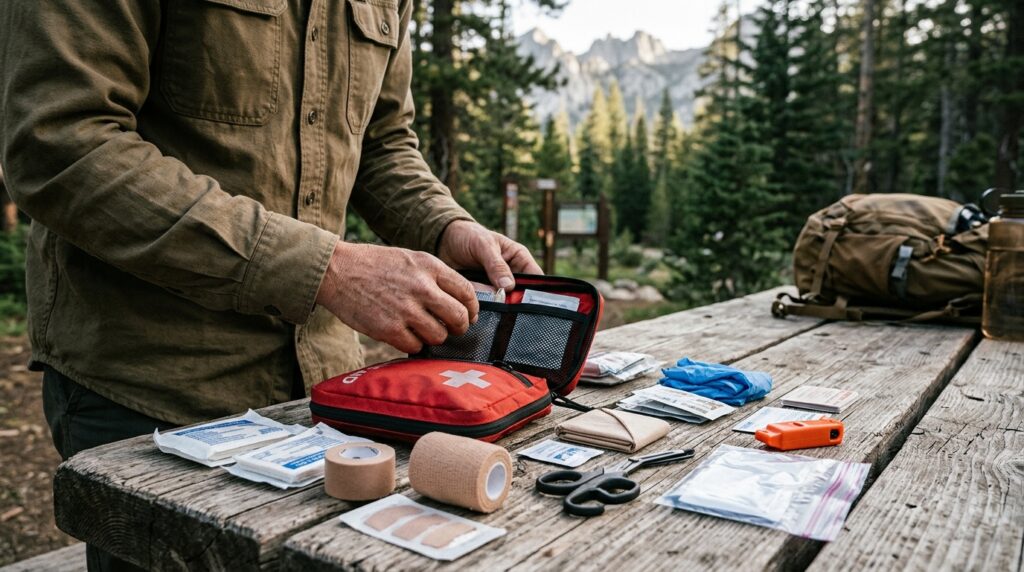
Custom hiking first-aid kit with sterile gauze, blister dressings, medical tape, elastic wrap, gloves, trauma shears, and emergency supplies organized on a mountain trailhead table.

⚡ Quick Answer: Essential Wilderness First-Aid Architecture

A wilderness first-aid kit is an evidence-based trauma and medical system that provides life-stabilizing care in remote backcountry terrain where EMS evacuation requires 2.0 to 24 hours: (1) commercial retail kits ($15 to 35 dollars) are notoriously deficient, packing 90% redundant adhesive bandages while omitting critical supplies like Leukotape P, 2-inch Coban self-adherent wrap, and WHO-standard Oral Rehydration Salts (ORS), (2) an authoritative solo day-hiking kit weighs under 5.0 ounces (140g) and fits in a quart Ziploc bag, and (3) all wilderness parties must tailor medical supplies dynamically according to party size (1 to 6+ hikers), trip duration (1 to 14 days), and specific environmental hazards (desert heat, alpine trauma, or tick vectors).

Clinical Standards: Wilderness Medical Society (WMS) Practice Guidelines, NOLS Wilderness Medicine Institute Curriculum, and Wilderness First Responder (WFR) Certification Protocols.

In this guide:

  1. The Flaws of Commercial Retail Kits: Why Off-the-Shelf First-Aid Packs Fail
  2. Interactive Hiking First-Aid Kit Checklist Builder
  3. Blister Management & Friction Pathophysiology: Leukotape P vs Moleskin
  4. Trauma, Hemorrhage Control & Orthopedic Stabilization: Coban Wrap & SAM Splints
  5. Wilderness OTC Pharmacology & Electrolytes: Ibuprofen, Diphenhydramine & ORS
  6. Wilderness Medical Kit Sizing Benchmark Matrix
  7. The 5-Phase Backcountry Medical Preparedness Protocol (Standard Operating Procedure)

  8. Close-up of a backpacker applying medical blister-prevention tape to the heel during a trail break, with hiking boots and compact first-aid supplies nearby.
    Close-up of a backpacker applying medical blister-prevention tape to the heel during a trail break, with hiking boots and compact first-aid supplies nearby.

    Frequently Asked Questions

The Flaws of Commercial Retail Kits: Why Off-the-Shelf First-Aid Packs Fail

Every year, thousands of hikers venture into wilderness trails carrying commercially packaged red first-aid kits purchased at retail stores. These off-the-shelf kits create a dangerous illusion of safety. Analysis by certified Wilderness First Responder (WFR) and Wilderness Emergency Medical Technician (WEMT) instructors reveals that typical commercial kits allocate 80% to 90% of their piece count to flimsy plastic adhesive bandages, low-grade sting wipes, and safety pins, while completely omitting the supplies required to manage real backcountry emergencies.

Consensus from the Wilderness Medical Society (WMS) [1] (Source: WMS Practice Guidelines, wms.org) and clinical curricula from the NOLS Wilderness Medicine Institute [2] (Source: National Outdoor Leadership School, nols.edu) noted that true backcountry injuries fall into distinct trauma categories: hot water scalding from tippy camp stoves, severe friction blisters that cripple mobility, orthopedic sprains and fractures on rocky descents, and heat-induced hyponatremia. None of these emergencies can be resolved with a plastic cartoon bandage.

⚠️ The Retail Kit Fallacy: Missing Life-Saving Supplies

Stated by wilderness rescue clinicians: retail kits omit Leukotape P (the gold standard for blister friction reduction), Coban self-adherent wrap (which holds dressings without adhesive residue), EMT trauma shears (essential for cutting boot laces and denim), and WHO-standard Oral Rehydration Salts (ORS). Building a custom kit using our interactive tool costs under $25 and saves up to 50% pack weight while delivering genuine trauma-readiness.

Interactive Hiking First-Aid Kit Checklist Builder

Engineered in accordance with WMS clinical guidelines and WFR certification curricula, this interactive checklist builder creates a customized, lightweight medical manifest tailored to your party size, trip duration, and terrain. Select your parameters below to generate and print your field-ready medical manifest for 1 to 14 days trips, cutting pack weight by 50% while assembling a trauma kit for under $25:


🩹
WFR & WMS Clinical Standard

Hiking First-Aid Kit Checklist Builder

Dynamic wilderness medical manifest tailored by party size, trip duration & environmental hazards.


Tailored First-Aid Manifest

12 Essential Items Selected

Total Pack Mass

140 g (4.9 oz)

Pack Checklist: Check off items as you pack into waterproof bags.

|


Meets WFR (Wilderness First Responder) & WMS Guidelines

✓ First-Aid Packing Manifest copied to clipboard! Paste it into your notes or gear checklist.


'); frameDoc.write('

'); frameDoc.write('

'); frameDoc.write('

WILDERNESS FIRST-AID KIT MANIFEST

FamaBlog Medical Telemetry Standard (WFR and WMS Practice Guidelines)

'); frameDoc.write('

FIELD READY

'); frameDoc.write('

');

frameDoc.write('

'); frameDoc.write('

Party Profile' + partyText + '

'); frameDoc.write('

Trip Duration' + durationText + '

'); frameDoc.write('

Total Kit Weight' + totalWt + ' g (' + (totalWt / 28.3495).toFixed(1) + ' oz)

'); frameDoc.write('

');

frameDoc.write('

'); frameDoc.write('

'); frameDoc.write('

'); for (var k = 0; k < items.length; k++) { var itm = items[k]; frameDoc.write(' '); frameDoc.write('

'); frameDoc.write('

'); frameDoc.write('

'); frameDoc.write('

'); frameDoc.write('

'); frameDoc.write('

'); } frameDoc.write('

Pack Medical Supply Item Category Prescribed Quantity Mass
' + itm.name + '
' + itm.desc + '
' + itm.cat + ' ' + itm.qty + ' ' + itm.wt + 'g

');

frameDoc.write('

'); frameDoc.write('

Packed By: _____________________

'); frameDoc.write('

Pack Date: _____________________

'); frameDoc.write('

Meds Expiry Audit: [ ] Verified

'); frameDoc.write('

');

frameDoc.write('

Standard Operating Procedure: Inspect all pharmaceuticals, sterile dressings, and blister hydrogels 48 hours prior to wilderness departure. Replenish immediately after return.

'); frameDoc.write('

'); frameDoc.close();

setTimeout(function() { iframe.contentWindow.focus(); iframe.contentWindow.print(); }, 250); }

function showCopyAlert() { var a = document.getElementById('fama-first-aid-copy-alert'); if (a) { a.style.display = 'block'; setTimeout(function() { a.style.display = 'none'; }, 4000); } }

function setupEvents() { var partyEl = document.getElementById('fama-med-party'); var durationEl = document.getElementById('fama-med-duration'); var terrainEl = document.getElementById('fama-med-terrain');

if (partyEl) partyEl.addEventListener('change', renderList); if (durationEl) durationEl.addEventListener('change', renderList); if (terrainEl) terrainEl.addEventListener('change', renderList);

var btnPrint = document.getElementById('fama-btn-print-first-aid'); if (btnPrint) { btnPrint.addEventListener('click', printFirstAidManifest); }

var btnCheckAll = document.getElementById('fama-btn-check-all'); if (btnCheckAll) { btnCheckAll.addEventListener('click', function() { var cbs = document.querySelectorAll('#fama-med-items-list input[type="checkbox"]'); cbs.forEach(function(cb) { cb.checked = true; }); }); }

var btnUncheckAll = document.getElementById('fama-btn-uncheck-all'); if (btnUncheckAll) { btnUncheckAll.addEventListener('click', function() { var cbs = document.querySelectorAll('#fama-med-items-list input[type="checkbox"]'); cbs.forEach(function(cb) { cb.checked = false; }); }); }

var btnCopy = document.getElementById('fama-btn-copy-first-aid'); if (btnCopy) { btnCopy.addEventListener('click', function() { var items = getActiveItems(); var partyEl2 = document.getElementById('fama-med-party'); var durationEl2 = document.getElementById('fama-med-duration'); var terrainEl2 = document.getElementById('fama-med-terrain');

var partyText = partyEl2 ? partyEl2.options[partyEl2.selectedIndex].text : 'Solo Hiker'; var durationText = durationEl2 ? durationEl2.options[durationEl2.selectedIndex].text : 'Day Hike'; var terrainText = terrainEl2 ? terrainEl2.options[terrainEl2.selectedIndex].text : 'Temperate'; var totalWt = 0; for (var j = 0; j < items.length; j++) totalWt += items[j].wt; var text = 'WILDERNESS FIRST-AID KIT MANIFEST (FAMABLOG)\n' + 'Party: ' + partyText + ' | Duration: ' + durationText + ' | Terrain: ' + terrainText + '\n' + 'Total Weight: ' + totalWt + ' g (' + (totalWt / 28.3495).toFixed(1) + ' oz) | ' + items.length + ' Items\n\n'; for (var i = 0; i < items.length; i++) { text += '[ ] ' + items[i].name + ' (' + items[i].qty + ') - ' + items[i].wt + 'g\n'; } if (navigator.clipboard) { if (navigator.clipboard.writeText) { navigator.clipboard.writeText(text).then(showCopyAlert); return; } } var ta = document.createElement('textarea'); ta.value = text; document.body.appendChild(ta); ta.select(); document.execCommand('copy'); document.body.removeChild(ta); showCopyAlert(); }); } renderList(); } if (document.readyState === 'loading') { document.addEventListener('DOMContentLoaded', setupEvents); } else { setupEvents(); } })();

Blister Management & Friction Pathophysiology: Leukotape P vs Moleskin

Friction blisters are the #1 medical complaint on hiking trails, responsible for more aborted expeditions than hypothermia, dehydration, or wildlife encounters combined. A blister is a second-degree shear burn caused by repetitive friction between the epidermal stratum spinosum layer and inner footwear. Traditional moleskin, while historically popular, suffers from weak acrylic adhesive that fails within 30 min once feet begin sweating, creating an 80% failure rate on mountain ascents exceeding 4.0 hours.

🦶 The Gold Standard: Leukotape P & Hydrocolloid Gel Dressings

According to backcountry medical studies published in wilderness medicine journals, Leukotape P features high-tensile rayon backing and zinc-oxide adhesive that stays anchored for 3 to 5 days through stream crossings, mud, and intense perspiration. Wrap 10 yards around a mini pencil or trekking pole shaft to eliminate the heavy cardboard spool. If a blister unroofs, apply a sterile hydrocolloid gel pad to maintain a moist healing environment before taping.

Trauma, Hemorrhage Control & Orthopedic Stabilization: Coban Wrap & SAM Splints

Slips, trips, and falls on descending switchbacks frequently result in lateral ankle ligament sprains, wrist fractures, or deep lacerations from sharp granite. Effective orthopedic stabilization across 2026 backcountry expeditions requires versatile, structural gear that conforms to irregular limb anatomy ( to average item cost per 3 days to 7 days trip):

  • 2-Inch Coban Self-Adherent Wrap: Coban adheres exclusively to itself, never to skin or body hair. It maintains 100% consistent elastic compression without slipping for over 12 hours, secures sterile 4x4 gauze sponges, and eliminates the need for pins or adhesive tape (.50 per roll).
  • SAM Splint (Structural Aluminum Malleable): Engineered from a thin sheet of aluminum alloy sandwiched between closed-cell foam, a SAM splint weighs only 115 grams (4.0 oz). When curved into a structural C-curve or structural U-curve within 60 sec (1.0 min), it becomes completely rigid, immobilizing fractured tibias or sprained wrists for 24 hours to 48 hours until evacuation ( retail).
  • Sterile 4x4 Gauze Sponges: Pack 4 sterile sponges for direct pressure hemorrhage control in under 180 sec (3.0 min) and wound irrigation. Never apply fluffy cotton balls that leave lint fibers in open tissue.

Wilderness OTC Pharmacology & Electrolytes: Ibuprofen, Diphenhydramine & ORS

Over-the-counter (OTC) pharmaceuticals in the backcountry must be selected with clinical precision. Carry small, clearly labeled ziplock baggies containing expiration dates and dosing instructions ( to total OTC pharmaceutical cost for a 3 days to 7 days trek, saving 70% space and weight):

  • Ibuprofen (200 mg / 8 to 12 tabs): Primary non-steroidal anti-inflammatory (NSAID) for joint sprains, muscle soreness, and tension headaches. Dosing: 400 to 600 mg every 6.0 hours with food for up to 3 days to 5 days on trail.
  • Diphenhydramine (25 mg / 4 to 6 caplets): First-line oral antihistamine for severe insect stings, acute hives, and allergic reactions. Induces drowsiness within 30 min to 45 min, aiding 8.0 hours of restorative sleep at high-elevation campsites.
  • Loperamide (2 mg / 4 caplets): Crucial anti-diarrheal medication. Uncontrolled backcountry diarrhea causes lethal dehydration within 24 hours. Loperamide slows peristalsis, allowing a hiker to walk out safely to medical evacuation.
  • WHO Oral Rehydration Salts (ORS): Clinical electrolyte formula (75 mmol/L glucose and 75 mmol/L sodium). Pack 2 to 4 packets (costing /bin/zsh.85 per packet) mixed in 500 ml water every 60 min to treat acute heat exhaustion and hyponatremia across 2 days to 5 days.

Wilderness Medical Kit Sizing Benchmark Matrix

The following 2026 empirical benchmark matrix compares medical kit configurations across party size, trip duration, and weight budgets:

Trip Profile Party Size Target Kit Mass Key Critical Add-On Cost to Assemble
Day Hike (< 8 Hours) 1 to 2 Hikers 4.5 to 5.0 oz (130–140g) Leukotape P, Coban, ORS, Shears $18 to 22 dollars
Weekend Backpacking (2–3 Days) 2 to 3 Hikers 8.0 to 10.5 oz (230–300g) SAM Splint, Hydrocolloid, Benzoin $35 to 45 dollars
Extended Wilderness (4–7 Days) 3 to 5 Hikers 14.0 to 18.0 oz (400–510g) Triangular Bandages, ACE wrap, ORS x6 $55 to 70 dollars
Remote Alpine Expedition (8+ Days) 6+ Hikers 24.0 to 32.0 oz (680–900g) Dual SAM Splints, Tourniquet, Space Bivvy $90 to 120 dollars

The 5-Phase Backcountry Medical Preparedness Protocol (Standard Operating Procedure)

Executing a flawless wilderness first-aid plan requires systematic pre-trip discipline. Follow this 2026 5-phase protocol with 100% adherence across your 3 days to 7 days expeditions:

  1. Conduct an Annual Expiration Audit: Inspect all blister hydrogels, OTC medications (Ibuprofen, Loperamide), and antiseptic pads 48 hours prior to wilderness departure. Replace expired items.
  2. Waterproof Your Medical Packaging: Pack supplies inside two heavy-duty Aloksak or freezer-grade Ziploc bags. Label each bag clearly with a black permanent marker: "Trauma & Bleeding" and "Blister & Meds".
  3. Wrap Tape to Save Dead Weight: Do NOT carry a full plastic roll of medical tape. Transfer 10 yards of Leukotape P around a pencil or trekking pole shaft, saving 1.5 oz of useless plastic core.
  4. Brief Your Hiking Party: Before leaving the trailhead, inform all group members where the first-aid kit is packed (ideally in the top brain or front mesh pocket of your backpack).
  5. Replenish Immediately Post-Hike: Upon returning home, inventory any used gauze pads, alcohol wipes, or electrolyte packets within 24 hours to ensure your kit remains 100% deployment-ready.

Frequently Asked Questions

What are the non-negotiable items in a lightweight wilderness first-aid kit?

An authoritative lightweight wilderness medical kit aligned with WFR and WEMT standards requires: (1) Leukotape P rigid blister tape and 2x hydrocolloid dressings, (2) 2-inch Coban self-adherent wrap and sterile 4x4 gauze sponges, (3) OTC pharmaceuticals: Ibuprofen 200mg, Diphenhydramine 25mg, and Loperamide 2mg, (4) 2x WHO-standard Oral Rehydration Salts (ORS) packets (75 mmol/L glucose), (5) pointed splinter tweezers and 5.5-inch EMT trauma shears, and (6) Steri-Strip wound closures and antiseptic povidone-iodine pads. For solo day hikes, this life-saving kit weighs under 5.0 oz (140 grams) and costs under $25 to assemble.

Why is Leukotape P preferred over traditional moleskin for blisters?

Moleskin relies on weak acrylic adhesive that slides and bunches up within 30 min of sweating inside hiking boots. In contrast, Leukotape P uses a high-tensile rayon backing and medical-grade zinc oxide adhesive that bonds aggressively to skin, resisting intense shear forces for 3 to 5 days even through wet stream crossings. It creates an ultra-thin, low-friction barrier that stops blister formation before hot spots tear.

How do you safely treat a large open blister on the trail?

If a blister has already unroofed: (1) cleanse the wound with clean potable water or an antiseptic wipe, (2) apply a sterile hydrocolloid gel dressing directly over the raw dermis to provide moist wound healing and cushion pressure, (3) paint the surrounding intact skin with tincture of benzoin to enhance adhesion, and (4) cover the hydrocolloid with a generous strip of Leukotape P extending at least 1.0 inch onto healthy skin. Do NOT apply adhesive tape directly to the exposed blister bed.

Related Trail Tools & Guides

Trail Safety Plan Generator →

Generate a printable search-and-rescue emergency contact card.

Hiking Boot Size & Fit Guide →

Prevent blisters and black toenails with proper trail footwear sizing.

Previous ArticleHiking Nutrition & Food Weight Calculator: Daily Calories, Ounces per Day & Bonking Prevention
Next Article Hiking Trail Difficulty Calculator: The Shenandoah NPS Rating Formula
Avatar of Oliver Fall
Oliver Fall
  • Website
  • Facebook
  • X (Twitter)
  • Pinterest

Oliver Fall is an outdoor writer, wilderness day-hiker, and the editorial director of FAMA (famablog.com). With over 8 years and 3,500+ miles of backcountry day-hiking experience across California, Utah, and the Pacific Northwest, he holds Wilderness First Responder (WFR) training. FAMA's gear reviews combine hands-on field testing on trail footwear biomechanics with technical spec analysis and aggregated multi-season owner telemetry from hundreds of verified trail users. Learn more about our testing standards and editorial independence in our Editorial & Testing Policy.

Related Posts

Hiker checking a phone connected to a power bank on a dry trailhead table.
Tools & Calculators

Hiking Power Bank Calculator: True Watt-Hours & Trail Energy Budget

November 27, 2026By Oliver Fall9 Mins Read
Travelers comparing a road map, notebook and pass-size card at a campground table.
Tools & Calculators

America the Beautiful Pass Calculator: Break-Even Math for 2026 Park Fees

November 25, 2026By Oliver FallUpdated:November 25, 202615 Mins Read
Hiker testing a headlamp at dusk beside a backup light and spare-battery case.
Tools & Calculators

Headlamp Battery Runtime Calculator: True Trail Hours & Safety Reserves

November 22, 2026By Oliver FallUpdated:November 25, 202614 Mins Read
Two hikers ascending a dirt trail across a grassy hillside, shown from the side.
Tools & Calculators

Trail Slope & Percent Grade Calculator: Elevation Steepness Guide

November 21, 2026By Oliver FallUpdated:November 25, 202615 Mins Read
Leave A Reply Cancel Reply

  • Recent Posts
  • Popular Posts
Hiker checking a phone connected to a power bank on a dry trailhead table.

Hiking Power Bank Calculator: True Watt-Hours & Trail Energy Budget

November 27, 2026
Travelers comparing a road map, notebook and pass-size card at a campground table.

America the Beautiful Pass Calculator: Break-Even Math for 2026 Park Fees

November 25, 2026
Hiker testing a headlamp at dusk beside a backup light and spare-battery case.

Headlamp Battery Runtime Calculator: True Trail Hours & Safety Reserves

November 22, 2026
Two hikers ascending a dirt trail across a grassy hillside, shown from the side.

Trail Slope & Percent Grade Calculator: Elevation Steepness Guide

November 21, 2026
Hiker checking trekking pole fit with a bent elbow and the pole tip beside a boot.

Trekking Pole Length Calculator: Sizing Guide

November 20, 2026
types of hiking trails explained

4 Types of Hiking Trails: Loop, Out & Back, Lollipop

June 17, 2026
hydration bladder and water bottle

Hydration Bladder vs Water Bottle for Hiking: Which Is Better?

August 12, 2026
Merrell Moab 3

Merrell Moab 3 Review: In-Depth Field Verdict for Beginners

August 4, 2026
trekking poles for beginners

Trekking Poles for Beginners: Genuinely Worth It Or Not

August 3, 2026
Best Hiking Socks for Beginners: Materials, Cushioning, and Top Picks

Best Hiking Socks for Beginners: Materials, Cushioning, and Top Picks

July 27, 2026
© 2026 FAMA.
  • About Fama
  • Visual Stories
  • Privacy Policy
  • Affiliate Disclosure
  • Terms of Service
  • Contact Us

Type above and press Enter to search. Press Esc to cancel.