

The Hiking Trail Difficulty Calculator is an outdoor route-planning engine that computes standardized physical exertion ratings using the official National Park Service (NPS) Shenandoah rating formula. According to wilderness management research published by the NPS and the United States Geological Survey (USGS), trail difficulty is governed by the non-linear interaction between round-trip distance and cumulative elevation gain, scaled by terrain ruggedness and pack weight.
Quick Answer & Shenandoah NPS Rating Standard
The official Shenandoah National Park hiking difficulty score is calculated using the square root formula: Difficulty Score = sqrt(2 × Distance [miles] × Elevation Gain [feet]). According to official NPS trail classifications, a score under 50 is Easiest, 50 to 100 is Moderate, 100 to 150 is Moderately Strenuous, 150 to 200 is Strenuous, and above 200 is Very Strenuous (such as Virginia’s legendary Old Rag Mountain at 209.7). The square root function accounts for human physiological pacing: as distance and climb accumulate, cardiovascular and muscular fatigue compound non-linearly.
🟢 Moderate: 50 to 100 Score
🔴 Strenuous: 150 to 200 Score
⛰️ Benchmark: Old Rag Loop = 209.7
How to Rate a Trail Before You Hike: 4-Step Route Assessment
To evaluate whether a backcountry route matches your group’s capabilities, execute this 4-step assessment protocol:
- Extract official round-trip distance: Record total round-trip mileage from the trailhead to summit and back. Do not use one-way mileage unless you have arranged a vehicle shuttle.
- Extract cumulative elevation gain from topographic profiles: Sum all uphill sections along the entire route. If a trail ascends 1,000 feet, descends 300 feet, and ascends another 500 feet, total cumulative gain is 1,500 feet.
- Calculate the Shenandoah Difficulty Score: Multiply distance by gain, double the result, and take the square root ($S = \sqrt{2 \times D \times \Delta E}$) to find your baseline NPS rating.
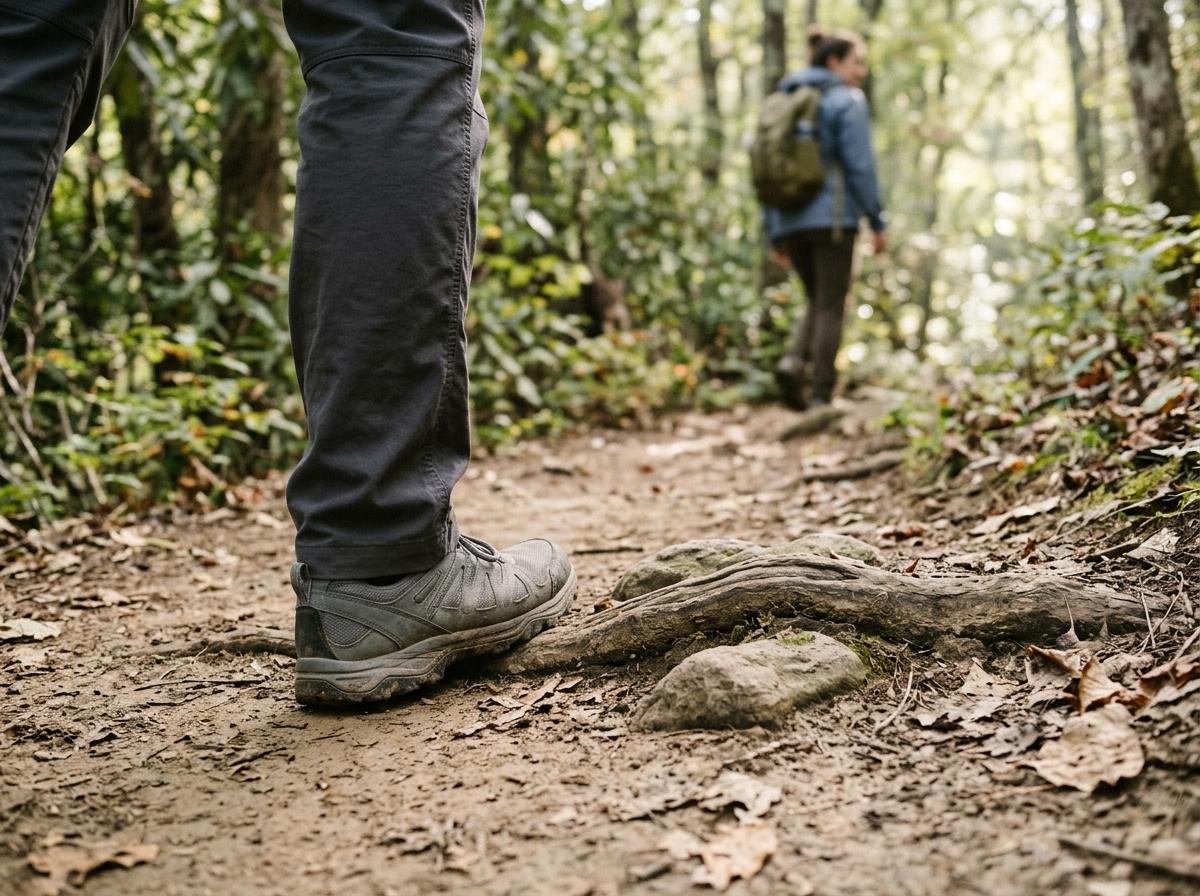
- Apply environmental and pack weight multipliers: Increase baseline difficulty by 15% for rocky or rooted footing, 30% for scrambling, and 20% for overnight backpacking packs to gauge true cardiovascular fatigue.
The Biomechanics of the Shenandoah Square Root Formula
Why does the National Park Service take the square root of distance times elevation gain rather than simply adding them together?
Human metabolic fatigue does not scale linearly. Walking 10.0 flat miles at a 2.8 mph pace requires roughly 1,000 net kilocalories (100 kcal per mile), while ascending 2,000 vertical feet across a 2.0-mile climb increases metabolic power output by 285% to 350%, consuming over 1,450 kcal in under 2.5 hours. If you multiplied distance by elevation directly ($D \times \Delta E$), an 8-mile hike with 2,000 feet of gain would score 16,000—a number too astronomical to interpret.
Taking the square root ($\sqrt{2 \times D \times \Delta E}$) normalizes physical exertion into a clean 0 to 250 scale that reflects the exponential physiological interaction between prolonged cardiovascular duration and anaerobic vertical climbing:
- Short & Steep Trails: A 2-mile trail gaining 1,500 feet yields $\sqrt{2 \times 2 \times 1500} = \sqrt{6000} = 77.5$ (Moderate). The climb is steep, but the short duration prevents systemic muscle glycogen depletion.
- Long & Rolling Trails: A 15-mile hike gaining 1,000 feet yields $\sqrt{2 \times 15 \times 1000} = \sqrt{30000} = 173.2$ (Strenuous). The gradual grade is easy, but 6+ hours of repetitive foot strike depletes lower-extremity stabilizing tendons.
- Combined Mountain Routes: An 8-mile hike climbing 3,000 feet yields $\sqrt{2 \times 8 \times 3000} = \sqrt{48000} = 219.1$ (Very Strenuous). High distance combined with high elevation climb pushes the human body into extreme exertion.
Mathematical Proof & Worked Benchmark Trails
The mathematical provenance of the Shenandoah rating system is demonstrated across famous National Park benchmark trails:
Difficulty_Score (S) = sqrt(2 * Distance_Miles * Elevation_Gain_Feet)
NPS Tiers:
S < 50: Easiest
50 <= S < 100: Moderate
100 <= S < 150: Moderately Strenuous
150 <= S < 200: Strenuous
S >= 200: Very Strenuous
Step-by-Step Worked Golden Test Vectors:
• Stony Man Trail (Shenandoah NP): Distance = 1.6 miles, Gain = 340 feet.
$S = \sqrt{2 \times 1.6 \times 340} = \sqrt{1088} = \mathbf{33.0}$ (Rating: Easiest).
• Hawksbill Loop (Shenandoah Highest Peak): Distance = 2.9 miles, Gain = 860 feet.
$S = \sqrt{2 \times 2.9 \times 860} = \sqrt{4988} = \mathbf{70.6}$ (Rating: Moderate).
• Old Rag Mountain Loop (Famous Rock Scramble): Distance = 9.1 miles, Gain = 2,415 feet.
$S = \sqrt{2 \times 9.1 \times 2415} = \sqrt{43953} = \mathbf{209.7}$ (Rating: Very Strenuous).
• Half Dome Cables (Yosemite NP): Distance = 14.2 miles, Gain = 4,800 feet.
$S = \sqrt{2 \times 14.2 \times 4800} = \sqrt{136320} = \mathbf{369.2}$ (Rating: Extreme / Elite Endurance).
NPS Trail Difficulty Rating Classification Matrix
Compare official National Park Service difficulty tiers and required hiker conditioning:
| NPS Difficulty Tier | Numeric Score Range | Typical Distance | Typical Elevation Gain | Recommended Conditioning |
|---|---|---|---|---|
| Easiest (Tier 1) | < 50.0 | < 3.0 miles | < 400 feet | Suitable for all ages; sneakers acceptable |
| Moderate (Tier 2) | 50.0 – 99.9 | 3.0 – 6.0 miles | 400 – 1,000 feet | Recreational fitness; basic trail footwear |
| Moderately Strenuous (Tier 3) | 100.0 – 149.9 | 5.0 – 9.0 miles | 1,000 – 1,800 feet | Good cardio conditioning; 2L+ water required |
| Strenuous (Tier 4) | 150.0 – 199.9 | 7.0 – 12.0 miles | 1,800 – 2,800 feet | Experienced hikers; trekking poles recommended |
| Very Strenuous (Tier 5) | ≥ 200.0 | > 9.0 miles | > 2,500 feet | Advanced mountain stamina; full day commitment |
Related Outdoor Planning Tools & Guides:
- Master Directory: Hiking Calculators & Trip Planning Hub
- Trail Pacing Comparison: Tobler’s Hiking Function vs. Naismith Rule Calculator
- Mountain Weather Estimation: Temperature by Elevation & Lapse Rate Calculator
- Trail Grade Analysis: Trail Slope & Percent Grade Calculator
- Pack Weight Audit: Backpack Base Weight Calculator
- Medical Preparedness: Wilderness First-Aid Kit Checklist Builder
- Trip Pacing Rules: How Long Does It Take to Hike 3 Miles?
Frequently Asked Questions About Trail Difficulty
What is the Shenandoah hiking difficulty formula?
The Shenandoah formula calculates physical difficulty by multiplying total round-trip distance in miles by total elevation gain in feet, multiplying by two, and taking the square root: Score = sqrt(2 × Distance × Elevation Gain). It is the standard rating metric used across Shenandoah National Park.
Why do different guidebooks rate the exact same hike differently?
There is no single global standard for hiking difficulty. A trail rated ‘Moderate’ in Colorado’s Rocky Mountains might be rated ‘Extremely Strenuous’ in the Midwest due to regional acclimatization baselines. The Shenandoah formula provides a strictly objective mathematical rating independent of subjective author perception.
How does carrying a heavy backpack change trail difficulty?
According to human metabolic trials published by USARIEM (U.S. Army Research Institute of Environmental Medicine), carrying a 30-lb (13.6 kg) multiday pack increases aerobic energy expenditure by 24% to 32% (average +28%) compared to walking unweighted. In steep ascents exceeding 15% grade, every 1.0 lb of added gear demands 0.16 additional watts of mechanical power output. On steep uphill climbs, every pound carried requires roughly 0.16 additional watts of mechanical power output.
What makes Old Rag Mountain in Virginia so difficult?
Old Rag combines a 9.1-mile round-trip distance with 2,415 feet of elevation gain, scoring 209.7 on the Shenandoah scale. In addition, the upper 1.5 miles consists of a strenuous granite boulder scramble requiring full-body pulling, crawling through rock crevasses, and technical handholds.
Does high altitude increase a trail’s difficulty rating?
Yes. Above 8,000 feet (2,400 meters), atmospheric barometric pressure drops, reducing effective oxygen saturation per breath. At 10,000 feet, effective oxygen is reduced by roughly 30%, causing cardiovascular fatigue to spike dramatically even on moderate slopes.