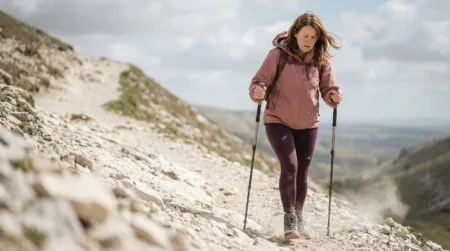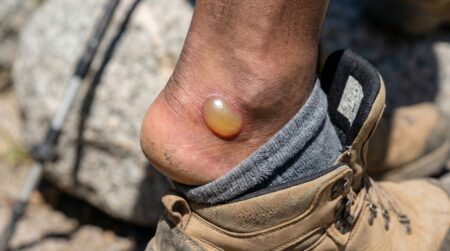


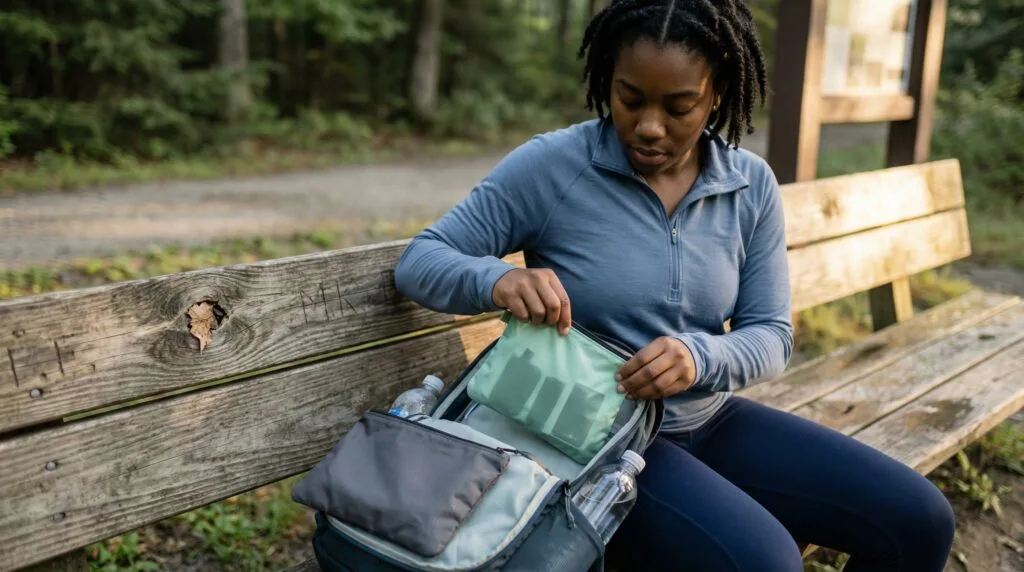
Hiking on your period is not a special accomplishment. It is logistics. The problem is not that trail hiking during menstruation is physically impossible or even particularly hard. It is that almost nobody lays out the specific decisions you need to make before you leave home, and a few of them matter enough that skipping them makes for a genuinely miserable day.
⚡ Quick Trail Takeaways
- Hygiene Kit: Carry a dedicated opaque ziplock bag, unscented wipes, and hand sanitizer.
- Leave No Trace: Pack out all used products in sealed waste bags; never bury menstrual products.
- Menstrual Cup / Disc: Offers up to 12 hours of leak-free protection without generating trail waste.
I once showed up at a trailhead with one tampon in my pack for a 7-mile out-and-back in July heat. I had underestimated how long the trail would actually take: 4.5 hours, not the 3 hours I planned. The sustained heat accelerated everything. By mile 4.5 I was rationing and thinking about logistics instead of the trail. That is the problem that good hiking on your period prep prevents. It cost me nothing to fix except 10 minutes at home the night before.
This article covers the 8 things worth addressing before you leave: product choice, supply quantity, TSS timing, waste disposal, cramp management, hydration adjustment, temperature layering, and what to tell your trail partner.
🟠 A Note Before You Head Out:
This guide covers planning and prevention. If you develop a high fever above 102°F, sudden confusion, or a sunburn-like rash while on trail wearing a tampon, these can be Toxic Shock Syndrome warning signs. Remove the tampon, get off the trail, and call 911 or go directly to an ER.
Read on for how to prevent this entirely. The timing rules are simple once you know them.
| Hygiene Method | Trail Wear Duration | Waste Generated | Best For |
|---|---|---|---|
| Menstrual Cup / Disc | Up to 12 Hours | Zero Waste | Multi-day & Backcountry Hikes |
| Organic Tampons + Applicator-Free | 4-8 Hours | Low (Pack Out) | Day Hikes |
| Biodegradable Wipes + Ziplock Kit | On Demand | Medium (Pack Out) | Sanitation & Cleanup |
What Actually Changes When You’re Hiking on Your Period
Why trail logistics are different from home logistics
At home, managing your period takes roughly 90 seconds in a private bathroom. Hiking on your period introduces a set of constraints that do not exist at home: limited or zero bathroom access, no disposal bins, the need to carry everything in and out, and a trail timeline you cannot always predict with accuracy.
None of these are complicated. They just require making decisions before you leave rather than improvising once you are committed to a trail. Three things change most on trail: your access to facilities is limited or zero, heat and physical effort affect product comfort and performance, and you cannot retrieve anything you forgot at the car once you are past the first half mile.
The most important single thing most beginner menstruation hiking tips skip is this: hiking timelines run long. A trail listed as 3 hours can take a first-timer 4.5. That extra 90 minutes is the difference between a tampon change that works on schedule and one that goes past the safe wear window. Plan your supply count around the longer version of the hike, not the best-case version. This article focuses primarily on day hikes, but the same principles apply to camping on your period. Multi-day trips just require more supplies and more deliberate waste management.
What period management outdoors planning looks like in practice
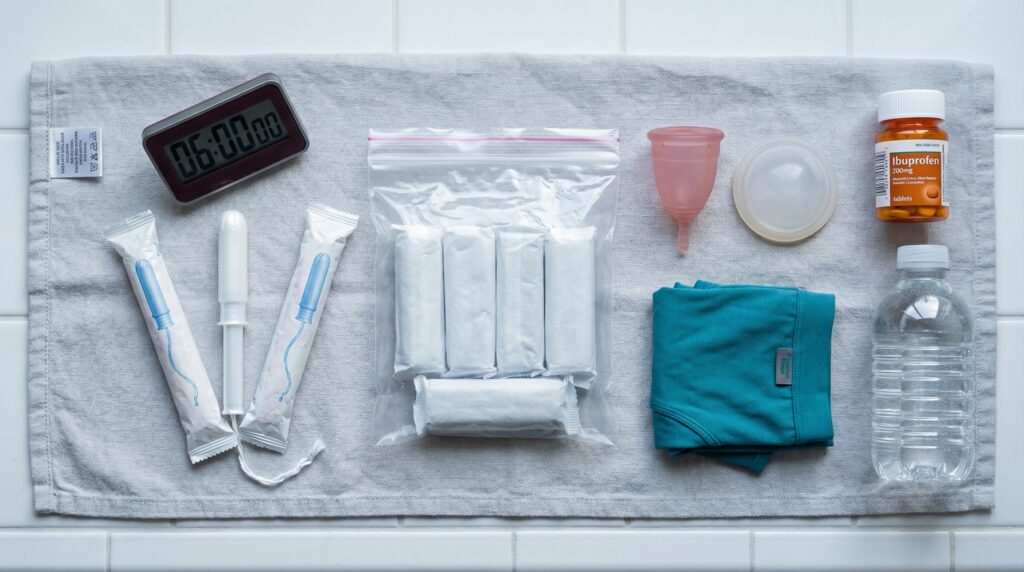
Pack your period supplies the night before, not at the trailhead. Build two separate bags: one for clean supplies, one as a waste bag for used products. These are not the same bag. Know your product’s wear timeline before you leave. Know your hike’s approximate duration. Cross-reference the two. That is period management outdoors planning. It takes five minutes and eliminates the main category of on-trail problems.
For your first hiking on your period experience, use a product you have already tested at home. New products go wrong in ways that are manageable at home and genuinely inconvenient at mile 4. Save the experimentation for non-trail days.
Hiking on Your Period: 8 Tips That Make the Difference
Tip 1: Choose your product before the trail, not at the trailhead
How to pick between tampons, cups, discs, and period underwear
My position on this: for any hiking day over 4 hours, a menstrual cup or menstrual disc is the most practical feminine hygiene hiking choice. Not because it is more comfortable, but because you can wear it for up to 12 hours without changing, which removes the biggest logistical constraint that trail hiking creates.
That said, one rule matters more than product type: do not try a new product for the first time on trail. Honestly, I got this wrong early on — I tried to figure out a menstrual cup for the first time in a trail pit toilet and spent 20 minutes learning something that would have taken five minutes at home. Use what you know. If you want to switch products, do it at home for a full cycle day before relying on it outdoors.
Period underwear works as a reliable backup layer under any other option. It adds almost no weight and provides security on heavy days or during longer stretches between product checks.
💡 Trail Tip: Menstrual discs can be emptied without full removal, which makes them a practical option when privacy is limited on trail.
This is worth knowing before you choose your product — and worth practicing at home before your first hike with one.
Tip 2: Pack more supplies than the math suggests
The backup kit that prevents rationing on trail
If you use tampons, calculate supplies for the full expected hike time plus 25%, then round up to the nearest whole product. A 6-hour hike can become 8 hours with a slower pace and rest stops. At the standard 4-6 hour change interval, that means at least 2 changes — bring 5, not 3. The extras weigh almost nothing.
Pack your supply bag and your waste bag as separate items the night before. Your waste bag goes in with your clean supply bag and comes out at the end of the hike carrying used products. A double-sealed zip-top bag handles day hikes. For multi-day trips, a purpose-made odor-blocking waste bag is worth using over standard zip-tops.
Tip 3: Know the TSS wear window before a long hiking day
What Toxic Shock Syndrome timing means for trail planning
Toxic Shock Syndrome risk increases when tampons are worn for more than 8 hours. FDA labeling requirements direct all tampon manufacturers to include this guidance, and it applies whether you are at home or hiking on your period. On a full-day hike that runs 7-9 hours, this is not a theoretical concern. It is a scheduling issue.
Plan to change tampons at the 6-7 hour mark regardless of flow level. In temperatures above 85°F, aim for 4-6 hours. Set a phone alarm if you need to. Menstrual cups and discs are typically rated for up to 12 hours — confirm your specific brand’s guidance before relying on that number. If you develop fever, sudden muscle aches, or a rash while wearing a tampon on trail, remove it and get off the trail without waiting to see whether symptoms improve.
Tip 4: Pack out all period waste — there is no in-ground option
What Leave No Trace guidelines say about period products
Period products cannot be buried. They cannot be burned without a sustained high-heat fire that most trail conditions do not produce. The Leave No Trace Center for Outdoor Ethics is specific: all sanitary products must be packed out in sealed bags in all terrain types, including areas where cat holes are permitted for human waste. Products do not break down adequately in soil and attract wildlife.
Bring a dedicated waste bag as part of your period management outdoors kit, not as an afterthought. A purpose-made odor-blocking bag works better than a single zip-top for any overnight trip. For day hikes, two nested resealable bags handle it. Feminine hygiene hiking waste goes in your pack’s main compartment or an internal pocket, not in an exterior pocket where seals are less reliable.
Tip 5: Pre-medicate for cramps before you leave home
Which approach works for active hiking days
Ibuprofen (400mg) taken 30-45 minutes before the hike consistently outperforms ibuprofen taken after cramps have already started. The anti-inflammatory effect is most useful when it is already active before sustained effort begins, not as a response to pain you are already in. Sports medicine practitioners routinely recommend pre-medicating for any prolonged physical activity during menstruation for this reason.
For longer hiking days, naproxen sodium (standard Aleve dose) lasts 8-12 hours compared to ibuprofen’s 4-6. If your hike runs 7 or more hours and you typically experience cramping, naproxen taken with food before departure covers the full day. Carry ibuprofen as backup for the second half if needed. Do not take both simultaneously.
Tip 6: Adjust your water intake upward
How menstruation affects fluid loss during hiking on your period
Menstruation increases baseline fluid loss. Most people do not factor this into their trail hydration. The standard starting point for moderate hiking is roughly half a liter per hour. During menstruation, particularly on heavier flow days, add 8-12 oz per hour on top of that baseline — not as a precaution, as a correction for actual increased fluid loss.
Dehydration symptoms on trail, including headache and fatigue that seems out of proportion to the distance, overlap with period symptoms. If you are feeling worse than the terrain should explain, drink 8-12 oz with an electrolyte pack before assuming the cause is your period. Both problems respond to the same intervention, and addressing dehydration early takes under five minutes.
Tip 7: Layer for hormonal temperature shifts
Why temperature fluctuations during menstruation catch hikers off guard
Hormonal changes during menstruation cause real variation in body temperature regulation: flushing warm during exertion, then chilling more rapidly at rest stops than usual. This is distinct from standard post-exercise cooling. On trail, where temperature already drops with elevation gain and shade, the two effects compound.
A moisture-wicking base layer plus a packable mid-layer you can pull on at rest stops handles this reliably. Do not hike in a cotton base layer during your period. Cotton holds sweat against the skin, which accelerates the chilling effect at stops and worsens the discomfort loop between sweating and stopping. Synthetic or merino wool base layers regulate the transition faster.
Tip 8: Give your hiking partner a simple heads-up
A pre-hike note that prevents scrambling on trail
This does not require a detailed conversation. Before the hike: “I have period supplies in my pack if either of us needs them, and I might need a couple of minutes at some point on trail.” That is the complete message. Your partner does not need context — just the practical note so a stop does not catch anyone off guard.
If you are hiking solo, this step applies to your trip plan: tell whoever is expecting you approximately when you plan to return, which is standard trail practice regardless of your period. Hiking on your period solo carries no additional safety considerations beyond standard solo hiking preparation.
Common Period Management Mistakes on Trail
The most frequent hiking on your period mistake is underestimating trail time and bringing supplies calibrated to the shorter version of the hike. A first-timer on a trail that “should” take 3 hours can spend 5. One planned product change becomes two needed. The fix is building supply count around the longer version of the hike, not the optimistic one.
Second most common: testing a new product for the first time on trail. Menstrual cups have a learning curve. Discs have a positioning learning curve. Period underwear varies widely between brands in terms of capacity and fit. None of these should be your first experience outdoors. Test at home first, on a day where you have five minutes and a clean bathroom.
Third: leaving the waste bag out of the pack entirely. Used period products go home with you — there is no trail disposal option. Forgetting the waste bag means improvising with food packaging, which technically works but adds a problem you did not plan for. Pack the waste bag when you pack the supplies, the night before.
When to Change Your Plan
🔴 Turn Around Now
- Cramping is severe enough that you are walking abnormally, stopping involuntarily, or the pain escalated sharply on trail — this pattern suggests something beyond typical period cramping and is a reason to descend
- You have a fever above 100.4°F, sudden muscle aches, or a sunburn-like rash while wearing a tampon — remove it immediately and get off the trail; these are Toxic Shock Syndrome warning signs requiring ER evaluation
- You have run out of supplies and are more than 1.5 hours from the trailhead
- Lightheadedness or confusion that does not resolve after 10 minutes of rest and 16 oz of water
🟡 Slow Down and Reassess
- Cramps are present but manageable — stop, take any remaining pain medication, drink 12 oz of water, rest for 15 minutes and reassess; cramping that is stable and not worsening can usually be managed and continued
- You are approaching or past your tampon’s maximum wear window and have not found a suitable change spot — find a location at least 200 feet from any water source before continuing, even if it delays the hike
- Heavy flow is affecting your comfort level — adjust pace, use the next stop for a product check, and consider whether extending the planned distance makes sense today
✅ You’re Fine — Keep Going
- Mild cramping that is easing as you move — this is the common pattern for most people during moderate hiking
- Normal fatigue for the distance and elevation, no signs of dehydration, product schedule is on track
- You have been managing supplies and waste correctly and nothing has changed or escalated
The rule: When unsure which tier applies, treat it as the higher one. Cutting a hike short because cramping was ambiguous is an inconvenience. Pushing through Toxic Shock Syndrome warning signs is a medical emergency.
Can you go hiking on your period?
Yes. Hiking on your period requires no special fitness clearance or physical adjustment. The preparation changes are logistical: the right product choice, enough supplies packed for the long version of the hike, a waste bag included, and cramp management addressed before departure. With those four things handled the night before, there is no functional difference between a hiking day on your period and any other.
Do bears or other wildlife detect menstruation on trail?
This is the most widely circulated concern, and the most overstated one. I will be direct: I was not confident what the evidence actually showed until I looked it up specifically for this article. The National Park Service states there is no reliable evidence that menstruation increases bear attack risk. Their guidance for backcountry travel in bear country recommends treating period supplies the same as food: store used products in a bear canister or hang bag, and pack them out completely. Menstruation hiking tips for bear country follow standard scent management protocol, not a separate safety framework.
What are the best feminine hygiene hiking products for a trail day?
For hikes over 4 hours: a menstrual cup or menstrual disc. Both allow up to 12 hours of wear without changing, which removes the main supply and timing problem trail hiking creates. For hikes under 4 hours: tampons work fine if you are already comfortable with them. Period underwear adds reliable backup coverage under either option. Whatever you choose: test it at home before relying on it outdoors.
How do I handle period waste disposal on trail?
Pack it out. The Leave No Trace Center for Outdoor Ethics specifies that all sanitary products must be carried out in sealed bags — this applies in all terrain types, including dispersed camping areas where cat holes are permitted for other waste. Double-seal used products in zip-top bags. In bear country or any area with active wildlife, store them in your bear canister or hang bag, not in an exterior pack pocket. There is no in-ground disposal option that meets Leave No Trace standards.
How long can I wear a tampon while hiking on your period?
FDA-required tampon labeling guidance sets the maximum at 8 hours. On a full hiking day, plan to change at the 6-7 hour mark regardless of flow. In temperatures above 85°F, shorten that window to 4-6 hours. Menstrual cups and discs are typically rated for up to 12 hours — confirm your brand’s specific guidance before your hike. If you develop fever, sudden muscle aches, or a rash while using a tampon on trail, treat it as an emergency and get off the trail.
Does hiking make cramps better or worse?
For most people, moderate hiking improves cramping rather than worsening it. Physical activity increases circulation, which is part of why movement is a standard recommendation for managing period pain. The exception: starting a strenuous hike when severe cramping is already present before you leave the house. If cramping is already at a level affecting your movement at home, cut the planned distance or reconsider the day. For manageable cramping: pre-medicate and go.
Are backpacking period tips different from day hiking tips?
The core approach is the same. The differences when camping on your period across multiple nights: waste disposal becomes more complex without nearby facilities, supply requirements multiply for multi-day trips, and bear country storage matters more when you are sleeping in the backcountry. For overnight and multi-day backpacking period trips, menstrual cups or discs are strongly preferred over tampons. They eliminate the daily supply problem and reduce waste volume considerably. Pack-out bags are non-negotiable for any trip in bear habitat. Backpacking period tips beyond those basics follow the same preparation logic as day hiking, scaled up.
Hiking on Your Period Starts With a Checklist, Not an Improvise
Hiking on your period is a logistics problem, and logistics problems have checklists. Product chosen and tested before the trip. Supplies packed for the long version of the hike. Waste bag included. Cramp medication taken 45 minutes before departure. Hydration target adjusted upward. Partner notified.
That is the complete preparation. Period management outdoors does not require specialized gear beyond what already belongs in a standard day pack. It does not require extraordinary planning. It requires the same 10-minute preparation the night before that prevents most first-hike problems regardless of your cycle.
The hikers who find hiking on your period difficult are, almost without exception, the ones who improvised at the trailhead instead of prepared at home. The preparation is not complicated. Do it the night before, where there is a bathroom, a clock, and no trail consequence for the items you forgot.
Next Steps
- Right now: Choose your trail period product and test it at home before relying on it outdoors. If you are considering a menstrual cup or disc for the first time, do a trial run on a normal home day first.
- Before your next hike: Pack your supply kit the night before — clean supplies in one bag, dedicated waste bag in the same pouch. Calculate supply count for the longer version of the hike.
- Day of: Take ibuprofen (400mg) or naproxen sodium 30-45 minutes before departure if you typically experience cramps. Check your tampon wear window against your expected hike duration before you leave.