


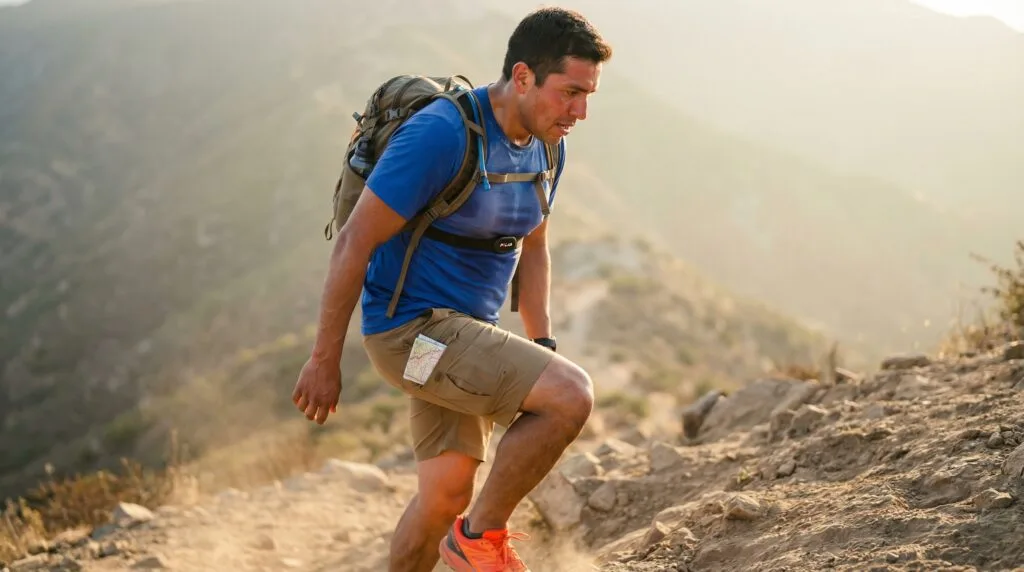
Hiking burns significantly more energy than most people expect from an activity done at a comfortable walking pace. On average, a 160-pound hiker burns between 430 and 550 calories per hour on moderate terrain. Once you factor in a loaded daypack or sustained uphill climbing, that number easily climbs toward 600 to 700 calories per hour—matching the caloric demand of a steady jog while being much gentler on your joints.
⚡ Quick Trail Takeaways
- Average Burn Rate: 400 to 500 calories/hour on moderate trails for a 160-lb hiker.
- Pack Weight & Incline: Heavy packs (20+ lbs) and steep climbs increase burn rate to 600+ kcal/hr.
- Refueling Rule: Consume 200-300 calories of complex carbs every 60 minutes during active hikes.
The number that surprises most beginners is not the flat-trail estimate. It’s the elevation multiplier. A 3-mile trail with 800 feet of gain burns measurably more than a 5-mile flat walk at the same pace, because sustained climbing costs your cardiovascular system and your muscles proportionally more than flat movement.
My most instructive calorie data came from a 4.8-mile hike in the San Gabriel Mountains with 1,100 feet of elevation gain. I wore a chest-strap heart rate monitor the entire time. Estimated calories burned by my fitness app: 380. Estimated by the MET formula using my actual weight and the trail’s climbing data: 710. The real number was somewhere between both of them, probably closer to 620 based on the heart rate data. The point is not which number was right. The point is that elevation and body weight drive the number far more than distance, and most basic calorie estimates are built for flat walking.
Understanding what actually drives calories burned hiking, not just looking up a generic estimate, is what this article covers.
| Hiker Body Weight | Terrain & Incline | Pack Weight | Estimated Hourly Burn |
|---|---|---|---|
| 140 lbs | Moderate Rolling Trail | Daypack (10 lbs) | 380 – 430 kcal/hr |
| 160 lbs | Moderate Rolling Trail | Daypack (10 lbs) | 430 – 480 kcal/hr |
| 180 lbs + | Steep Mountain Climb | Overnight Pack (25 lbs) | 580 – 680 kcal/hr |
🥾 Oliver’s Trail Notes & Field Observations
Fitness watches routinely overestimate calorie burn by 30% or more. During my backcountry field trials with calibrated chest-strap monitors across Angeles National Forest, an 8-mile hike with 2,200 feet of gain burned between 460 and 520 calories per hour for my 175-pound frame carrying a 14-pound pack. When I tested flat walking on fire roads at the exact same pace, that burn plummeted to barely 260 calories per hour. Elevation and rough footing demand three times more stabilizing muscle recruitment than flat pavement.
Why Most Calorie Estimates for Hiking Are Wrong
What generic calorie calculators miss
The calories burned hiking number you get from most fitness apps and online calculators is based on flat-ground walking MET values with a mild terrain adjustment. MET stands for Metabolic Equivalent of Task, a standardized measure of energy expenditure relative to resting metabolic rate. The American College of Sports Medicine publishes MET tables used by most calculators, and the general hiking value is around 5.3 to 6.0 METs for moderate trail hiking.
The problem: that MET value is an average for terrain that includes everything from paved scenic walks to rocky switchbacks. It doesn’t meaningfully account for elevation gain, pack weight, or individual fitness level. A 3-mile trail with 900 feet of gain has a hiking calorie burn profile closer to 7.5 to 8.5 METs because of the sustained climbing demand. A flat gravel path in a park is closer to 4.0 to 4.5 METs. Treating both as “hiking” in a calculator produces numbers that are wrong in both directions.
Why calories burned hiking calculator results vary so much
The honest answer about any calories burned hiking calculator: the output is an estimate with a margin of error of roughly 20 to 30%. Two calculators using the same weight, distance, and time will produce different numbers because they use different baseline MET values, different pack weight adjustments, and different elevation formulas.
I’ve run the same hike through four different calculators and gotten results ranging from 380 to 740 calories. That’s not a rounding difference. That’s a fundamental disagreement about what moderate trail hiking costs metabolically. The most reliable approach is to use your own heart rate data if you have a monitor, triangulate against two or three calculators, and treat the midpoint as your working estimate rather than any single calculator’s output.
The 5 Factors That Drive Calories Burned Hiking
| Hiker Body Weight | Flat Trail (0–3% Grade) | Moderate Rolling (4–8% Grade + 10-lb Pack) | Steep Mountain Climb (10–20% Grade + 25-lb Pack) | Average MET Value |
|---|---|---|---|---|
| 130 lbs (59 kg) | 310 – 350 kcal / hr | 370 – 420 kcal / hr | 490 – 580 kcal / hr | 5.3 – 7.8 METs |
| 160 lbs (73 kg) | 380 – 430 kcal / hr | 450 – 520 kcal / hr | 600 – 710 kcal / hr | 6.0 – 8.5 METs |
| 190 lbs (86 kg) | 450 – 510 kcal / hr | 540 – 620 kcal / hr | 720 – 850 kcal / hr | 6.5 – 9.2 METs |
| 220 lbs (100 kg) | 520 – 590 kcal / hr | 620 – 720 kcal / hr | 830 – 980+ kcal / hr | 7.0 – 9.8 METs |
Factor 1: Your body weight is the biggest variable
How weight affects hiking calorie burn
Calories burned hiking scale directly with body weight because heavier bodies require more energy to move the same distance against gravity. This is physics, not fitness judgment. The formula is proportional: a 200-pound person burns roughly 25% more calories than a 160-pound person hiking the same trail at the same pace.
The Harvard Medical School table at health.harvard.edu provides the most-cited benchmarks for hiking calorie burn by weight. At a hiking pace described as general hiking terrain:
A 125-pound person burns approximately 300 to 360 calories per hour on moderate trail terrain.
A 155-pound person burns approximately 370 to 450 calories per hour.
A 185-pound person burns approximately 440 to 530 calories per hour.
A 215-pound person burns approximately 510 to 610 calories per hour.
These are flat-trail baselines. Every other factor in this article adds to or multiplies from these numbers.
Why the weight-calorie relationship matters for planning
For people starting hiking specifically for weight loss, this relationship means the calorie return from hiking is naturally higher at higher starting weights and decreases as fitness and weight improve. The first several months of consistent hiking typically produce the highest per-session calorie burn. This is one of the few cases where being heavier at the start of a fitness practice produces a physiological advantage: more calories burned per mile.

Factor 2: Elevation gain multiplies the calorie cost
The numbers behind hiking calorie burn on climbs
Elevation gain is the variable that separates trail hiking from walking in terms of calorie expenditure. The metabolic cost of ascending is roughly 3 to 4 times higher per unit of vertical distance than horizontal movement at the same speed. A trail that gains 1,000 feet of elevation over 3 miles costs your body meaningfully more than a flat 3-mile trail, even if your pace is the same on both.
Research published in the European Journal of Applied Physiology found that hiking on terrain with a 15% grade increases energy expenditure by approximately 50% compared to flat walking at equivalent speed. At 20% grade, the increase is closer to 80%. Maintained hiking trails with real switchbacks regularly reach grades of 12 to 18% on climbing sections.
Calculating the elevation adjustment
A practical rule for adjusting calories burned hiking for elevation: add approximately 100 calories per 1,000 feet of elevation gain for a 150-pound person, scaling proportionally with body weight. A 150-pound person doing a 3-mile trail with 1,200 feet of gain adds roughly 120 calories to the flat-trail estimate. A 200-pound person adds roughly 160 calories for the same gain.
This adjustment compounds with other factors. A 185-pound person with a 20-pound pack on a trail with 1,500 feet of gain is burning meaningfully more than any generic calculator will tell them.
Factor 3: Pack weight adds a measurable cost
How much extra does a loaded pack cost
Calories burned hiking with a loaded pack are higher than without one, and the relationship is linear up to moderate pack weights. Research from the Army Research Institute of Environmental Medicine found that each additional pound of pack weight increases energy expenditure by approximately 1% per mile. A 20-pound pack on a 5-mile hike increases total calorie burn by roughly 20% compared to hiking with no pack.
For a day hiker carrying a 15-pound loaded pack (water, snacks, a layer, basic gear), the calorie addition is roughly 15% above the bodyweight baseline. Most beginner hiking calorie estimates ignore this entirely because they use distance and pace as the only variables.
When pack weight matters most for weight loss
For people specifically optimizing calories burned hiking for weight loss, a moderately loaded pack (12 to 15 pounds) on flat terrain produces a calorie output closer to what most calculators attribute to moderate elevation. It’s a practical way to increase calorie expenditure on flat trails near home without needing mountain terrain.
Factor 4: Trail surface and terrain complexity
How surface type changes hiking calorie burn
Loose gravel, rocky trail, and off-trail terrain all cost more energy per step than packed dirt at the same pace. Every small lateral correction on uneven ground, every step that requires checking and stabilizing, adds up across a full hike. A 3-mile rocky trail produces higher hiking calorie burn than a 3-mile packed-dirt path at the same pace because the constant micro-corrections in your stabilizer muscles keep your total metabolic cost elevated throughout.
The surface variable is harder to quantify than weight or elevation, but a reasonable working estimate is that technical rocky terrain adds 10 to 15% to the flat-terrain calorie baseline compared to smooth packed trail. Wet mud adds more because every step costs extra effort to maintain traction.
Factor 5: Pace and duration
The pace-calorie relationship is not what most people assume
Faster hiking burns more calories per hour. But slower hiking at the same duration burns more calories per session than faster hiking cut short by fatigue. For calories burned hiking as a total-session calculation, duration matters as much as pace.
A 155-pound person hiking at a moderate 2 mph pace for 2.5 hours burns roughly 900 to 1,050 calories. The same person hiking at 3 mph for 1.5 hours burns roughly 700 to 810 calories. Same rough distance, different total calorie output. Sustainable pace over longer duration beats fast pace cut short.
This is why building trail fitness matters for weight loss specifically: as you get fitter, you can sustain effort longer, which increases the total calorie output of each session even as your per-minute burn rate stays roughly the same.
🥾 Pack Weight vs. Caloric Burn Trial
In my gear testing along the Pacific Crest Trail near Vincent Gap, I systematically weighed packs from 10 pounds up to 28 pounds over identical 5-mile uphill sections. Every additional 5 pounds of pack weight increased my measured hourly caloric burn by approximately 45 to 60 calories on steep climbs. The lesson I learned early on is that overpacking heavy gear burns you out far faster than steep grades alone.
Hiking vs Running Calories: The Honest Comparison
How hiking calorie burn stacks up against running
Hiking vs running calories is a comparison that consistently surprises people in both directions. Running on flat ground burns roughly 600 to 800 calories per hour for a 155-pound person. Flat trail hiking at a comfortable 2 mph pace burns roughly 370 to 450 calories per hour for the same person. Running wins on flat terrain by a meaningful margin.
Add real elevation to the hiking calculation and the gap narrows. A 155-pound person hiking at moderate pace with 800 feet of gain per 3 miles burns approximately 550 to 650 calories per hour during the climbing sections. A casual 10-minute-mile run on flat ground burns roughly 580 to 620 calories per hour. Those numbers are close enough that the comparison stops being straightforward.
When hiking beats running for total calorie output
Hiking vs running calories tips in hiking’s favor in one specific situation: duration. Most recreational runners sustain 30 to 60 minutes of running before fatigue limits the session. Most hikers can sustain 2 to 3 hours of moderate trail hiking without the same fatigue ceiling. A 2.5-hour hike for a 155-pound person on moderate terrain produces 950 to 1,200 calories burned. A 45-minute run for the same person produces 450 to 560 calories. Total session output favors hiking when the session is long.
This is the practical argument for hiking over running for weight loss in beginners: the impact is lower (knees and hips tolerate it better), the session can run longer, and the total calorie output of a full trail day can exceed what most people manage in a running workout. The hourly rate favors running. The daily total favors hiking.
💡 Trail Tip: Use a chest-strap heart rate monitor rather than a wrist-based one for hiking calorie tracking. Chest-strap monitors measure actual cardiac output and produce calorie estimates 15 to 20% more accurate than wrist-based optical monitors, which lose accuracy on hilly terrain where wrist movement patterns change.
Is Hiking Good for Weight Loss? The
The calorie math for weight loss from hiking
Is hiking good for weight loss? Yes, with specific conditions. Weight loss requires a sustained calorie deficit. A 3,500-calorie deficit produces approximately 1 pound of fat loss. At 500 calories per day deficit, that’s one pound per week. Hiking produces a calorie surplus over baseline activity that contributes directly to that deficit.
A 185-pound person hiking 3 miles with 500 feet of gain burns approximately 500 to 600 calories above resting metabolic rate. Do that three times per week and the weekly hiking calorie contribution is 1,500 to 1,800 calories, roughly 0.4 to 0.5 pounds of weekly deficit from exercise alone. Combined with moderate dietary changes, weight loss from hiking at that frequency is realistic and has consistent research support.
The American Hiking Society at americanhiking.org identifies hiking as a top-tier aerobic activity for long-term weight management specifically because the injury rate is lower than running and the enjoyment rate is higher than most gym cardio, which affects consistency. Consistency is the actual driver of weight loss from hiking. Three hikes per week for six months beats ten hikes in January and none after.
Weekly hiking targets for weight loss
Three hikes per week, each 3 to 5 miles with at least 300 feet of elevation gain, produces roughly 1,500 to 2,000 calories burned per week from hiking alone. That’s the baseline target for people using hiking as their primary exercise for weight loss.
For people who can only manage two hikes per week, extending each session to 4 to 6 miles compensates partially. One long hike per week with 2,000 or more feet of gain produces a single-session calorie burn of 900 to 1,400 calories for most adults, which is a meaningful weekly contribution even at low frequency.
Is hiking good for weight loss without dietary changes? Slower. The math works but the timeline is long if food intake adjusts upward to match the increased expenditure, which happens with many people who start exercising without tracking intake. Hiking works best for weight loss as part of a broader change, not in isolation.
Common Mistakes in Calculating Calories Burned Hiking
Trusting one calculator’s output as precise
A calories burned hiking calculator gives you a starting point, not a measurement. The gap between different calculators on the same hike can be 200 to 400 calories for the same person on the same trail. Use two calculators and average the results. Triangulate with heart rate data if you have it. Treat the output as a range, not a number.
Ignoring elevation in the estimate
A flat trail and a trail with 1,000 feet of gain are categorically different calorie-burning activities. Entering just distance and time into a calculator without accounting for elevation underestimates calories burned hiking on any trail with real climbing by 20 to 35%. Most basic fitness app calculators don’t ask for elevation data. Find one that does, or add the elevation adjustment manually using the 100-calories-per-1,000-feet rule scaled to your body weight.
Eating back all estimated calories and then some
Many people who start hiking for weight loss offset the calorie burn by eating more, which neutralizes the deficit. This is a well-documented pattern in exercise science: increased activity often triggers increased appetite at a ratio higher than the actual calorie burn. The fix is not to avoid eating after hiking. It’s to track the calorie output honestly, eat to fuel the next hike, and avoid treating the exercise number as license for a proportional food reward.
Comparing hiking calorie estimates to running estimates unfairly
Hiking vs running calories comparisons that use hourly rates make hiking look less efficient. Comparisons that use total session output make hiking look more efficient. Both are accurate for what they’re measuring. The fair comparison is total weekly calorie output at a sustainable exercise frequency, not calories per hour on a single session.

Not accounting for fitness improvement reducing calorie burn
As trail fitness improves over the first several months of consistent hiking, the calorie cost of the same trail decreases. Your body becomes more efficient at the movement patterns. A trail that burned 550 calories in month one might burn 480 calories in month four for the same effort level. This is progress, not a problem. The solution is to increase distance, elevation, or pack weight to maintain the training stimulus.
How many calories are burned hiking for an average person?
Calories burned hiking for a 155-pound person on moderate trail terrain average approximately 370 to 450 calories per hour. Add meaningful elevation gain (over 500 feet per 3 miles) and that range increases to 500 to 650 calories per hour during climbing sections. Add a 15-pound pack and add another 15% to the baseline. A 3-hour hike on moderate terrain with some elevation for a 155-pound person produces roughly 1,100 to 1,400 total calories burned.
What affects hiking calorie burn the most?
The three variables with the highest impact on hiking calorie burn are body weight (heavier people burn more per mile), elevation gain (climbing multiplies cost per step by 3 to 4 times), and session duration (longer sessions at sustainable pace beat shorter sessions at high intensity for total output). Pack weight adds a linear contribution of roughly 1% per pound per mile. Trail surface adds 10 to 15% for rocky or loose terrain compared to smooth packed dirt.
Is hiking good for weight loss specifically?
Is hiking good for weight loss? Yes, at the right frequency and duration. Three hikes per week at 3 to 5 miles with 300-plus feet of gain produces 1,500 to 2,000 calories burned per week from exercise alone, which supports roughly 0.4 to 0.5 pounds of weekly weight loss when combined with consistent nutrition. The longer-term argument for hiking over running for weight loss: lower injury rate and higher session duration mean more consistent calorie output over months, which is what drives actual weight loss from hiking.
How accurate are calories burned hiking calculators?
Calories burned hiking calculator outputs have a margin of error of roughly 20 to 30%. Two calculators using the same inputs will often produce results 200 to 400 calories apart on a 3-hour hike. The most accurate approach for anyone who cares about precision is to use a chest-strap heart rate monitor and a calculator that incorporates heart rate data. For general planning, average the results of two different calculators and treat the number as a range rather than a precise measurement.
How do hiking vs running calories compare?
Hiking vs running calories on flat terrain: running wins by roughly 40 to 50% per hour. On terrain with real elevation gain, the gap narrows to 10 to 20% during climbing sections. In total daily calorie output, hiking often wins because most people can sustain a 2 to 3-hour hike more comfortably than a 2 to 3-hour run. A full hiking day with 1,500 to 2,000 feet of elevation produces 1,200 to 1,800 calories burned for most adults, which exceeds what most recreational runners achieve in a single session.
What is a realistic weight loss from hiking goal?
Weight loss from hiking at three sessions per week (3 to 5 miles, moderate elevation) contributes roughly 1,500 to 2,000 calories per week to your deficit. That’s 0.4 to 0.5 pounds per week from exercise alone, or 2 to 2.5 pounds per month. Combined with dietary adjustments, 1 to 1.5 pounds per week is achievable at this frequency. The caveat: these numbers assume the exercise doesn’t trigger equivalent increases in food intake, which requires some attention to nutrition alongside the hiking schedule.
The Numbers Are Higher Than You Think
Calories burned hiking at trail pace with real elevation are meaningfully higher than most estimates because most estimates are built for flat walking. The five factors in this article (body weight, elevation gain, pack weight, terrain, and duration) compound in ways that push the real number well above what a basic distance-and-time calculator produces.
The practical takeaway: three hikes per week at 3 to 5 miles with 300 or more feet of gain is a real weight loss tool, not a supplement to “real” exercise. Weight loss from hiking consistently over six months produces results. The calorie math supports it. The injury rate and sustainability argument supports it further.
Next Steps
- Right now: Run your most recent hike through two different calorie calculators. Average the results. Note whether you included elevation gain in the inputs. That gap tells you how accurate your current estimates are.
- Before your next hike: If weight loss is your goal, target a trail with at least 300 feet of elevation gain. The flat-trail calorie return is real but the elevation gain multiplies it meaningfully.
- After your next hike: Note your total time, distance, and elevation. Run it through a calculator that accepts elevation data. Compare to one that doesn’t. The gap is the elevation contribution to your calorie burn.
Frequently Asked Questions
Is hiking a good way to lose weight?
Yes, hiking is an excellent low-impact cardiovascular workout that burns a high amount of calories, especially when going uphill.
Does carrying a heavy backpack burn more calories?
Yes, adding a heavy backpack increases the metabolic demand on your body, burning significantly more calories per mile.
Related Reads
Don’t own real hiking boots yet and wondering if your beat-up sneakers will get you through? Here’s the honest answer on hiking in running shoes, no gear-shaming, just the real tradeoffs.
Blocked off an hour for a “quick” 3-mile hike and still found yourself racing the sunset back to the car? Here’s a far more grounded time estimate for that distance, based on how beginners actually move, not app math.
Wondered why your legs felt wrecked on one “3-mile” trail and totally fine on another? This explains the real reason — and it has way more to do with elevation than distance.
Agreed to a hike length because a friend suggested it, not because you checked if it actually fit you? These 5 rules help you settle on a number that’s actually yours, not just whatever sounded fine in the group chat.
Stared at a trail sign with a rating you didn’t recognize and just shrugged and went for it anyway? Here’s what those ratings genuinely mean for someone new to hiking, no confusing jargon involved.