

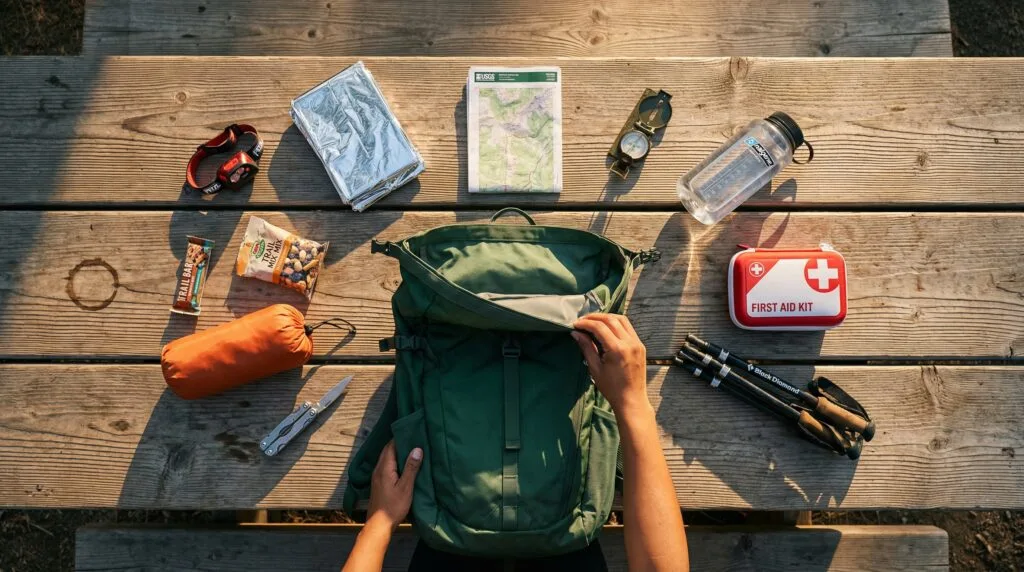
The Ten Essentials are a time-tested collection of safety supplies that outdoor organizations and search-and-rescue teams have recommended for decades. Rather than packing random gear or overfilling your daypack with unnecessary items, focusing on these ten core safety systems ensures you are prepared for unexpected weather shifts, minor trail delays, or route navigation challenges on every day hike.
⚡ Quick Trail Takeaways
- Core 10 Systems: Navigation, Headlamp, First Aid, Knife, Fire, Shelter, Food, Water, Extra Clothes, Sun Protection.
- Always Carry: Even on short 2-mile day hikes, emergency delays can happen to anyone.
- Modern Navigation: Carry an offline GPS map (Gaia/AllTrails) plus a backup physical map/compass.
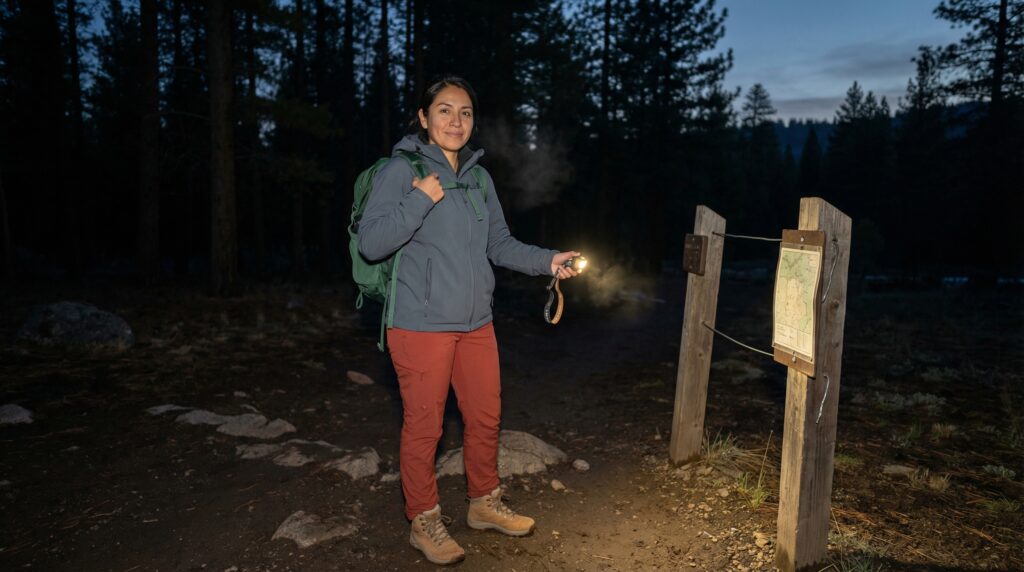
I learned this the hard way on a 6-mile trail in the San Gabriel Mountains. I left my headlamp home because I was starting at 8am and planned to be back by 2pm. At mile 4, a friend twisted her ankle on a rocky descent. We moved slowly. By mile 5.5, the sun was dropping and we were navigating a rocky section with phone flashlights at under 20% battery. We made it out fine. I’ve never hiked without a headlamp since.
The 10 essentials for hiking exist because the gap between a good hike and a dangerous one is often one missing item. This guide covers what those 10 categories are, what to actually carry in each, and the honest difference between what a beginner day hiker needs versus what overnight trips require.
🟠 Before You Head Out:
This guide covers preparation and gear selection, not emergency medical care.
If you are currently dealing with a trail emergency, call 911. In areas with
no cell service, activate your PLB or satellite communicator, stay put if safe,
and signal for help.Read on for everything you need to prevent this situation entirely.
| System # | 10 Essential Category | Essential Daypack Item |
|---|---|---|
| 1 | Navigation | Offline Phone Map + Paper Map/Compass |
| 2 | Illumination | Headlamp + Extra Batteries |
| 3 | First Aid | Blister Kit, Bandages, Medications |
| 4 | Emergency Shelter | Lightweight Mylar Bivy / Space Blanket |
What Are the 10 Essentials for Hiking
Where the list comes from
The 10 essentials for hiking were first published by The Mountaineers in their 1974 book “Mountaineering: The Freedom of the Hills.” The original list named 10 specific items. The modern version, adopted by the American Hiking Society, REI, and the National Park Service, organizes those into 10 systems rather than individual objects. The shift matters because it allows substitution: a compass and a downloaded offline map both satisfy the navigation system requirement.
The list has not changed in intent since 1974. What changes is the gear available to fill each category. A modern emergency shelter is a $7 space blanket under 2 ounces.
The modern 10 essentials system vs. the original list
The original 10 essentials for hiking named specific objects: map, compass, sunglasses, sunscreen, extra clothing, headlamp, first aid, firestarter, matches, and extra food. The modern system names categories: navigation, sun protection, insulation, illumination, first-aid supplies, fire, repair tools and knife, nutrition, hydration, and emergency shelter.
The system framing is more useful for beginners because it makes substitution obvious. You need illumination, not specifically a headlamp. A headlamp is the best choice, but the category tells you what problem you’re solving.
What the list does not include is useful to know upfront. No tent, sleeping bag, or stove for day hiking. Those belong to the overnight version. For a day hike under 10 miles, the 10 systems below are the complete picture.
The 10 Essentials for Hiking, Explained
1. Navigation
What to carry for navigation
At minimum: a downloaded offline map of the specific trail on AllTrails or Gaia GPS, fully loaded before you leave cell range. Not a screenshot. The actual downloaded map so GPS tracking works without data.
The better version: offline map plus a paper map from the land manager, plus the ability to read it. A compass is worth adding for trails where navigation is genuinely in question. For most urban-adjacent day hikes, the offline map is sufficient.
Download the map at home the night before, not in the parking lot with one bar of signal.
2. Sun Protection
What to carry for sun protection
Sunscreen at SPF 30 minimum. Sunglasses. A brimmed hat. All three, not just one.
Apply sunscreen before you leave the car: it needs 15 minutes to absorb before it’s effective. Reapply after 2 hours of active sweating.
At elevation above 6,000 feet, UV exposure increases roughly 6% per 1,000 feet of altitude gain. SPF 50 is the sensible choice for any hike above treeline.
3. Insulation
What to carry for insulation
One more layer than you think you’ll need. For most three-season day hiking, that means a lightweight insulated jacket or a midlayer fleece that fits in a daypack side pocket.
Check the summit temperature, not the trailhead temperature. Temperature drops approximately 3.5 degrees Fahrenheit per 1,000 feet of elevation gain. A trailhead at 65°F with a 3,000-foot climb means a summit around 55°F on a still day, colder with wind.
Cotton is wrong for insulation. A wet cotton layer provides almost no warmth. Synthetic or wool holds warmth when damp.
4. Illumination
What to carry for illumination
A headlamp, not a phone flashlight. A headlamp keeps both hands free, runs on replaceable batteries, and won’t drain your phone. A phone flashlight is a backup, not a primary light source on any trail that might extend past sunset.
The $18 Black Diamond Spot runs on AAA batteries, produces 200 lumens, and weighs 86 grams. There is no reason to spend more than $40 on illumination until you’re doing technical terrain at night. Carry fresh batteries for any hike over 4 hours.
5. First-Aid Supplies
What to carry for first aid
A pre-built first-aid kit rather than assembling your own. The Adventure Medical Kits Ultralight Watertight .7 covers blisters, wound closure, bandaging, and basic pain relief in a waterproof case at about $24.
Open it at home and read through it once. The best first-aid kit is useless if you’re searching through it in poor light trying to identify items you’ve never seen before.
Ibuprofen is the most-used item in most trail kits. Carry it.
6. Fire
What to carry for fire
A lighter plus waterproof matches as backup. Both are small, cheap, and redundant in a way that matters when one gets wet.
Fire on a day hike is almost never for warmth in normal conditions. It’s an emergency signal if you’re stranded. A fire starter cube or dryer lint in a ziplock bag extends the category for situations where everything around you is damp.
Check fire restrictions for your specific trail before heading out, particularly in the American West from June through October. The USDA Forest Service posts current restrictions at fs.usda.gov.
7. Repair Tools and Knife
What to carry for repair and tools
A small folding knife or multitool, plus duct tape wrapped around a water bottle, plus a few safety pins. This covers the most common gear failures: broken pack straps, torn gaiters, clothing repairs, cutting cord or medical tape.
A basic $15 Morakniv Companion is sufficient. This is not a category to overspend on.
8. Nutrition
What to carry for nutrition
More food than you plan to eat. The guideline: pack for the distance you’re hiking plus one extra meal equivalent in calorie-dense snacks.
A 5-mile day hike with lunch packed needs one additional 300-400 calorie item that doesn’t require preparation. A Clif bar, a bag of trail mix, a packet of almond butter. Not because you expect to eat it, but because a delayed exit on a blood-sugar crash is dangerous on technical terrain.
High-fat, high-carb snacks outperform most energy bars for sustained hiking energy. Nuts, jerky, dried fruit, and chocolate travel well in heat and cold. Most energy gels are designed for running pace, not hiking pace, and produce a spike-crash cycle that doesn’t serve most hikers.
9. Hydration
What to carry for hydration
At least 2 liters of water for a half-day hike in moderate conditions. 3 liters in summer heat above 80°F. A water filter or purification tablets as backup for any hike that passes a water source and extends past 3 hours.
The Sawyer Squeeze filter weighs 3 ounces, costs about $30, and filters up to 100,000 gallons over its life. For day hikes under 5 miles, carrying enough water from the trailhead is usually sufficient. For anything longer, having filtration capacity removes the risk of running short.
Drink on a schedule, not when thirsty. Half a liter per hour of active hiking is the baseline. Increase in heat and elevation.
10. Emergency Shelter
What to carry for emergency shelter
A space blanket or emergency bivy. The SOL Emergency Blanket costs $6 and weighs 1.4 ounces. There is no reasonable argument for leaving it at home.
This is the item most beginners skip because it feels like worst-case-scenario gear. That logic is exactly backwards. Emergency shelter is cheap enough, light enough, and small enough that the only reason not to carry it is the assumption that nothing will go wrong. The hikers who needed it didn’t plan to need it either.
I skipped the space blanket for my first two years of hiking. I stopped after a thunderstorm moved in 40 minutes faster than the morning forecast on a trail in the Angeles National Forest. I was soaked, wind was up, 2 miles from the car. A space blanket would have mattered. I’ve carried one since.
What to Bring on a Hike vs. What’s Overkill
The day hike packing list is not the backpacking list
The 10 essentials for hiking scale with trip length. A day hike packing list for a 3-mile loop near a city looks different from the backpacking 10 essentials for a 3-day wilderness trip.
On a short day hike: the navigation system is your downloaded AllTrails map. The emergency shelter is a space blanket. The fire system is a lighter and a matchbook. The whole 10 essentials for hiking fit in a 1-quart ziplock bag and add less than a pound to your pack.
For day hiking, the lighter version of each category is right.
What actually gets used from the list
The items most day hikers actually reach for: sunscreen, extra water, headlamp, snacks, and first-aid kit for blister management. These are the regular-use items.
The items that almost never get used but matter when they do: emergency shelter, fire kit, water filter. Carrying these is not about expecting to use them. It’s about covering the scenarios where not having them compounds an already bad situation.
The 10 essentials split into items you’ll use on most hikes and items you hope never to use. Both are non-negotiable.
Common Mistakes with the Essentials List
Packing by checklist but not by conditions
The 10 essentials categories set the baseline. Conditions set the specifics. A summer hike above treeline in Nevada needs twice the sun protection and extra hydration that the baseline suggests. A fall hike in the Pacific Northwest needs a real waterproof layer, not just an insulation layer.
The fix: after reviewing the hiking essentials checklist, check the forecast for trailhead and summit temperature. Then adjust two things: insulation and hydration. These are the two categories that vary most with conditions and matter most when wrong.
Carrying safety gear you’ve never opened
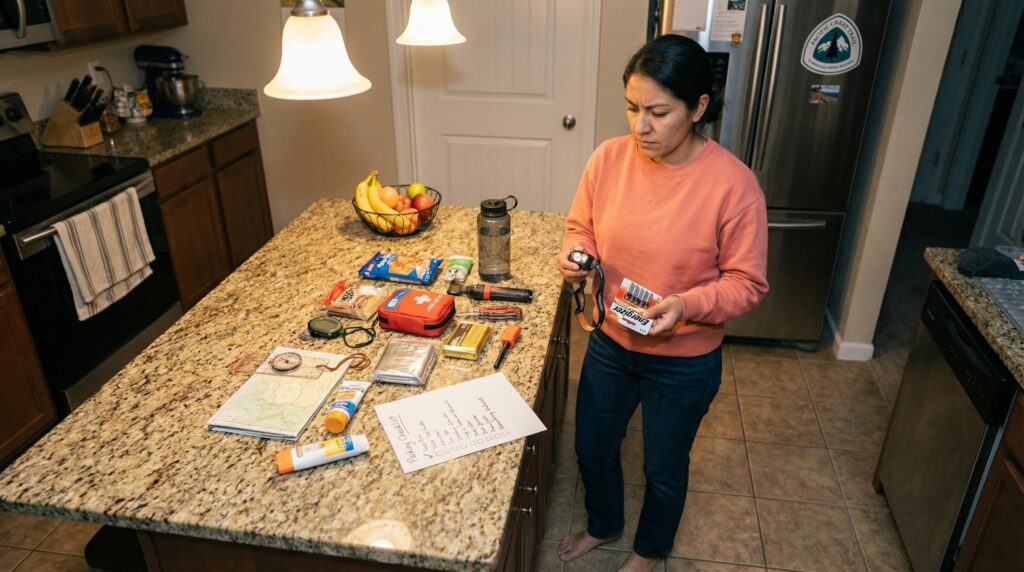
Your trail safety gear is useless if you don’t know how to use it. A first-aid kit still in its factory packaging at mile 4 of a trail with a bleeding wound is the same as not having one. A space blanket that you’ve never deployed takes 90 confusing seconds to figure out in cold, wet conditions.
Open every piece of emergency gear for hiking at home before you need it on trail. Practice deploying the space blanket once. Read through the first-aid kit. Know where the wound closure strips are and what a SAM splint does. This costs 20 minutes at home and is the difference between gear that works and gear that looks good in photos of your pack.
Relying on a phone for navigation without a downloaded map
The most common single-item failure in beginner packs: navigation entirely dependent on a phone with no offline map. Cell signal is unreliable at elevation and absent in canyons. A phone at 8% battery is not a navigation tool.
Download the trail map at home. Confirm GPS tracking works before you leave the parking lot by checking that your position updates on the offline map. Takes 45 seconds and removes the most common navigation failure from your risk list.
When to Change Your Plan
Signs your gear is not matched to the day’s conditions
Temperature at the summit is more than 20 degrees colder than forecast and you have no additional insulation. Turn back. The emergency shelter covers the gap temporarily; it’s not a substitute for an adequate insulation layer on a cold day.
You’re past the halfway point and have under 500ml of water remaining. This is a reassessment point. Continuing means rationing on the return. Turning back means an unpleasant but safe exit. When in doubt, head back.
Pack access rule for safety items
Every safety item should be accessible within 30 seconds without digging. Headlamp in the top pocket. First-aid kit on an outside strap or loose in the main compartment. Space blanket in a hip belt pocket or outer mesh. When you need any of this, conditions are already compromised. A 3-minute pack excavation makes a bad situation worse.
What are the 10 essentials for hiking and do beginners really need all of them?
The 10 essentials for hiking are: navigation, sun protection, insulation, illumination, first-aid supplies, fire, repair tools and knife, nutrition, hydration, and emergency shelter. Yes, beginners need all 10 categories. Emergencies don’t filter by experience level. The beginner version of the 10 essentials for hiking is lighter and simpler than what an experienced backpacker carries, but it covers the same categories. The combined weight of a beginner-appropriate day hike version is under 2 pounds and costs under $75 to assemble.
What should be on a day hike packing list for a first-time hiker?
A day hike packing list for a first timer: downloaded offline trail map on AllTrails, SPF 50 sunscreen plus sunglasses and a hat, one extra layer, a headlamp with fresh batteries, a $24 pre-built first-aid kit, a lighter and backup matches, a small knife or multitool, extra food beyond what you plan to eat, at least 2 liters of water, and a space blanket. That’s the 10 essentials in plain language. Everything fits in a 20-25L daypack.
What is the difference between the 10 essentials for hiking and the backpacking 10 essentials?
The backpacking 10 essentials extend each category for overnight use and greater distance from help. Navigation adds a paper topo map. Insulation becomes a sleep system. Emergency shelter becomes a tent or emergency bivy rated for expected temperatures. The backpacking version adds weight and redundancy because failures at backcountry distances are harder to recover from. For day hiking, the lighter version of each category is appropriate.
What counts as emergency gear for hiking on a basic day hike?
Emergency gear for hiking on a day hike covers three scenarios: unexpected weather (emergency shelter, insulation layer), delayed exit past dark (headlamp with fresh batteries), and physical injury (first-aid kit, repair tools). Those three item categories are the core safety gear for any day hike. Fire is the fourth, for scenarios where you’re stranded overnight.
How do I build a hiking essentials checklist on a budget?
Building a hiking essentials checklist doesn’t require expensive gear. The budget version: AllTrails free tier for navigation (free), SPF 50 drugstore sunscreen ($8), a basic fleece you already own, the $18 Black Diamond Spot headlamp, the $24 Adventure Medical Kits .7 first-aid kit, a BIC lighter ($1), a Morakniv Companion knife ($15), trail mix and a Clif bar ($4), a 2-liter Nalgene ($12), and the SOL emergency space blanket ($6). Total: under $90, often under $60 if you own any of the clothing items.
Is there a standard what to bring on a hike list for the US specifically?
The 10 essentials list is the standard what to bring on a hike framework used by the National Park Service, American Hiking Society, and REI across US trails. What changes by region is how you fill each category. What to bring on a hike in Arizona in July means 4 liters of water and electrolyte supplements. What to bring on a hike in the Pacific Northwest in November means a waterproof shell over the insulation layer. The 10 categories stay constant; the gear in each category adjusts to conditions.
The Gear That Keeps a Good Hike From Becoming a Bad One
The 10 essentials for hiking are not a suggestion list or a gear wish list. They’re the minimum that experienced hikers, trail search and rescue teams, and wilderness medicine practitioners agree prevents the situations that turn manageable into serious.
You don’t need expensive gear. For under $75, the complete beginner version fits in any daypack’s top pocket and adds less than 2 pounds. That’s the argument for it.
The one thing to do before your next hike: check your pack against the 10 essentials for hiking categories above. If any is missing, it’s probably the emergency shelter. It almost always is.
Next Steps
- Right now: Open your pack and check it against the 10 categories. The missing item is almost always the space blanket or the headlamp.
- Before your next hike: Download the AllTrails offline map at home, not in the parking lot. Confirm GPS tracking works before you leave.
- This week: Buy the $6 SOL space blanket if you don’t have one. Cheapest item on the list, highest consequence for being missing.
Frequently Asked Questions
Do I really need all 10 essentials for a short hike?
Yes. Even short day hikes can turn into overnight emergencies if you get injured or lost. The 10 essentials are designed for unexpected survival situations.
What is the most important of the 10 essentials?
While all are important, navigation (knowing where you are) and hydration (water) are generally the most critical for immediate survival.
Related Reads
Pulled out your usual hiking gear for a cold-weather trail and realized none of it was actually built for snow or ice? Here’s what beginners genuinely need to know before winter hiking, from footing to layering to shorter daylight hours.
Felt that gut-drop moment when the trail markers stopped matching your map and nothing looked familiar? Here are 5 steps to actually follow if you get lost hiking, the kind that keep panic from making things worse.
Committed to a trail distance based on a number that sounded fine in theory but felt totally wrong in practice? These 5 rules help you settle on a distance that actually fits you, not just a number that looked reasonable on paper.
Hit a fork in the trail with a faded paint mark and had no clue which direction it was even pointing you toward? Here are 8 trail marker blazes worth knowing before you take a guess at the wrong one.
Wondering if hiking is supposed to feel this brutal every single time, or if something’s actually wrong with how you’re doing it? Here’s an honest look at why hiking feels so hard at first, and when that actually starts to change.