

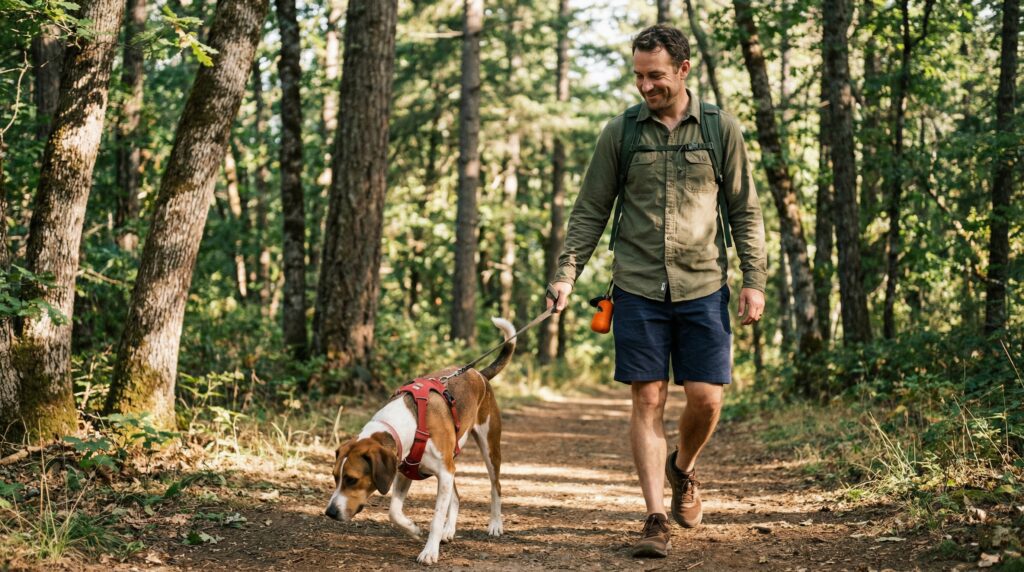
Taking your dog on their very first trail adventure is one of the most rewarding ways to enjoy the outdoors together. While dogs naturally love exploring new sights and smells, ensuring a smooth outing requires a little extra preparation. You need to know which trails allow canine companions, how to pack enough extra hydration for two, and how to spot subtle early signs of fatigue before your dog gets overheated.
Trail Note: When I first started hiking, I had to learn this the hard way. Here is what I discovered from my own time out on the trails.
⚡ Quick Trail Takeaways
- Leash Etiquette: Keep dogs on a 6-ft fixed leash; avoid retractable leashes on trails.
- Hydration Needs: Carry 8 oz of water per hour for your dog plus a collapsible silicone bowl.
- Paw Care: Inspect paw pads for thorns/cuts; apply Musher’s Secret paw wax for rough terrain.
My first hike with my dog was a 3.2-mile trail in the Santa Monica Mountains. I brought enough water for me and none specifically planned for her. I brought her regular collar instead of a harness. didn’t check whether the trail required a leash. She was fine, in the way that dogs are fine even when they’re not fine, because they don’t tell you they’re overheating until they’re sitting down and refusing to move. At mile 2.1, she sat down and wouldn’t get up. I poured my remaining water over her head and she drank half of it out of my cupped hands. We made it back. I did much more research before hike two.
The ten tips below are that research, organized in the order you’ll need them.
| Dog Hiking Gear | Essential Function | Why It Matters |
|---|---|---|
| 6-Ft Fixed Leash | Control & Wildlife Safety | Prevents trail conflicts & wildlife chases |
| Collapsible Silicone Bowl | Clean Hydration | Prevents dog from drinking stagnant parasite water |
| Musher’s Secret Paw Wax | Pad Protection | Shields paws against hot rock, sharp gravel, and ice |
What Most People Get Wrong on Their First Hike With a Dog
The gear gap most dog owners miss
Most beginners preparing for their first hike with dog think through their own gear carefully: footwear, water, pack. They forget that their dog is also going on a 3-mile hike in the heat, carrying nothing, relying entirely on what the owner brings and manages. The dog’s needs are simpler but no less specific: water, a collapsible bowl, a harness that doesn’t chafe on uneven terrain, and a leash long enough for trail comfort but short enough for control near other hikers.
The American Hiking Society at americanhiking.org notes that dogs are among the most common sources of trail incidents involving other hikers, most of which are the result of loose dogs or owners who didn’t know the trail’s leash policy before arrival. A trail that prohibits dogs entirely, or requires on-leash dogs, and an owner who discovers this at the trailhead has wasted the drive and stressed the dog. Trail research for dog hiking tips starts with checking dog policy, not just difficulty.
How dog hiking tips differ from regular hiking tips
The practical differences between hiking with and without a dog are not dramatic. They’re specific. Your water calculation doubles. Your attention is split between your footing and your dog’s behavior. Certain trails are closed to dogs regardless of how well-trained they are. Your rest stops are more frequent. Your pack gets heavier by about 2 pounds of dog supplies.
Most dogs adapt to trail hiking faster than their owners expect. They navigate uneven terrain instinctively, they stay interested and energetic longer than most humans on the same trail, and they give clear physical signals when they’re done. Learning to read those signals is the dog hiking tips skill most first-timers underestimate.
Hiking With a Dog for Beginners: 10 Tips
Tip 1: Start shorter than you think you need to for a first hike with dog
Matching the trail to both fitness levels
For a first hike with dog, the right trail is shorter than what you’d choose for yourself alone, even if your dog seems high-energy. A 1.5 to 2-mile flat trail on a cool morning is the correct starting point for most dogs on their first trail outing, regardless of the dog’s size or breed.
This is not about doubting your dog’s capacity. It’s about the specific combination of heat, unfamiliar terrain, and sustained effort that trail hiking creates versus what your dog experiences on walks or at the dog park. These are different physical demands. The first hike with dog should give you real data on how your dog handles trail terrain, temperature, and duration without any downside risk if the answer is “less well than expected.”
Choosing a dog-friendly trail
Check three things before committing to any trail for dog hiking: does the trail allow dogs, is the leash requirement on-leash or off-leash allowed, and what is the surface. Rocky technical terrain is harder on dog paws than packed dirt. Paved trails in summer heat conduct heat into paw pads. Wide packed-dirt trails in the shade are the correct first trail for most dogs.
AllTrails has a dog-friendly filter. Use it. Then open the trail page and check the specific dog policy in the Details section. Some parks allow dogs on some trails but not others within the same park. Confirming this before you leave is a two-minute check that prevents a wasted trip.
Tip 2: Know your dog’s actual fitness level, not your estimate of it
Why leash walks don’t predict trail performance
Dogs who get regular neighborhood walks are not necessarily ready for a 4-mile trail with 600 feet of elevation gain. Leash walking on flat pavement uses a narrow set of muscle groups at a controlled pace. Trail hiking uses the same stabilizer muscles in dogs that it uses in humans: the small muscles around the ankle and hip that flat, even surfaces don’t train.
The American Kennel Club at akc.org recommends that puppies under 18 months avoid sustained trail hiking because their growth plates are not fully formed and the repetitive impact on uneven terrain can cause joint damage. Senior dogs (over 8 years for most breeds) need careful distance management because trail terrain can expose joint issues that normal walks don’t reveal. For dogs in between, the honest fitness assessment is: how does your dog handle a 30-minute sustained walk with varied terrain and heat? That’s your baseline. A trail hike is more demanding than that baseline, not less.
Breed considerations that actually matter
Most dog hiking tips don’t say this clearly enough: brachycephalic breeds (short-muzzled dogs like bulldogs, pugs, and Boston terriers) overheat faster than other breeds and have restricted breathing capacity that makes sustained aerobic effort harder. These dogs can hike, but they need shorter distances, more frequent rest, and stricter heat monitoring than longer-muzzled breeds. Saying “my dog loves exercise” is not the same as “my dog handles heat and sustained effort well.” The breed matters.
For working dogs, herding breeds, and sporting breeds (retrievers, labs, vizslas, huskies), trail hiking is usually well within their capacity once they’re past 18 months. The risk with these dogs is often the opposite: they’ll push past their limit because they won’t stop before you do.
Tip 3: Check the trail’s dog policy before every outing
Dog friendly hiking rules vary by trail, park, and season
Dog friendly hiking rules are not consistent across trail systems. National parks generally have more restrictive dog policies than national forests or state parks. Some national parks ban dogs from trails entirely but allow them in parking areas and on paved paths. Some state parks require dogs on a 6-foot leash maximum. Other trails are open to dogs year-round; others close seasonally due to wildlife nesting.
The trail’s AllTrails page lists the dog policy under Details. But AllTrails doesn’t always reflect recent policy changes. For any trail on federal or state land, check the land manager’s website or call the ranger station if the stakes are high (long drive, specific trail planned). A five-minute check prevents arriving at a trailhead with a dog on a trail that closed to dogs last season.
What on-leash means in practice
On-leash means on-leash. A 6-foot maximum is the standard in most parks that specify a length. A retractable leash extended to 16 feet is not on-leash in any practical sense and creates a genuine hazard for passing hikers and other dogs. Dog friendly hiking rules around leashes exist because off-leash dogs run ahead on switchbacks and surprise ascending hikers, chase wildlife into restricted habitat, and create conflict with dogs that are leashed and reactive. An on-leash rule applies to your dog regardless of how well-trained they are.
Tip 4: Pack double the water you think you need
What to pack for a dog hike: water is the non-negotiable
What to pack for a dog hike starts and ends with water. Dogs regulate body temperature almost entirely through panting, which loses fluid fast. A dog doing moderate exercise on a 70°F day loses water at roughly twice the rate of a resting dog. On a warm day with real exertion, that rate climbs further.
The baseline: 1 ounce of water per pound of body weight per hour of hiking, in temperatures below 70°F. A 50-pound dog on a 2-hour hike in mild weather needs roughly 100 ounces (about 3 liters). Most beginners bring a single bottle of water for themselves and share sips with the dog. That’s not enough for either of you.
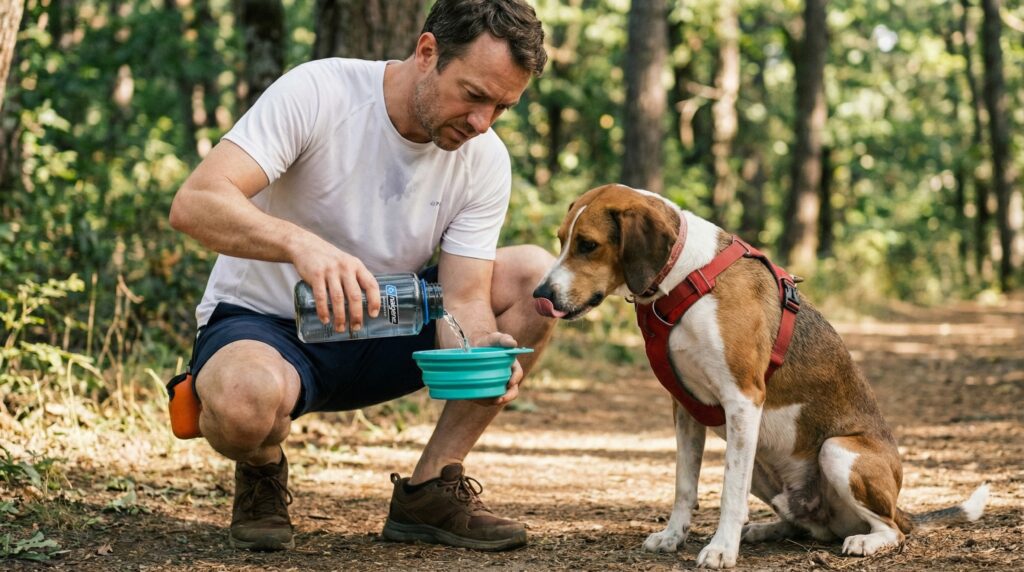
Bring a collapsible silicone bowl. Dogs drink better from a bowl than from your hands or a poured bottle. These weigh almost nothing and cost under $8. It’s the piece of dog hiking gear most first-timers leave at home and miss most on trail.
The heat threshold rule
In temperatures above 80°F, shorten your planned distance by 30% and add a rest stop in shade every 30 minutes. Above 90°F, postpone the hike entirely unless the trail is heavily shaded and you’re going out before 8am. Dogs don’t self-regulate heat the way humans do. They’ll keep running toward you until they can’t. The temperature rule is yours to enforce because they won’t.
💡 Trail Tip: Before leaving the trailhead, fill your dog’s collapsible bowl and let them drink fully. A dog that starts the trail at full hydration handles the first mile better than one that hasn’t had water since home. This also gives you baseline data on whether your dog is interested in water, which matters more mid-hike.
Tip 5: Use a harness, not a collar, on any trail with terrain
Why collar hiking causes problems
A collar is designed for identification and short-duration walks on flat terrain. On trail terrain where your dog is pulling toward a smell, scrambling over a root, or getting surprised by another dog, collar pressure concentrates on the trachea and can cause real injury over a 2-hour hike, particularly in excited dogs who pull consistently.
A well-fitted harness distributes leash pressure across the chest and shoulders. It gives you better control on uneven terrain, reduces tracheal stress, and makes a back-clip attachment available for trail use where a front-clip creates a tripping hazard on narrow paths.
The correct fit: you should be able to slide two fingers between the harness and your dog’s body at every contact point. Too tight restricts breathing and creates chafing over a multi-mile hike. Too loose and the dog can step out of it on a scramble.
Tip 6: Keep your dog on a standard 4 to 6-foot leash
How leash length affects other hikers
Retractable leashes are not trail leashes. This is the dog hiking tips point that causes the most friction between dog owners and other hikers, so it’s worth being direct: a retractable leash extended to 12 or 16 feet creates a horizontal cord across the trail that cyclists and fast-moving hikers can trip over. It gives you no real control if your dog lunges at another dog or a squirrel. It does not count as on-leash in parks that specify a 6-foot maximum.
A standard 4 to 6-foot leash keeps your dog close enough for you to manage trail interactions, gives other hikers enough clearance to pass comfortably, and lets you move the leash to your inside hand on narrow sections when passing hikers going the opposite direction.
Trail etiquette with dogs: stepping aside
Trail etiquette with dogs requires stepping fully off the trail and asking your dog to sit when other hikers pass, particularly hikers with dogs. Not every dog on a trail is dog-friendly. Some leashed dogs are reactive and their owners are managing a real situation. Stepping aside, giving full trail width, and holding your dog steady until the other hiker has passed and is past visual range is the standard that makes trails work for everyone.
If another hiker’s dog reacts to your dog, don’t create an interaction. Move your dog off the trail immediately, create maximum distance, and let the situation pass. Trail etiquette with dogs isn’t about your dog’s friendliness. It’s about respecting that the other dog’s behavior is not yours to control.
Tip 7: Protect your dog’s paws before and after
What trail terrain does to paw pads
Paw pads are tougher than they look but not invincible. Rocky trail terrain, hot pavement sections, and coarse gravel all produce abrasion on paw pads over a sustained hike. A dog who walks primarily on grass and smooth surfaces has softer paw pads than a dog who walks on varied terrain regularly. On a first trail hike, softer pads are more vulnerable to cuts and abrasion from rocky sections.
The 7-second rule for hot surfaces: press the back of your hand on the trail surface for 7 seconds. If you can’t hold it there comfortably, it’s too hot for your dog’s paws. This applies particularly to exposed rock faces, dark gravel, and any paved connector between trail sections. Summer midday hikes create surface temperatures that cause paw burns in under a minute of sustained contact.
Post-hike paw check
After every trail hike, check all four paws before your dog gets in the car. Look for cuts, embedded gravel, swelling between the toes, or redness on the pad surface. Remove any debris carefully. If a cut is bleeding or a pad is visibly damaged, rinse gently with clean water, apply pet-safe antiseptic if you have it, and keep the paw clean for the next 24 hours. Limping that continues after 10 minutes of rest warrants a vet visit.
💡 Trail Tip: Musher’s Secret paw wax ($15 to $20 at most pet stores) applied before the hike creates a protective barrier on paw pads for rocky terrain and hot surfaces. It’s not necessary for every trail, but it’s worth having for any trail with known rocky sections or exposed summer heat.
Tip 8: Know the signs your dog needs to stop
What overheating looks like in dogs
A dog who needs to stop doesn’t always sit down and refuse to move. The earlier signs come first: excessive panting that isn’t matched to the effort level, slower pace without an obvious reason, tongue that’s wider and flatter than normal (a paddle-shaped tongue means the dog is working hard to cool down), glassy or unfocused eyes, or stumbling on terrain they’ve been handling fine.
If any of these appear: stop immediately, find shade, pour water over the head and back of the neck, and let the dog drink slowly. Wait until panting normalizes and the dog is interested in surroundings again before continuing. That recovery typically takes 10 to 15 minutes in mild conditions.
If the dog won’t drink, is vomiting, or loses coordination: cool them with water immediately, carry them to the shade if possible, and call a vet. These are heat exhaustion signs that go beyond standard overexertion. Get off the trail and get to a vet.
Tip 9: Leave No Trace applies to your dog too
What to pack for a dog hike: waste bags are non-negotiable
What to pack for a dog hike as a matter of trail etiquette: waste bags, at minimum four for a 2-mile hike. Leaving dog waste on trail is the single most common complaint land managers receive from other hikers, and it’s increasingly enforced in parks that have received formal complaints. Dog waste introduces bacteria and parasites to trail soil at concentrations that don’t occur naturally.
Bag the waste and carry it to the trailhead bin. If no bin exists at the trailhead, carry it out in a sealed bag in your pack. The same Leave No Trace principles that apply to your own behavior on trail apply to your dog’s.
Dogs and wildlife: why on-leash protects more than other hikers
Dog friendly hiking rules requiring on-leash dogs exist partly for other hikers and partly for wildlife. A dog chasing a deer into a forest doesn’t seem harmful in the moment. Across thousands of hikes, dogs off-leash push wildlife away from feeding areas, disrupt nesting, and introduce scent profiles that alter animal behavior patterns for days after the hike.
In areas with rattlesnakes, on-leash is also for your dog’s protection. A leashed dog stays on the trail where snake encounters are less likely. An off-leash dog investigating every rock and brush pile is the target profile for a defensive strike.
Tip 10: Start small, track what you learn, and build from there
How to build a hiking practice with your dog over the first month
The fastest way to develop a confident hiking practice with your dog is a simple progression: three hikes in the first four weeks, each slightly longer than the last, each tracked for the same three data points: how your dog moved at the halfway mark, how much water they consumed, and how quickly they recovered after the hike.
Week 1: 1.5 to 2 miles, flat, cool morning. Note energy level at the halfway point and water consumption.
Week 2: 2 to 2.5 miles, same terrain type. Compare to week one. Did your dog hit a wall earlier or handle it consistently?
Week 3 to 4: 3 miles with a gentle elevation variation (under 200 feet). This is the test of whether trail fitness has developed beyond what the first two flat hikes built.
By week four, you have real data on your dog’s trail capacity, not an estimate based on park behavior. That data is more useful for planning hike five than any general breed guideline.
The honest part about hiking with a dog
I don’t know with certainty how every dog responds to trail hiking, because dogs vary as much as people do. What I do know is that the common failure mode is owner overconfidence in the first hike. The 3.2-mile trail I mentioned in the intro was too long for our first outing together, and I knew it halfway through and didn’t turn around because I thought she’d be fine. She was, but that was luck, not planning. Start shorter than you think you need to.
Common Mistakes on a First Hike With a Dog
Choosing a trail for yourself, not for both of you
The trail that matches your current fitness level may not match your dog’s first-day trail capacity. An AllTrails Moderate trail with 600 feet of gain might be perfect for you on your fourth outing and too much for your dog on their first. Use the same trail selection logic for your dog that applies to a beginner hiker: flat, short, well-marked, cool conditions.
Not checking the dog policy before leaving home
Arriving at a trailhead with a dog on a trail that prohibits dogs or showing up on a day when seasonal dog restrictions are in effect wastes the drive and stresses the dog. This check takes two minutes at home and is worth doing every time, not just for new trails. Policies change seasonally and after land management updates.
Relying on a retractable leash
Retractable leashes are not trail tools. They create cord hazards for other hikers, give inadequate control in sudden situations, and don’t comply with most parks’ 6-foot leash requirements. Bring a standard 4 to 6-foot leash. Leave the retractable at home.
Underestimating water needs for the dog
The most common reason first-time dog hikers turn around early is a dog who overheats or becomes lethargic from dehydration. One liter of water for a 50-pound dog on a 2-hour moderate hike is not enough. Bring 3 liters for the dog alone on that outing, bring a collapsible bowl, and offer water every 30 minutes regardless of whether the dog seems to want it.
Skipping the post-hike paw check
Paw damage from trail terrain is easier to prevent than to treat. A 60-second check of all four paws at the trailhead before getting in the car catches cuts, embedded debris, and pad abrasion before they worsen during the drive home. Make it automatic after every trail hike.
When to Turn Around or Skip the Hike
Signs that mean turn back now
Your dog sits or lies down and won’t move after rest and water. This is not stubbornness. It’s a physical limit signal. Don’t coax or wait it out. Begin the return immediately.
Your dog is panting in a way that isn’t matching their exertion level, has a paddle-shaped tongue, is stumbling on terrain they’ve been handling, or has glazed eyes. These are heat exhaustion signals. Get to shade, cool with water, and move toward the trailhead.
The surface temperature is above the 7-second threshold for your hand. Turn around and find a shaded trail or return on a cooler day.
Signs to adjust your plan mid-hike
Your dog is drinking more water than your baseline estimate. Slow your pace, increase shade stops, and evaluate whether finishing the trail is the right call.
Your dog’s pace has dropped noticeably from the first mile without a reason like heat or terrain. This usually means fatigue is accumulating faster than expected. Reduce pace, add a rest stop, and consider turning around before the halfway point if recovery isn’t clear.
Signs you’re on track
Your dog is engaged and interested at the halfway mark. Their pace is consistent with the start. They’re drinking water at rest stops but not urgently. They’re scanning the surroundings rather than moving with head down.
What should I know about hiking with a dog for beginners?
Hiking with a dog for beginners requires three things before the trailhead: confirm the trail allows dogs and check the leash policy, bring enough water for two (1 ounce per pound of body weight per hour for your dog), and choose a trail shorter and flatter than what you’d pick for yourself alone on a first outing. The first hike with dog is a data-gathering exercise. Start short and build on what you learn.
What are the best dog hiking tips for a first outing?
The most important dog hiking tips for a first trail are: use a harness rather than a collar, bring a collapsible bowl and more water than you calculate, keep your dog on a 4 to 6-foot standard leash rather than a retractable, and learn the early signs of overheating before you go. Most first-hike problems are water and leash problems. Both are preventable with 15 minutes of preparation.
What do I need to pack for a dog hike?
What to pack for a dog hike: a collapsible silicone bowl, water (at minimum 1 ounce per pound of dog per hour of hiking), waste bags (at least four per 2-mile hike), a 4 to 6-foot standard leash, a well-fitted harness, and paw wax for rocky or hot-surface trails. A small travel first aid kit with pet antiseptic is worth adding for any hike over 3 miles. The total pack weight for dog supplies adds roughly 2 to 3 pounds to your load on a moderate day hike.
What are dog friendly hiking rules I need to know?
Dog friendly hiking rules vary by trail system, but the baseline across most US trails: dogs on leash at all times unless the trail explicitly permits off-leash, 6-foot maximum leash length in parks that specify a length, dogs must be under voice control even where off-leash is permitted, all dog waste must be bagged and packed out. National parks generally have stricter dog policies than national forests. Check the specific trail’s policy on AllTrails and verify with the land manager’s site for any trail on federal or state land.
What is the right trail etiquette with dogs?
Trail etiquette with dogs: step fully off the trail when other hikers approach, hold your dog in a sit or stand beside you rather than letting them move toward the other hiker or dog. Ask your dog to sit at junctions where multiple hikers are converging. Give passing hikers full trail width, not just enough room to squeeze by. Pick up waste immediately and carry it out. An on-leash rule applies to your dog regardless of how friendly they are.
How do I know if my dog is ready for trail hiking?
Your dog is ready for trail hiking if they’re over 18 months old (growth plates fully formed), handle a 30-minute sustained walk in heat without distress, don’t have known joint issues, and aren’t a brachycephalic breed that needs specific heat monitoring. The first hike with dog should be short and flat regardless of the answer to all of those questions. Trail hiking is a specific demand. The data from the first outing is more reliable than any prediction from park or neighborhood behavior.
Most Dogs Are Ready Before Their Owners Are
Hiking with a dog for beginners is a preparation problem, not a capability problem. The dogs almost always handle the trail. The owners run short on water, pick a trail that’s too long, forget the leash policy, or miss the early overheating signals because they didn’t know what to look for.
The ten tips in this article cover the full preparation gap: trail selection, fitness honest assessment, dog friendly hiking rules, what to pack for a dog hike, leash choice, water management, paw protection, overheating signals, Leave No Trace, and building a consistent practice. Work through them before your first outing and you’ve done the preparation most first-timers skip.
Next Steps
- Right now: Open AllTrails and filter for dog-friendly Easy trails under 2 miles near you. Open one trail page and confirm the leash policy in the Details section.
- Before your first hike: Pack a collapsible bowl, calculate water for your dog (body weight in pounds = ounces per hour minimum), and switch to a harness if you’ve been using a collar. Check sunrise temperature and plan a morning start if it’s above 70°F.
- After your first hike: Note how much water your dog drank, their energy level at the halfway mark, and how quickly they recovered at home. That data shapes every subsequent trail choice.
Frequently Asked Questions
How far can a beginner dog hike?
A healthy adult dog can generally hike a few miles, but you should start with 1-2 mile flat trails to condition their paw pads before attempting longer hikes.
Can I let my dog off leash on a hike?
You should only let your dog off leash if the specific trail rules allow it, and only if your dog has perfect recall to prevent wildlife encounters.
Related Reads
Kept opening your closet to check your gear five separate times the night before your first hike? Here’s exactly what your first hike actually involves, so the overthinking can finally stop.
Said yes to a “moderate” distance without stopping to think about whether that actually matched your fitness? These 5 rules help you land on a number that’s genuinely yours, not just whatever sounded reasonable at the time.
Rolled out of bed late and hit the trail way later than you meant to? These 3 rules nail down when you should actually be starting so daylight and weather are working in your favor, not against you.
Treated your first trail like a slightly longer version of your evening walk? These 5 differences explain why your body notices the difference fast once real elevation and terrain come into play.
Looked at a trailhead sign rating you’d never seen and just hoped for the best? Here’s what those ratings are actually telling you, explained without any confusing jargon.