

The best time to start a hike is earlier than most beginners plan for. Not as a preference. Because three specific things get worse as the day progresses: temperature, afternoon weather, and available light. All three are predictable. All three are manageable if your start time accounts for them.
⚡ Quick Trail Takeaways
- Optimal Morning Window: Starting at or before 7:00 AM avoids peak afternoon heat, thunderstorm cycles, and crowded trailhead parking.
- Seasonal Adjustments: In summer, hike early to beat 90°F+ midday heat; in late autumn/winter, maximize the 10:00 AM to 3:00 PM sun window.
- Daylight Buffer: Always calculate total trail time and ensure a minimum 2-hour buffer before sunset.
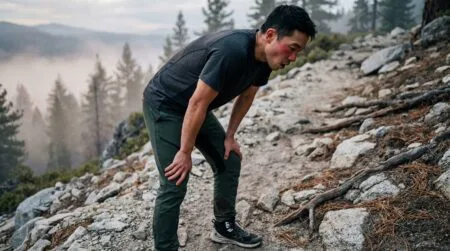
I started a 6.8-mile trail in the Angeles National Forest in late July at 10:15 AM. I thought that was reasonable. By mile 3.5, the temperature on the exposed ridge section had reached 97°F. I was through two of my three water bottles by mile 4 with 2.8 miles still ahead. I finished the hike, but the return was genuinely miserable and came close to the point where turning around would have been the right call. The trail, the distance, and the conditions were all fine. The start time was the entire problem.
This guide covers the three rules that determine the best time to start a hike, how those rules shift by hiking season, what specifically separates morning vs afternoon hiking in practical terms, and the thresholds for when your start time has become a safety problem rather than just a preference.
🟠 Before You Head Out:
This guide covers start time planning for day hikes. If you are currently on trail
showing heat exhaustion signs (nausea, stopping sweating, confusion): move to shade,
pour water on your skin, and call 911. Do not attempt to hike out.Read on for everything you need to prevent this situation entirely.
🥾 Oliver’s Trail Notes & Field Observations
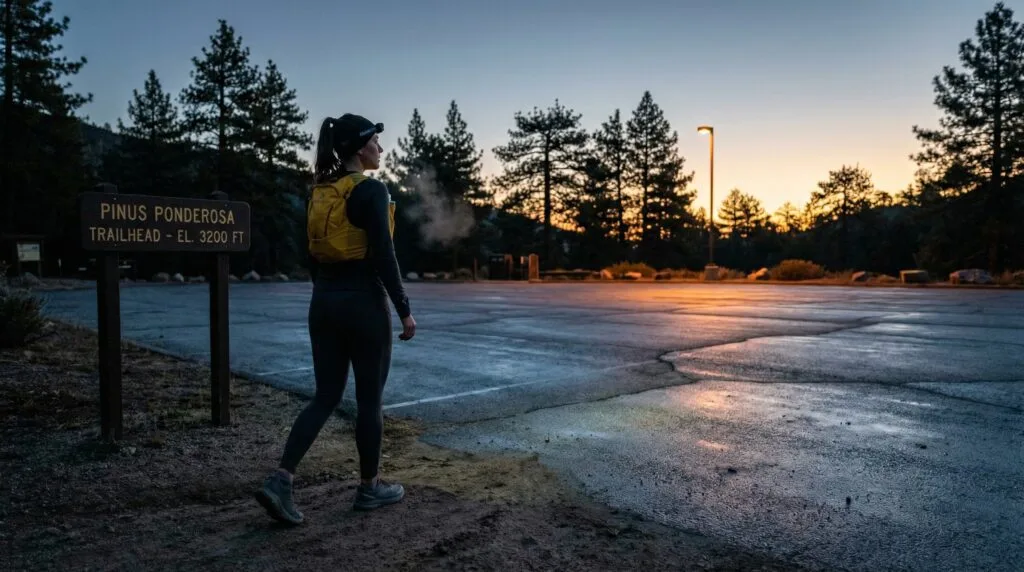
In Southern California, starting a hike at 10 AM is a recipe for heat exhaustion and full parking lots. When I hike exposed routes like the Sam Merrill trail or Cucamonga Peak, I plan to arrive at the trailhead at first light—typically between 5:30 AM and 6:30 AM. Starting at dawn gives you cool morning shade on the steepest climb, guarantees a parking spot, and leaves ample daylight buffer in case of unexpected delays.
Best Time to Start a Hike: Why It Is a Safety Decision
What changes as the day progresses
Most beginners treat start time as a scheduling preference. That framing misses the actual mechanism. Trail conditions are not static throughout the day. Three things change, and all three change in the wrong direction after late morning.
Temperature. Ambient temperature typically peaks between 2 PM and 4 PM. On a summer day that starts at 75°F at 7 AM, the same trail may reach 95°F by 2 PM. The National Park Service identifies heat illness as one of the leading preventable medical issues on day hikes, with most incidents occurring between noon and 4 PM. A 7 AM start puts you off exposed terrain before the peak heat window opens. A 10:30 AM start puts you in the middle of it.
Afternoon thunderstorms. Across the Southwest, Rocky Mountain region, and Appalachians, convective thunderstorms develop reliably between 1 PM and 3 PM during summer months. These storms build faster than most hikers expect. A clear morning sky can become a lightning-active storm within 45 minutes. Above treeline, there is no cover. A start time that gets you above treeline before 11 AM and back below before 1 PM dramatically shrinks your exposure window.
Available light. The math is fixed: if your hike takes 4 hours and you start at 2 PM, you finish near sunset in most seasons. Finishing an unfamiliar trail in fading light is how people get disoriented on a descent they would have handled without difficulty in daylight.
Morning vs afternoon hiking: what the difference actually is
Morning vs afternoon hiking is not about aesthetics or energy levels. The conditions are measurably different.
Morning gives you cooler air, typically 10 to 25°F lower than afternoon peak. Trails are less crowded. Wildlife is more active. Parking lots have space. The light creates contrast that makes terrain features visible in ways that flat overhead afternoon sun does not.
Afternoon gives you peak temperature, highest thunderstorm probability in storm-prone regions, more trail traffic, and diminishing daylight. In fall and winter, afternoon hiking carries far less risk than summer. As a default for beginners in summer: morning is the right operating window, and the earlier within that window, the better.
The 3 Rules for the Best Time to Start a Hike
Rule 1: Be on trail by 7 AM in summer, 8 AM in spring and fall
How to apply the temperature rule
This is my clearest opinion on the best time to start a hike in warm weather, and I hold it without exceptions: if the high temperature forecast for that day exceeds 85°F, be on trail no later than 7 AM. If that start time is not possible, choose a shorter or shadier trail, or go on a different day.
The calculation is straightforward. Most beginner day hikes take 2 to 4 hours. A 7 AM start finishes most beginner hikes by 11 AM, before temperatures approach their afternoon peak. A 10 AM start finishes a 3-hour hike at 1 PM, which is when temperatures are climbing toward their daily maximum and afternoon storm development begins in many regions.
In spring and fall, when daily highs stay below 75°F, an 8 AM start gives you comfortable conditions and gets you off the trail before afternoon weather risk builds. In winter, the concern shifts from heat to daylight, and the rule adjusts accordingly.
Check the forecast the morning of the hike at the National Weather Service mountain forecast for the specific trail area, not the nearest city. A city forecast regularly underreports mountain heat and misses localized afternoon storm development.
What early morning hiking tips actually change
Early morning hiking tips are not just about avoiding heat. The operational differences between a 6:30 AM start and a 9:30 AM start compound across the full hike.
At 6:30 AM: trailhead parking is available without competition, the trail is significantly less crowded, trail surface temperature is cooler underfoot, directional morning light makes terrain features more readable, and wildlife is at peak activity.
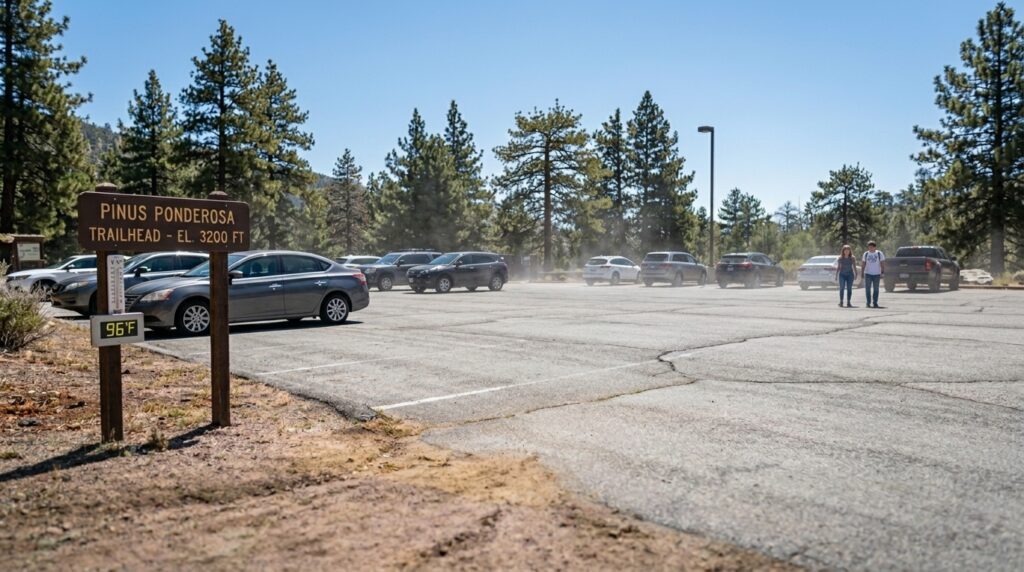
At 9:30 AM: popular trailhead lots commonly fill before 8 AM on summer weekends, the full heat load of the day sits ahead of you, and parking may require additional walking before you start hiking. The early start advantage on a summer hike is real from the first step.
Logistically, early morning hiking tips that produce the most consistent difference are the night-before ones: pack ready, food prepared, clothes laid out, trail downloaded offline, alarm set to account for actual drive time rather than estimated drive time. An alarm at your planned start time gets you to the trailhead at your planned start time, not on trail.

Rule 2: Be below treeline by 1 PM in lightning-prone regions
When and where the thunderstorm rule applies
In the Rocky Mountains, Colorado Plateau, desert Southwest, and Appalachians from July through September, the best time to start a hike above treeline is whatever time gets you back below treeline before 1 PM. This is a fixed departure deadline, not a suggestion.
Lightning above treeline is a specific and serious hazard. Open ridgelines, exposed summits, alpine meadows, and any position without tall trees within 100 feet leave you as the tallest conductive object in the area during active lightning. You can see a storm building across the valley. You cannot guarantee getting below treeline before it reaches you if you are already at the high point with distance to descend.
The American Hiking Society recommends checking hiking etiquete the morning of any above-treeline hike. If the forecast shows afternoon convective activity between noon and 5 PM, plan your start time so you reach the high point by 10 AM and begin descent by 10:30 AM at the latest.
For trails that remain below treeline, standard awareness applies. Count the seconds between lightning flash and thunder. Five seconds equals one mile. Under 10 seconds means the storm is under 2 miles away, which is a reason to move to lower ground immediately rather than wait.
Rule 3: Start no later than half your total trail time before sunset
What time of day is best for hiking by the daylight rule
This rule applies year-round regardless of temperature. Take the estimated time for your complete hike, divide by two, and subtract that number of hours from sunset. That is your latest reasonable start time.
A 4-hour hike with sunset at 6 PM: latest start is 2 PM with zero buffer. That is not a comfortable margin. What time of day is best for hiking under this rule is almost always morning for any hike over 3 hours, since the latest safe start falls close to midday or earlier once a buffer is added.
Build a 90-minute buffer beyond the basic calculation on any trail you have not done before. Add more for trails with significant descent. A descent that takes 40 minutes in full daylight can take 70 minutes in fading light, as pace naturally slows when terrain becomes harder to read. That difference is where people make ankle-rolling missteps that would not have occurred 2 hours earlier.
A headlamp in your pack is a backup for unexpected delays, not a planning tool. If your plan requires the headlamp to finish the hike, the plan needs a new start time.
🥾 Reverse Planning from Official Sunset
Whenever I plan an afternoon trek, I use reverse math: calculate total estimated hike time, add a mandatory 1.5-hour safety buffer, and count backward from official sunset. During winter months along Angeles Crest, shadows fall across mountain canyons an hour before sunset, and temperatures drop 15 degrees in minutes. Planning your finish 90 minutes before dusk prevents scrambling for headlamps on rocky switchbacks.
When to Go Hiking by Season
How the best time to start a hike shifts across the year
When to go hiking changes more by season than most beginners adjust for. These windows apply to the continental US.
Summer (June through August): 6 to 7 AM target start. No later than 8 AM for trails with significant sun exposure when the forecast exceeds 85°F. Summer hiking times in the desert Southwest and Mountain West require the most aggressive early starts. Plan for 5:30 to 6 AM on above-treeline routes or trails with 2,000 or more feet of elevation gain.
Spring and fall (March through May, September through November): 7 to 8 AM works for most day hikes. The heat risk is lower, but afternoon weather and shortening daylight still matter. Check sunset times, which fall as early as 4:45 PM by early November across much of the northern US.
Winter (December through February): Daylight governs everything. Sunrise is between 7 and 8 AM across most of the continental US in winter, and sunset can arrive as early as 4:30 PM. A 10 AM start on a 6-hour trail leaves no margin whatsoever. Winter start time and trail length have to be planned as a pair, not separately.
Summer hiking times and the specific adjustments they require
Summer hiking times require three preparation adjustments that other seasons do not.
Start the alarm calculation from sunset backward, not from when you want to wake up forward. Set the latest acceptable start time first, then subtract drive time and morning preparation, then set the alarm. This sequence prevents the gradual start-time creep that makes a planned 7 AM start into an actual 9 AM departure.
Carry a minimum of half a liter of water per hour of planned hiking time. On a summer hike above 85°F, increase that to three-quarters of a liter per hour. Carry more than you calculate needing, because the consequence of running short on a hot trail is severe and the weight penalty is minor.
Check the trail surface in AllTrails reviews from the last 14 days before any summer hike. Trail conditions in summer, including water availability, shade coverage, and surface temperatures on exposed rock sections, change more between seasons than the official trail description reflects.
Common Start Time Mistakes
Four patterns that put hikers in the wrong conditions
Starting based on how you feel, not what the clock requires. The best time to start a hike is calculated from the forecast, the trail length, and the sunset time. Feeling ready at 10 AM and starting at 10 AM on a July trail is not a timing decision. It is the absence of one.
Underestimating parking and logistics time. A trail 45 minutes away requires a 5:15 AM wake-up for a 7 AM trailhead start. Popular trails fill their parking lots by 8 AM on summer weekends. Adding 20 to 30 minutes of parking uncertainty to your estimate is not pessimism. It is the experience of anyone who has sat in a parking queue while the clock runs toward their planned start time.
Using one season’s start time for a different season’s conditions. A trail done at 9 AM in April does not give you a 9 AM starting point in July on the same trail. Temperature profiles, shade coverage, and afternoon storm risk are all different. Reset the start time calculation at the beginning of each season, not just once at the beginning of the hiking year.
Calculating arrival at the turnaround, not arrival back at the car. On an out-and-back, reaching the viewpoint at noon means you are at the halfway point, not finished. The second half of that hike happens during the hottest and most weather-exposed window of the day. The start time needs to account for when you return, not when you turn around.
When to Change Your Plan
Specific thresholds for start time and trail conditions
The decisions below happen before and during the hike. These thresholds are specific so you are not estimating in the moment.
Turn Around Now
- Temperature has exceeded 100°F and you have more than 2 miles remaining to the trailhead
- A thunderstorm is within 2 miles (under 10 seconds between lightning flash and thunder) and you are above treeline or on an exposed ridge
- Less than 90 minutes of daylight remains and you have more than 1 mile to the trailhead on unfamiliar terrain
- You or a hiking partner is showing heat exhaustion signs: nausea, stopping sweating, confusion, or inability to walk normally
Slow Down and Reassess
- Temperature is between 90 and 99°F, you are past the halfway point, and you have adequate water remaining
- You can see a storm building but it is more than 5 miles away and you are below treeline with an option to descend further
- Less than 2 hours of daylight remain but the trail is familiar and you have under 2 miles to the trailhead
You’re Fine: Keep Going
- Temperature is below 85°F, trail has shade, and water supply is on track
- Sky is clear or showing only high clouds with no convective development visible
- You have more available daylight than you need for the remaining distance at your current pace
One rule: When unsure which tier applies, treat it as the higher one. Heat exhaustion and lightning are not situations where caution has a meaningful downside.
What is the best time to start a hike in summer?
The best time to start a hike in summer is between 6 and 7 AM on most trails with sun exposure. For above-treeline routes in lightning-prone regions, a 5:30 to 6 AM start gets you off exposed terrain before afternoon convective storms typically develop. Summer hiking times in the desert Southwest and Mountain West are more demanding than coastal or heavily forested regions where shade and sea breezes moderate afternoon heat. Check the specific forecast for your trail area at weather.gov the morning of every summer hike.
What is the difference between morning vs afternoon hiking?
Morning vs afternoon hiking differs on three measurable conditions: temperature (typically 10 to 25°F cooler in the morning), thunderstorm exposure (afternoon convective storms peak between 1 and 3 PM in many US regions during summer), and available daylight. Morning hiking also means less trail traffic, available parking, and better light for reading terrain. For beginners on any hike over 3 miles in summer, morning is the safer and more comfortable operating window by a significant margin.
What time of day is best for hiking if I cannot start early?
What time of day is best for hiking on a later start depends on season and location. In fall and winter outside of storm-prone regions, a 9 to 10 AM start is workable for hikes under 4 hours. In summer in the Southwest or Mountain West, a late start means choosing a trail under 3 miles with good shade, carrying extra water, and targeting a return to the trailhead by 2 PM. If the only available start time puts you finishing after 3 PM in summer, the better decision is a different day.
What are the most useful early morning hiking tips?
Early morning hiking tips that produce the biggest change are logistical, not physical. Prepare the night before: pack ready, food made, clothes laid out, trail downloaded offline, alarm set for a time that includes your actual drive plus 15 minutes. Eat a real breakfast before starting even if it feels early. Skipping it compounds significantly around mile 3. Bring a light layer for the cooler morning air even in summer, since trail temperatures at 6 AM can run 20°F below the afternoon forecast. The layer takes 5 minutes to remove and weigh almost nothing.
When should I adjust my summer hiking times?
Summer hiking times should shift earlier any time the high temperature forecast exceeds 85°F, the trail has extended exposed sections, or the route crosses above treeline in a region with afternoon storm activity. Adjust to a different day when the forecast high exceeds 105°F on a fully exposed trail, afternoon thunderstorm probability is above 60 percent on an above-treeline route, or air quality reaches Unhealthy on AirNow. Summer hiking times set the week before a hike are not reliable. Check the specific day’s forecast the morning you plan to go.
How do I figure out when to go hiking based on a specific trail?
When to go hiking on a specific trail: take the AllTrails estimated time, add 30 to 50 percent for beginner pace, then apply all three rules. Apply the temperature rule: if the forecast high exceeds 85°F, the 7 AM cap is binding regardless of other calculations. Apply the daylight rule: subtract half your adjusted trail time plus a 90-minute buffer from sunset. Whichever constraint produces the earlier required start time is the one that governs. Read AllTrails reviews from the last 14 days, since hikers consistently note specific start time recommendations based on what conditions they found.
Start Time Is the Planning Step Most Beginners Skip
The best time to start a hike is the first planning decision, not the last. Temperature, weather, and daylight all have specific windows, and the right start time keeps you inside those windows from the trailhead to the car.
Morning vs afternoon hiking is not a real debate in summer: 6 to 7 AM keeps you ahead of the heat, the storms, and the clock. A 10 AM start that felt reasonable in May becomes a heat management problem by July on the same trail. Adjust summer hiking times at the beginning of every season, not as a reaction to a bad experience.
For your next hike, calculate your start time before you confirm the trail. Set the alarm the night before based on drive time, not preference.
Next Steps
- Right now: Find tomorrow’s forecast for your nearest trail area at weather.gov, not the city forecast. Check the high temperature and afternoon storm probability.
- Before your next hike: Calculate your latest safe start using Rule 3: estimated trail time divided by two, subtracted from sunset, minus 90 minutes. Write it down.
- Day of: Set your alarm for 45 minutes before your planned start time, not at it. That gap disappears fast on a morning with any preparation left to do.
Frequently Asked Questions
What is the best time to start a hike in summer?
The best time to start a hike in summer is between 6 and 7 AM on most trails with sun exposure. For above-treeline routes in lightning-prone regions, a 5:30 to 6 AM start gets you off exposed terrain before afternoon convective storms typically develop. Summer hiking times in the desert Southwest and Mountain West are more demanding than coastal or heavily forested regions where shade and sea breezes moderate afternoon heat. Check the specific forecast for your trail area at weather.gov the morning of every summer hike.
What is the difference between morning vs afternoon hiking?
Morning vs afternoon hiking differs on three measurable conditions: temperature (typically 10 to 25°F cooler in the morning), thunderstorm exposure (afternoon convective storms peak between 1 and 3 PM in many US regions during summer), and available daylight. Morning hiking also means less trail traffic, available parking, and better light for reading terrain. For beginners on any hike over 3 miles in summer, morning is the safer and more comfortable operating window by a significant margin.
What time of day is best for hiking if I cannot start early?
What time of day is best for hiking on a later start depends on season and location. In fall and winter outside of storm-prone regions, a 9 to 10 AM start is workable for hikes under 4 hours. In summer in the Southwest or Mountain West, a late start means choosing a trail under 3 miles with good shade, carrying extra water, and targeting a return to the trailhead by 2 PM. If the only available start time puts you finishing after 3 PM in summer, the better decision is a different day.
What are the most useful early morning hiking tips?
Early morning hiking tips that produce the biggest change are logistical, not physical. Prepare the night before: pack ready, food made, clothes laid out, trail downloaded offline, alarm set for a time that includes your actual drive plus 15 minutes. Eat a real breakfast before starting even if it feels early. Skipping it compounds significantly around mile 3. Bring a light layer for the cooler morning air even in summer, since trail temperatures at 6 AM can run 20°F below the afternoon forecast. The layer takes 5 minutes to remove and weigh almost nothing.
When should I adjust my summer hiking times?
Summer hiking times should shift earlier any time the high temperature forecast exceeds 85°F, the trail has extended exposed sections, or the route crosses above treeline in a region with afternoon storm activity. Adjust to a different day when the forecast high exceeds 105°F on a fully exposed trail, afternoon thunderstorm probability is above 60 percent on an above-treeline route, or air quality reaches Unhealthy on AirNow. Summer hiking times set the week before a hike are not reliable. Check the specific day's forecast the morning you plan to go.
How do I figure out when to go hiking based on a specific trail?
When to go hiking on a specific trail: take the AllTrails estimated time, add 30 to 50 percent for beginner pace, then apply all three rules. Apply the temperature rule: if the forecast high exceeds 85°F, the 7 AM cap is binding regardless of other calculations. Apply the daylight rule: subtract half your adjusted trail time plus a 90-minute buffer from sunset. Whichever constraint produces the earlier required start time is the one that governs. Read AllTrails reviews from the last 14 days, since hikers consistently note specific start time recommendations based on what conditions they found.
Related Reads
Caved and agreed to whatever distance the group suggested, even though you had no idea if it actually fit you? These 5 rules help you push for a number that’s genuinely realistic instead of going along with the crowd.
Layered up like it was a normal cold day and found out winter trails play by completely different rules? Here’s what beginners actually need to know before winter hiking, from icy footing to losing daylight fast.
Kept pushing forward on a hike even though something in the back of your mind said maybe you shouldn’t? Here’s how to actually know when to turn back before stubbornness turns into a real problem out there.
Promised you’d be back in an hour for a “quick” 3-mile hike and ended up way later than planned? Here’s a far more grounded time estimate for that distance, based on how beginners actually move.
Shot out fast at the start and spent the rest of the trail just trying to recover? These 7 pacing techniques fix that imbalance so your energy actually lasts the whole way.