


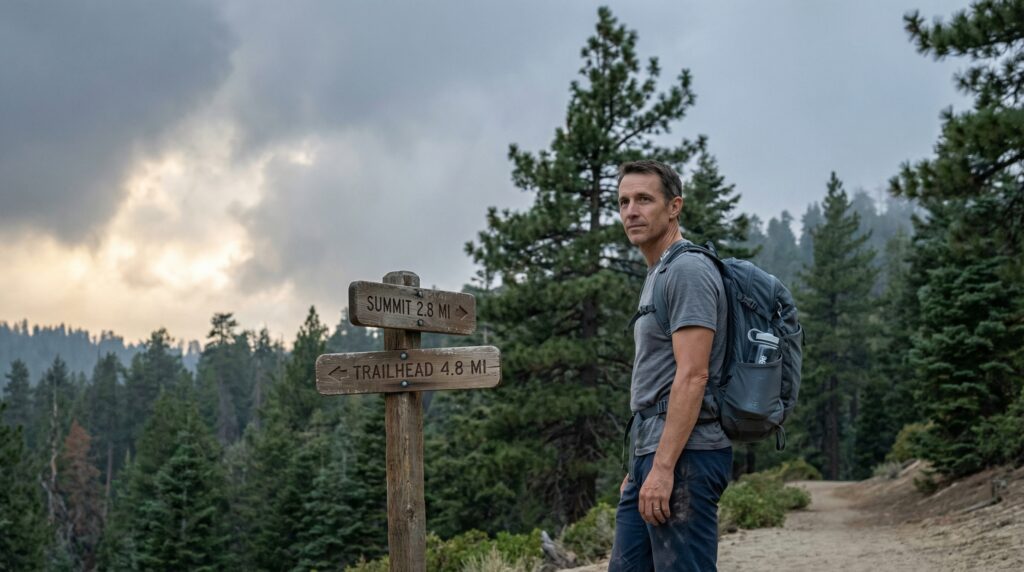
Knowing when to turn back on a hike is a more specific skill than most trail guides describe. It is not just “listen to your body” or “trust your instincts.” Beginners do not have trail instincts yet. What they need are specific, pre-decided rules that remove the in-the-moment negotiation from a decision that is always emotionally harder than it should be.
⚡ Quick Trail Takeaways
- Strict Turnaround Time: Set a hard ‘turnaround clock’ before leaving the trailhead, regardless of how close you are to the summit.
- Weather Triggers: Turn back immediately at the first sound of thunder or unexpected drop in temperature above treeline.
- Physical Red Flags: Dizziness, acute joint pain, or running through half your water supply are non-negotiable turnaround signals.
I turned around on a 7.2-mile trail in the San Bernardino Mountains at mile 4.8. Not because anything had gone seriously wrong. Because my water was at 40 percent of what I started with, the sky to the west had shifted from clear to building cumulus in the previous 45 minutes, and my pace had dropped by roughly a third from what it was at mile 2. Each signal on its own was manageable. Together, they were the decision.
That was the first time I turned around without second-guessing myself, and it was because I had set rules before I started. Previous hikes, I had pushed through signals I should not have pushed through. One of those ended with a sprained ankle at mile 5.6 of a 6-mile trail in fading light, because I was moving faster than conditions warranted to get back before dark. That ankle cost me three weeks off trail.
This guide covers the specific signals, the specific rules, and the specific thresholds that make when to turn back on a hike a decision you can make without guilt or hesitation.
🟠 Before You Head Out:
This guide covers turnaround decision-making for day hikes. If you are currently in a
trail emergency: call 911. In areas without cell service, activate your PLB or satellite
communicator, stay put if safe, and signal for help.
Read on for everything you need to make the right call before it becomes an emergency.
When to Turn Back on a Hike: The Decision Most Beginners Get Wrong
Why turning around feels harder than it should
The emotional difficulty of turning around has nothing to do with the trail. It is sunk cost reasoning applied to a physical situation where sunk cost is irrelevant. You drove 45 minutes to get here. You told people you were doing this trail. You are past the halfway point. None of those facts change what the terrain ahead requires of you in the next 90 minutes.
The hikers who end up in search and rescue situations are overwhelmingly not people who ignored dramatic warning signs. They are people who made a series of individually small decisions to keep going. Each one felt reasonable in the moment. Each one added to the gap between where they were and where they could safely manage.
Knowing when to turn back on a hike is uncomfortable because it requires overriding a strong human instinct to complete what was started. The fix is not a different mindset. It is a pre-committed rule that removes the need to have the internal debate at mile 4 when you are tired, invested, and emotionally biased toward continuing.
Knowing your limits hiking before you leave the trailhead
Knowing your limits hiking is not a vague self-awareness exercise. It is three specific numbers you establish before you start: your turnaround time, your water allocation, and your pace benchmark.
Turnaround time: Set an explicit time at which you will turn around regardless of where you are on the trail. Calculate it from your expected total hiking time and your planned return to the car, then subtract 30 minutes as a buffer. Write it on your phone. This number is not negotiable when you reach it.
Water allocation: Divide your water into thirds. The first third is for the way out. The second is for the way back. The third is your emergency reserve. If you have used half your total water and you have not reached the turnaround point, you are behind and the turnaround point moves closer.
Pace benchmark: Note your pace at miles 1 and 2. If your pace at any point drops below 60 percent of your mile 1 pace, something has changed. Fatigue, heat, terrain, or physical strain. That drop is a signal to assess, not to ignore.
These three numbers are your hiking safety limits. They are not feelings. They are not estimates. They are pre-decided rules that protect you from the bias toward continuing that hits every hiker past the halfway point. The American Hiking Society identifies pre-trip planning as the single most consistent factor separating safe day hikes from incidents requiring rescue.
Signs You Should Stop Hiking
Physical signals that require an immediate assessment
Signs you should stop hiking appear in a predictable sequence. Most hikers notice them and keep walking because no single signal feels conclusive. The important thing to understand is that these signals exist precisely because the body is telling you something before the situation becomes acute. They are the early warning, not the emergency itself.

Heat and dehydration signals
Stop and assess when you notice: a headache that was not present at the start of the hike, significantly dark yellow urine at a trail stop, nausea that appeared after mile 2 on a warm day, unusual dizziness when standing up after rest, or a marked decrease in your desire to drink water when you know you should be thirsty. Any two of these together is a reason to stop, rest in shade for 15 minutes, drink 12 ounces of water, eat something salty, and honestly evaluate whether continuing makes sense.
Heat exhaustion on trail looks like: pale or gray skin, weakness that feels disproportionate to effort, headache, and nausea. This is the stage where turning around is still a realistic option. The National Park Service’s heat illness prevention guidance identifies this progression specifically and notes that most heat emergencies on day hikes are preventable when early signals are acted on rather than walked through. Heat stroke looks different: hot, dry skin even in heat, confusion, and disorientation. Heat stroke is a call-911 situation, not a hike-out situation.
Joint and muscle failure signals
A hiker’s knee that begins aching on a descent at mile 3 is a different situation from a hiker who rolls an ankle at mile 5 with a mile still to go. The first is a signs-you-should-stop-hiking situation where turning around prevents a manageable discomfort from becoming an injury. The second is a situation that requires a slower, more careful exit regardless of what you want.
The signal most beginners wait too long on: one leg consistently feeling less stable than the other on uneven terrain. That asymmetry means one side is compensating for something. Continuing on compensating mechanics for another 2 miles is how minor strains become minor injuries, and how minor injuries become three weeks off trail.
Navigation and weather signals
Turn around at the first sign of: a trail junction you do not recognize from your pre-hike map review, a trail that has become less distinct without explanation, or trail markers that have not appeared for 15 minutes on a trail that was well-marked earlier. Do not continue walking in the hope the trail becomes clear again. Stop, pull up your offline map, establish your position, and make a deliberate decision.
For weather: if the sky ahead or to the west shows significant vertical development in cumulus clouds, or if thunder is audible at any distance, the decision is turn around. Not assess. Not wait five minutes. Turn around. On exposed terrain, there is no safe position to wait out a lightning storm.
Hiking Turnaround Tips: 5 Rules That Remove the Guesswork
The turnaround time rule
Setting a turnaround time before you leave
The single most consistent hiking turnaround tip I can give, based on doing this wrong more than once: set the turnaround time in the car, not at the trailhead, and not as a range. A specific time. 11:45 AM, not “around noon.” Write it in your phone notes so it does not exist only in your memory, where it becomes easy to revise under trail fatigue.
Turnaround time hiking calculations use this formula: take the estimated trail time from AllTrails, add 50 percent for beginner pace, then add 30 minutes of buffer. Subtract that total from your intended return-to-car time. The number you get is your turnaround time. If the trail takes you longer to reach the turnaround point than expected, you still turn around at that time. You just come back to the trail another day.
A turnaround time also prevents the pressure that builds when people in your group have different fitness levels. Rather than the faster hikers waiting and the slower hiker feeling guilty, the time is the governing variable, not your relative speeds.
The water thirds rule
Divide your total water into thirds at the trailhead. Not mentally. Actually mark the level on each bottle with a piece of tape. If the first third is gone before you are at the one-third point on the trail, your water consumption is ahead of your distance, and the turnaround point moves closer to your current position. If you have used two-thirds of your water and have not yet turned around, turn around.
The reservation I used to have about this rule: it felt too conservative. The reason I changed my mind is that the one time I ignored it, I finished a 9-mile trail with less than 4 ounces of water remaining on a 91°F day. The math worked out. The margin was unacceptable.
The pace drop rule
Note your natural walking pace in the first mile. Not a forced fast pace and not deliberately slow. Your natural comfortable trail pace. If your speed drops below 60 percent of that number at any point on the trail, something is wrong. It might be terrain. It might be fatigue. It might be heat or dehydration beginning to affect your physical output.
The pace drop rule is not about pushing to maintain speed. It is a diagnostic signal. When the drop is detected, stop for 10 minutes, drink water, eat something, and take an honest inventory of how you feel. If pace recovers and you feel normal after the break, continue. If pace stays low after the break, the day is done.
The sky check rule
Every 20 to 30 minutes on any summer or fall hike, look at the sky in all four directions. You are looking for vertical cloud development, darkening cloud bases, or any color shift in the sky to the west. This is not a sophisticated meteorological skill. It is the habit of paying attention regularly rather than walking with your eyes on the trail for hours.
In regions with afternoon convective storms (Rocky Mountains, desert Southwest, Appalachians), this check is mandatory, not optional. A sky that was clear at 9 AM can develop serious storm structure by 11:30 AM in monsoon season. The sky check at 11 AM is often the one that changes the plan.
The honest third rule
At the planned turnaround point, ask one honest question: do I have enough energy to complete the return at a pace that keeps me on the right side of all the other rules? Not the energy to push through. The energy to move at a controlled, safe pace on whatever terrain the return requires.
If the answer is yes, you are fine. If the answer is “probably,” that means no. “Probably” at the turnaround point is a body trying to signal something your investment in the day is trying to override. The trail does not require you to push. Coming back another day costs nothing except the plan you had for today.
Common Mistakes That Delay the Right Call
Four patterns that turn a manageable situation into a real one
Treating the destination as the point
The viewpoint, the summit marker, the waterfall at mile 4.2: these are nice to reach and not the reason to ignore a turnaround signal. The destination is a feature of the hike. The hike is not in service of the destination. A trail done safely with a turnaround at mile 3.5 is more valuable to your hiking habit long-term than a trail completed at cost to your body and safety.
Hiking safety limits exist in direct tension with destination thinking. The two mindsets cannot coexist on the same trail. Pick one. The correct pick is the limits.
Waiting for another person to call it
Hiking with a group creates a social dynamic that delays turnaround decisions by an average of 20 to 40 minutes past when the first person wanted to turn around, in my direct experience across more hiking trips than I can count accurately. Nobody wants to be the one who calls it. The result is a group that continues past the point where any individual would have turned around alone.
The fix: give the group permission before the hike. Say out loud, before you start: “Anyone can call turnaround at any point for any reason and we go back together. No debate, no pressure.” This statement removes the social friction from the decision and makes it possible for the person who notices the first warning sign to say something before it becomes an emergency.
Confusing discomfort with incompetence
Discomfort is normal on a real hike. Legs that are working hard feel like legs that are working hard. Lungs at altitude breathe more visibly than lungs at sea level. Feet that have been walking for 3 hours feel different from feet that walked for 1 hour. None of that is a turnaround signal.
Knowing your limits hiking means distinguishing between normal physical effort and the specific signals that indicate something is wrong. Normal effort: sustained fatigue across the whole body that stays proportional to exertion. Signals: fatigue that is disproportionate to effort, localized joint pain, one-sided asymmetry in how the legs are functioning, or any cognitive change like unusual confusion or difficulty concentrating.
Deciding the turnaround rule does not apply this time
Every specific reason you might give for why the turnaround time rule does not apply on today’s specific hike is a rationalization. Not an exception. The rule was set when you were fresh, rested, not emotionally invested in the outcome, and not already past the halfway point. That version of you made a better decision than the version of you standing at mile 4.3 tired and invested in reaching mile 4.8.

When to Change Your Plan
Specific thresholds for when to turn back on a hike
These thresholds apply regardless of where you are on the trail, how far you have come, or whether anyone else in your group wants to turn around.
Turn Around Now
- You have used more than two-thirds of your water and have not yet reached the turnaround point
- Your turnaround time has arrived and you are not yet at the turnaround point
- Any member of your group is showing confusion, disorientation, or is unable to walk normally
- Thunder is audible or lightning is visible at any distance and you are on exposed terrain
- A joint is producing sharp, localized pain that is affecting how you walk
- You have been off trail for more than 10 minutes and cannot identify your position on the map
- Less than 90 minutes of daylight remains and you have more than 1 mile to the trailhead
Slow Down and Reassess
- Pace has dropped below 60 percent of mile 1 pace and has not recovered after a 10-minute rest
- A headache has appeared and is not resolving after water and shade
- Sky shows developing cumulus to the west but storm structure is not yet confirmed
- One member of the group is significantly slower than expected and the rest are waiting regularly
- You have reached the halfway point and feel less energetic than you expected at this distance
You’re Fine: Keep Going
- All three pre-set numbers (turnaround time, water, pace) are on track
- Energy is consistent with earlier in the hike
- Weather is stable and the forecast you checked this morning is holding
- All members of the group are moving comfortably
One rule: When unsure which tier applies, treat it as the higher one. The cost of an unnecessary turnaround is finishing a shorter hike than planned. The cost of missing the right call is not comparable.
What are the main signs you should stop hiking?
Signs you should stop hiking fall into three categories: physical, navigational, and weather-related. Physical signs include disproportionate fatigue, localized joint pain, heat-related symptoms like headache and nausea together, and any asymmetry in how the legs are moving. Navigational signs include a trail that has become unclear or markers that have gone missing. Weather signs include audible thunder, visible lightning, or significant vertical cloud development over the route ahead. Any one of these is a reason to stop and assess. Two together is a reason to turn around.
How do I set a turnaround time for hiking?
Turnaround time hiking calculation: take the AllTrails estimated time for your trail, add 50 percent for a realistic beginner pace, add 30 minutes of buffer, then subtract that number from your intended return-to-car time. That result is your turnaround time. Set it before you leave the trailhead and write it in your phone. Do not revise it on trail. The version of you who set it before starting made a better-informed decision than the version of you who wants to revise it at mile 3.
How do I practice knowing my limits hiking without undershooting every trail?
Knowing your limits hiking improves specifically: do 5 to 8 hikes at a level that feels comfortable, note your energy level and pace at the halfway point and at the end, and use that data to calibrate your next trail choice. After several hikes, you have real data about how long it takes your energy to drop, what signals appear first, and what distance leaves you genuinely comfortable at the end versus depleted. That data replaces guessing. You are not estimating your limits anymore. You are measuring them.
What are the best hiking turnaround tips for a group?
The most effective hiking turnaround tips for a group start before the hike, not at the moment the decision becomes relevant. Say explicitly before you start: any person can call a turnaround for any reason and the group returns together with no debate. Set a group turnaround time hiking calculation based on the slowest hiker’s expected pace, not the fastest. Check in verbally with every group member at each rest stop. The person who is struggling rarely volunteers that information spontaneously, especially in a group context. These hiking turnaround tips require nothing except saying them out loud before mile 1.
What are hiking safety limits I should know before my first hike?
Hiking safety limits that apply on a first hike: turn around at your pre-set turnaround time regardless of distance reached; turn around if you have used two-thirds of your water before reaching the halfway point; turn around if any physical signal appears and does not resolve after 10 minutes of rest, water, and shade. These three limits cover the scenarios that produce most beginner hiking incidents. They require no experience to apply because they are based on measurable numbers, not on reading trail conditions you have not seen before.
Is it normal to feel bad about turning around on a hike?
Yes. The feeling is predictable, not a sign that you made the wrong call. Sunk cost reasoning and completion instincts are strong in most people, and the trail does not turn those off. What changes over time is the speed at which you override that feeling with the pre-committed decision. After several experiences where the turnaround was the right call and the trail was there to come back to, the feeling diminishes. The trails do not disappear. The one you turned around on will be there next weekend. Going home safely and returning is the option with the better outcome every time.
Turning Around Is the Skill, Not the Failure
When to turn back on a hike is not a reflection of fitness, experience, or commitment to the trail. It is a skill. Specifically, it is the skill of applying pre-decided rules against real-time emotional pressure, which is harder than almost anything else the trail asks of you.
My standing opinion on this: hikers who turn around consistently at the right call are better hikers than hikers who push through, not worse ones. They have more data on their actual limits. They have more consistent experiences that make them want to go back out. They end up doing more hiking over a season, not less.
Set the three numbers before you start. Know the signs you should stop hiking. Give the group permission before the trailhead. And when the rule says turn around, turn around without the internal debate. The trail has no interest in how invested you were in reaching the endpoint. Hiking safety limits exist for the hike after this one as much as for this one.
Next Steps
- Right now: For your next planned hike, calculate your turnaround time using the formula in Rule 1. Write it in your phone now, before the day of the hike.
- Before your next hike: Divide your water into thirds at home and mark the levels with tape on the bottle. Build the habit before you need it.
- Day of: At the trailhead, note your natural walking pace in the first 10 minutes. That is your benchmark. If it drops below 60 percent at any point, you have a signal to assess.
Frequently Asked Questions
What are the main signs you should stop hiking?
Signs you should stop hiking fall into three categories: physical, navigational, and weather-related. Physical signs include disproportionate fatigue, localized joint pain, heat-related symptoms like headache and nausea together, and any asymmetry in how the legs are moving. Navigational signs include a trail that has become unclear or markers that have gone missing. Weather signs include audible thunder, visible lightning, or significant vertical cloud development over the route ahead. Any one of these is a reason to stop and assess. Two together is a reason to turn around.
How do I set a turnaround time for hiking?
Turnaround time hiking calculation: take the AllTrails estimated time for your trail, add 50 percent for a realistic beginner pace, add 30 minutes of buffer, then subtract that number from your intended return-to-car time. That result is your turnaround time. Set it before you leave the trailhead and write it in your phone. Do not revise it on trail. The version of you who set it before starting made a better-informed decision than the version of you who wants to revise it at mile 3.
How do I practice knowing my limits hiking without undershooting every trail?
Knowing your limits hiking improves specifically: do 5 to 8 hikes at a level that feels comfortable, note your energy level and pace at the halfway point and at the end, and use that data to calibrate your next trail choice. After several hikes, you have real data about how long it takes your energy to drop, what signals appear first, and what distance leaves you genuinely comfortable at the end versus depleted. That data replaces guessing. You are not estimating your limits anymore. You are measuring them.
What are the best hiking turnaround tips for a group?
The most effective hiking turnaround tips for a group start before the hike, not at the moment the decision becomes relevant. Say explicitly before you start: any person can call a turnaround for any reason and the group returns together with no debate. Set a group turnaround time hiking calculation based on the slowest hiker's expected pace, not the fastest. Check in verbally with every group member at each rest stop. The person who is struggling rarely volunteers that information spontaneously, especially in a group context. These hiking turnaround tips require nothing except saying them out loud before mile 1.
What are hiking safety limits I should know before my first hike?
Hiking safety limits that apply on a first hike: turn around at your pre-set turnaround time regardless of distance reached; turn around if you have used two-thirds of your water before reaching the halfway point; turn around if any physical signal appears and does not resolve after 10 minutes of rest, water, and shade. These three limits cover the scenarios that produce most beginner hiking incidents. They require no experience to apply because they are based on measurable numbers, not on reading trail conditions you have not seen before.
Is it normal to feel bad about turning around on a hike?
Yes. The feeling is predictable, not a sign that you made the wrong call. Sunk cost reasoning and completion instincts are strong in most people, and the trail does not turn those off. What changes over time is the speed at which you override that feeling with the pre-committed decision. After several experiences where the turnaround was the right call and the trail was there to come back to, the feeling diminishes. The trails do not disappear. The one you turned around on will be there next weekend. Going home safely and returning is the option with the better outcome every time.
Related Reads
Picked a distance off a “beginner-friendly” list without checking if it actually matched your own fitness? These 5 proven distance rules cut through the guesswork so you stop borrowing someone else’s idea of doable.
Stood at the start of a loop trail with zero clue whether to tackle the climb first or save it for the end? Here’s the real answer on hiking uphill or downhill first, and the logic might surprise you.
Felt that gut-drop moment when the trail markers stopped lining up with what your map showed? Here are 5 steps to actually follow if you get lost hiking, the kind that keep a bad moment from turning worse.
Burned out fast in the first mile and spent the rest of the trail just trying to recover? These 7 pacing techniques fix that imbalance so your energy actually carries you the whole way.
Lying awake the night before your first hike, running through every possible thing that could go sideways? Here’s exactly what to expect so you walk in feeling ready and strong, not anxious.