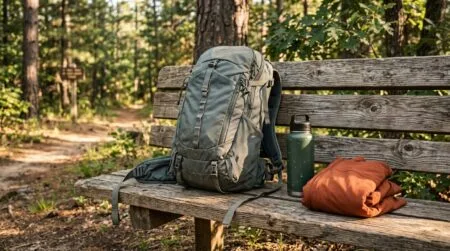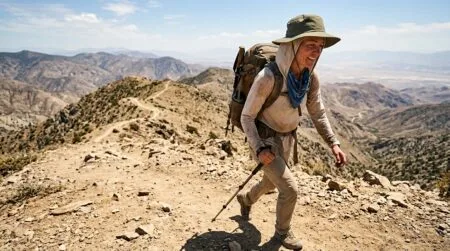


The first time I loaded a pack for a day hike, I brought everything. Two water bottles, a full first aid kit, three trail snacks, sunscreen, extra layers, a camp towel, and trekking poles I had no idea how to use. My pack weighed 21 pounds for a 4-mile maintained trail. By mile 2, my shoulders were done with the arrangement. By mile 3, my lower back had joined the complaint. I finished, rethought every item I had packed, and never made the same mistake again.
⚡ Quick Trail Takeaways
- Daypack Weight Rule: A fully loaded daypack should not exceed 10% of your body weight (typically 12-18 lbs including water).
- Water Weight Fact: Water is your heaviest item: 1 liter (33.8 oz) equals exactly 2.2 pounds (1 kg) on your back.
- Load Distribution: Pack heavy water and dense gear close to your spine between shoulder blades and mid-back to prevent sagging.
How heavy should a day hike backpack be? For most beginners on a 3-6 mile maintained trail, the target is 8-12 pounds total pack weight, roughly 7-10% of your bodyweight. The 10-15% rule you will see quoted everywhere is the ceiling, not the goal. Most first-timers are carrying 4-6 extra pounds they do not need and they pay for it in shoulder strain and fatigue on the return leg.
This article covers four specific weight rules: the bodyweight percentage rule and what it means for day hiking, the distance and terrain adjustment most packing guides skip, the minimum pack weight floor beginners consistently miss, and the temperature variable that changes everything in cold weather.
🥾 Oliver’s Trail Notes & Field Observations
For an average day hike, your loaded pack should never exceed 10 to 15% of your body weight. Weighing 175 pounds, my sweet spot for a rigorous 8-mile mountain day is 14 to 17 pounds, which includes 3 liters of water, first aid, layers, and emergency gear. When I tested carrying a 26-pound load on the Mt. Wilson trail just to see the difference, the excess weight created painful shoulder pinch and crushed my pace by 25%.
How Heavy Should a Day Hike Backpack Be? The Short Answer
Why day hike backpack weight has a target range, not a fixed number
The standard answer for how heavy should a day hike backpack be is “10-15% of your bodyweight.” That rule comes from military load-bearing research and has been adapted to recreational hiking for decades. It is a useful ceiling. It is not a day-hiking target.
At 150 pounds, 10-15% of bodyweight gives you 15-22.5 pounds. A 22-pound daypack on a 5-mile trail is uncomfortable for almost everyone and unnecessary on maintained terrain in moderate weather. The rule was designed for multi-day backpacking, where you carry a tent, cooking system, and several days of food. For a single day out, 7-10% is the practical target.
The American Hiking Society recommends that recreational day hikers keep pack weight under 10% of their bodyweight on trails under 8 miles. Under 5 miles on flat to moderate terrain, 7-9 pounds covers everything you need. The gap between that and what most beginners carry comes almost entirely from over-packing gear, not water. Water is the one category where being generous is always correct.
What average backpack weight for day hike looks like in real pounds
The average backpack weight for day hike among experienced hikers on maintained trails runs 8-12 pounds. Here is what that weight actually contains:
- Water (2 liters): 4.4 pounds
- Food (2-4 hours of hiking): 0.8-1.5 pounds
- First aid kit (compact trail kit): 0.3-0.5 pounds
- Rain layer (packable): 0.5-1 pound
- Sunscreen, phone, navigation: 0.5-0.8 pounds
Total: approximately 6.5-8.2 pounds of non-optional gear. Everything above that is a choice. A beginner carrying 18 pounds on a 5-mile trail has made 8-10 pounds of choices that are making their hike harder without making it meaningfully safer.
I have hiked the same 6-mile trail twice in the same season: once with a 21-pound pack, once stripped down to 9 pounds. The 9-pound version was not marginally better. It felt like a different trail. The clearest signal came after the turnaround. With 21 pounds, my knees were absorbing each descent step differently. With 9 pounds, I finished feeling like I could have added 3 more miles.
The 4 Weight Rules That Actually Answer the Question
Rule 1: The 10% bodyweight rule and what it means for day hiking
How to apply the rule before you pack
The 10% rule is a ceiling. Use 7-10% as your target and 10-15% as the outer limit you cross only when trail conditions actually require it.
| Bodyweight | 7-10% target | 10-15% ceiling |
|---|---|---|
| 120 lbs | 8.4-12 lbs | 12-18 lbs |
| 150 lbs | 10.5-15 lbs | 15-22.5 lbs |
| 180 lbs | 12.6-18 lbs | 18-27 lbs |
| 200 lbs | 14-20 lbs | 20-30 lbs |
Most beginners asking how heavy should a day hike backpack be are already at or above the 10-15% ceiling. The goal is not to pack to the limit of what your body can tolerate. The goal is to carry exactly what the trail requires and leave everything else in the car.
One clarification that saves beginners a lot of shoulder strain: the rule applies to total loaded pack weight, not gear weight alone. A fully loaded 2-liter hydration bladder weighs 4.4 pounds. Your rain jacket, food, and first aid kit add 3-4 more pounds. On a 4-mile trail, that 7-8 pound kit is your total pack, not a starting point you build gear on top of.
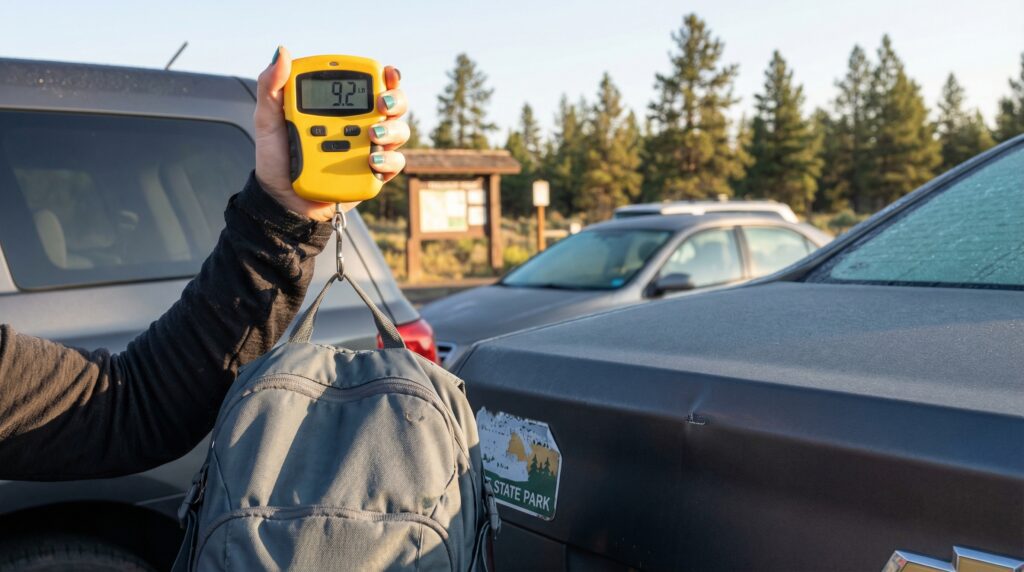
💡 Trail Tip: Weigh your pack before leaving the parking lot, not after the hike.
A $15 luggage scale attached to the carry handle gives you an accurate reading in 10 seconds. Most beginners carry 3-5 more pounds than they estimate by feel. The actual number tells you whether the pack you assembled matches the trail you are doing.
Rule 2: The distance and terrain multiplier
How trail difficulty changes your daypack weight limit
Translating how heavy should a day hike backpack be into a specific number requires accounting for distance and elevation. The 7-10% target assumes a trail between 3-8 miles with moderate terrain. Both variables adjust the number.
For trails under 4 miles with under 300 feet of elevation gain, day hike backpack weight can come down to 5-7 pounds. The daypack weight limit on a 3-mile urban nature trail is your water, a snack, sunscreen, and a phone. You are never more than 90 minutes from the trailhead. A heavier kit adds no safety value on this category of trail.
For trails over 8 miles or over 1,000 feet of gain, the target increases. More water (0.5 liters per hour minimum), more food, and additional weather protection are genuine requirements at this scale. On a 10-mile trail with 1,500 feet of gain, a 12-15 pound pack is the correct number, not an over-pack.
The rule: shorter and flatter trails call for less than the formula suggests. Longer and more exposed trails justify more, up to the 10-15% ceiling.
Rule 3: The non-negotiable pack weight floor
Why hiking pack weight has a minimum, not just a maximum
Every discussion of how heavy should a day hike backpack be focuses on the maximum. The minimum gets almost no attention.
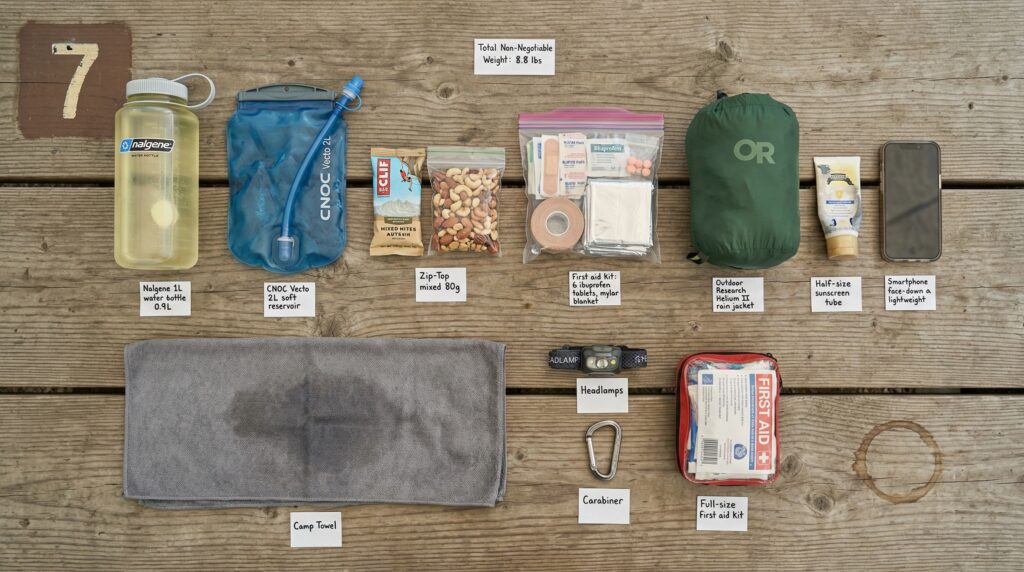
There is a minimum. You cannot cut hiking pack weight below a certain threshold and still be adequately prepared. For any day hike over 2 miles, the non-negotiable kit includes:
- Water: Minimum 500ml per hour of expected hiking time. On a 2-hour round-trip, that is 1 liter (2.2 pounds). Non-negotiable.
- Sun and weather protection: A packable rain layer (6-10 ounces) plus sunscreen add under 1 pound together.
- Navigation: Your phone with the trail map downloaded for offline use, or a printed map. Adds nothing meaningful to pack weight.
- Basic first aid: A compact trail kit covering blisters, minor cuts, and personal medications. Under 0.5 pounds.
Below this floor, you are not hiking light. You are hiking underprepared.
Rule 4: How temperature changes how much weight to carry hiking
Seasonal pack weight adjustments most guides ignore
Temperature changes the correct answer for how heavy should a day hike backpack be more than any other single variable. Most packing calculators skip it entirely.
Spring and summer above 70°F: Water, food, sun protection, and a rain layer. Total hiking pack weight for most adults: 7-10 pounds.
Fall (50-70°F): Add a mid-layer (a fleece or insulated vest) plus gloves and a warm hat. The kit adds 1.5-2 pounds. Target: 9-12 pounds.
Winter or cold mountain trails below 40°F: The kit expands for real reasons. Insulated jacket, waterproof gloves, gaiters if snow is present, and additional food for higher caloric expenditure in cold. Day hike backpack weight in winter legitimately reaches 14-18 pounds for a complete safety kit.
The honest admission: I have under-packed for cold conditions more than once. A 40-degree morning that drops to 28°F at elevation with unexpected wind on a 4-hour hike is genuinely uncomfortable without the right kit. Getting the weight right for warm-weather trails is straightforward. Getting it right for cold or changing conditions requires more deliberate planning than most beginners expect.
🥾 Balancing Water Weight Close to the Spine
Remember that water is the heaviest single item in your daypack: one liter weighs exactly 2.2 pounds (1 kilogram). In my desert and high-heat trials along the PCT, carrying 4 liters of water added nearly 9 pounds to my back right at the trailhead. I pack heavy hydration bladders close to my spine between shoulder blades and hip level, ensuring the pack’s hip belt carries the load on my pelvis rather than hanging off my collarbones.
Average Backpack Weight for Day Hike by Trail Type
What experienced hikers actually carry on different terrain
The average backpack weight for day hike varies meaningfully by trail type. Here is the realistic range across terrain categories:
Urban park or nature preserve (under 3 miles, well-marked): 5-7 pounds. Water, snack, phone, sunscreen. A compact first aid kit adds minimal weight. This is a neighborhood walk with better scenery.
Maintained dirt trail (3-6 miles, under 500 feet of gain): 8-12 pounds. The standard beginner trail and the core use case for the 7-10% rule. Full water supply, trail food, first aid kit, rain layer.
Mountain or rocky trail (5-8 miles, 700-1,500 feet of gain): 12-16 pounds. Increased water and food, a warm layer, trekking poles if knee support is a factor. This is the point where how much weight to carry hiking starts affecting your joints on the descent.
Full-day mountain trail (8+ miles, 1,500+ feet of gain): 15-22 pounds. Not the right starting trail for a beginner without several easier hikes already completed. At this weight range, whether the hip belt is fitted correctly and transferring load off the shoulders becomes a genuine issue.
The elevation penalty beginners miss
The calculation that most beginners skip: every additional pound in a pack feels heavier on elevation gain than on flat ground. Research from the National Outdoor Leadership School on wilderness travel load-bearing found that loaded hikers on steep terrain experience significantly higher cardiovascular and muscular demand per mile than carrying the same weight on flat trail.
The practical result: a 15-pound pack on a 600-foot climb feels closer to 18-20 pounds in terms of sustained effort. The daypack weight limit for beginners on trails with real elevation is therefore lower than the standard formula implies, not higher.
When Your Day Hike Backpack Weight Is Too Heavy
The physical signals your pack is too heavy
Most beginners do not know their pack is too heavy until the trail communicates it. Here are the signals in order of when they typically appear:
Miles 1-2: Shoulder strap pressure requiring readjustment every 10-15 minutes. Minor on a short trail. On a 7-mile trail, it becomes cumulative shoulder fatigue by the halfway point.
Miles 2-4: Lower back tightness or pain during the climb. A correctly weighted pack with the hip belt engaged should not produce lower back pain. If it does, the pack is either too heavy, the hip belt is not doing its job, or both.
Downhill sections: Knee impact on descents is directly proportional to pack weight. A 20-pound pack creates measurably more knee joint load on a 400-foot descent than a 10-pound pack on the same slope. Most beginners only recognize the weight problem when the descent starts loading their knees differently.
The gear most beginners carry that adds no value
My direct take: most beginner hikers are carrying 3-5 unnecessary pounds on every hike. The specific items:
Full-size retail first aid kits: The standard 100-item kit from a sporting goods store weighs 1.5-2.5 pounds. A purpose-built trail kit covering blisters, bandages, antiseptic wipes, pain relievers, and personal medications weighs under 0.4 pounds.
Multiple Nalgene bottles instead of a hydration bladder: Three 32-oz Nalgene bottles weigh 2 pounds empty. A 2-liter hydration bladder from Platypus or HydraPak weighs 1.4 oz empty and carries more water for most 4-6 hour hikes. The switch saves nearly 2 pounds of empty carry weight.
A backpacking pack on a day hike: A standard 65-liter pack weighs 4-6 pounds empty. A quality 25-30 liter daypack weighs 1-2 pounds empty. On a single-day trail, you are carrying 2-4 pounds of unnecessary pack weight before one item goes in.
Too much food: Two trail bars and a handful of nuts covers fuel for a 3-4 hour hike. Packing a full lunch plus multiple snacks adds 1.5-2 pounds. Save the meal for the car.
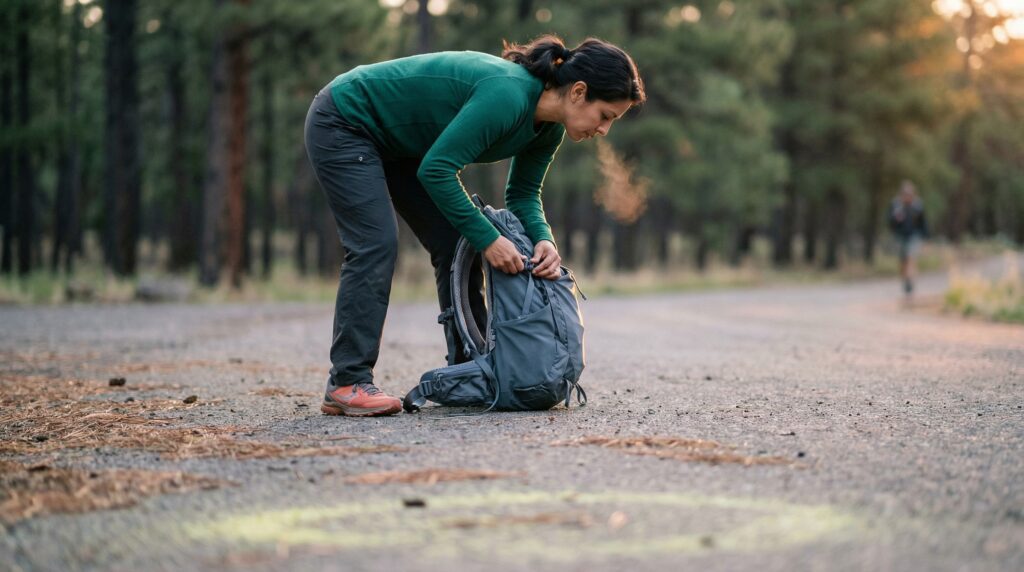
Daypack Weight Limit: What You Can Leave Behind
Items that do not belong on short day hikes
For trails under 6 miles in moderate weather, these stay in the car:
- Trekking poles (unless you have knee pain or are doing sustained steep descent)
- Camp towel, camp stove, or cooking equipment
- Full-size water filter (a personal filter or purification tablets at 2-3 ounces covers actual day-hiking emergencies)
- Sleeping bag, emergency bivy, or tent
When the lightweight version is worth paying for
My clear position on lightweight gear for beginners: do not spend money on ultralight equipment as your first purchase. Buy gear that fits and works. Then, once you hike often enough that pack weight becomes a persistent issue, three items deliver the best weight reduction per dollar:
- Rain jacket: A 5-6 oz packable shell versus a 1-lb midrange jacket saves nearly a pound. The Outdoor Research Helium II runs around $99 at 5.1 oz for a size medium. The Columbia Watertight II weighs approximately 15 oz. Same weather protection, 10 ounces of difference.
- Water carry system: A collapsible container like the CNOC Vecto (1.5 oz empty) versus a standard Nalgene 32-oz bottle (6.5 oz empty) saves 5 oz per bottle. Carry two and that is over half a pound from one switch.
- First aid kit: A custom-built trail kit at 3-4 ounces versus the standard retail kit at 16-40 ounces. This is the single highest weight-reduction move available to most beginners.
How heavy should a day hike backpack be for a beginner?
For a beginner on a 3-6 mile maintained trail in moderate weather, target 8-12 pounds total. The average backpack weight for day hike among experienced hikers on comparable trails falls in the same range. Start lighter rather than heavier. A 7-pound pack with everything you need is better than a 16-pound pack with everything you might conceivably need.
What is the daypack weight limit for a long day hike?
For hikes over 8 miles, keep total pack weight under 15% of your bodyweight. Build the pack starting with the water calculation: 0.5 liters per hour of expected hiking time. Then add food, then gear. If the total exceeds the 15% ceiling, identify what can come out. The daypack weight limit answers how heavy should a day hike backpack be for the longest outings most beginners will encounter.
Does pack weight actually matter on short trails?
Yes, measurably. The USDA Forest Service recommends that recreational day hikers stay well under military load-bearing thresholds because recreational hikers are not load-conditioned. Every extra pound creates additional cumulative joint load across thousands of steps. A 5-pound reduction in hiking pack weight is not marginal on a 5-mile trail. It is thousands fewer pound-force impacts on the knees over every descent.
How do I calculate how much weight to carry hiking in summer heat?
At 80°F or above, increase your water estimate to 0.75 liters per hour instead of 0.5. On a 4-hour summer hike, that is 3 liters (6.6 pounds of water). Factor water first, then build gear on top. On hot days, how much weight to carry hiking often reaches the 10% ceiling from water alone, which means everything else has to be lighter. A hydration bladder, compact first aid kit, and stripped-down food selection matter more in summer than in mild conditions.
Is a 20-pound pack too heavy for a day hike?
For most adults on maintained trails under 8 miles, yes. It approaches the 10-15% bodyweight ceiling for a 150-pound person and exceeds it for lighter hikers. The specific costs: more shoulder strain on the ascent, more knee load on the descent, faster caloric depletion overall. When asking how heavy should a day hike backpack be for a standard day out, 20 pounds is the upper end of the ceiling, not a target you want to be hitting regularly.
What should not go in a day hiking backpack?
Multi-day camping gear: sleeping bags, camp stoves, tents. Full-size retail first aid kits when a compact trail kit covers actual day-hiking risks. Heavy camera equipment unless photography is the purpose. Every item that is not water, food, safety gear, or navigation can be evaluated for removal before the day hike backpack weight calculation begins.
Build Your Pack to Match the Trail
How heavy should a day hike backpack be is a question with a specific, calculable answer for any trail you are planning. The four rules in this guide give you the complete framework: the 7-10% bodyweight target (not the 15% ceiling), the distance and terrain adjustment that makes the number lower for short easy trails and higher for longer exposed ones, the non-negotiable minimum floor that keeps you prepared without over-packing, and the temperature variable that adds 2-4 pounds in cold conditions for real reasons.
Apply those four rules before you pack, weigh the loaded pack before leaving the parking lot, and you will know within 30 seconds whether your day hike backpack weight matches what is ahead. The hikers carrying 20-pound packs on 4-mile trails are not safer. They are working harder for the same destination. For how much weight to carry hiking on any specific trail, the right answer to how heavy should a day hike backpack be is almost always lower than beginners expect, and the hike is better for it.
Next Steps
- Right now: Weigh your current pack setup. Not your estimate — the actual loaded weight with everything you normally carry. That number tells you whether you have a weight problem or a worry problem.
- Before your next hike: Lay every item out and sort into two columns: non-negotiable (water, food, first aid, navigation, weather protection) and optional. Cut one item from the optional column.
- Day of the hike: Check pack weight at the trailhead. Adjust before you start, not at mile 2 when the shoulder discomfort has already established itself.
For detailed pack capacity guidance by season and distance, see our complete guide on what size backpack for a day hike you actually need.
Frequently Asked Questions
How heavy should a day hike backpack be for a beginner?
For a beginner on a 3-6 mile maintained trail in moderate weather, target 8-12 pounds total. The average backpack weight for day hike among experienced hikers on comparable trails falls in the same range. Start lighter rather than heavier. A 7-pound pack with everything you need is better than a 16-pound pack with everything you might conceivably need.
What is the daypack weight limit for a long day hike?
For hikes over 8 miles, keep total pack weight under 15% of your bodyweight. Build the pack starting with the water calculation: 0.5 liters per hour of expected hiking time. Then add food, then gear. If the total exceeds the 15% ceiling, identify what can come out. The daypack weight limit answers how heavy should a day hike backpack be for the longest outings most beginners will encounter.
Does pack weight actually matter on short trails?
Yes, measurably. The USDA Forest Service recommends that recreational day hikers stay well under military load-bearing thresholds because recreational hikers are not load-conditioned. Every extra pound creates additional cumulative joint load across thousands of steps. A 5-pound reduction in hiking pack weight is not marginal on a 5-mile trail. It is thousands fewer pound-force impacts on the knees over every descent.
How do I calculate how much weight to carry hiking in summer heat?
At 80°F or above, increase your water estimate to 0.75 liters per hour instead of 0.5. On a 4-hour summer hike, that is 3 liters (6.6 pounds of water). Factor water first, then build gear on top. On hot days, how much weight to carry hiking often reaches the 10% ceiling from water alone, which means everything else has to be lighter. A hydration bladder, compact first aid kit, and stripped-down food selection matter more in summer than in mild conditions.
Is a 20-pound pack too heavy for a day hike?
For most adults on maintained trails under 8 miles, yes. It approaches the 10-15% bodyweight ceiling for a 150-pound person and exceeds it for lighter hikers. The specific costs: more shoulder strain on the ascent, more knee load on the descent, faster caloric depletion overall. When asking how heavy should a day hike backpack be for a standard day out, 20 pounds is the upper end of the ceiling, not a target you want to be hitting regularly.
What should not go in a day hiking backpack?
Multi-day camping gear: sleeping bags, camp stoves, tents. Full-size retail first aid kits when a compact trail kit covers actual day-hiking risks. Heavy camera equipment unless photography is the purpose. Every item that is not water, food, safety gear, or navigation can be evaluated for removal before the day hike backpack weight calculation begins.
Related Reads
Glanced at your fitness tracker after a hike and weren’t sure if that calorie number was even close to real? Here’s what hiking actually burns in real numbers, not some generic guess your app pulled from nowhere.
Stared at a sprawling gear checklist online and had no clue which items were genuinely essential versus just padding? Here’s a breakdown of the real 10 essentials for hiking, no overpacking required.
Agreed to a trail distance that sounded fine in theory but felt completely off once you were actually moving? These 5 rules help you land on a number that’s genuinely realistic for you, not just whatever sounded good at the time.
Kept pushing forward on a hike even though something in your gut said maybe you shouldn’t? Here’s how to actually know when to turn back on a hike before stubbornness turns into a real problem.
Thinking about bringing your dog along but not totally sure what you’re signing up for? Here are 10 tips for hiking with a dog as a beginner that go way beyond just packing extra water.