



This guide focuses on understanding the physical difficulty of hiking and how to physically prepare for steep terrain.
If you can easily walk several miles on a gym treadmill or around your neighborhood but find yourself gasping for breath on a short trail climb, you are not alone. Hiking feels significantly harder than road walking because natural trails demand continuous stabilizer muscle engagement, eccentric braking on downhills, and sustained cardiovascular effort under changing outdoor weather conditions.
⚡ Quick Trail Takeaways
- Physiological Demands: Trail hiking requires eccentric quadriceps braking and stabilizer muscle engagement absent on flat pavement.
- Adaptation Timeline: Cardiorespiratory and muscular trail fitness typically adapts noticeably between weeks 4 and 6 of consistent hiking.
- Aerobic Pacing: Maintain a conversational Zone 2 effort on climbs to prevent early lactic acid buildup and glycogen depletion.
I did my first real trail six weeks after starting to run. I was running 3 miles three times a week, felt fit, and chose a trail described as moderate: 4.2 miles, 820 feet of gain. By mile 1.8, my quads were loaded in a way that running had never produced. By mile 2.3, I was stopping every 8 to 10 minutes, not to rest exactly, but because my legs were refusing the pace I was trying to hold. I finished. It took 2 hours 40 minutes for 4.2 miles, which is about twice what I had planned for. I was not unfit. I was unprepared for what hiking actually is.
This article covers the six specific reasons why hiking is so hard at first, when it gets noticeably easier and by how much, and what you can do between hikes to make that timeline faster.
🥾 Oliver’s Trail Notes & Field Observations
When I started hiking in 2018, I distinctly remember stopping every 50 yards on the first switchbacks of Chantry Flat, gasping for air and wondering why walking uphill felt so punishing. In my experience coaching novice hikers, the first month is pure shock to your cardiovascular system and stabilizing ankles. Around week 5 or 6, something clicks: your tendon stiffness adapts to uneven granite, your breathing cadence syncs with your stride, and 1,000 feet of climb shifts from an ordeal to a rhythmic workout.
Why Is Hiking So Hard: The Honest Answer
What makes hiking different from other cardio
The physical demands of hiking are distinct from running, cycling, and gym training in ways that make almost everyone underestimate their first trail. Why is hiking so hard in physical terms comes down to three mechanics that everyday fitness does not train.
Eccentric muscle loading on descent. On any trail with real elevation, the descent loads your quad muscles eccentrically: the muscle lengthens while contracting to brake your steps. This is roughly 40 percent more demanding on muscle tissue than the concentric loading of climbing. The American Hiking Society identifies this eccentric loading pattern as one of the primary reasons beginners experience significant leg soreness after their first descent, even when the climb felt manageable. The result: legs that feel fine on the way down hurt two days later in a way that surprises almost everyone on their first real descent.
Stabilization demand on uneven terrain. Every step on unpacked trail surface requires your foot, ankle, and lower leg stabilizers to make micro-corrections. On a flat surface, those muscles are largely passive. On a trail with roots, rocks, and irregular camber, they work continuously. Three miles on unpaved trail produces more lower leg fatigue than 6 miles on a treadmill because the treadmill requires almost no stabilization.
Cumulative loading over distance. A 4-mile hike means roughly 8,000 steps. Each step carries your full body weight plus pack weight on terrain that varies in grade and surface. The cumulative joint and muscle load over that distance exceeds what most gym sessions produce simply because of the duration and variation.
The beginner hiking struggles nobody warns you about
The beginner hiking struggles that catch people most off guard are not the dramatic ones. Part of why is hiking so hard to predict before your first trail is that the specific physical sensations are not described anywhere in trail guides.
Your feet stop working the way you expect around mile 3. Not pain necessarily, just a flattening of sensation and a kind of dead weight that makes picking up your feet feel more effortful than it was an hour ago. This is normal. Plantar fatigue from continuous uneven-surface impact is real and almost universal in new hikers.
The second surprise: how much harder the last mile is than the first. Not proportionally harder. Dramatically harder. The gap between mile 1 and mile 4 on a moderate trail is bigger than the gap between mile 1 and mile 4 on a treadmill because trail hiking accumulates fatigue non-linearly. Heat, terrain variation, pack weight, and muscle depletion compound. That is why the last half-mile of a beginner’s first real trail often takes as long as the first full mile.
Why Is Hiking So Hard: 6 Specific Reasons
Reason 1: Elevation gain multiplies the effort
How much harder uphill is than flat terrain
Most beginner trails listed as “Easy” or “Moderate” on AllTrails have between 300 and 800 feet of elevation gain. That number does not look significant on a screen. On a trail, it means sustained climbing that produces a heart rate response well above what walking on flat ground requires.
REI’s guide to understanding hiking intensity notes that sustained uphill effort on trail grades between 10 and 18 percent increases energy expenditure by 40 to 50 percent compared to flat walking at the same speed. Most maintained hiking trails reach those grades on their climbing sections. The AllTrails description says 2.8 miles with 600 feet of gain. Your cardiovascular system hears: sustained uphill effort for 35 to 50 minutes.
The fix is not to avoid elevation. It is to start with trails where the gain is spread across the full distance rather than front-loaded. A trail with 600 feet of gain over 3 miles is a different experience from 600 feet of gain over 0.8 miles. Check the elevation profile in AllTrails, not just the total gain number.
Reason 2: Your hiking muscles are not your gym muscles
Why fitness transfers less than expected
This is the honest admission: most gym fitness transfers poorly to trail hiking, and I say this having spent two years thinking otherwise. Part of why is hiking so hard for fit people specifically is this mismatch. Running builds cardiovascular capacity. Weight training builds strength. Neither builds the specific stabilizer strength, eccentric quad capacity, and hip abductor endurance that trail terrain demands.
The muscles most undertrained in people who are otherwise fit: the tibialis anterior (the shin muscle that controls foot drop on uneven surfaces), the hip abductors (which prevent the knee from caving inward on each descending step), and the single-leg stabilizers in the ankle complex. A person who squats 200 pounds can have weak ankle stabilizers that produce significant fatigue by mile 2 on rough terrain.
This mismatch is why fit beginners are often more surprised than sedentary ones, in some ways. The sedentary beginner expects it to be hard. The fit beginner does not, and the gap between expectation and experience is bigger.
Reason 3: Your feet are doing work they have never done
What trail terrain does that shoes and socks cannot fully offset
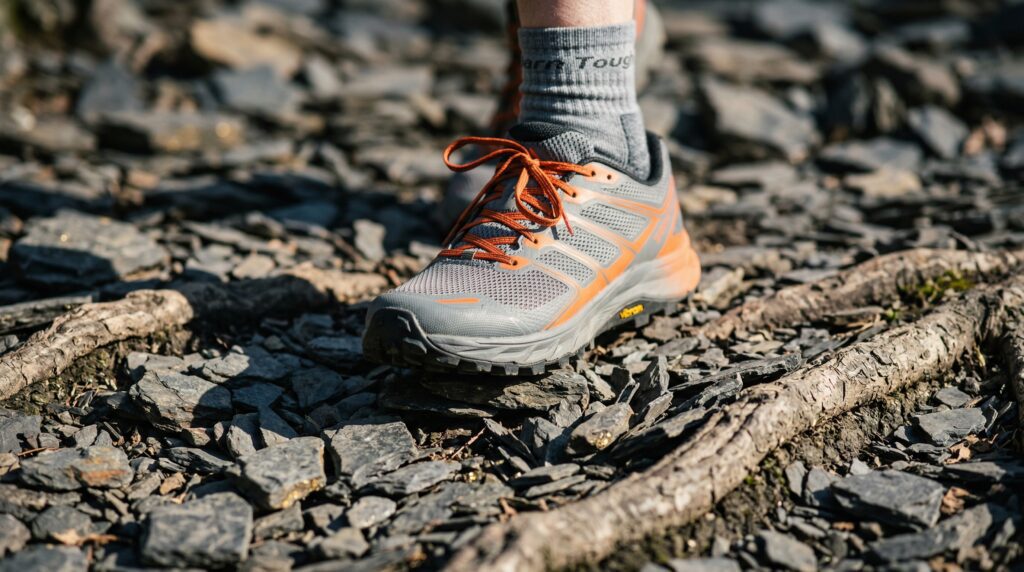
Flat, predictable surfaces are what most human feet experience all day: floors, sidewalks, paved roads. Trail terrain is none of those things. Roots, rocks, uneven camber, surface mud, loose gravel, and creek crossings all require the foot to adapt in real time. The small muscles of the foot are, for most beginners, genuinely untrained.
The result is plantar fatigue, arch soreness, and toe-box cramping that appears around mile 2.5 to 3 on a first hike and feels out of proportion to the distance. A 4-mile trail walk feels physically harder on the feet than a 7-mile walk on pavement because the stabilization demand is categorically different.
The practical fix: footwear with a stiffer midsole reduces the stabilization demand on the foot muscles. It is not a permanent workaround, but it meaningfully reduces fatigue on early hikes while trail-specific foot strength builds.
Reason 4: Sun and heat add a load that does not appear in trail descriptions
What temperature does to perceived effort
A 60°F overcast day and a 90°F sunny day on the same trail are not remotely the same experience. The AllTrails listing describes neither. Heat increases cardiovascular demand for the same level of physical output. Sweating depletes sodium and fluid faster than most beginners account for. Direct sun on exposed skin adds radiant heat load that compounds with ambient temperature.
These struggles intensify significantly in warm weather because new hikers underestimate how much thermal load the trail adds. A 4-mile hike in April that felt manageable becomes a harder experience on the same trail in July, not because the trail changed, but because the conditions tripled the thermal demands.
Check the forecast high temperature before any hike and apply this rough rule: above 85°F, the same trail requires 25 percent more water, a 30 percent earlier start time, and a 20 percent adjusted pace expectation.
Reason 5: The pack adds cumulative load you do not feel until mile 2
How pack weight compounds over distance
A 15-pound daypack feels light in the parking lot. Over 4 miles on varied terrain, it is a different number. Studies on load-carrying and hiking efficiency consistently show that packs at 20 percent of body weight increase knee joint forces by 10 to 12 percent per step on level terrain. On descent, that number increases further.
Most beginners overpacking is a genuine problem, and I include myself in this. My first hiking pack for a 4-mile trail contained: three layers I did not need based on the forecast, enough food for a full day instead of a morning, two liters of water when one and a half would have been sufficient, and a first aid kit twice the size required for a trail 2 miles from a trailhead.
A properly loaded daypack for a 4-mile beginner hike should weigh 8 to 12 pounds, not 18 to 22. Every pound over that number is fatigue you carry for every step of the return trip.
Reason 6: Mental pacing is a skill you have not built yet
Why managing effort feels different on trail than in a gym
In a gym or on a treadmill, pace is set for you. The machine beeps. The number on the screen tells you you are moving at 5.2 miles per hour. On a trail, pace management is entirely internal, and new hikers almost universally start too fast. This pacing failure is one of the underappreciated reasons why is hiking so hard on the first several outings.
The right pace for beginner hiking is slow enough that you can hold a full conversation without more than slightly elevated breathing. Not walking and chatting at street level. Slightly elevated. If you are breathing too hard to talk in full sentences on a climb, you are above sustainable pace and you will hit a wall faster than the trail requires.
Most beginners learn pace management after two or three hikes, not before. The honest truth about managing this difficulty from a pacing standpoint is that you cannot read about it and apply it immediately. You have to experience the feeling of going out too fast and fading on a descent to calibrate the right effort level. That calibration is a skill, and it takes repetition.
🥾 The Rest Step on Steep Ascents
During my early ascents up Mt. San Antonio, I made the classic beginner mistake of pushing hard for 3 minutes and then collapsing over my trekking poles for 2 minutes. That stop-and-start pattern spikes lactic acid and wastes massive energy. When I adopted the ‘rest step’—briefly locking the rear knee on every uphill stride to transfer weight onto bone structure—my heart rate dropped by 18 beats per minute, making sustained 20% trail grades feel manageable for hours.
When Does Hiking Get Easier?
Hiking gets easier on a specific timeline
The specific answer on hiking gets easier: the most significant change happens between hike 3 and hike 8 for most beginners doing hikes twice a month or more. This is also the answer to why is hiking so hard in a longer sense: it is not permanently hard. The body adapts to what it is consistently exposed to, and trail hiking is no exception. Not because fitness improves dramatically in that window, though it does some, but because calibration improves. You learn what pace is actually sustainable. You learn how your body responds to elevation. You stop fighting the terrain and start moving with it.
My specific data on this from my own progression: by hike 6, a trail I had rated as genuinely hard on my first attempt felt like moderate work. Same trail, same distance, same elevation. The difference was pacing, prior exposure to the stabilization demands, and understanding what the descent would require of my legs.
The timeline in more specific terms for beginner hikers doing trails twice a month:
- Hikes 1 to 3: Hard. Unexpectedly hard. Your body is adapting to movement patterns it has not encountered. The soreness after hikes 1 and 2 will be real.
- Hikes 4 to 6: Noticeably easier than the first three. You have started to develop the stabilizer strength and eccentric capacity the trail requires. Pace management has improved through experience.
- Hikes 7 to 12: Hiking gets easier in a sustained way. Trails you found very challenging early in this range feel manageable by the end of it. This is where most beginners start genuinely enjoying the experience rather than just surviving it.
- Month 6 and beyond: Trails that seemed inaccessible in month 1 are realistic options. Physical demands of hiking have become a known quantity you plan around rather than a surprise you manage through.
Is hiking supposed to be hard, and what is normal discomfort
Is hiking supposed to be hard? Yes, at first, and in specific ways that diminish predictably. Normal beginner discomfort is quad fatigue on climbs and the specific ache of eccentric muscle loading after descents. Breathing harder than you do on flat walks is normal. Feeling significantly more tired than the distance suggested you would be is normal.
What is not normal: sharp joint pain anywhere, especially in the knee or ankle. One-sided pain that does not mirror on the other side. Any pain that worsens consistently over the course of the hike rather than leveling off or diminishing on flat sections. Those signals are reasons to stop, not push through.
Overcoming Hiking Difficulty: What Actually Works
The training approach that produces real change
Overcoming hiking difficulty specifically requires training that addresses what trail hiking demands specifically. Running more does not directly address eccentric quad strength. Cycling does not build ankle stabilizers. The training that transfers most directly:
Step-downs: Stand on a step, lower the opposite foot to the floor slowly over 3 to 4 seconds, stop before contact, return to start. Three sets of 10 per leg, twice a week. This builds the eccentric quad loading that descent demands, specifically.
Single-leg balance: Stand on one foot on an unstable surface, a folded towel, a balance disc, or even just on uneven ground, for 30 to 60 seconds per side, three sets. This builds the ankle stabilizer complex that trail terrain demands with every step.
Stair climbing with a loaded pack: 20 minutes of stair climbing with 10 to 15 pounds on your back twice a week produces direct cardiovascular and muscular adaptation for elevation gain. No equipment required beyond a stairwell and a backpack with weight in it.
None of these require gym equipment. All three address the specific movement demands that general fitness training misses.
What to do between hikes to speed up the timeline
The fastest way to make hiking easier is to hike more frequently, but on trails that do not exhaust you. A common beginner mistake is doing one challenging hike, spending a week recovering, and doing one challenging hike again. The adaptation that makes hiking easier comes from more frequent exposure to the movement patterns, even at lower intensity.
Two or three shorter, easier hikes per week at a pace you can fully recover from within 24 hours produces faster adaptation than one hard hike per week. If a full trail is not accessible midweek, 30 minutes on uneven terrain in a local park or greenbelt counts. The stabilization demand and movement pattern exposure are what the body needs, not just cardiovascular load.
Common Beginner Hiking Struggles and How to Address Them
Five patterns that keep hiking hard longer than necessary
Understanding why is hiking so hard is part of the answer. These five patterns explain why it stays harder than necessary for longer than it needs to.
Choosing trails that match your aspirational fitness, not your current fitness. A trail listed as Moderate with 1,100 feet of gain over 4 miles is not a beginner trail regardless of how fit you feel on the way to the trailhead. Use the Fama criteria: under 4 miles, under 300 feet of elevation gain per mile, on a maintained surface. Starting below your estimated level produces success experiences. Starting above it produces the kind of first hike that people do not go back from.
Not eating before the hike because it is early. Blood sugar management matters on trail in ways it does not in a gym session. Hiking on an empty stomach is fine for the first 40 minutes. By mile 2, most people notice cognitive and physical performance dropping in ways they attribute to fitness rather than to the fact that they had half a coffee three hours ago. Eat a real meal 60 to 90 minutes before any hike over 2 miles.
Skipping the warm-up mile. The first mile of a hike should be slow. Not slightly slower than your target pace. Genuinely slow. 30 percent slower. This is not a personality preference for cautious hikers. Cold muscles on a cold trail morning have less elasticity and more injury vulnerability. A slow first mile is physiological preparation, not wasted time.
Wearing the wrong socks. Cotton socks hold moisture, create friction, and blister. Merino wool or synthetic trail socks wick moisture and reduce friction. The difference this makes is not minor. I did my first three hikes in cotton running socks. I did my fourth in wool trail socks. The difference in foot comfort at mile 3 was not subtle.
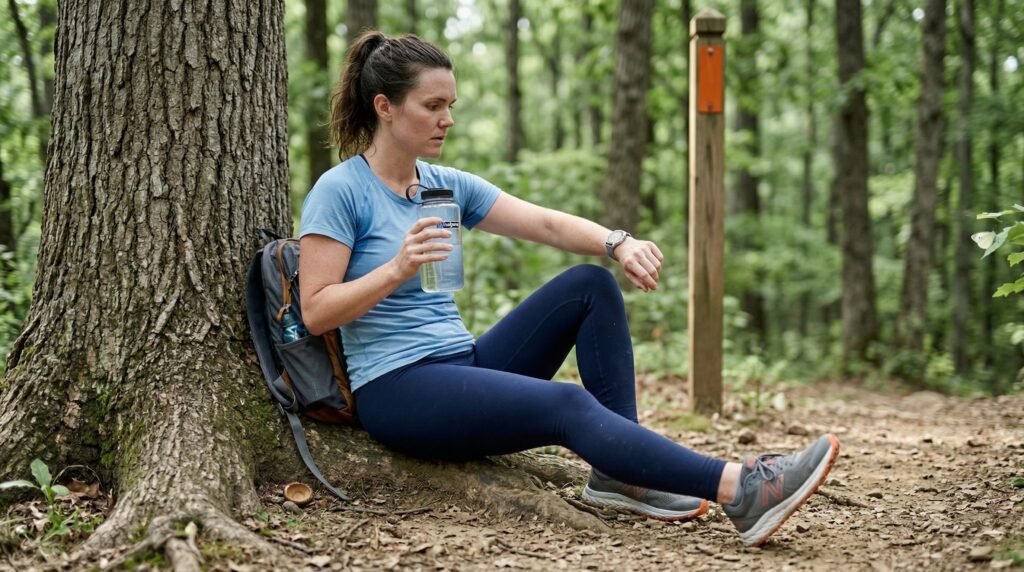
Stopping for rest only when they must rather than before they must. Proactive rest stops taken every 30 to 40 minutes on a hike keep energy more consistent than reactive rest stops taken when legs are already failing. A 5-minute stop before fatigue accumulates restores function. A 5-minute stop after fatigue has been building for 20 minutes does not.
Why is hiking so hard when I’m already in shape?
Why is hiking so hard for fit people? Because trail fitness is specific. Running builds aerobic capacity but not eccentric quad strength or ankle stabilization. Cycling builds cardiovascular fitness and quad strength but not the stabilizer chain that uneven terrain demands. Weight training builds strength but rarely the sustained endurance capacity of 4 miles under load. Fit beginners often find their first trail harder than unfit beginners find it, because the expectation gap is larger. The body adapts specifically, and hiking adaptation requires hiking.
When does hiking get easier for most beginners?
Hiking gets easier significantly between hike 4 and hike 8 for most beginners hiking twice a month. The early improvement is primarily calibration: learning sustainable pace, understanding how your specific body responds to elevation, and developing the proprioceptive awareness that reduces stabilization fatigue on uneven terrain. Muscular adaptation, the strengthening of the specific muscles hiking demands, follows over 6 to 8 weeks of consistent hiking. By month 3 of regular hiking, most beginners have crossed the threshold where the experience shifts from primarily hard to primarily enjoyable.
Is hiking supposed to be hard on every hike?
Is hiking supposed to be hard at all points? No. Early hikes will be challenging in ways that diminish with repetition. By hike 6 to 10, trails you find very hard now should feel significantly more manageable. If hiking feels equally hard on your tenth hike as it did on your first, one of three things is happening: you are choosing trails above your current fitness every time, you are not recovering adequately between hikes, or there is a physical issue worth addressing. Normal progression produces noticeable adaptation within 8 to 12 hikes.
What are the physical demands of hiking I should prepare for specifically?
The physical demands of hiking that most beginners are least prepared for: eccentric quad loading on descent, ankle and lower leg stabilizer fatigue on uneven terrain, and the cumulative joint load of 4 miles under pack weight. The preparation that transfers most directly: step-down exercises twice a week for eccentric quad strength, single-leg balance work for stabilizers, and stair climbing with a loaded pack for direct cardiovascular and muscular hiking adaptation. These three exercises address the movement demands that running and gym training miss.
What does overcoming hiking difficulty look like in practice?
Overcoming hiking difficulty is a timeline, not a single breakthrough. The first several hikes are hard. They are supposed to be. Between hike 4 and 8, most beginners notice that trails they found difficult early in that range feel manageable at the end of it. The pattern that speeds this up: more frequent shorter hikes rather than less frequent longer ones, specific exercises between hikes (step-downs and single-leg balance), and deliberate attention to starting pace. Overcoming hiking difficulty does not require exceptional fitness. It requires consistent exposure to the specific movement patterns involved.
What helps most with beginner hiking struggles on the trail itself?
The three adjustments that reduce difficulty most immediately on trail: slow down by 30 percent in the first mile regardless of how you feel, take proactive rest stops every 30 to 40 minutes rather than waiting until you need to stop, and eat 150 to 200 calories at each rest stop on any hike over 2 hours. These do not require any preparation beyond the trail itself. They are behavioral adjustments that make the existing difficulty more manageable while adaptation catches up over time.
Why Hiking Is Hard Now and Different in 8 Weeks
Why is hiking so hard at first? Because it demands specific movement patterns that almost no other activity trains for, and the body adapts to what it practices. The physical demands of hiking are real, specific, and genuinely different from other cardio work. That gap closes faster than most beginners expect.
My standing opinion on beginner hiking struggles: the first three hikes are not representative of what hiking is. They are the adaptation period. The hikers who conclude that hiking is not for them because the first two outings were hard have stopped before the experience became the actual experience.
By hike 8 on a twice-a-month schedule, hiking gets easier in a sustained way. By month 3, the question shifts from “why is hiking so hard” to something closer to “how do I find trails with more interesting terrain.” That is not a motivational claim. It is a description of what consistent exposure to specific physical demands produces.
Next Steps
- Right now: Find a trail under 3 miles with under 200 feet of elevation gain per mile. That is your first two to three hikes. Build the base before adding difficulty.
- This week: Add step-downs and single-leg balance to your current routine. Three sets of 10 step-downs per leg, three sets of 30-second single-leg balance per side, twice a week.
- Before your next hike: Eat a real meal 60 to 90 minutes before starting. Check pack weight: 8 to 12 pounds for a 4-mile trail is the target.
Frequently Asked Questions
How long does it take for hiking to get easier?
If you hike consistently (once a week), you will typically notice significant improvements in your cardiovascular stamina and leg strength within 4 to 6 weeks.
Why does hiking feel harder than running?
Hiking often involves carrying weight up a steep incline for hours, which places a prolonged, heavy load on your muscles that running on flat ground does not.
Related Reads
Went on one great hike and then somehow let two months slip by before doing it again? Here’s a clear answer on how often beginners should actually hike to build real momentum instead of starting over every time.
Let a friend talk you into a distance that sounded fine in the group chat but felt way off once you were actually out there? These 5 rules help you set a number that’s genuinely yours, not just whatever got the most votes.
Trusted an app’s “moderate” label and got blindsided by a trail that fought back way harder than advertised? Here’s how AllTrails actually builds those ratings, and why the same word can mean very different things.
Stared at a trailhead sign with a rating system you’d genuinely never seen before and just hoped for the best? Here’s what those ratings actually mean for someone brand new to hiking, no confusing jargon attached.
Came home from your first hike feeling strangely different in ways you weren’t expecting at all? Here are 7 body changes first-timers often notice, some good, some surprising, all worth knowing ahead of time.