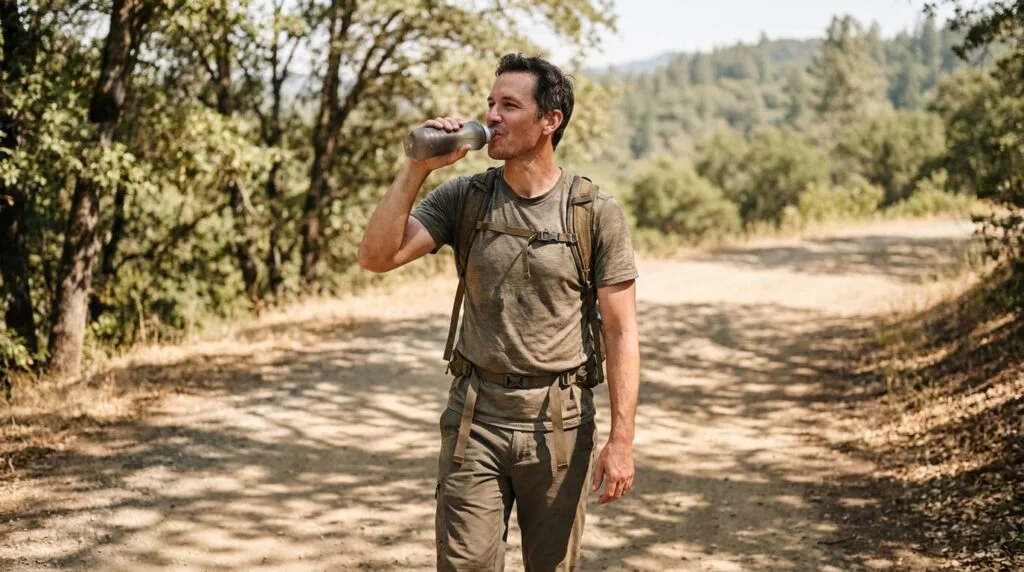
How much water to bring hiking comes down to one number most people get wrong in both directions: too little, because they planned around miles instead of hours and heat, or too much, because they’re carrying for a hike that isn’t the one they’re actually doing. The fast answer: about half a liter per hour on a moderate day hike, closer to a full liter per hour once it’s hot or the trail turns into real climbing. That’s the number worth memorizing tonight.
Two years back, in July, me and my friend packed the same 2.5 liter tumbler each (see our comparison of a hydration bladder vs water bottle), not because it made sense for hiking, but because it was viral and looked nice. It was made for work and casual hangouts, not an 8 mile hike with 1,500 feet of climbing. No large bottle, no bladder, just the trendy tumbler. I was 92 pounds, she was 132, and we packed the same amount anyway. We both ran out of water by mile 2, exhausted, and regretfully had to turn back right there. After that experience, I always pack different amounts of water according to my body weight, the weather, and how much I sweat on that terrain.
The three formulas below get you from that fast answer to a number that’s actually right for your body, your pace, and the hike in front of you. None of them need an app or a subscription.
This guide covers dehydration prevention, not emergency treatment. If you or a hiking partner shows signs of heat stroke, meaning confusion, hot skin that isn’t sweating, or loss of consciousness, call 911 immediately. That’s a medical emergency. Everything below is about keeping it from reaching that point in the first place.
⚡ Quick Trail Takeaways
Standard Hourly Rate: Carry 0.5 liters (17 oz) of water per hour for moderate hiking in temperatures under 75°F.
Heat & Elevation Scale: Scale your intake up to 1.0 liter (32 oz) per hour in temperatures exceeding 80°F or on steep climbs.
Reserve Margin: Always finish your hike with 0.5 liters of untouched emergency reserve water remaining in your pack.
Table of Contents
🥾 Oliver’s Trail Notes & Field Observations
During an August field trial on the exposed Bridge to Nowhere trail through the San Gabriel River canyon, ambient temperatures climbed past 96 degrees. In my experience, the textbook half-liter-per-hour rule collapses in arid western mountain terrain. Carrying uphill under direct sun, I burned through nearly a full liter every 60 minutes. I learned to budget water by elevation gain: adding 500ml for every 1,000 vertical feet climbed.
How Much Water to Bring Hiking: What Actually Drives the Number
Most first-hike water questions start from the wrong variable. Beginners plan around distance: five miles, so bring two liters. Distance is a weak proxy. A flat 5-mile trail in October and a 5-mile trail with 1,500 feet of climbing in July show the identical number on a trail map and demand completely different amounts of water.
What actually drives the number: how long you’ll be moving, how hot it is, how hard you’re working, and your own sweat rate, which varies more between two people than most hydration advice admits. Time matters more than distance because a flat, shaded mile and a steep, exposed mile take wildly different effort for the same ground covered. Convert distance to estimated hours first. Everything else in this guide runs off that hour number, not the mileage.
The opposite mistake is just as common: waiting for thirst. Saguaro National Park’s hiking safety guidance, written for hikers heading into serious desert heat, is direct about this: drink before you feel thirsty, not after, because thirst shows up once you’re already behind on fluids. By the time your mouth feels dry, your pace and your judgment have usually already dipped, even if you haven’t noticed yet.
Here’s my honest take on the three formulas ahead: none of them is more “correct” than the others in any absolute sense. They’re three ways of answering the same question with different amounts of information about yourself. Formula 1 asks the least of you and gets you out the door tonight. Formula 3 asks the most and hands back a number that’s actually yours instead of an average built for a hiker who isn’t you.
The 3 Formulas for How Much Water to Bring Hiking
Hiking Water Requirement Formula by Temperature and Terrain
Temperature Range
Trail Intensity & Incline
Hourly Water Intake
Recommended 5-Mile Total (2.5 Hrs)
Electrolyte Requirement
Cool (< 65°F / 18°C)
Flat to Rolling Terrain
0.5 L (17 fl oz) / hr
1.25 – 1.5 Liters
Optional / Food sources
Moderate (65°F – 80°F / 18°C – 27°C)
Moderate Incline (4–8% Grade)
0.5 – 0.75 L (17–25 fl oz) / hr
1.5 – 2.0 Liters
Recommended past 90 mins
Warm (80°F – 90°F / 27°C – 32°C)
Steep Ascent (>10% Grade)
0.75 – 1.0 L (25–34 fl oz) / hr
2.0 – 2.5 Liters
Essential (300–500 mg sodium/hr)
Extreme Heat (> 90°F / 32°C)
Exposed Desert / Mountain Slopes
1.0 – 1.25 L (34–42 fl oz) / hr
2.5 – 3.0+ Liters
Mandatory every 45 minutes
Each formula below answers a slightly different version of the same question. Use the table to see which one fits what you’re actually trying to plan, then read the one that applies.
Formula 1: The Half-Liter-Per-Hour Rule
This is the one to memorize. Drink about half a liter, roughly 17 ounces, for every hour you’re actively moving on moderate terrain in moderate temperatures. Once it climbs past 80°F or the trail turns into sustained climbing, move to a full liter per hour. The American Hiking Society lands in the same range, recommending 0.5 to 1 quart per hour depending on conditions, and Saguaro National Park’s own guidance for hot, dry hiking calls for a full quart an hour once you’re in real desert heat.
Worked example: a 5-mile hike at a beginner’s pace of about 2 miles per hour takes roughly 2.5 hours. At the half-liter rate, that’s 1.25 liters. Round up to 1.5 for a margin. If it’s genuinely hot, you’re closer to 2.5 liters for that same 5 miles.
The limitation, stated plainly: it’s an average built for an average hiker, which means it’s wrong for you specifically in one direction or the other. Use it anyway. Being roughly right before you’ve hiked enough to know your own number beats being precisely wrong with a formula you don’t have the data to run yet.
Formula 2: The Body-Weight Baseline
This one scales to you instead of to an average hiker, and it answers a different question than Formula 1: not “how much per hour,” but “how much for the whole day.” Take your body weight in pounds, divide by two, and that’s a commonly used baseline for total ounces of water across the day, not just your moving time. A 150-pound hiker lands around 75 ounces, a little over 2.2 liters, as a full-day number covering the drive out, the trail itself, and the drive home.
Treat this as your day total, then layer Formula 1’s per-hour rate on top of it for the actual hours you’re moving. It earns its place on longer or full-day trips, where you’re accounting for more than just trail miles: an early start, a long drive, a late return.
Honest caveat: this is a general hydration guideline, not a hiking-specific formula from a trail safety organization, and it doesn’t adjust itself for heat or exertion. Use Formula 1 for the trail-specific number and this one for the bigger picture of your whole day out.
Formula 3: The Sweat-Rate Test
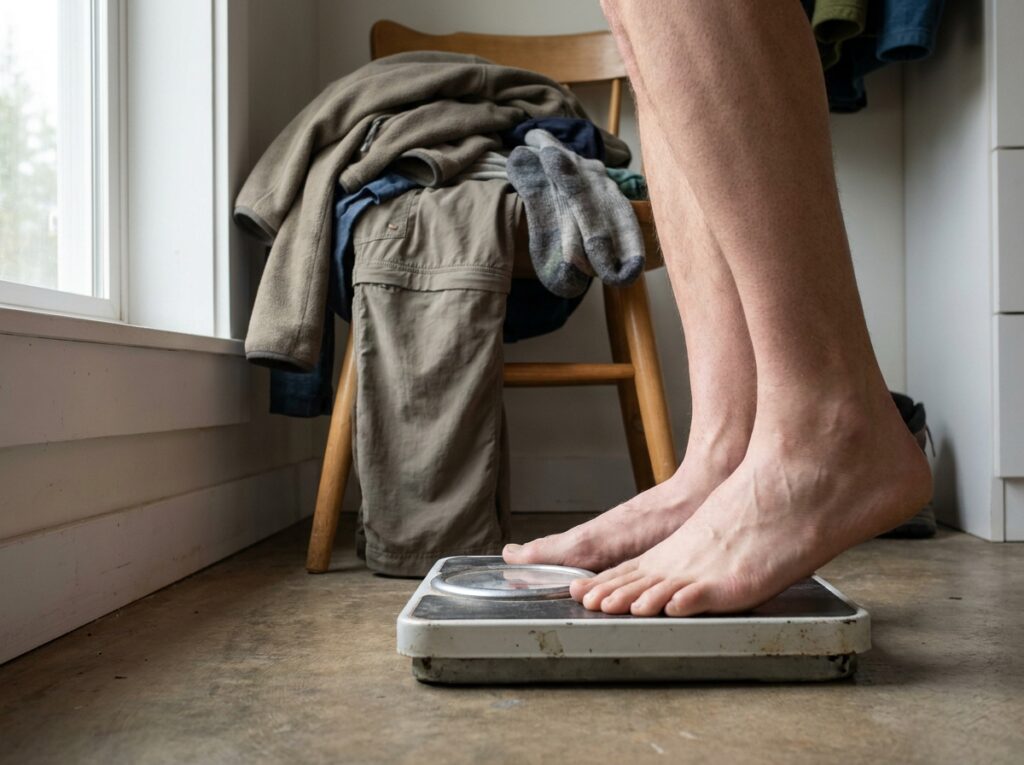
This is the one worth running after you’ve done three or four hikes and want a number that’s actually yours instead of an average. Weigh yourself, in the same clothes, right before and right after a hike of at least an hour. Every pound you lost equals about 16 ounces of fluid, close to half a liter, that you sweated out and need to replace. Add back any water you drank during the hike to get your true hourly loss.
The CDC’s method for calculating sweat rate, built for outdoor workers and athletes managing heat exposure, uses this same before-and-after weigh-in to set a personal hourly number instead of leaning on a generic average. Run it once on a warm hike and once on a cool one, and you’ll have two real numbers instead of one guess.
The catch: it requires a working scale and a hike you’ve already completed, so it’s no help planning your very first trip. This is the formula to graduate to, not the one to start with.
Formula
Best For
The Number
Real Limitation
Half-Liter-Per-Hour
Your first few hikes, quick planning
0.5 L per hour moderate, 1 L per hour in heat
An average, not a personal number
Body-Weight Baseline
Full-day trips, whole-day planning
Body weight in lbs ÷ 2 = oz for the day
Doesn’t adjust for heat or effort
Sweat-Rate Test
Dialing in your real number
Weight lost in lbs × 16 oz
Needs a scale and a completed hike
If you only take one thing from this article: start with Formula 1 on your next hike. It’s the one you’ll actually use standing in your kitchen the night before, and being roughly right beats being exactly right two formulas from now. Move to the sweat-rate test once you’ve got a few hikes behind you and want to stop guessing.
💡 Trail Tip: Set a recurring phone timer for every 25 minutes instead of a mental note to “drink more.”
Thirst cues lag behind your actual fluid need by the time you’d notice them on trail. A timer catches the gap before it turns into a headache.
🥾 Emergency Reserve Rule
When I started hiking in Southern California’s desert-adjacent ranges, I foolishly rationed water assuming I could drink freely once back at my vehicle. On a hot descent of Strawberry Peak, a minor route detour almost left me completely dehydrated. In my pack, I always carry a dedicated 750ml reserve bottle that remains strictly untouched until the trailhead parking lot is in direct sight.
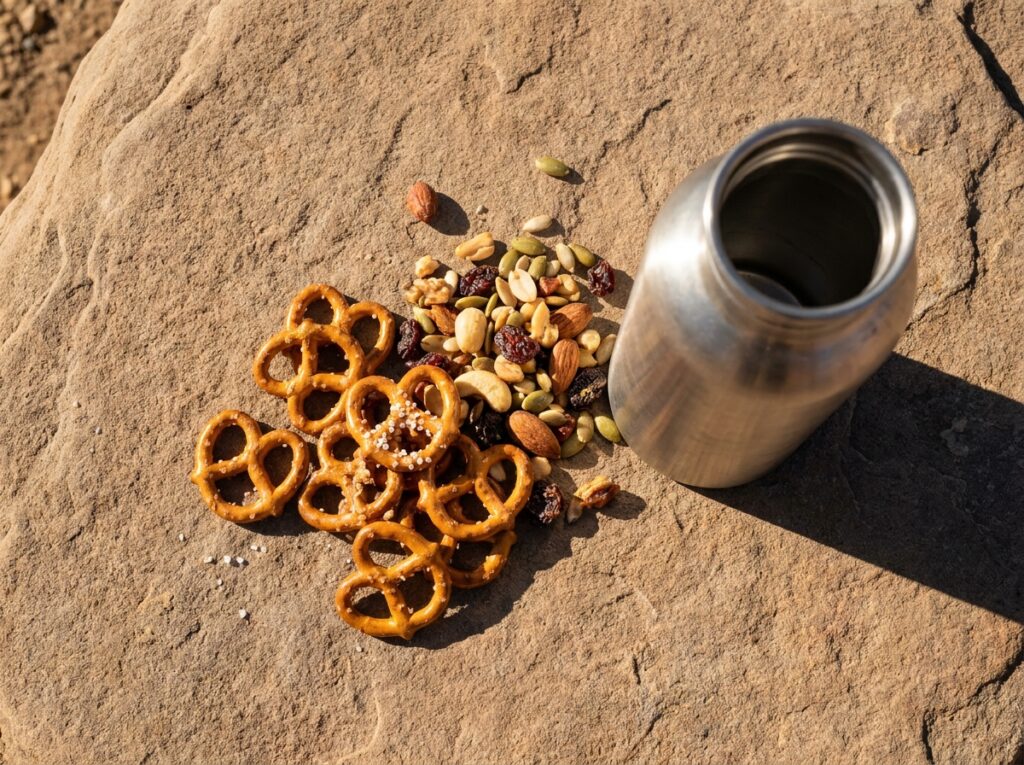
None of the three formulas above mention electrolytes, and that’s a real gap. Sweat carries out sodium along with water, and on a hike over 90 minutes, water alone doesn’t fully replace what you’re losing. A handful of pretzels, a salty snack, or an electrolyte tablet dropped into one bottle covers this without turning your pack into a chemistry set.
Altitude changes the math too. Above roughly 8,000 feet, you lose more fluid just from breathing harder in drier air, on top of whatever the heat and exertion formulas already account for. If you’re flying in for a hike at elevation, add about 20 percent to whatever number you calculated at sea level.
And you don’t need a hydration app to run any of this. The formulas above work on a phone’s calculator or, honestly, on the back of a trail map. Skip the subscription that promises a personalized hydration score. It’s the same three formulas wearing a nicer font.
One more caveat, in the other direction: more water is not automatically safer. Drinking far beyond what you’re actually losing to sweat, especially without replacing any sodium, can dilute your blood sodium level faster than most beginners expect on a hot, long day. It’s rare on a standard day hike. It’s also the reason “just drink constantly” was never the right advice, which is exactly why these three formulas exist instead of one flat rule.
A 5-mile flat trail and a 5-mile trail with 2,000 feet of climbing are not the same hike, even though they show identical mileage on a map. Convert distance to estimated time first, using your actual pace on similar terrain, then run that time through Formula 1. Skipping this step is the single most common reason beginners come up short on trail.
Waiting until you’re thirsty to start drinking
By the time thirst kicks in, you’re already running a deficit that your pace and focus have started paying for. Drink on a rough schedule instead, roughly every 20 to 30 minutes, whether or not you feel like it yet. The trail tip above covers exactly how to build that habit without thinking about it.
Skipping salt on a long or hot hike
Plain water with zero sodium on a hike over 90 minutes in heat can leave you feeling worse, not better, even as you keep drinking more of it. A few pretzels or a pinch of salt in a bottle solves this for close to nothing in cost or pack weight.
Reusing last week’s number for a different forecast
The 2 liters that comfortably covered a cool, overcast October hike will not cover the same trail in August. Check the weather forecast for the trailhead itself, not your home zip code, and re-run Formula 1 for that day’s real temperature before you fill your bottles.
When to Change Your Plan
Dehydration on trail rarely announces itself as an emergency right away. It builds gradually, and here’s exactly how to read it before it becomes one.
🔴 Turn Around Now
You haven’t urinated in over 4 hours on a full day out
A headache isn’t improving after 20 minutes of rest, shade, and water
Confusion, extreme dizziness, or vomiting: turn back and call for help
It’s above 95°F and you’re already less than half through your water
🟡 Slow Down and Reassess
A mild headache that started in the last hour: drink 8 to 12 ounces now and find shade for 10 minutes
Your urine has gone noticeably dark yellow: drink 8 ounces now and again every 20 minutes until it clears
You’re sweating heavily and craving something salty: that’s your body asking for water and sodium together, so give it both
✅ You’re Fine: Keep Going
You’re drinking roughly every 20 to 30 minutes without waiting to feel thirsty first
Your urine is pale yellow
No headache, normal energy in your legs, and you can hold a full conversation without getting winded
When you’re not sure which tier applies, treat it as the higher one. Turning around an hour early costs you a view. Pushing through a red flag costs a great deal more.
How much water should I bring hiking?
Plan for about half a liter of water per hour hiking on a moderate trail in moderate temperatures, roughly doubling once it’s hot or the climbing gets serious. For a typical 2 to 3 hour beginner hike in comfortable weather, that lands you around 1 to 1.5 liters total. Adjust up using Formula 1’s heat threshold before you second-guess the number.
How much water do I need for a 5-mile hike?
At a beginner’s pace of about 2 miles per hour, a 5-mile hike takes roughly 2.5 hours. At the half-liter-per-hour rate, that’s 1.25 liters; round up to 1.5 for a margin. In real heat, plan closer to 2.5 liters to cover the same 5 miles safely.
What’s a safe water requirement for a day hike in hot weather?
Once temperatures climb past 80°F, move from the half-liter baseline to about a full liter per hour, matching what Saguaro National Park recommends for hot, dry trail conditions. Add an electrolyte source too, since water alone doesn’t fully replace what heat and sweat are taking from your body.
How do I run a real hiking hydration calculation instead of using an average?
Weigh yourself right before and right after a hike of at least an hour, wearing the same clothes both times. Every pound lost equals about 16 ounces of sweat to replace, plus whatever you drank during the hike. Run this calculation once on a hot day and once on a cool one for two real, personal numbers.0
Can you drink too much water while hiking?
Yes, though it’s uncommon on a standard day hike. Drinking far more than you’re actually losing to sweat, especially without replacing sodium, can dilute your blood sodium faster than most beginners expect. The fix isn’t drinking less out of fear. It’s pairing water with a salty snack on any hike past 90 minutes.
What hydration rules for hiking should beginners actually follow?
Three rules cover most of it: drink before you’re thirsty, not after; match your rate to time and heat, not distance; and pair water with something salty on any hike past 90 minutes. The three formulas above are just more precise versions of those same three rules.
The Number That Actually Matters
How much water to bring hiking isn’t a question with one universal answer, but it is a question with a reliable starting point: half a liter per hour, doubling in heat, refined once you know your own sweat rate. That’s not a hedge. It’s the honest answer, because your real number depends on variables a single flat rule can’t see from a trailhead sign.
Start with Formula 1 on your next hike. It won’t be exactly right, and it doesn’t need to be. It needs to keep you ahead of thirst instead of chasing it, which is the entire job water has to do out there.
Next Steps
Right now: Weigh yourself and run the Formula 2 math: your weight in pounds, divided by two, in ounces. That’s your baseline for a full day out, before you’ve taken a single step.
Before your next hike: Check the weather forecast for the trailhead itself, not your home zip code’s, and run Formula 1 for that specific temperature and your estimated hours on trail.
After your next hike: If it ran over an hour, weigh yourself again right after and run the Formula 3 math once. You’ll have a real number for next time instead of an average.
Oliver Fall is an outdoor enthusiast with over 8 years of trail and backcountry hiking experience across Southern California. Two years ago, he founded Fama to break down real-world gear advice, practical trail skills, and honest beginner mistakes to help newcomers explore the outdoors with confidence.