


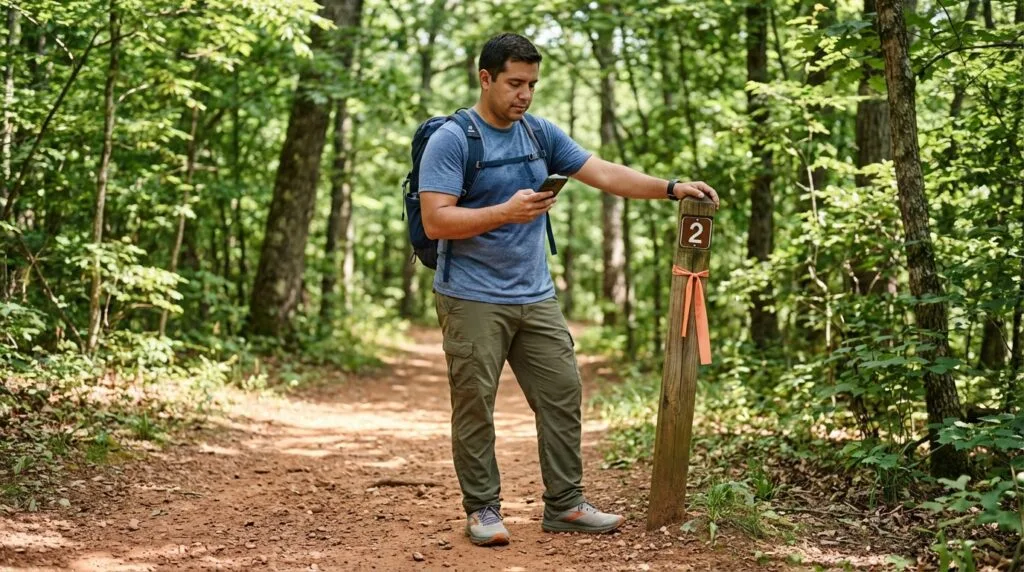
Here is the direct answer to how far can a beginner hike in a day: most adults starting out do well on 2 to 4 miles with minimal elevation gain. That is the benchmark. Where you land in that range depends on three things most beginner hiking guides skip entirely: your current fitness baseline, the elevation gain on your specific trail, and the trail surface underfoot.
⚡ Quick Trail Takeaways
- Beginner Mileage Cap: First-time hikers should limit initial hikes to 3 to 5 miles on flat to rolling terrain.
- Pacing Benchmark: Average beginner pace is 1.5 to 2.0 miles per hour including brief rest and photo stops.
- Progression Rule: Add no more than 1 to 2 miles per subsequent hike to allow joints and tendons time to strengthen.
When I first started hiking, I signed up for a 4-mile loop a friend described as “totally manageable.” I did not check the elevation gain. It was 650 feet over 4 miles, which sounds modest until you are on the back half, your legs have nothing left, and you still have 1.5 miles of trail to cover. I finished. I was also more tired than I had been in years. That hike taught me that beginner day hike distance has almost nothing to do with miles alone.
This article gives you the specific planning formula, the distance ranges that fit your first few months on trail, and the four mistakes that turn manageable hikes into long, draining afternoons.
🥾 Oliver’s Trail Notes & Field Observations
I always advise newcomers to ignore internet brags about 12-mile loops and start with 4 to 5 miles with no more than 600 feet of elevation gain. When I brought friends out to Eaton Canyon and Gabrielino Trail for their inaugural treks, groups that stuck to 4 miles finished smiling and eager to plan their next trip. Those pushed onto 8-mile routes suffered severe foot soreness and knee pain that kept them off trails for a month.
How Far Can a Beginner Hike in a Day: The Honest Numbers
The standard answer to how far a beginner should hike in a day is 2 to 3 miles. That answer is not wrong. It is just incomplete, because it treats all miles as equal, and they are not.
| Experience Level | Recommended Distance | Max Elevation Gain | Estimated Time | Recommended Terrain |
|---|---|---|---|---|
| First Hike (Outing 1–3) | 2 – 3 miles (3.2 – 4.8 km) | Under 300 ft | 1.5 – 2.5 hours | Flat, well-marked, packed-dirt loop |
| Month 1 (Outing 4–6) | 3 – 5 miles (4.8 – 8.0 km) | 300 – 500 ft | 2.0 – 3.5 hours | Maintained trails with gentle rolling terrain |
| Month 2–3 (Conditioned) | 4 – 6 miles (6.4 – 9.6 km) | 500 – 800 ft | 3.0 – 4.5 hours | Moderate single-track with switchbacks |
| Late Season Peak (10+ hikes) | 6 – 8 miles (9.6 – 12.8 km) | 800 – 1,200 ft | 4.5 – 6.0 hours | Rocky trails, ridgelines, moderate steepness |
A 3-mile flat trail and a 3-mile trail with 800 feet of elevation gain share the same mileage. They share almost nothing else. Effort, time on trail, how your legs feel the next morning, and how much water you burn through are all completely different. Two trails with identical mileage can produce two completely different experiences depending on what the terrain does in between.
A more useful starting framework for beginner day hike distance:
- Flat trail (under 200 feet of total gain): 3 to 5 miles is reasonable for most adults on early outings.
- Moderate elevation (200 to 500 feet of gain): Target 3 to 4 miles until you know how your body responds to sustained climbing.
- Significant elevation (500 to 1,000 feet of gain): 2 to 3 miles is enough. The effort on these trails is close to double a flat route of the same length.
- Strenuous elevation (over 1,000 feet of gain): Save this for after several easier outings. Not because you physically cannot handle it, but because you will not enjoy it yet, and enjoyment matters for building a lasting habit.
How far a beginner can hike in a day becomes much clearer after two or three actual outings than any planning guide can make it. These ranges give you the starting point. Real trail time gives you the calibration.
Why fitness alone doesn’t determine your distance limit
Gym fitness and trail fitness are genuinely different things. People who run regularly and consider themselves fit are often surprised by how hard 4 miles on trail feels compared to 4 miles on pavement. Uneven surface, actual hills, and the absence of a moving belt force different muscle groups to work harder and longer than standard cardio does.
That does not mean general fitness does not help. It does. But if your current exercise is mostly flat cardio, reduce your expected hiking mileage per day by 20 to 30 percent for your first two or three outings compared to what you can cover on a treadmill or a sidewalk. That gap closes fast. It just takes a few outings to calibrate.
The elevation multiplier most beginners skip
The planning formula used by experienced hikers is Naismith’s Rule: for every 1,000 feet of elevation gain, add one hour to your expected trail time. For a beginner whose pace slows more on steep terrain, a more accurate adjustment is one hour added for every 600 feet of gain.
This changes the math significantly. A 4-mile trail with 900 feet of elevation gain will take most beginners 3.5 to 4.5 hours. The same 4 miles on flat terrain takes 1.5 to 2 hours. Both are listed as “4-mile trails” in any app. That elevation number tells you which hike you are actually signing up for when asking how far can a beginner hike in a day.
What Actually Controls Beginner Day Hike Distance
Most planning conversations about how far can a beginner hike in a day focus on total miles. Miles are the least useful variable. Three factors actually determine how your day goes on trail.
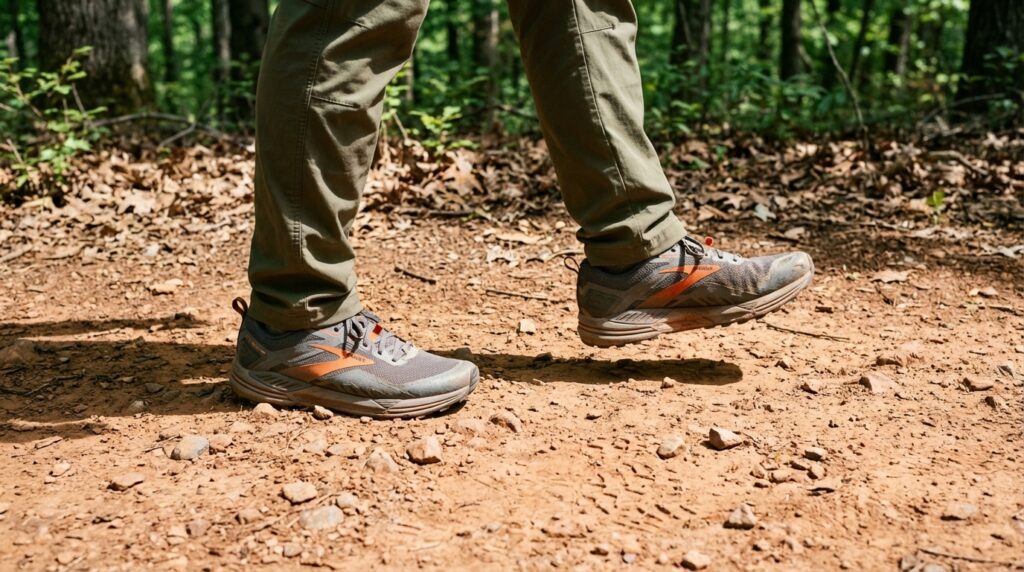
Trail surface controls your pace more than most beginners expect. Packed dirt allows roughly 2 to 2.5 miles per hour for most adults with average fitness. Rocky trails and root-covered terrain drop that to 1.5 to 2 miles per hour. Significant mud can cut your pace by half and roughly double your calorie burn. A “3-mile trail” on a rocky surface takes the same time as 4 miles on packed dirt.
Heat and sun exposure increase physical effort substantially. Hiking in temperatures above 85°F adds roughly 20 to 30 percent to your exertion level. A trail you could finish comfortably at 65°F becomes meaningfully harder in 90°F. According to the American Hiking Society’s guidance on planning summer hikes, finishing strenuous hiking by 10 AM during summer months helps most hikers avoid the worst of peak heat exposure.
Pack weight compounds on uphills. For a beginner carrying a fully loaded 15-pound pack, the added weight becomes noticeable on sustained climbs in a way it does not on flat terrain. Start with a lighter pack on early hikes. The average daily hiking distance you can cover comfortably drops as pack weight increases.
Planning day hike length the right way
Before selecting a trail, run this two-minute check to decide how far can a beginner hike in a day given your specific trail and conditions:
- Find the trail’s total mileage and elevation gain on AllTrails or a comparable app. Both appear on every trail listing.
- Calculate your time estimate: trail miles × 30 minutes, plus 1 minute per 100 feet of elevation gain.
- Add 30 minutes for breaks, snacks, and the moments you stop to look around.
- If that total exceeds the time you actually have, choose a shorter trail.
For a 4-mile trail with 600 feet of gain: (4 × 30) + (600 ÷ 100 × 1) + 30 = 156 minutes, roughly 2.5 hours. That is your realistic planning number.
The pace math most beginners skip
Most beginners assume they will move at something close to their normal walking pace. Trail pace is consistently slower. On maintained trails with moderate terrain, most adults cover 1.5 to 2 miles per hour. On trails with significant elevation or rough surface, that drops to 1 to 1.5 miles per hour.
Use 1.5 miles per hour as your default until you have data from actual hikes. Once you have three or four outings logged, you will know your real number.
On a flat, packed-dirt trail, most beginners cover 3 to 5 miles in 1.5 to 3 hours. Add moderate incline (200 to 500 feet of gain) and that range drops to 2 to 4 miles for the same time investment. On trails with significant elevation gain (500 to 1,000 feet), 2 to 3 miles is a full outing. Mixed surface and elevation together: 2 to 3 miles, 3 to 4 hours.
These assume average fitness and a pack under 15 pounds. Adjust down if temperatures exceed 80°F or if you are returning to exercise after a long break.
🥾 Elevation Gain vs. Distance Ratio
In my GPS tracking archives, 3 miles in Icehouse Canyon with 1,500 feet of rocky elevation took beginners the same elapsed time and energy expenditure as 7 miles on a rolling dirt fire road in the Verdugo Mountains. When calculating how far you can hike, I learned to add 1 hour of effort for every 1,000 feet of vertical gain regardless of the nominal mileage.
How Far Can a Beginner Hike in a Day: Ranges by Scenario
Distance planning looks different depending on where you are in your first hiking season. Here is what the progression actually looks like, stage by stage.
How far can a beginner hike in a day on your first outing
For a first hike with no prior trail experience: target 2 to 3 miles on a trail with under 300 feet of elevation gain. This is the range where most adults can have a genuinely good time without hitting a wall in the second half.
The goal for the first outing is not distance. It is finishing the trail feeling like you want to go back. If you end the hike with energy in reserve, you chose the right trail. If you are completely depleted at the trailhead, you went too long.
Plan 1.5 to 2.5 hours for this distance depending on elevation. Choose a trail with clear markers, a defined turnaround point or loop, and cell service where possible. REI Co-op’s beginner day hiking guide has a practical checklist for what to bring on that first outing.
💡 Trail Tip: Look for a trail with something worth stopping at around the halfway mark: a viewpoint, a creek crossing, a large boulder, or a bench.
When you reach it, you have done half the hike. The second half is the same terrain in reverse, and knowing that changes how the return trip feels psychologically. Pick that feature as your destination, not the trailhead sign.
Hiking mileage per day in months two and three
Once you have 3 to 5 completed hikes logged, your hiking mileage per day can increase. Most beginners at this stage do well with 4 to 6 miles on flat to moderate terrain, or 3 to 4 miles on trails with 500 to 800 feet of elevation gain.
A useful rule from distance running: do not increase your total weekly hiking distance by more than 10 percent week over week. Cardiovascular fitness adapts quickly. Tendons, ligaments, and the connective tissue in your feet and knees adapt more slowly. The most common beginner hiking injury is not the muscle soreness the morning after. It is knee and foot issues that develop after two or three weeks of increasing distance too fast.
My standing opinion on mileage progression: most beginners are physically ready to cover more ground long before their joints have fully adapted to trail demand. Two to three months of consistent hiking on moderate trails is the right window before asking how far can a beginner hike in a day on an 8-plus-mile route. Anyone who tells you otherwise is probably not factoring in recovery time.
Maximum distance for beginner hiker before terrain changes everything
After 10 to 15 hikes in your first season, 8 to 10 miles on moderate terrain is within reach for most adults. How far can a beginner hike in a day at that stage depends less on beginner status and more on cumulative trail time and consistent progression.
Skip the buildup and go straight to 10 miles — you will probably finish. You will also be miserable for the final 3 miles and sore for two days afterward, which makes the next outing less likely. The distance is achievable. The enjoyment is not guaranteed without the progression.
Distance Mistakes That End First Hikes Early
Four specific mistakes account for the majority of first hikes that go badly.
Picking trail length before checking elevation gain
A 4-mile trail sounds approachable. A 4-mile trail with 1,200 feet of elevation gain is a genuinely hard outing for a beginner. These look identical in a search result and feel nothing alike on the trail.
Check elevation gain before committing to any trail. AllTrails shows total gain prominently on every trail card. The number that matters is total elevation gain, not average grade. A trail that climbs 1,000 feet over 3 miles and then returns on a flat service road feels very different from one that gains and loses the same elevation evenly throughout.
Underestimating pace on unfamiliar terrain
Most beginners calculate their day hike length based on their walking pace around the neighborhood. Trail pace is 20 to 40 percent slower on maintained trails and significantly slower on technical terrain.
If you walk 3 miles per hour on flat pavement, plan for 1.8 to 2.2 miles per hour on a well-maintained trail. Start with that assumption and revise upward after you have actual data from real hikes.
Confusing out-and-back with loop mileage
A 4-mile out-and-back trail goes 2 miles to the turnaround point and 2 miles back. A 4-mile loop covers 4 miles total. Both show up as “4 miles” in trail apps. Before you go, confirm whether the mileage is one-way, out-and-back total, or loop total.
For any out-and-back trail, turn around at the halfway point of your planned time, not halfway through the mileage. If you planned 2.5 hours, head back at 1 hour 15 minutes regardless of where you are on the trail.
Ignoring heat and pack weight on the day
On days above 85°F, reduce your target hiking mileage per day by 20 percent. A 5-mile trail becomes a 4-mile plan. On cold days requiring heavy layering, leg fatigue arrives earlier than expected.
Pack weight compounds this. A 20-pound pack adds real effort on uphills compared to a 10-pound pack. The target for a beginner day pack: 10 to 15 pounds fully loaded, including water.
When to Reassess Your Plan
Beginners rarely need to turn around for dramatic reasons. More often, it is a gradual realization mid-trail that the route was longer or harder than expected. Here is how to read that situation.
Turn Around Now
- You are at the halfway point and already low on water with no reliable water source ahead
- Any member of your group shows dizziness, nausea, or stops sweating in hot weather: these are heat exhaustion signs that require immediate shade, water, and turning back; call 911 if confusion or loss of consciousness develops
- Less than 2 hours of daylight remain and you do not have a headlamp
- Ankle or knee pain that has progressed from mild to sharp in the last 30 minutes
Slow Down and Reassess
- You are tired but not depleted: stop, eat a snack, rest 10 minutes, then honestly evaluate whether you can finish the planned distance at a slower pace
- You are behind your time estimate: recalculate your turnaround time and adjust before continuing
- The trail surface is significantly harder than listed: revise your pace and check how much time you have remaining
You’re Fine: Keep Going
- Legs are tired but you can maintain a steady pace without pain
- You are slightly behind schedule but have enough water, food, and daylight to complete the planned route
- Your turnaround time has not arrived yet
The rule for all three tiers: when you are not sure which applies, treat it as the higher one. Getting off trail an hour early is an inconvenience. Getting into real trouble because you pushed through a yellow flag is a much bigger problem.
Beginner Day Hike Distance: Frequently Asked Questions
How far can a beginner hike in a day on a first trail?
Most beginners do well on 2 to 3 miles for their first outing, with under 300 feet of elevation gain. That combination is enough to feel like a real hike without the risk of the second half becoming a survival exercise. Planning day hike length too ambitiously on a first outing is the most common reason first hikes produce a reluctance to go back out. Finish with energy to spare on your first two or three hikes. You can always increase distance next time.
What is the average daily hiking distance for a beginner?
The average daily hiking distance for a beginner in the first month is 3 to 5 miles on flat to moderate terrain. After two to three months of consistent hiking, that range typically extends to 5 to 8 miles on trails with moderate elevation. These averages shift substantially based on trail surface, elevation gain, heat, and your baseline fitness coming in. Use the numbers as a starting point, then adjust based on your own experience on trail.
What is the maximum distance for beginner hiker on a single day hike?
Maximum distance for beginner hiker depends more on accumulated trail experience than on beginner status alone. On a first outing, 4 to 5 miles on easy terrain is a reasonable ceiling. After three months with 10 or more completed hikes, 8 to 10 miles on moderate terrain is within reach for most adults. The progression matters more than any specific distance limit. Skipping the buildup usually means completing the distance and then not wanting to hike again for two weeks.
How does elevation gain affect how far a beginner can hike in a day?
Significantly. How far can a beginner hike in a day changes by 30 to 40 percent when a trail has 500 feet of elevation gain versus the same mileage on flat terrain. The adjustment formula: add one hour for every 600 feet of gain to your estimated trail time. A beginner planning a 4-mile hike with 800 feet of gain should budget 3.5 to 4.5 hours, not the 2 hours flat trail math would suggest. Elevation gain is the single variable most beginners fail to account for in their planning.
What is the best way to use planning day hike length as a beginner?
Start with time rather than miles. Calculate your estimate using trail miles × 30 minutes, plus 1 minute per 100 feet of elevation gain, plus 30 minutes for breaks. Work backward from how much time you have available, choose a trail that fits that window with buffer built in, and use 1.5 miles per hour as your default pace assumption. After a few outings, replace that assumption with your actual pace from real hikes.
Should I measure beginner day hike distance in miles or hours?
Use hours for planning, miles for trail selection. Hours account for elevation, surface type, pace, and breaks in a way that miles alone do not. A 4-mile hike can take anywhere from 1.5 to 4.5 hours depending on those factors. Filter by distance when choosing a trail, then convert that distance to a time estimate and build your schedule around that number, not the mileage on the trail card.
What to Do Before Your Next Hike
The clearest answer to how far can a beginner hike in a day: 2 to 4 miles with under 400 feet of elevation gain is the right starting range for most adults, and that range extends naturally as you accumulate trail time and learn your actual pace.
The specific number changes once you factor in elevation, surface, heat, and your individual fitness baseline. The framework does not change: check elevation gain before choosing a trail, plan your day by time rather than miles, default to 1.5 miles per hour until you know your real pace, and leave 30 minutes of buffer in every plan.
Three consistent outings in the 2-to-4-mile range will tell you more about your personal beginner day hike distance than anything you read beforehand, because you will have real data from your own legs on real terrain.
Next Steps
- Right now: Open AllTrails, search trails near you, and filter by “easy” with a distance of 2 to 4 miles. Before bookmarking any trail, check the elevation gain. Target under 400 feet for your first two outings.
- Before your first hike: Run the time estimate formula from this article. Tell someone the trail name, trailhead location, and when to expect you back.
- Day of: Note your start time and check how you feel at the halfway point. That real-time data is your calibration for planning day hike length going forward.
- After your first hike: Log how you felt at the halfway point, at the finish, and the morning after. Three hikes of this data tells you more than any guide.
Related Reads
Picked a distance based on what looked impressive in an Instagram caption, not what actually fit your fitness level? These 5 rules cut through that and help you land on a number that’s genuinely realistic for where you’re at right now.
Noticed two trails listed at the exact same mileage leaving you with completely different levels of soreness the next day? This explains what elevation gain is actually doing that the distance number conveniently leaves out.
Blocked off exactly one hour for a “quick” 3-mile hike and still found yourself way behind schedule by the end? Here’s a far more grounded time estimate for that distance, based on how beginners actually move out there.
Opened fifteen browser tabs trying to plan your first hiking trip and somehow ended up with zero actual plan? Here are 9 steps that actually work for planning a beginner hiking trip, cutting straight through the tab chaos.
Glanced at a trailhead sign with a rating system that meant absolutely nothing to you and just shrugged your way past it? Here’s what those difficulty ratings genuinely mean for someone brand new, no confusing jargon attached.