

How to find hiking partners is something almost every new hiker hits around week three. The first hike is usually solo or with a reluctant friend who goes once and then has a standing conflict every Saturday. After that, you want someone consistent, and the obvious moves produce almost nothing: texting people who don’t hike, posting vaguely on Instagram.
⚡ Quick Trail Takeaways
- Local Hiking Clubs: Join local chapters of AMC, Sierra Club, or established Meetup groups with designated trail coordinators.
- Skill Matching: Choose group hikes rated explicitly for beginner paces (1.5-2.0 mph) to avoid falling behind or overexertion.
- Safety First Rule: Meet partners in daylight at busy public trailheads; never ride in private vehicles with unknown hikers on first meetups.
I texted eight people when I started looking for a regular hiking partner. Two responded. One came once and developed a rotating set of reasons to cancel. The other committed for three months before moving cities. By month two, I was hiking alone and starting to believe that finding someone to hike with was harder than the hiking itself.
It is not. The methods that actually work are specific, available in almost every US city, and the fastest one can put you on a group hike within four to seven days. This guide covers all six, ranked roughly by how quickly each one produces a real hike on a calendar.
🥾 Oliver’s Trail Notes & Field Observations
When I wanted to transition from casual walking to serious alpine hikes, finding reliable partners was a major challenge. I joined local Sierra Club outings and regional Meetup groups in the Los Angeles area. Joining structured group hikes allowed me to observe experienced trip leaders navigate off-trail hazards, manage pacing, and handle wilderness first aid. It is the fastest way to meet partners whose fitness pace matches your own.
How to Find Hiking Partners: Why Most People Overthink It
The actual problem with looking for hiking partners
Most guides on how to find hiking partners list every platform without telling you which one to try first. That produces people who read the full list, feel briefly informed, and do nothing.
Finding hiking partners is a coordination problem. You need a specific date, a specific trail, and other people committed to the same time and location. Platforms that solve that coordination in advance are useful. Anything that leaves the date as a future negotiation is slower.
The fastest method for most US beginners is a Meetup hiking group. Not because Meetup is a superior platform, but because it has groups in almost every metro area with pre-scheduled hikes, listed difficulty levels, and a registration system that signals to the organizer you are actually showing up. No awkward “we should hike sometime” thread that dies after two messages. You register, you show up, you hike with people.
All six methods in this guide work reliably. The right one depends on your city, your schedule, and what kind of hiking companionship you want.
What you actually want before picking a method
Before opening any app, be specific about what you’re looking for. A consistent one-on-one partner you can text for Saturday plans is a different search than a rotating group of a dozen people who hike every weekend. Both are available through different channels.
Three questions worth answering first: Do you want a fixed weekly commitment or flexible scheduling? Are you willing to drive more than 30 minutes to a trailhead? Do you want people at exactly your pace, or are you comfortable with a mixed group that will sometimes move faster or slower?
If you don’t have clear answers, start with a group. Groups remove the pressure of matching one person’s calendar and expose you to different trails and paces. A few group hikes will tell you more about what kind of hiking partner you want than a week of thinking about it.
6 Methods to Find Hiking Partners Near You
Method 1: Meetup hiking groups
How to use Meetup to find a group hike this week
Meetup.com hosts organized hikes in almost every US metro area. Most large cities have five or more active hiking groups with regular scheduled events. Search “hiking” in your city, then filter for groups with recent activity: at least one completed event in the last 30 days and upcoming events already posted.
Check the event descriptions for difficulty labeling. Most Meetup hiking groups use “easy,” “moderate,” or “strenuous” with distance and pace notes. An “easy/moderate” event typically covers 4 to 7 miles at a pace where conversation is easy, which suits most beginners who have done a few solo hikes.
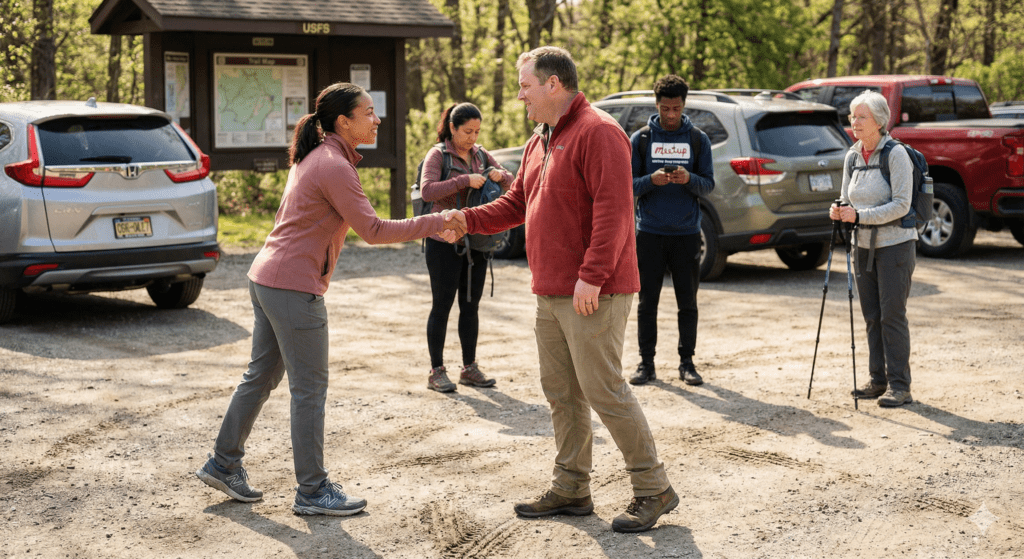
My first Meetup hike had 14 people in a suburban parking lot at 8am on a Saturday. I knew no one. By the turnaround at mile 3.5, I had coffee plans with two people and a standing invite for the following week. Meetup hiking groups work because everyone there showed up specifically to meet new hiking people. The social awkwardness most beginners dread clears within the first half mile.
One practical check before registering: look at the event photos, not the “going” count. An event showing 18 registrants alongside photos from past events with 4 people means most registrants are no-shows. Real attendance is in the photos.
💡 Trail Tip: Register for any Meetup hike at least 48 hours before the event. Organizers send logistics to registered attendees in the 24 hours before: parking location, trailhead address, what to bring, and carpool info.
Showing up without those details adds confusion at the trailhead that a two-minute email could have prevented.
Method 2: REI classes and in-store events
What REI hiking events actually offer beginners
REI runs hiking events and outdoor skills classes through its REI Experiences and Co-op Adventures programs. Most REI stores near trail access offer beginner hiking events, from one-time guided hikes to multi-session skills courses. REI membership ($30 lifetime) opens member-only events, though many beginner events are available without it.
The advantage over Meetup: REI events are led by someone with verified experience, group sizes are smaller (typically 6 to 12 people), and the difficulty is calibrated by someone accountable for the experience. A “beginner” REI hike is genuinely designed for people with little trail time.
Availability depends on store location and staffing. Stores near trail systems in the Pacific Northwest, Mid-Atlantic, and Mountain West run the most consistent event calendars. Check your local store’s events page at rei.com/experiences.
Method 3: Local hiking clubs
How to find local hiking clubs through the American Hiking Society
The American Hiking Society maintains a searchable directory of local hiking clubs across the United States at americanhiking.org. Most of these are independent clubs that organize regular group hikes, often with a trail maintenance component.
Local hiking clubs take more effort to join than Meetup. Many charge a modest annual membership between $15 and $40, and some ask new members to attend a few hikes before full membership. The payoff is stability. Club members often hike together weekly for years. Attendance doesn’t vary by event the way it does on an open platform.
For beginners, look for clubs with an explicit “beginner” or “easy” hiking category. Many clubs run mixed-difficulty schedules with pace groups designed to keep newer hikers from being dropped. Local hiking clubs are the right long-term answer once you want consistent weekly company and have done enough hikes to know what type of terrain and pace you prefer.
Method 4: AllTrails groups and community features
Using AllTrails to find hiking buddies by location
AllTrails has a Groups feature in its app showing active hiking communities organized by geographic area. You can search for groups in your city or county and request to join. Active AllTrails groups in hiking-dense metros like Denver, Portland, and Asheville regularly coordinate informal group hikes through the app’s messaging and event tools.
AllTrails is a slower entry than Meetup, but has one real advantage: self-selection. Someone who has logged 60 hikes in the past 12 months is a meaningfully different potential hiking buddy than someone who downloaded the app twice. The activity history is visible before you reach out.
The free AllTrails tier includes group access. Search your city in the Groups tab and look for posts within the last two weeks. A group that last posted in October is likely inactive regardless of member count.
Method 5: Facebook Groups for local hikers
How to post in a Facebook Group to find hiking buddies
Local hiking Facebook Groups are active in most US metro areas. Search “[Your City] hiking group” or “[Your State] beginner hikers” to find them. The effective approach for how to find hiking partners here is a specific ask, not a general one.
A post that says “looking for hiking partners!” gets ignored because it requires someone else to do all the planning before they can say yes. A post that says “Looking for 1 or 2 people for a 4-mile moderate hike at [trail name] on Saturday March 29. My pace is about 2 miles per hour. DM if interested” only needs a yes or no. Specificity does the coordination work for you.
Method 6: The people you already know
Why this method works better than most beginners expect
Before opening any app, tell 10 people you know personally that you’ve started hiking and want someone to come with you. Coworkers, neighbors, family members, people from other activities. Not your Instagram followers.
The conversion rate is lower than Meetup. Most people will express interest and never commit to a specific date. But the conversion that does happen produces the most durable hiking partnership of any method. Someone you already have genuine rapport with is far more likely to maintain a weekly hiking routine than a stranger from a Facebook group.
The offer that works: “I’ve been hiking lately and looking for someone to come Saturday mornings. Usually 3 to 4 miles, relaxed pace. Want to try it once?”
I tried this with a coworker I’d worked alongside for two years without ever spending time outside the office. She came on one hike, found the elevation annoying, loved the conversation, and kept coming. We’ve hiked together roughly 40 times since then. Most of those hikes happen because one of us texts the other on Thursday to confirm Saturday. No app. No registration.
The coworker you’ve worked with for two years is often a better long-term hiking partner than a stranger who describes themselves as “really into hiking.” That sounds backwards. It is not.
🥾 The Low-Stakes Shakedown Hike
Before agreeing to tackle an ambitious 12-mile summit with a new partner, I always schedule a low-stakes 4-mile shakedown hike first. In my experience, an easy preliminary walk reveals critical habits: do they bring adequate water, do they stop without warning, and do they respect trail etiquette? Testing compatibility on an easy local trail prevents dangerous friction high in the backcountry.
What to Do Before Your First Group Hike
Safety basics for meeting hiking partners from the internet
Meeting strangers from a Meetup group, AllTrails community, or Facebook Group on a trail involves a few practical steps that take less than five minutes.
Tell someone not in the group exactly where you are going. The trail name, trailhead parking address, the group name, and your expected return time. For your first hike with any new group, choose a well-trafficked trail where you are never genuinely isolated. After two or three hikes with the same people, you will have a clear read on whether this is a group you want to hike with in a more remote area.
Check the event organizer’s history before committing to a remote location. A Meetup organizer who has run 40 or more events over two years has a public track record you can verify. A group account created three weeks ago with no event history warrants more scrutiny before you drive an hour to a trailhead.
💡 Trail Tip: Download the offline trail map on AllTrails or Gaia GPS for any group hike before you leave home, while you still have cell service.
You should be able to navigate the trail independently, regardless of whether the group stays together or spreads out by pace.
How to set expectations before the first hike
Send the organizer one practical question before the day: “Is this trail mostly flat or does it have significant climbing?” or “Does the group tend to stay together or spread out by pace?” The response tells you whether the hike actually suits you and gives you a contact if something goes wrong at the trailhead.
The two frustrations that ruin most first group hikes: being left behind by a faster group on mile two, or feeling stuck matching a pace much slower than planned. One question sent in advance prevents both.
What Slows People Down When Finding Someone to Hike With
Three patterns that delay the first real group hike
Waiting until conditions are perfect. People delay posting on Meetup or Facebook because they’re “not fit enough yet” or want to do “one more solo hike first.” This inverts the actual value of group hiking. Group hikes build fitness and trail confidence faster than solo hiking does, not slower. Post now.
Joining without attending. The most common pattern across Meetup and AllTrails: someone joins groups, watches events, and never registers for one. The fix is a specific rule: register for one event within the next seven days. Not soon. Seven days. If you cannot name the hike, the date, and the time, you haven’t started yet.
Messaging without setting a date. When you find hiking buddies directly through Facebook or AllTrails, conversations stall at “we should hike together sometime.” Convert fast: “Are you free Saturday the 29th? I’m planning [trail name] at 8am.” If they say yes, the hike exists. Three declined weekends in a row is useful information about whether this person is actually going to hike with you.
How to Find Hiking Partners: FAQ
How do I find hiking partners if I’ve never hiked before?
Meetup hiking groups labeled “beginner” or “easy” are the most forgiving starting point for how to find hiking partners with no trail experience. Look for events under 5 miles with a “leisurely” or “easy” pace tag. REI beginner hiking events are the second-strongest option, with smaller groups and a leader who sets the pace to the actual skill level in the group. Neither requires your gear to be fully sorted or your fitness at any particular level before showing up.
What are the best apps for finding hiking groups for beginners?
Meetup is the most consistently effective app for finding hiking groups for beginners across US metro areas. AllTrails Groups gives you access to communities of committed local hikers. Facebook Groups for your city often have active members looking for partners right now. For structured events with experienced leaders, REI’s Experiences calendar is the most reliable option for beginners who want more support than a self-organized Meetup provides.
How do I find hiking buddies who match my pace?
Be specific about your pace before joining any group. A realistic pace for a beginner on flat trail with a pack is 1.5 to 2 miles per hour, slower on elevation gain. Most Meetup groups describe pace as “leisurely” (under 2 mph), “moderate” (2 to 2.5 mph), or “brisk” (over 2.5 mph). When posting to find hiking buddies directly on Facebook or AllTrails, include your approximate pace. It filters out mismatches before anyone drives to a trailhead.
Are local hiking clubs worth it for someone just starting out?
Local hiking clubs through the American Hiking Society directory are worth joining once you have done five or more hikes and want consistent weekly company. The structured schedule builds a more durable hiking habit than the variable attendance of Meetup events. For the first three months, Meetup or REI events give you more flexibility while you figure out your preferred terrain, pace, and trail type.
How do Meetup hiking groups work for first-time users?
Meetup.com lets you create a free account, search for hiking groups by city or zip code, and register for upcoming events. Most groups don’t require prior attendance. You register for the specific event and show up at the listed time and trailhead. The organizer sends logistics to registered members in the 24 hours before. Your first Meetup hike will feel like walking into a room where you know nobody, and then finding out everyone is there for exactly the same reason. The awkwardness clears before the first mile marker.
Is finding someone to hike with harder in rural areas?
Finding someone to hike with in a rural area is harder on Meetup, which has fewer active groups outside major metros. In rural areas, the American Hiking Society club directory at americanhiking.org, county or regional Facebook Groups, and word of mouth are more effective than app-based platforms. Ask at the nearest outdoor gear shop whether informal group hikes are organized locally. These groups exist in most outdoor communities and rarely advertise anywhere online. The question alone is usually enough to get an invitation.
The Method That Gets You on Trail With Other People
How to find hiking partners is a solvable problem, and it’s faster than most beginners expect once they stop researching and start registering.
Meetup hiking groups are the fastest reliable method for most US beginners. Not because they’re the best community you’ll build, but because they have strangers who’ve already committed to being on trail on a specific day. You don’t have to convince anyone or plan anything. You register and show up.
My direct recommendation: if you’re in any US city with more than 75,000 people, open Meetup right now and search “hiking.” Find one event in the next 14 days that matches your pace and distance. Register before you close this tab. That’s how to find hiking partners in most US cities. One registration. One date. One actual hike.
If Meetup has no active groups near you, the American Hiking Society club directory at americanhiking.org is the next search. Local hiking clubs in rural and suburban areas run consistent weekly hikes that don’t appear on any major app.
Next Steps
- Right now: Open Meetup.com, search “hiking” in your city, and register for one event in the next 14 days before closing this tab.
- Today: Search “[Your City] hiking” on Facebook and post one specific ask with a trail name, date, pace, and distance.
- This week: Tell 10 people you already know that you want a hiking partner. Give them a specific time and trail, not a vague invitation.
Related Reads
Skipped exploring trails near you for months because every search result seemed to come with a parking fee attached? Here’s how to track down solid hiking trails near you that won’t cost you anything to access.
Kept pushing forward on a hike even though something in the back of your head was quietly telling you to stop? Here’s how to actually know when to turn back before stubbornness turns into a real problem out there.
Noticed your legs torching way faster on one “3-mile” trail compared to another with the exact same listed distance? This explains what elevation gain is actually doing to your hike, the part the mileage number never tells you.
Lay awake the night before your first hike running through every possible thing that could go wrong? Here’s exactly what to expect so the nerves settle before you even hit the trailhead.
Heard a seasoned hiker call a 7-mile trail “barely anything” and started wondering if you were aiming way too low? These 5 rules cut through that and help you land on a distance that’s genuinely realistic for you, not someone else’s definition of barely anything.