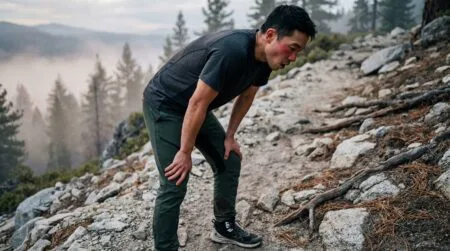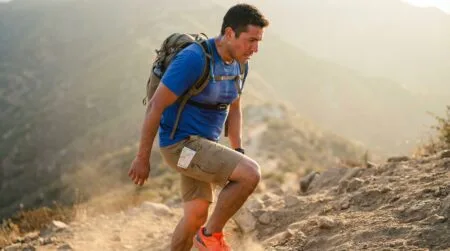


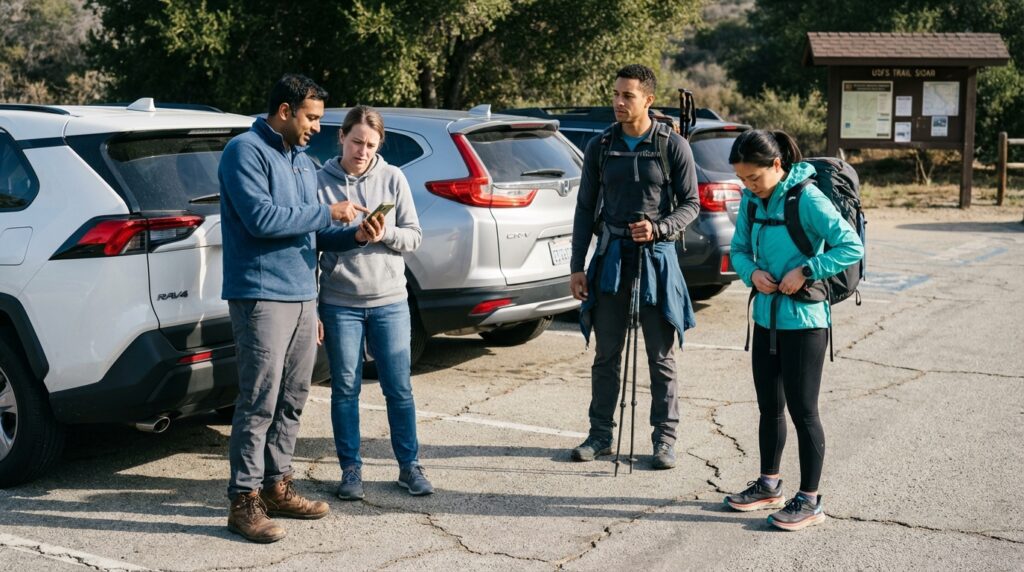
The most useful group hiking tips for beginners have nothing to do with how fit you are. They have to do with what happens in the parking lot before anyone takes a step.
⚡ Quick Trail Takeaways
- Pace Setter Protocol: Place the slowest hiker in the second position directly behind the leader to dictate sustainable group pace.
- Designated Sweep: Assign an experienced hiker with first-aid knowledge as the rear sweep so no one gets left behind.
- Junction Stopping Rule: The entire group must stop and regroup at every trail fork or junction before continuing.
I learned this on a 5.4-mile trail in Griffith Park with four friends one October morning. Three different fitness levels in the group, zero pre-hike conversation about pace, and no agreement on what “moderate” meant on the trail description. By mile 2, our group had spread across 500 feet of trail. The two strongest hikers were stopped at every junction, waiting with increasingly visible impatience. The slowest hiker hadn’t eaten since 7am and was rationing a single 500ml water bottle with 2.8 miles still ahead. One friend had shoes she hadn’t tested before that morning. Nobody said anything until mile 3, when the frustration had already built to the point where the conversation was harder than it needed to be.
We finished. But the group didn’t hike together again for four months.
Group hiking tips for beginners almost always focus on what to do once you’re moving. The actual problems usually get set up before anyone leaves the car. This guide covers five rules that prevent that: how to pick a trail for a group, how to set a pace everyone can live with, what the strongest hiker’s actual job is, what hiking group etiquette requires from everyone, and how to handle the specific situation where fitness levels genuinely don’t match.
Group Hiking Tips for Beginners: Start With the Right Trail
How trail selection changes when you’re hiking with other people
Picking a trail for a group hike is a different calculation than picking one for yourself. Most groups get it wrong in the same direction: they pick a trail that works for the average fitness level in the group, not the lowest.
The rule is simple. Build trail selection around the least-fit or least-experienced person, not the median. If your group has four people who hike regularly and one who hasn’t been on trail in a year, that fifth person sets the ceiling. Not because the stronger hikers need to be held back as a preference — but because putting the newest hiker on a trail they’re not ready for makes the day worse for everyone, not just them.
This is the most direct of any group hiking tips for beginners I can offer: agree on a trail that the least-fit person can finish comfortably at their own pace, not at their maximum effort. The difference between those two things is about 30 to 40 percent of distance and elevation.
A working framework for beginner group trail selection:
If anyone in the group hasn’t hiked in the last six months, cap the day at 4 miles and 400 feet of elevation gain. If everyone has been active on trail in the last month, 6 miles and 700 feet is a reasonable ceiling. Above that, you need actual confirmation — not assumptions — that everyone has done something comparable recently.
AllTrails shows both distance and elevation gain for every trail. Use those numbers. The difficulty rating varies too much by reviewer to be reliable as your only filter.
The one question every group skips
Before committing to any trail, ask each person: “What’s the longest hike you’ve done in the last 60 days, and how did you feel the next morning?”
Not their best hike ever. Not what they think they could probably do. Their most recent actual number.
That answer tells you what you need to know. “I hike all the time” is not data. “I did a 3.5-mile loop last month and was fine” is data. Most groups skip this conversation because it feels awkward to ask. Finding out at mile 3 that someone hasn’t hiked since the previous spring is significantly more awkward.
Set the Group Pace Before Leaving the Parking Lot
What group pace hiking actually means
Group pace hiking is not everyone walking at the same speed. Nobody in any group walks at the same speed. Group pace hiking means everyone agrees, before mile one, on how the group will handle the speed differences that are guaranteed to appear.
Here is my clearest opinion on the subject, and I hold it without exceptions: the fastest hiker in the group controls the pace only if they walk at the back and stay there. The person at the front sets the natural tempo for the group. If the fastest person walks ahead, the pace fragments into two separate hikes sharing a trail. If the fastest person walks last, the whole group moves at the speed that actually works for everyone.
I’ve been the fast hiker who walked ahead and waited at every junction. I thought I was being patient — I was stopping, after all. What I was actually doing was making the slower hikers feel terrible about their pace. They could see me stopped ahead, watching them close the distance. That’s not hiking together. That’s supervised walking. The fix was simple: I stopped being the one who walked first.
The strongest hiker goes last. Not as a punishment. As structure. It keeps the group intact and eliminates the wait-and-start cycle that makes the hike feel like a chore for the hikers in the middle.
Rules for staying together on trail without constant headcounts
Staying together on trail doesn’t require everyone moving in lockstep. It requires one rule that everyone knows and follows: no one gets more than one junction ahead of the slowest hiker.
If you can see the person behind you from where you’re standing, keep moving. If a junction is coming up and you don’t know whether the person behind you has it in their sightline yet, stop before the turn. This one rule eliminates almost every group separation problem on maintained trails.
💡 Trail Tip: Count heads at every junction before anyone takes the turn. Every time.
This takes 15 seconds. It prevents the 20-minute search that happens when one person assumes someone else confirmed the count. Make it automatic at junction one, not a response to the first time someone goes missing.
For groups of four or more: assign a sweep hiker at the trailhead. One designated person who is always last and never lets anyone fall behind them. The person at the front confirms the route. The sweep confirms the headcount. Everyone in between follows, and that is completely fine.
Leading a Beginner Hike the Right Way
What the strongest hiker’s actual job is
Most hiking with friends tips focus on what slower hikers should do: train more, bring more food, start earlier. That’s useful. What gets less attention is this: leading a beginner hike is a specific job, and the strongest person in the group has to learn it.
Leading a beginner hike does not mean walking fastest and having everyone catch up at the end. It means managing the group’s energy so everyone finishes in a mood where they’d go again. That is a fundamentally different job than finishing first.
Here’s what it specifically requires:
Control the first mile deliberately. The opening mile of any group hike with beginners should feel almost too easy. This is not about warming up. It is an energy management decision. Beginners who push hard in the first mile are exhausted by mile 3. Beginners who hold back in the first mile finish strong. The leader controls this by actively slowing down, even when it feels unnecessary, even when you know the pace is sustainable for everyone. The first mile sets the group’s actual rhythm for the whole day.
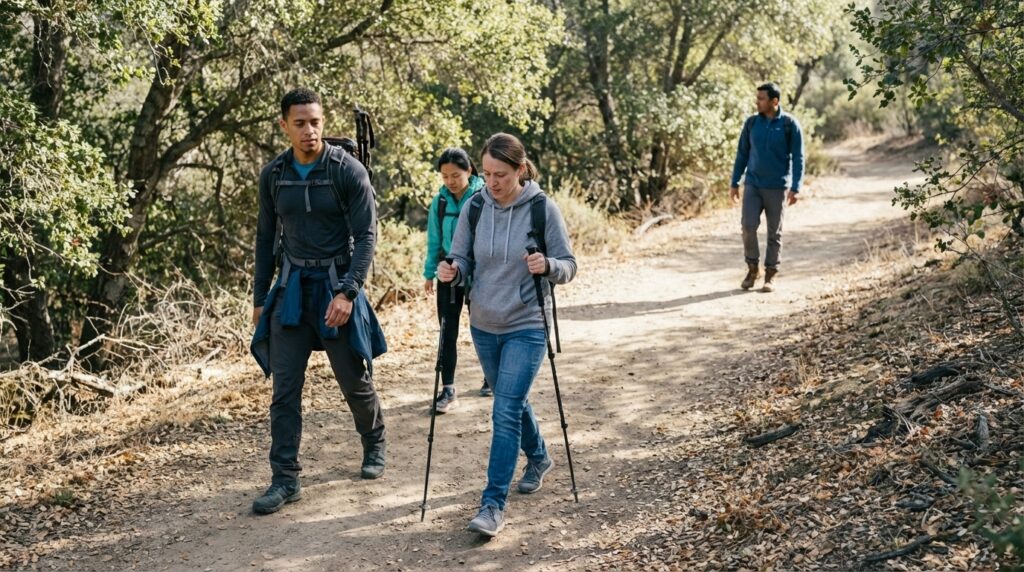
Call rest breaks before anyone asks. Experienced hikers know to take a break before they feel like they need one. Beginners don’t know this yet. On any hike over 3 miles, call a 5-minute water break at mile 1.5 whether or not anyone is asking for it. You’re preventing fatigue from building, not responding to it after the fact. There is a real difference between those two interventions.
Check in once per mile, specifically. “How’s everyone doing” invites “fine.” “How are your feet feeling — any hot spots starting?” invites an actual answer. The second version catches the blister that’s forming at mile 2 before it becomes the reason someone is limping at mile 4.
How to give a slower hiker an out before they need it
Here is a specific detail that most group hiking tips for beginners leave out: before the hike, tell the newest hiker quietly and directly, “If you need to turn back at any point, that is absolutely the right call. I’ll go back with you.”
Not as a warning. As permission.
Most beginners who are struggling on trail don’t say anything. The social cost of being the person who called the group’s hike short feels higher than the physical discomfort. They push past the point where they should have turned back because nobody told them that asking to stop was an acceptable option. A direct, calm “you can ask to turn around and that is fine” from the group leader, said privately before the hike starts, eliminates most of this.
You may never need to use it. Say it anyway.
Hiking Group Etiquette: What It Actually Requires
Trail etiquette when other hikers are around
Hiking group etiquette matters more in a group than it does solo. A solo hiker who drifts toward the center of a trail is a minor inconvenience for passing hikers. A group of six spread across the width of a narrow trail, unaware that uphill hikers have been visible behind them for two minutes, is a real problem for everyone in the vicinity.
The hiking group etiquette rules that beginner groups most consistently miss:
Walk single-file on any trail under 5 feet wide. Not loosely single-file, where one person stepping off the path pulls two others with them. Actually single-file, with enough gap between hikers that each person can step aside independently. A group spread loosely across a 3-foot trail occupies about 9 feet of space.
Let uphill hikers pass without waiting to be asked. The uphill hiker has right of way on most trails and is working harder for it. In a group, step right and stop. Don’t drift left while maintaining pace. Stop. Let them through. Then resume.
Keep group conversations at a volume that doesn’t carry. A group of four having a normal conversation on a quiet trail can be heard from 50 feet away and around multiple corners. The rule is not silence. The rule is awareness that your group takes up more acoustic space than one person does.
💡 Trail Tip: Groups larger than 12 people require a permit on many National Park Service and USDA Forest Service trails.
Check the specific land manager’s website before your trip. Some popular California trails enforce this at the trailhead. Splitting a group of 14 into two groups of 7 with staggered start times is the straightforward solution, but it needs to be decided before you arrive.
Hiking group etiquette with rest breaks and food stops
Where your group stops matters as much as when it stops. A group of five who sit down at a junction to eat lunch, on the trail itself, blocking hikers arriving from two directions, creates a bottleneck that affects everyone who passes in the next 20 minutes.
Hiking group etiquette on breaks: move at least 6 feet off the trail before sitting, keep the group together rather than spreading across a wide rest area, and leave before you feel fully recovered. The gap between “I could stand up” and “I feel like standing up” is the window where you should move.
Hiking With Friends Tips for Mixed Fitness Levels
How these group hiking tips for beginners change when the fitness gap is real
Hiking with friends tips tend to assume the group is within one fitness tier of each other. That assumption is usually wrong. Most groups have at least a 2-to-1 pace difference between the fastest and slowest hiker. Some have more.
For groups with a genuine fitness gap, the standard pace rules need a structural adjustment: instead of one continuous group, hike as two semi-independent clusters with defined meeting points.
Here is how that works. The faster hikers move ahead to a specific, named landmark (not “somewhere near the top” — a specific junction or viewpoint on the map). They wait there. The slower hikers arrive. Everyone rests together for 10 minutes. Then both clusters move to the next named meeting point. This keeps hiking with friends tips practical instead of theoretical, because nobody spends the full hike waiting impatiently or feeling rushed.
The meeting points must be specific. “Wait at the stone bench overlook at mile 2.4” works. “Wait somewhere around the 2-mile area” creates two groups walking past each other in opposite directions, which has happened more than once to groups I know.
The pre-hike fitness conversation that prevents most problems
Most beginners don’t know how to self-assess accurately against a trail description. They read “moderate, 5 miles, 600 feet gain” and make a guess based on general self-perception rather than recent actual experience. Group hiking tips for beginners are only useful if the group’s trail choice is grounded in real data.
The hiking with friends tip that addresses this: before any group hike, have each person share their “honest hike number.” That’s the longest distance they’ve completed in the last 60 days, and how they felt the following morning. Not their best hike in the last three years. The most recent actual number.
If the planned trail is within 20 percent of everyone’s honest hike number, proceed. If the planned trail is 40 percent longer than someone’s most recent hike, you’re planning for that person to struggle. That’s useful information to have in the parking lot, not at mile 4.
When to Change Your Plan
Turn around now
- Anyone in the group has been in visible pain in their feet, knees, or ankles for more than 30 minutes and the discomfort is worsening rather than stabilizing
- You’ve lost track of any group member for more than 10 minutes and have not reestablished visual or voice contact
- Someone is showing heat exhaustion signs on a warm day: stopped sweating despite the temperature, nausea that doesn’t pass after 10 minutes of rest in shade, or confusion about where they are or how far you’ve hiked
- Less than 90 minutes of daylight remain and you are more than 1.5 miles from the trailhead
Slow down and reassess
- One group member is visibly falling behind a pace that had been comfortable for the first mile, or is consistently taking longer than 90 seconds to respond to simple questions
- Someone has consumed more than two-thirds of their water before the halfway point on the trail
- The group has gone quiet in a way that feels different from normal comfortable silence — when people stop talking during movement, it usually means someone is working harder than they’re letting on
You’re fine, keep going
- The slowest hiker is within 200 feet of the rest of the group at trail pace, and closes that gap at every rest stop
- Everyone has drunk water in the last 30 minutes without being reminded to
- No blisters starting, no joint pain developing, and the terrain ahead matches what you planned and prepared for
Group Hiking Tips for Beginners: FAQ
What are the most important group hiking tips for beginners who have never hiked together?
The two group hiking tips for beginners that matter most before the first hike together: pick a trail calibrated to the least-fit person in the group, not the average fitness level, and have a specific trailhead conversation about who walks last and how far ahead of the slowest hiker anyone is allowed to get. Agree on those two things and most of what goes wrong on group hikes gets prevented before it starts.
How do you manage group pace hiking when fitness levels are very different?
For group pace hiking with a real fitness gap, use a two-cluster format with specific meeting points. Faster hikers move ahead to a named landmark and wait. Slower hikers arrive, everyone rests together for 10 minutes, and both clusters move to the next specific meeting point. The meeting points must be named landmarks on the map, not approximate locations. This makes staying together on trail manageable without asking anyone to walk at a pace that’s wrong for their body.
What is the hiking group etiquette for a beginner group on a popular trail?
The hiking group etiquette rules beginner groups most often miss: single-file on any trail under 5 feet wide, stop and step right to let uphill hikers pass without making them ask, take all rest breaks at least 6 feet off the trail surface, and keep group conversation at a volume that doesn’t carry more than 30 feet ahead. On busy trails, those four rules determine whether your group adds to the experience of other hikers or complicates it.
What does leading a beginner hike actually require from the most experienced hiker?
Leading a beginner hike means walking at the back, slowing the first mile down deliberately, calling a 5-minute rest break at mile 1.5 before anyone asks for it, and checking in on specific things (feet, water, hot spots) rather than general wellness. The experienced hiker’s job is managing the group’s energy from mile one, not demonstrating what they’re capable of. The group finishes better and wants to go again. That’s the metric.
What hiking with friends tips apply specifically to groups of four or more people?
For groups of four or more, assign a sweep hiker from the trailhead: one designated person who is always last and never lets anyone fall behind them. Count heads at every junction before anyone takes the turn. Set specific named meeting points if the group will split by pace. Tell every newer hiker privately that turning around is always a legitimate choice. Staying together on trail in larger groups requires structure, and that structure needs to be established before the hike starts.
What should beginners know about staying together on trail when someone is slower?
Staying together on trail with mixed paces works when everyone follows one rule: no one gets more than one junction ahead of the slowest hiker. The person in front stops before any junction until they can confirm the person behind them has that junction in their sightline. This is a visibility rule, not a speed rule — it doesn’t require everyone to walk the same pace, only that no one disappears around a turn without visual confirmation that the person behind them knows where the trail goes.
The Parking-Lot Conversation Is the Hike
Group hiking tips for beginners come down to this: the decisions that determine how the day goes are almost all made before you reach the trail. Trail selection, pace agreement, who walks last, meeting points, the quiet conversation with the newest hiker about turning back — these are parking-lot decisions. Trying to make them at mile 3 costs time and goodwill you don’t have left.
The groups that take 10 minutes at the trailhead to cover these things finish better than groups that skip it, regardless of who’s the most fit.
For your next group hike: get the honest hike numbers before you choose the trail. Put the strongest hiker at the back. Call the mile 1.5 rest break whether or not anyone asks for it. Count heads at every junction. That framework covers most of what can go wrong.
Next Steps
- Right now: If you have a group hike planned, message everyone and ask for their honest hike number — longest distance completed in the last 60 days. Compare against the planned trail’s distance before committing.
- Before the hike: Decide who is sweeping (designated last hiker) and what the specific named meeting points are if the group splits by pace. Write it down. Send it in the group chat the night before.
- At the trailhead: Take 5 minutes for the group conversation: pace, meeting points, who walks last, and the quiet check-in with any newer hikers about the turn-back option. Do this before anyone starts moving.
- On trail: Count heads at every junction. Call a rest break at mile 1.5 on any hike over 3 miles. Check in on feet and water, not just general wellness.
Related Reads
Tired of hiking solo every weekend but had no real idea where you’d actually find people who wanted to come along? Here are 6 methods for finding hiking partners near you, beyond just posting a hopeful message in a group chat.
Kept walking even though a quiet voice in the back of your head was telling you maybe this hike had gone far enough? Here’s how to actually know when to turn back before stubbornness turns into a real problem out there.
Hit that mental wall where your legs could keep going but your brain had already checked out completely? Here are 6 mental tricks for pushing through when hiking gets hard, the kind that actually work mid-trail.
Took off fast at the start and spent the entire back half of the trail just trying to recover? These 7 pacing techniques fix that imbalance so your energy actually lasts the whole way.
Agreed to a trail distance because it was the only option in the group chat, not because it actually fit you? These 5 rules help you push for a number that’s realistic for you, no awkward conversation needed.