



The hiking motivation tips that actually work on trail are not about mindset or mantras. They are specific mental maneuvers you practice on purpose, starting before the hard part begins.
⚡ Quick Trail Takeaways
- Micro-Targeting Technique: Focus eyes only 10-20 steps ahead to the next landmark tree or rock rather than staring at the peak.
- Cadence Breathing: Match 2 footfalls per inhale and 2 footfalls per exhale to stabilize heart rate on demanding ascents.
- Scheduled Rest Stops: Take 60-second standing breather breaks every 15 minutes instead of long sitting breaks that stiffen muscles.
My third real hike was a 4.3-mile trail in Shenandoah National Park with 1,100 feet of gain. At mile 2, I wanted to turn around. Not because my legs were failing. Not because I was out of water. I had convinced myself, over about 15 minutes of quiet, miserable walking, that the view from the top was not worth the remaining mile and a half. I turned around. I got back to the trailhead in 40 minutes, felt fine physically, and sat in my car annoyed at myself for the next two hours.
The view, I later found out on AllTrails, was about 12 minutes of hiking above where I stopped.
That is what hiking mental blocks actually do. They do not feel like a crisis. They feel like a reasonable decision. For more on how time outside affects your mental state, visit the American Hiking Society.
This guide covers six specific hiking motivation tips that interrupt that process before it finishes.
🥾 Oliver’s Trail Notes & Field Observations
Staring up at the summit of Mt. Baden-Powell from switchback 15 can feel demoralizing when your lungs burn. In my experience on tough solo climbs, looking all the way to the top triggers mental panic. I break the climb into visual micro-goals: hiking only to that twisted Jeffrey pine 40 paces ahead, pausing for two nasal breaths, and picking the next granite boulder. Segmenting the trail keeps your focus locked on immediate mechanics rather than the overwhelming total distance.
Hiking Motivation Tips: Why the Hard Part Is Rarely Physical
What actually makes a hard hike feel impossible
Most beginners assume that when a hike gets hard, the problem is physical: they are not fit enough, not trained enough, not ready. That is usually wrong.
The physical limit on most beginner-to-intermediate day hikes is further out than the mental limit. A healthy adult who walks regularly can complete most trails rated moderate on AllTrails. What stops them is rarely their cardiovascular system. It is a story their brain starts telling around mile 2 or 3, usually when pace has dropped, breathing has increased, and novelty has worn off.
The story sounds like: “This is harder than I expected.” Then: “I’m not enjoying this.” Then: “I should probably turn around.” Each sentence feels like a logical observation. Together they form a reliable pattern of quitting that has nothing to do with physical capacity.
Recognizing that pattern is the first and most useful hiking motivation tip in this guide. You cannot interrupt something you have not noticed.
How hiking mental blocks form during a climb
The three-stage pattern most hikers don’t recognize
Hiking mental blocks follow a consistent structure across almost every beginner who hits a hard stretch.
Stage one: comparison. You compare how the hike feels right now to how you expected it to feel. The gap is the source of the problem. Expectations are usually calibrated against flat walking, not sustained climbing.
Stage two: catastrophizing. You make the current difficulty mean something larger: “I’m not fit enough for this,” or “I should have trained more,” or “I’m not a hiker.” None of these conclusions is supported by the available evidence, which is just that you are tired and breathing hard on a climb.
Stage three: permission. The brain finds a reason to stop that sounds responsible. “I should conserve energy for the walk back.” “I don’t want to push too hard on a trail I don’t know.” These feel sensible. They are almost always the brain finishing a case it started building at stage one.
Staying motivated to hike through a hard stretch requires catching stage one early. Once you’re at stage three, the decision is nearly made.
6 Hiking Motivation Tips That Work on Trail
Tip 1: Set a micro-goal to the next visible landmark
The summit is too far away to be motivating when you’re struggling at mile 2. It functions as a reminder of how much is left, not as a goal that feels achievable.
Replace the summit with the next bend in the trail. The next trail marker. The next rock large enough to sit on. Pick something visible from where you are standing right now and commit to reaching only that.
How to use micro-goals without stopping your momentum
The key is to set the next micro-goal before you reach the current one. When you get to the trail marker you were targeting, look ahead and pick the next one immediately. Do not pause to reassess whether you want to keep going. That reassessment is where stage three of the mental block pattern lives.
This is one of the simplest hiking motivation tips on this list, and the one most dismissed before being tried. The distance to the summit does not change. Your psychological relationship to the climb does.
Tip 2: Name the feeling accurately before reacting to it
What discomfort on a climb actually is versus what it feels like
Hard hiking feels bad. Breathing is labored, legs are heavy, pace is slow, and the whole experience produces a vague sense that something is wrong. That sense is a misread. The feelings are physical signals that your body is working hard. They are not danger signals.
There is a meaningful difference between the discomfort of sustained effort and the discomfort of an actual problem. Discomfort of effort: elevated breathing, muscle fatigue, some sweating, a wish to be done. Discomfort of a problem: dizziness, nausea, a headache that is worsening, joint pain that is sharp rather than general fatigue, confusion.
On a hard climb, pause for five seconds and name what you are feeling. “This is uncomfortable. My legs are tired. I am breathing hard. None of this is an emergency.” That sentence is one of the more effective mental toughness hiking tools available because it separates the physical experience from the story being built around it.
Tip 3: Check your fuel and water before assuming it’s a fitness problem
This is the hiking motivation tip that beginners overlook most consistently, and it costs the most when skipped.
A significant percentage of what feels like motivation failure on trail is actually low blood sugar or dehydration. Both produce near-identical symptoms to “I just can’t do this today”: fatigue, low mood, difficulty concentrating, a desire to stop. The fix for one has nothing to do with mental toughness. It requires food and water.
The check-in protocol to run before giving up
When finding energy to hike feels impossible and you want to turn around, do this first. Stop at a safe place off the main trail. Drink 8 to 12 ounces of water immediately, even if you do not feel thirsty. Eat something with carbohydrates and a bit of sodium: half an energy bar, a handful of trail mix, a few crackers. Wait 10 minutes.
If you feel meaningfully better after 10 minutes, the problem was fuel. Keep going. If nothing changes after 10 minutes of rest, water, and food, that is more informative. A fitness or pacing issue responds to rest. A nutrition issue responds to eating. If neither helps, turn around. That is a real signal.
Set a phone alarm every 25 minutes to prompt a small drink and a few bites of food on any hike over two hours. Do not rely on hunger or thirst as cues. Both lag behind actual need on trail.
Tip 4: Count steps in sets during the hardest section
This sounds basic. It works.
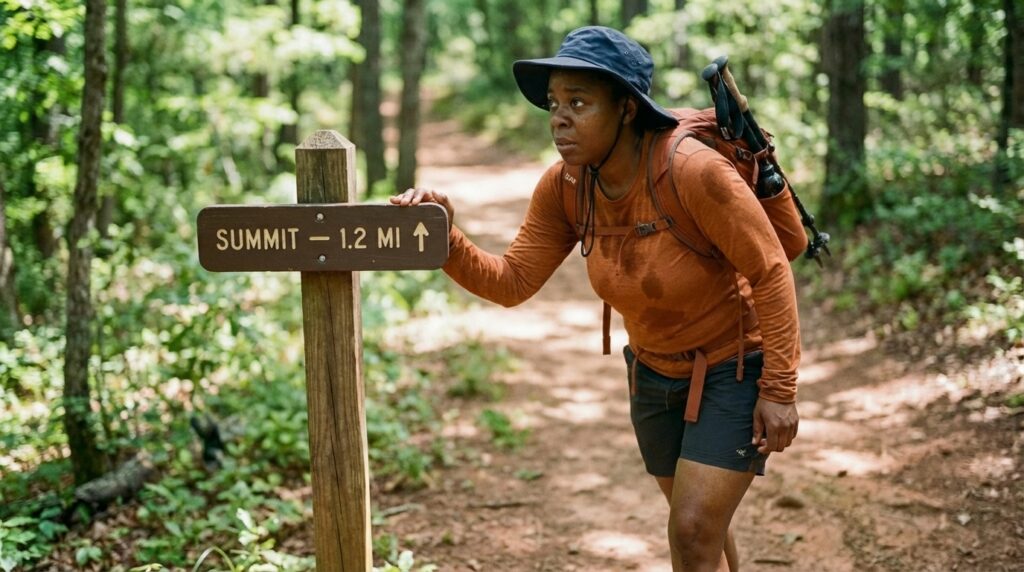
On the steepest section of a climb, stop trying to manage the whole thing and count 20 steps. Then 20 more. The counting gives the brain something specific to do other than run the mental block pattern from stage one to stage three.
How step-counting changes the experience of a steep section
The goal of step-counting is not distraction. It is narrowing of focus. When you count 20 steps, you are not thinking about the summit, your fitness level, whether you trained enough, or what the last mile will feel like. You are counting to 20.
A lot of mental toughness hiking comes down to reducing the cognitive space available for stage-one thinking to start. Counting steps is one of the simplest ways to do that. The other benefit: it naturally slows your pace, which is usually what a hard steep section requires anyway.
After each set of 20, take three full breaths before starting the next count. Not to rest, just to reset the rhythm. This sequence (20 steps, three breaths, 20 steps, three breaths) can move you through a hard quarter mile that would otherwise produce a mental block at step eight.
Tip 5: Use the ten-minutes-more commitment rule
When you want to stop, commit to exactly ten more minutes. Not the summit. Not the next mile. Ten minutes of walking.
Why ten minutes works when “just keep going” does not
“Just keep going” is not a rule. It is an exhortation, and the brain does not respond to exhortations once it has already built a case for stopping.
“Ten more minutes” is specific and bounded. The brain accepts it because it has a defined end. At the end of ten minutes, you reassess honestly: Do you want another ten? Can you keep a sustainable pace? Has anything changed in how you feel?
Most of the time, ten minutes of hiking at a pace you can sustain changes the experience enough that stopping no longer feels as necessary. The breathing settles. The legs find a rhythm. The visual environment shifts as you cover ground. None of this happens when you stop.
The rule for how to push through a hard hike is not “push through.” It is “commit to a small, specific, timed unit and then reassess.” Repeat as needed.
Tip 6: Reset completely at a planned rest stop
Scheduled rest stops are a hiking motivation tool most beginners do not use because they feel like giving in. They are the opposite. A 4 to 6 minute stop at a planned point gives your cardiovascular system a partial recovery, gives you a moment to eat and drink, and gives your brain a clear transition point between “the hard stretch” and “the next stretch.”
How to structure a rest stop that actually helps
Sit down. Eat something. Drink 8 ounces of water. Look at your AllTrails map and identify your next landmark. Set a specific time to stand up: 5 minutes from now. When the time is up, stand up. Do not negotiate with yourself about whether you feel ready.
The structure matters because unstructured rest stops tend to extend themselves. Sitting down without a restart timer means the restart conversation starts, and that conversation involves reassessing whether to keep going at all. That is stage three.
A rest stop with a fixed endpoint is not a weakness. It is pacing. Experienced hikers use them systematically. Beginners who skip them in the name of staying motivated to hike often produce the opposite result: they push until they genuinely cannot continue, then stop for a long time, then struggle to restart with cold muscles and a blood sugar dip they have been ignoring for 20 minutes.
💡 Trail Tip: Plan one rest stop at the halfway point of every hike, whether you think you need it or not. Set a 5-minute timer the moment you sit down.
Hikers who eat and drink at the halfway mark consistently complete the second half at a better pace than hikers who skip food and push through. The difference is not fitness. It is fuel timing.
🥾 Somatic Scanning on High-Heat Climbs
When testing hard routes on the PCT in intense afternoon heat, my inner monologue used to scream at me to quit. I developed a habit of performing a 30-second physical audit: unclenching my jaw, dropping my shoulders away from my ears, loosening my death grip on the trekking poles, and synchronizing my inhalation with two strides. Releasing unnecessary muscular tension immediately drops perceived exertion by two full points.
How to Build Mental Toughness for Hiking Before You’re on Trail
Staying motivated to hike starts the week before
Hiking mental blocks on trail are easier to interrupt when they are not your first exposure to sustained discomfort. Building baseline tolerance for effort before you reach the trailhead changes the experience significantly.
Three things you can do off-trail that transfer directly to on-trail mental toughness:
Walk without stopping. Pick a 45-minute walk and commit to not sitting down until the 45 minutes are up, regardless of how you feel. This is not about fitness. It is about practicing the “don’t negotiate with the impulse to stop” skill in low-stakes conditions.
Walk with a loaded pack. Carry your hiking daypack loaded to its actual trail weight for a 30-minute neighborhood walk, twice a week in the month before any elevation hike. Physical familiarity with the weight reduces the novelty effect that contributes to stage-one comparison thinking on trail.
Do one thing that is deliberately uncomfortable each week. Cold shower for 60 seconds. A workout at 70 percent of what feels hard. A walk in light rain when it is easier to stay inside. The activity is less important than the pattern: choosing to continue something mildly unpleasant past the first impulse to quit. That pattern is the transferable skill.

Finding Energy to Hike When You Have None Before You Even Start
When the motivation problem starts before the trailhead
Sometimes finding energy to hike is a problem that begins at home, not on trail. The alarm goes off, the drive feels long, the parking lot is full, the pack is heavier than you remembered. Before you have taken a step, the case for skipping the hike has already started building.
What works when you do not want to go at all
Commit to reaching the trailhead. Not the summit. Not mile 2. Just driving to the parking lot. Put your boots on. Get in the car. Go.
This sounds trivial. The decision point for a lot of skipped hikes is not on trail: it is in the kitchen before the second cup of coffee. Committing to “I’ll at least drive there” bypasses the negotiation because the threshold is low enough that the brain accepts it.
At the trailhead, give yourself five minutes to decide whether to start. Almost everyone starts.
How to handle hiking mental blocks that start before the trail
There is an honest version of “I don’t want to hike today” that deserves to be honored: if you are sick, significantly sleep-deprived, or dealing with something that genuinely needs your attention, skipping a hike is a reasonable decision.
The version that is not worth honoring: “I don’t feel like it” as a stand-alone reason. Feeling like hiking is not a prerequisite for hiking, in the same way that feeling like exercising is not a prerequisite for exercising. The feeling typically arrives somewhere around mile 1, not before it.
💡 Trail Tip: Set a five-minute decision window at the trailhead on days when motivation is low. Walk five minutes in. If you genuinely want to turn around after five minutes of moving, turn around.
In practice, most people do not turn around at five minutes. The resistance is almost always pre-trail, not on-trail.
Hiking Motivation Tips: FAQ
What are the best hiking motivation tips for beginners who want to quit mid-hike?
The most practical hiking motivation tips for someone who wants to quit mid-hike are these, in order: first, check fuel and water before assuming the problem is mental. Drink 8 to 12 ounces and eat something. Wait 10 minutes. Second, set a micro-goal to the next visible landmark rather than thinking about the full remaining distance. Third, commit to 10 more minutes of walking at a sustainable pace, then reassess. If all three produce nothing and you still feel genuinely depleted, turn around. That is a real signal, not a mental block.
How do I build mental toughness hiking over time?
Mental toughness hiking builds the same way physical conditioning does: progressive, deliberate exposure to discomfort in a controlled setting. Walk without stopping for 45-minute blocks. Carry a loaded pack on neighborhood walks twice a week. Do one deliberately uncomfortable thing per week that is not hiking. On trail, practice the micro-goal system and the 10-minute commitment rule starting on easy hikes, not hard ones. The pattern transfers. By the time you are on a hard climb, interrupting stage-one thinking is a practiced skill rather than a theoretical strategy.
What’s the most effective way to push through a hard hike when everything hurts?
The honest answer on how to push through a hard hike: slow down first, before trying any mental strategy. Most of what feels unbearable on a hard climb is sustainable at a pace 30 to 40 percent slower than the one that produced the feeling. Drop your pace until breathing returns to a level where you can say a full sentence without stopping. Then use step-counting in sets of 20 and micro-goals to the next visible landmark. Hard hiking rarely requires heroic willpower. It almost always requires a pace correction made five minutes before the moment it starts to feel unmanageable.
How do I find energy to hike when I feel tired before the hike starts?
Finding energy to hike when you’re already tired before starting comes down to one decision: get to the trailhead before you decide whether to hike. Most pre-trail resistance dissolves on contact with the trail itself. If it does not, a 5-minute rule gives you an honest out: walk five minutes, then decide. Practically speaking, eat a real meal or a substantial snack 60 to 90 minutes before you expect to start hiking. Hiking on an empty stomach produces real fatigue within the first mile. That is nutrition, not motivation.
What causes hiking mental blocks and how do you stop them?
Hiking mental blocks form in three predictable stages: comparison (this feels harder than expected), catastrophizing (this means I’m not capable), and permission (here is a reasonable-sounding reason to stop). The earliest stage is the easiest to interrupt. The interruption is naming the feeling accurately: “I’m uncomfortable, not in danger.” Add a micro-goal to a visible landmark and 10 minutes of committed walking. The block almost never survives contact with all three of those responses simultaneously.
How do I stay motivated to hike regularly, not just on one hike?
Staying motivated to hike as a long-term habit comes from one thing more than any other: ending hikes feeling like you could have gone further. That specific feeling is what produces a return. Hikes that end in exhaustion and soreness produce recovery weeks, not next weekends. Choose trails that are slightly shorter and slightly less challenging than your absolute limit, especially in the first two months. Build the finish-wanting-more pattern first. Difficulty can come later.
The Hard Part Is Almost Never the Steepest Section
The hardest mile of any hike is almost never the steepest one. It is the mile where you have talked yourself into believing the rest is not worth it. That mile starts at stage one: comparison between how the hike feels and how you thought it would feel.
Good hiking motivation tips do not eliminate that gap. They give you something specific to do while it is there.
Pick the next visible landmark. Name the discomfort accurately. Check your water and food before deciding the problem is mental. Count 20 steps. Commit to ten more minutes. Sit down at the halfway mark with a timer.
None of these is a mindset shift or a philosophy. They are six specific actions with defined endpoints. Use them in order, starting from the top, and adjust when something works.
Next Steps
- On your next hike: Set a micro-goal to the next visible landmark the first time the trail gets hard. Do not think about the summit. Think about the next bend.
- Before your next hike: Pack food you will eat at the halfway mark and a water reminder on your phone every 25 minutes. Fuel problems look identical to motivation problems until you fix one.
- This week off-trail: Do one 45-minute walk without stopping, regardless of how you feel at minute 30. Practice not negotiating with the impulse to quit in low-stakes conditions.
Related Reads
Spent the night before your first hike spiraling through every possible thing that could go wrong instead of sleeping? Here’s exactly what to expect so you walk in feeling ready, not anxious.
Thinking about bringing your dog along but genuinely unsure what you’d be signing both of you up for? Here are 10 tips for hiking with a dog as a beginner that go way beyond just packing extra water.
Took off fast at the start and spent the entire second half of the trail just trying to catch up to yourself? These 7 pacing techniques fix that imbalance so your energy actually carries you the full distance.
Kept walking even though a quiet voice in your head was telling you maybe this wasn’t a great idea anymore? Here’s how to actually know when to turn back on a hike before stubbornness turns into a real problem.
Packed a granola bar and called it lunch, then hit a wall two hours into your hike? Here are 6 foods that actually hold up on a day hike, way beyond just trail mix.