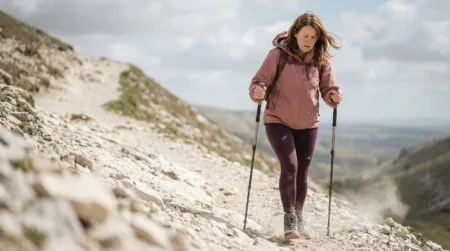


Hiking with asthma is a management problem, not a fitness problem. That distinction matters more than anything else on this page.
Trail Note: When I first started hiking, I had to learn this the hard way. Here is what I discovered from my own time out on the trails.
⚡ Quick Trail Takeaways
- Pre-Hike Premedication: Use your rescue inhaler (albuterol) 15-20 minutes before starting trail ascents per physician guidance.
- Cold & Dry Air Defense: Wear a buff or neck gaiter over nose and mouth in temps below 50°F to warm and humidify inhaled air.
- Gradient Pacing: Monitor heart rate on steep climbs to avoid hyperventilation-induced bronchospasm.
According to the Asthma and Allergy Foundation of America, roughly 25 million Americans have asthma, about 1 in 13 people. A meaningful portion of them hike regularly and do it well. What separates the hikers who manage it from the ones who struggle isn’t lung capacity or severity. It’s preparation: knowing what triggers symptoms on trail, carrying the right gear, and building a specific plan for outdoor exertion rather than hoping symptoms stay quiet.
There’s one thing most people searching hiking with asthma need to hear first: the trail is often a better environment for your lungs than the gym, a crowded bus, or an urban street at rush hour. Clean air, lower particulate exposure on most maintained trails, and moderate steady movement are actually favorable conditions for many asthma patients. The obstacle is usually preparation gaps, not the activity itself.
🟠 A Note Before You Head Out:
This guide covers preparation and management strategies for hiking with asthma, not emergency medical care. If you are currently experiencing a severe asthma attack, or any symptoms not responding to your rescue inhaler after two doses, call 911 immediately. A severe asthma attack on trail is a medical emergency. Read on for everything you need to prevent this situation.
What You’re Actually Dealing With
Exercise-induced vs. allergen-triggered asthma
Most people dealing with hiking and asthma have one of two primary patterns. They respond to different management strategies, and confusing them is the most common reason preparation fails.
Exercise-induced bronchoconstriction (EIB) is triggered by physical exertion, typically because rapid breathing during activity delivers cold, dry air to the airways faster than the body can condition it. Symptoms usually appear within 10-15 minutes of starting activity and peak 5-10 minutes after stopping. The American Lung Association estimates that roughly 90% of people with asthma have some degree of EIB. Critically, about 10% of people without any asthma diagnosis also experience it. For exercise-induced asthma hiking, a pre-exercise bronchodilator taken 15-20 minutes before you start significantly reduces episodes in most patients.
Allergen and environmental triggers are the second pattern. Pollen, smoke, wildfire air quality, cold dry air, and high altitude each belong here. These triggers don’t respond the same way to a pre-exercise inhaler. Managing them requires knowing your personal trigger profile and checking outdoor conditions before you leave home.
Most people with asthma have both patterns operating at once. Understanding which one is dominant on a given day changes how you prepare.
What this means for your preparation
If EIB is your primary pattern, the timing of your inhaler and your warm-up pace are the highest-leverage changes you can make. If allergen or environmental triggers dominate, the air quality index and pollen forecast matter more than pace. Many hikers with asthma need to address both in the same session.
Before Your Hike: The Non-Negotiables
Check the air quality index the morning of your hike
The EPA’s AirNow tool at airnow.gov gives you the current Air Quality Index (AQI) for any US zip code. An AQI of 51-100 (Yellow) is acceptable for most people with asthma on moderate trail activity. An AQI above 100 (Orange or Red) is a legitimate reason to reschedule, especially during pollen season or near wildfire activity.
Check it within two hours of departure. The previous night’s forecast doesn’t tell you enough. AQI shifts with morning traffic patterns, humidity, and wind changes that happen between 5 and 9am.
During active wildfire periods, the National Weather Service publishes smoke and air quality alerts for affected regions. A wildfire 40 miles away can push AQI from Green to Hazardous in under three hours depending on wind direction.
Take your inhaler before you start, not when symptoms appear
If your doctor has prescribed a pre-exercise protocol, typically one to two puffs of a short-acting bronchodilator 15-20 minutes before activity, follow it before every hike. Not just the ones where you expect trouble.
Managing asthma outdoors reactively is harder than managing it proactively. Airway narrowing has already begun by the time symptoms register consciously. Pre-treating puts you ahead of the process.
Tell your hiking partners your plan before you leave the trailhead
This is the preparation step most people with asthma skip. Your hiking partner should know three things: where your rescue inhaler is, what a serious episode looks like (audible wheeze, inability to complete a sentence, bluish tinge to lips or fingernails), and when to call 911 versus help you rest and reassess.
Write it down on your phone’s notes app before you go if you’re hiking with someone unfamiliar with your asthma. Thirty seconds of prep removes the guesswork from a high-stress moment.
7 Tips for Managing Hiking With Asthma
Tip 1: Warm up before the first real mile
Cold-starting a hike, stepping out of the car and directly into uphill effort, is a consistent trigger for exercise-induced symptoms. Your breathing rate needs time to adjust gradually, not spike from rest to exertion in 90 seconds.
Spend 5-10 minutes walking flat and slow before any significant incline. On a trail that begins flat, let the first half mile serve as your warm-up by consciously keeping the pace easy. This is not wasted time. It’s airway preparation.
If you’re using a pre-exercise inhaler, take it before this warm-up period, not after.

Tip 2: Use the talk test to govern your pace
The talk test is a practical breathing hiking tip that costs nothing: if you can carry on a normal conversation while hiking, your exertion is at a level your airway can manage. If you can only produce four or five words before needing to breathe, you are working above your sustainable threshold.
Slow down before your breathing becomes labored, not after. Once airway narrowing begins, pace reduction alone may not be enough to reverse it quickly. The goal is to stay below the effort level where symptoms start, not to react once they have.
Tip 3: Practice hiking breathing techniques on the trail
Nasal breathing as a primary tool
Nasal breathing is the most underused hiking breathing technique for people with asthma. Your nasal passages warm and humidify air before it reaches your bronchial tubes. Cold, dry air delivered directly to your airways via mouth breathing is a consistent EIB trigger.
This takes deliberate practice. Most hikers default to mouth breathing on any real incline. Build the habit on flat and recovery sections first. Return to nasal breathing whenever effort drops. Over several hikes, the range of effort you can sustain while nasal breathing expands.
On cold days below 40°F, a lightweight buff or neck gaiter pulled over the nose and mouth acts as a heat exchanger for incoming air. The Outdoor Research Alpine Start Buff runs about $30 and is light enough to forget it’s in your pack.
Tip 4: Choose routes that support your management strategy
Not all trails create equal conditions for hiking with asthma. Three specific characteristics worth evaluating before you commit to a route:
Elevation profile and grade
Sustained moderate inclines are easier to manage than short steep pitches. A sudden 400-foot climb over a quarter mile creates a breathing spike that a steady 400-foot gain over two miles does not. Look at the elevation profile on AllTrails before your first visit to a trail, not just the total gain figure.
Surface type and dust exposure
Dry dusty trails kick up particulate matter with every step. Compact dirt, gravel, or paved surfaces are lower-risk on dry days. After a rainfall, even dusty trails settle significantly.
Shade and heat exposure
Full-sun trails on hot days add cardiovascular stress on top of respiratory management. Tree cover reduces both UV load and ambient temperature. It also reduces direct pollen exposure for tree-pollen-sensitive hikers, though it cuts both ways if trees are your primary trigger.
Tip 5: Keep your rescue inhaler in an accessible outer pocket
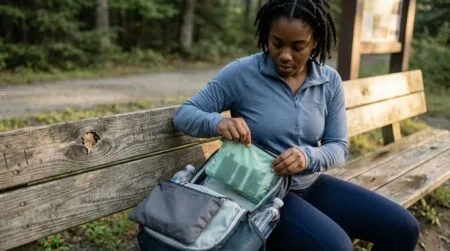
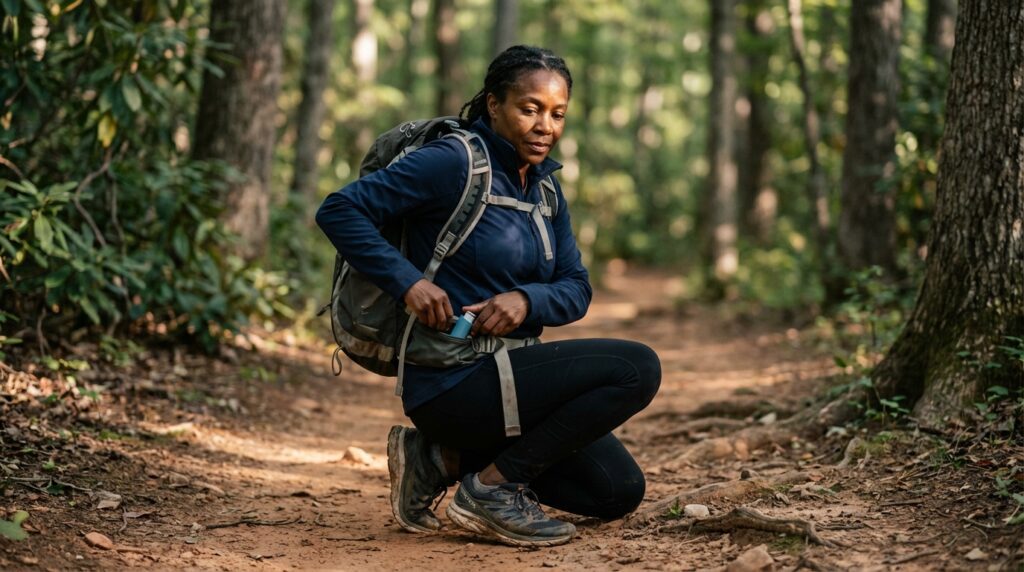
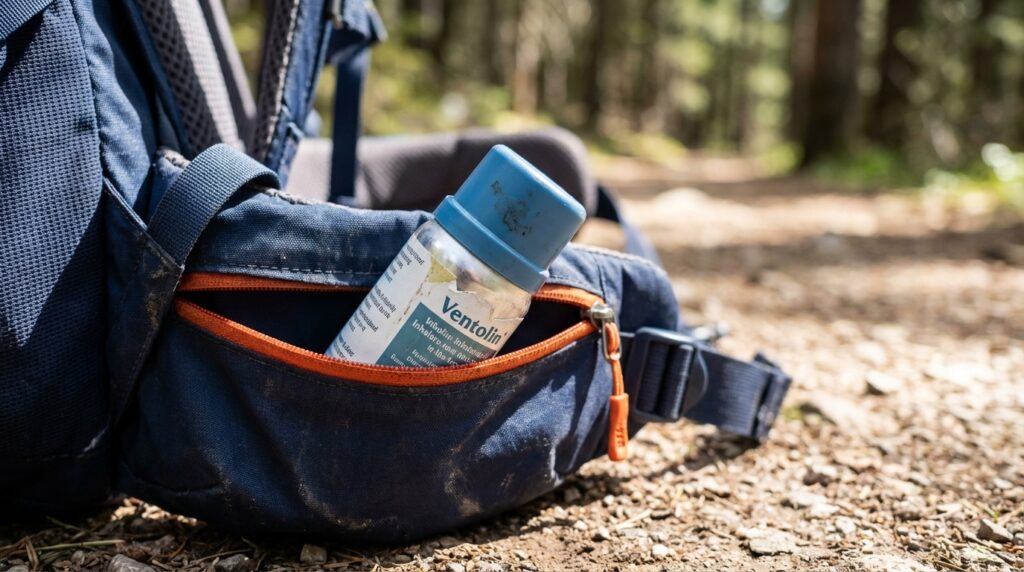
Not buried in your main compartment. Not at the bottom of a bag. Your inhaler belongs in a hip belt pocket, a shirt breast pocket, or a daypack side pocket you can reach one-handed without removing your pack.
Every second matters when symptoms escalate on trail. A 90-second pack excavation under a full bronchospasm is a different problem than a 5-second reach.
Cold temperatures below 50°F reduce metered-dose inhaler effectiveness because the propellant doesn’t pressurize correctly when chilled. On cold days, keep the inhaler against your body in an inside shirt pocket rather than an exposed outer pocket.
💡 Trail Tip: Shake your metered-dose inhaler before each use, even if you haven’t used it in several days.
The propellant and medication separate when the inhaler sits idle. Three shakes before use ensures you’re delivering a full dose, not a partially separated one.
Tip 6: Carry a written hiking-specific action plan
A standard asthma action plan covers indoor daily life. A hiking-specific plan addresses what “rest in a quiet room” looks like when that room doesn’t exist and you’re two miles from the trailhead.
Ask your doctor for a written action plan that specifies three scenarios: mild symptoms with a clear management response, moderate symptoms with a turn-around threshold, and the specific conditions that mean call 911. If you’ve only ever discussed daily management and never trail management, raise the question at your next appointment. The distinction matters because the options are different.
Tip 7: Track the pollen calendar for hiking with asthma
For allergen-triggered asthma, season timing matters as much as trail selection. Tree pollen typically peaks March through May. Grass pollen runs May through July. Ragweed, the dominant trigger for most people with allergic asthma, typically peaks August through October in the US.
The American Academy of Allergy, Asthma and Immunology publishes real-time pollen counts by region through its National Allergy Bureau. A low-count day in the middle of peak season is still hikeable for many people. A high-count day at peak season may be the day to reschedule. Checking the pollen forecast for your specific region is a two-minute step that removes most of the uncertainty around allergen-triggered episodes.
Conditions That Make Hiking With Asthma Harder
Cold and dry air
Cold air below 40°F is a consistent EIB trigger for most people with asthma. It is dry, which irritates the bronchial lining, and cold, which compounds airway constriction. Managing asthma outdoors in cold conditions means covering your mouth and nose to pre-warm inhaled air, keeping your exertion level lower than in mild weather, and treating any wheeze earlier than you would on a warm day.
Cold-weather hiking with asthma is workable. It needs a different threshold for what “manageable” looks like.
High altitude hiking with asthma
What changes above 8,000 feet
High altitude hiking with asthma introduces a specific variable that doesn’t exist at lower elevations: reduced oxygen per breath. Above 8,000 feet, your breathing rate increases naturally to compensate, which increases air volume moving through potentially sensitive airways.
For most people with well-controlled asthma, elevations up to 8,000 feet don’t create significant additional problems beyond ordinary acclimatization adjustment. Above 8,000 feet, high altitude hiking asthma management requires closer monitoring. Symptoms that are controlled at sea level can appear or worsen at altitude without the same exertion level.
Planning your first high-altitude hike with asthma
If you’re planning a hike above 8,000 feet for the first time, discuss it with your doctor before you go. Some patients are prescribed a short course of additional medication for high-altitude exposure. Discovering this for the first time on trail isn’t a useful learning experience.
Ascend gradually if possible. Spending a night at an intermediate elevation around 6,000-7,000 feet before hiking above 10,000 feet gives your respiratory system time to adjust. This applies to driving to high-elevation trailheads too, not just the hiking itself.
When to Change Your Plan
🔴 Turn Around Now
- Symptoms are not improving after two doses of your rescue inhaler. Turn around and move toward the trailhead; call 911 if you’re in significant distress or symptoms are worsening
- You cannot complete a full sentence without stopping to breathe
- Audible wheeze is present without pressing your ear to your chest
- Any symptom your written action plan identifies as a turn-around threshold
- Bluish or gray discoloration of lips or fingernails (cyanosis): call 911 immediately. This signals inadequate oxygen
🟡 Slow Down and Reassess
- A mild wheeze appeared in the last 20 minutes. Use your rescue inhaler, stop for 10 minutes, monitor before continuing
- Your resting breathing rate hasn’t returned to baseline after 5 minutes of standing rest
- You’re breathing noticeably harder than the terrain and your pace would normally require
- AQI or smoke conditions changed while you were on trail (visible haze, ash, or wind shift toward a fire area)
- Chest tightness that appeared without a clear cause. Stop, use your inhaler, reassess
✅ You’re Fine: Keep Going
- You completed your pre-hike inhaler protocol and have had no symptoms through the first 20 minutes of hiking
- Your breathing feels proportional to your effort level
- You can speak in full sentences at your current pace without stopping
- No wheeze, no chest tightness, no unexpected shortness of breath at rest
The rule for hiking with asthma: When you’re unsure which tier applies, treat it as the higher one. Getting off trail an hour early is a minor inconvenience. An asthma attack two miles from the trailhead with no cell service is a different problem entirely.
Hiking With Asthma: FAQ
Can I go hiking with asthma if I’ve never hiked before?
Yes. Hiking with asthma is possible for first-timers with well-controlled or mild-to-moderate asthma. The right starting point is a short, flat, low-elevation trail under 3 miles with under 300 feet of elevation gain, close enough to the trailhead that turning back is genuinely easy. Let your doctor know you’re starting to hike before your first outing. Some patients benefit from an adjusted pre-exercise inhaler protocol before building trail fitness, and the appointment takes five minutes.
What’s the difference between exercise-induced asthma hiking and regular asthma on trail?
Exercise-induced bronchoconstriction is triggered by exertion itself, typically because rapid breathing delivers cold or dry air to the airways faster than the body conditions it. About 90% of people with asthma have some EIB component. For exercise-induced asthma hiking specifically, a short-acting bronchodilator taken 15-20 minutes before starting and a slow warm-up in the first mile are the two highest-impact management steps. Environmental triggers like pollen and smoke require a separate strategy: checking AQI and pollen counts before you go rather than managing exertion on trail.
What breathing hiking tips actually help with asthma?
Three breathing hiking tips that change outcomes: First, breathe through your nose rather than your mouth whenever possible, because nasal passages warm and humidify incoming air before it reaches your airways. Second, use the talk test to keep exertion below the threshold where breathing becomes labored. Third, slow your pace before you feel symptoms, not in response to them. Learning hiking breathing techniques like diaphragmatic breathing and controlled nasal breathing before you need them on a difficult section is more useful than trying to apply them mid-episode.
Is high altitude hiking with asthma safe?
High altitude hiking with asthma is manageable for most people with well-controlled asthma at elevations up to 8,000 feet. Above that, reduced oxygen per breath increases your breathing rate naturally and can intensify symptoms that are otherwise controlled at lower elevation. The American Academy of Allergy, Asthma and Immunology recommends discussing any hike above 8,000 feet with your physician if you have asthma. Some patients are prescribed adjusted medication for high altitude hiking asthma situations. Gradual ascent and a night at intermediate elevation significantly reduce altitude-related respiratory stress.
What should I carry for managing asthma outdoors on a hike?
For managing asthma outdoors, carry: your rescue inhaler in an outer accessible pocket (not buried in your main compartment), your written hiking-specific action plan, an extra dose of any prescribed pre-exercise medication, your emergency contact information, and an ID or health insurance card. On remote trails, a personal locator beacon adds a safety layer that a phone alone can’t provide in areas without cell service. Your hiking partner should know where the inhaler is and what your plan says before you start moving.
Are some trails genuinely better for hiking with asthma?
Yes. Trails with consistent moderate grade rather than sudden steep pitches, compact or paved surfaces rather than dry dusty ground, and tree cover or shade reduce the specific stressors that most commonly affect hikers with asthma. Distance from the trailhead matters too, especially on early hikes: a loop that keeps you within 1.5 miles of the parking lot for the first several trips gives you a fast exit if conditions or symptoms change. Check the pollen forecast and AQI for the specific region the morning of your hike. The same trail can present very different conditions on different days.
The Real Barrier to Hiking With Asthma
Hiking with asthma is a preparation problem. Most people who struggle aren’t struggling because their asthma is too severe. They’re managing outdoor exertion the same way they manage daily life, and those plans weren’t built for trail conditions.
Get the pre-hike protocol right. Keep your inhaler where you can reach it in five seconds. Know your triggers before you leave home. Pick trails and conditions that match your current management capacity. Those four steps resolve the majority of the issues that keep people with asthma off the trail.
The part most guides don’t include: for some people with exercise-induced asthma, consistent hiking at moderate intensity actually improves baseline lung function over time. Not for everyone, and not as a substitute for medical management. But the American Lung Association notes that regular moderate-intensity aerobic exercise tends to improve breathing capacity in most asthma patients, including those who find it hardest at the start. That trajectory is worth working toward.
Next Steps
- Before your next hike: Check airnow.gov the morning of your hike. AQI of 51-100 is acceptable for most people with asthma. Above 100, reschedule.
- This week: Ask your doctor for a written hiking-specific asthma action plan that includes specific turn-around thresholds for trail use, not just home management.
- Before any hike above 8,000 feet: Have a direct conversation with your doctor about high altitude hiking with asthma and whether your current medication protocol covers it.
Related Reads
Burned through all your energy in the first mile and spent the rest of the trail just limping along? These 7 pacing techniques fix that imbalance so your energy actually lasts the whole way.
Threw on your normal cold-weather layers and found out a winter trail doesn’t play by the same rules as a winter walk? Here’s what beginners genuinely need to know before winter hiking, from icy footing to shorter daylight.
Thinking about bringing your dog along but not totally sure what you’d actually be signing up for? Here are 10 tips for hiking with a dog as a beginner that go way beyond just packing extra water.
Caved to a trail distance suggested by someone more experienced, without checking if it actually fit your fitness? These 5 rules help you set a number that’s genuinely yours, not borrowed from someone faster than you.
Ran through every possible worst-case scenario the night before your first hike instead of actually sleeping? Here’s exactly what to expect so you walk in feeling ready, not anxious.