The short answer to stretching before or after hiking: do it after. That answer will frustrate anyone who spent 10 minutes holding static stretches in a parking lot this morning. But the reason matters, because once you understand why timing changes everything, the whole system clicks into place.
⚡ Quick Trail Takeaways
Dynamic Warm-up First: Perform dynamic leg swings and high knees at the trailhead; never do cold static stretching.
Post-Hike Static Protocol: Hold 30-second static stretches for calves, hamstrings, and hip flexors within 20 minutes of finishing.
DOMS Reduction: Light 10-minute flat cooldown walks and adequate hydration reduce next-day muscle stiffness by over 30%.
Static stretching (the kind where you hold a hamstring pull or a calf lean for 20-30 seconds) works best on warm muscle tissue, not cold muscle tissue. Before a hike, your muscles have been sitting in a car or asleep in bed. Pulling cold muscle into a sustained hold does not prepare it for a 3-mile trail. It just creates tension in tissue that has no blood flow and no elasticity yet.
I learned this on a 4.5-mile trail in the Santa Monica Mountains on a cold January morning. I spent 10 minutes doing thorough static stretches in the parking lot, feeling diligent. By mile 1.5, my calves were cramping badly enough that I stopped twice on the ascent. My muscles had not warmed up at all. The stretching gave me a false sense of readiness and probably stressed cold tissue before any real blood flow reached it.
What actually works: a brief dynamic warm-up before the trail, and a proper post hike stretch routine when you finish. Both take less than 10 minutes. Together, they do more for preventing muscle cramps hiking than any static stretch held before you take a step.
Getting stretching before or after hiking right is not complicated once you understand why the timing matters. This article covers the full system.
Table of Contents
Stretching Before or After Hiking: What Actually Matters
The confusion around stretching before or after hiking almost always comes from conflating two completely different types of stretching. Static stretching and dynamic stretching serve different purposes, work best at different times, and produce different outcomes. Using the right type at the right time is the entire system.
Static stretching holds a position for 20-60 seconds to gradually lengthen muscle fiber. It improves range of motion over time. “Over time” means weeks of consistent practice, not one session before a hike. A single pre-hike static stretch does not meaningfully increase your range of motion for that specific trail. The flexibility gains accumulate across sessions, which is why timing them after exercise matters so much.
Dynamic stretching moves muscles through their full range of motion repeatedly: leg swings, walking lunges, controlled ankle rotations. It raises muscle temperature, increases blood flow, and activates the neuromuscular connection between brain and muscle. This is what the body needs before physical effort: not sustained holds, but active movement.
The practical problem is that most beginner hiking guides say “stretch before your hike” without specifying which kind. A reader doing static stretching before cold muscles have warmed up is following technically accurate advice in the least effective way possible. Research published in the Scandinavian Journal of Medicine & Science in Sports found that prolonged static stretching before exercise reduced muscle strength by 5-8% for up to an hour afterward. Doing that before a trail with real elevation gain is the opposite of preparation.
My opinion on this is direct: static stretching before a cold hike is the most common and most counterproductive habit in beginner hiking preparation. It feels productive and does nearly nothing useful.
Why static stretching before hiking misses the point
Muscle tissue in your legs when you step out of a car at a trailhead is stiff. Blood flow to skeletal muscle decreases during inactivity. Connective tissue (tendons, fascia) is less pliable at rest than during movement. Forcing a static hamstring stretch on that tissue does not lengthen the muscle. It creates tension in already-tense tissue, and you finish feeling like you accomplished something when you did not.
The muscle needs blood flow first. Blood flow requires movement. Movement first, then stretching. That is the sequence that works.
The real purpose of a hiking warm up
A hiking warm up has one specific job: raise muscle temperature and activate the movement patterns you are about to use on trail. Walking slowly for the first five minutes of a hike qualifies as a warm-up. Adding 5-7 minutes of targeted dynamic movement before the trail is better. The goal is arriving at the first real uphill section with warm muscles, not cold ones that have been held in a static position and then expected to climb 400 feet.
The American Hiking Society identifies muscle preparation and hydration as the two most controllable factors for trail comfort on day hikes. The warm-up handles the first. Hydration handles the second. Both are addressed before the trailhead, not on it.
Hiking Warm Up Stretches That Work
The best hiking warm up stretches are dynamic: they move joints through their range of motion, elevate heart rate slightly, and activate the specific muscles demanded by trail. Most beginner questions about stretching before or after hiking focus on which stretches to do. The more useful question is which type to do and when. Before the trail, that answer is always dynamic. Do these for 5-10 minutes at the trailhead or in the parking lot before you start.
This sequence targets the hip flexors, glutes, calves, and ankles. These four systems absorb the most stress on any trail with elevation change. For a flat trail under 2 miles, the full sequence is optional. For anything with more than 300 feet of gain, it earns its time.
Dynamic movements to do before the trail
These are not complicated. You do not need a mat, a foam roller, or any equipment. You need enough space to take three steps in any direction.
Leg swings
Stand next to a tree or fence for balance. Swing one leg forward and back 10-15 times, keeping the movement controlled, not a passive dangle. Switch legs. This activates the hip flexor and glute, the two muscles most engaged on uphills. Beginners consistently underestimate how much the hip flexors fatigue on steep trails. Getting them moving before the climb starts makes a measurable difference by mile two.
Walking lunges with a torso twist
Take a lunge step forward, drop the back knee toward the ground, then rotate your upper body toward the front knee. Stand up and repeat on the other side. Do 8-10 total. This stretches the hip flexor of the back leg while activating the glute of the front leg, and the rotation adds thoracic mobility that a loaded pack will demand from the first mile.
Ankle circles and calf raises
While standing, lift one foot and rotate the ankle 10 times in each direction. Set it down, rise onto both toes, lower slowly. Do 10 calf raises. On rocky and uneven terrain, ankle stability is where a significant amount of beginner energy goes, and tight ankles fatigue faster than ones that have been moved before you start. This takes three minutes and most people skip it entirely.
How long the warm-up actually needs to be
Five minutes is enough for a flat trail on a warm day. Ten minutes for hikes with significant elevation gain, cold morning starts, or if you drove more than 45 minutes to the trailhead. The functional test: do your muscles feel warm and your joints feel loose? That is the signal, not a clock.
💡 Trail Tip: Walk the first quarter mile at a pace noticeably slower than your hiking pace.
This extends the warm-up into the hike itself. Muscles that need more time to activate will get it on the trail before any real climbing starts. On hikes over 5 miles, this first-quarter-mile slower start often prevents the tight, reluctant feeling that hits beginners around mile 2.
Your Post Hike Stretch Routine
A post hike stretch routine is where flexibility for hiking actually gets built. The right approach to stretching before or after hiking separates the two types of stretching by their optimal timing: dynamic before, static after. After a trail, your muscles are warm, blood-pumped, and at their most pliable state of the day. Static stretching in this window works significantly better than the same stretch performed on cold muscle. The 30-second hold that does almost nothing in a parking lot before a hike produces real results when the muscle has been working for two hours.
The ideal window is within 15 minutes of finishing the trail. Do not drive home and do it on the living room floor an hour later. The effect is meaningfully reduced. Do it by your car, on a bench near the parking lot, or at a picnic table before you leave.
Why static stretching works after a hike
Muscle temperature peaks shortly after exercise ends. Tissue extensibility (the ability of a muscle to lengthen under load) is highest when the muscle is warm and has active blood flow. Stretching in this window produces more length change per unit of time than stretching at any other point in the day. For beginners trying to build flexibility for hiking before their fitness catches up to their trail ambitions, this timing difference is the main lever available.
Honestly, I cannot give you a precise percentage advantage for post-exercise versus pre-exercise stretching. The research varies considerably by study design, muscle group, and population tested. What I can tell you from two years of consistent post-hike stretching: hip flexibility measurably improved within six weeks, and the hip flexor cramping on long descents that plagued my first season dropped from a recurring problem to a non-issue.
Best stretches for hikers: the 4-move post-hike sequence
Hold each for 30-45 seconds per side. The goal is a gentle pull, not pain, not a sharp sensation. If a stretch produces a shooting or intense sensation, ease out of it. REI’s expert hiking preparation advice covers form cues for these movements if you want a visual reference before your first session.
Hip flexor stretch
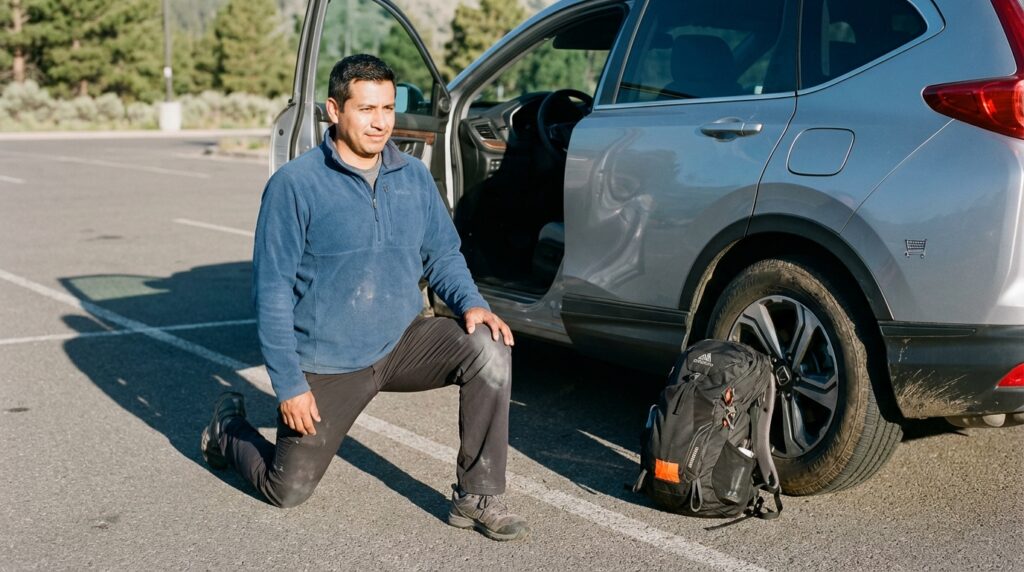
Step one foot forward into a half-kneeling position, front knee at 90 degrees, back knee on the ground. Shift your hips slightly forward until you feel the pull at the front of the back hip. This is the most important post-hike stretch for any trail with uphill sections. Hip flexors work hardest going uphill and shorten most predictably during sustained hiking. Skip every other stretch before you skip this one.
Calf and Achilles stretch
Stand facing a wall or tree. Step one foot back, heel flat on the ground, and press gently forward. Straight knee targets the calf muscle. Slightly bent knee targets the Achilles tendon. Do both versions. Calves and Achilles absorb the most impact on descents and are the primary site for preventing muscle cramps hiking on trails over 4 miles.
Standing quad stretch
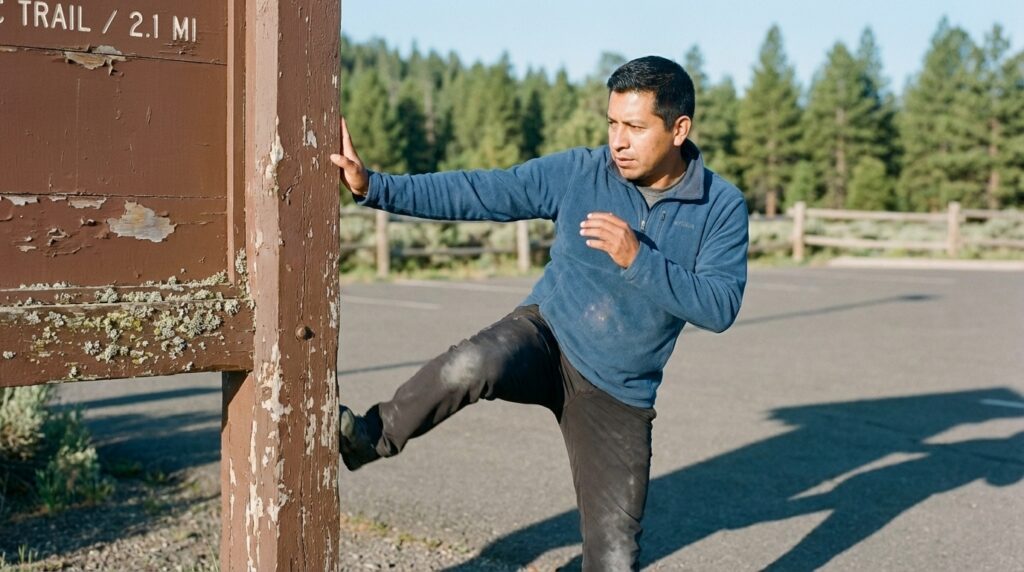
Stand on one leg, pull the opposite foot toward your glute, knee pointing toward the ground. Hold a tree or trail sign if balance is difficult. This targets the quadriceps, which decelerate the body on downhill sections and accumulate the most fatigue in that direction. Most beginners notice quad soreness two days after a hike with significant descent; this stretch is the main tool for reducing it.
Seated hamstring stretch
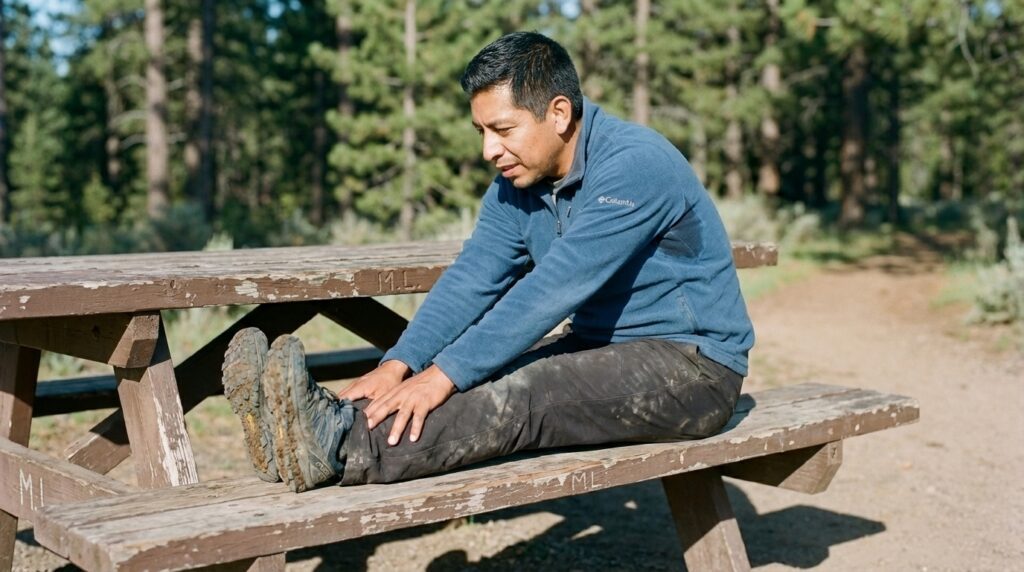
Sit on the ground, both legs extended. Hinge forward from the hips (not the back) until you feel the pull behind the thighs. Beginners commonly round the spine to reach their feet, which loads the lower back and defeats the purpose. Hinge at the hip, keep the back as flat as you can manage, and stop at the point where you feel the hamstring engage. You do not need to touch your toes.
Flexibility for Hiking: Building It Consistently
Flexibility for hiking does not improve from one post-hike session per week. It improves from consistent practice: 3-5 sessions per week, 30-60 seconds per stretch, maintained over 6-8 weeks. Stretching before or after hiking consistently is what builds the range of motion that makes longer trails feel manageable instead of punishing. That is not a dramatic commitment. It is 10 minutes on most days you are not on trail.
The four-move post hike stretch routine above is the foundation. On non-hiking days, adding a simple hip flexor and hamstring routine in the morning or evening accelerates progress. The flexibility that takes eight weeks to build with irregular practice takes four to five weeks with consistent daily sessions. That difference matters when your hiking goals are outpacing your current range of motion.
How often to stretch for real improvement
The American College of Sports Medicine recommends stretching major muscle groups at least 2-3 days per week for measurable flexibility improvement. For hiking specifically (where hip flexors, hamstrings, calves, and IT bands all need work) 4-5 sessions per week produces faster results. This does not mean long sessions. A focused 8-10 minute routine every time you hike, combined with a shorter 5-minute session on 2-3 other days, is sufficient.
Consistency beats duration every time. Five minutes daily beats 45 minutes once a week.
Preventing muscle cramps hiking through flexibility and hydration
Muscle cramps during a hike have two primary causes: dehydration with electrolyte depletion, and muscle fatigue from tissue that is not prepared for the demand placed on it. Flexibility work addresses the second cause but not the first. Drink at least half a liter of water per hour of hiking. On hikes over two hours in temperatures above 70 degrees, add an electrolyte packet or salty snack. Flexibility handles the tissue preparation side. Hydration handles the electrolyte side. Both are required for preventing muscle cramps hiking on longer trails.
💡 Trail Tip: Cramps that appear in the first mile are almost always dehydration. Cramps after mile 3 are almost always a muscle fatigue and preparation issue.
Knowing the difference tells you what to address on trail and what to fix before the next hike.
Common Stretching Mistakes Beginners Make
Stretching cold muscles and calling it a warm-up
Holding a static stretch in the parking lot before you have walked a single step is the most common mistake. Cold muscle does not stretch effectively. The tissue is stiff, blood flow is low, and you are creating tension in already-tense muscle before expecting it to climb 500 feet of elevation gain. The result is usually tight muscles on the trail, not prepared ones.
The fix: walk for 3-5 minutes at an easy pace before any stretching. Even this brief movement raises muscle temperature enough to make the dynamic warm-up exercises more effective. If you only have five minutes before the trailhead and you have to choose between five minutes of dynamic movement and five minutes of static stretching, choose movement every time.
Skipping the post-hike window entirely
Most beginners stretch before exercise out of habit and skip the post-trail routine entirely. The timing is backwards. Post-exercise is when muscles are most receptive to lengthening work. Skipping the post hike stretch routine means putting effort into the least effective window and none into the most effective one.
Driving home and stretching an hour later is better than not stretching at all. But it is measurably less effective than stretching within 15 minutes of finishing. The muscle temperature drop after a hike is faster than most people expect.
Ignoring hip flexors and calves
Most beginner routines focus on hamstrings and quads. Both matter, but the hip flexors and calves create the most trouble on hikes with elevation. Hip flexors tighten from hours of stepping uphill and then sitting in a car for the drive home. Calves and Achilles absorb repeated impact on descents. Leave either group out of the post-hike routine and you will notice it at the first hill on your next trail and on any sustained downhill section.
The best stretches for hikers are not the ones that feel familiar from gym class. They are the ones targeting the muscles that hiking actually loads most heavily.
Stretching Before or After Hiking: FAQ
Is stretching before or after hiking more important?
After the hike is more effective for building lasting flexibility. Static stretching after a trail, when muscles are warm and blood flow is high, produces more measurable improvement than stretching before. What matters before the trail is a dynamic warm-up: controlled movement through range of motion, not static holds. If you only have time for one or the other, do the post hike stretch routine. The pre-hike dynamic warm-up is important, but it serves a different purpose than flexibility building.
What are the best hiking warm up stretches for beginners?
Leg swings, walking lunges with a torso twist, and ankle circles are the three most effective hiking warm up stretches for beginners. They target the hip flexors, glutes, and calves, the muscles most demanded on any trail with elevation change. Do them for 5-7 minutes before starting the trail. If you are short on time, leg swings and 10 slow calf raises are the minimum effective version and take under two minutes.
How long should a post hike stretch routine take?
A complete post hike stretch routine for beginners takes 8-12 minutes. Four stretches, 30-45 seconds each, both sides, with brief transition time between positions. You do not need longer sessions to see improvement. What produces results is consistency: doing the routine within 15 minutes of every hike, not how long you hold each position. A 10-minute routine done after every hike beats a 30-minute session done once a month.
How do I prevent muscle cramps while hiking?
Preventing muscle cramps hiking requires addressing two separate causes: muscle fatigue and electrolyte depletion. For muscle fatigue: a dynamic warm-up before the trail and consistent flexibility work between hikes. For electrolytes: drink at least half a liter of water per hour, and on hikes longer than two hours, add sodium through food or an electrolyte packet. Cramps in the first mile point to dehydration. Cramps after mile 3 point to muscle preparation. Both are preventable with different interventions.
Can flexibility for hiking improve in a few weeks?
Yes, measurable flexibility for hiking improves in 4-6 weeks with consistent practice. Consistent means 3-5 sessions per week of 8-10 minutes each. Irregular long sessions produce less improvement than shorter, frequent ones. Focus on hip flexors, hamstrings, calves, and IT band. Those four areas cover the majority of flexibility limitations that slow beginners down or produce discomfort on longer trails. Six weeks of daily 10-minute routines produces more change than most people expect.
What are the best stretches for hikers with tight hips?
Tight hips on trail are almost always the hip flexors and hip rotators, not just the glutes. The best stretches for hikers with this pattern: the half-kneeling hip flexor stretch, a figure-4 stretch performed lying on your back with one ankle crossed over the opposite knee, and a low lunge with a slight lateral lean. All three can be done at the trailhead after a hike with no equipment. Add them directly after the four-move post-hike sequence covered above.
The Real Answer on Stretching Before or After Hiking
Stretching before or after hiking is not an either/or question. It is a sequence question. Dynamic movement before the trail. Static holds after. The type of stretching determines when it works, and using the right type in the wrong window wastes the effort entirely.
The most common beginner mistake is treating stretching as a checkbox before the hike and skipping it after. This puts effort into the least effective window and skips the most effective one. If you want to prevent muscle cramps, build flexibility for hiking, and feel less destroyed the day after a long trail, put your time into the post-hike window. It takes 10 minutes and produces results that compound over weeks.
Start with the four-move post hike stretch routine after your next hike. Add the dynamic warm-up before the one after that. That is the complete system. No equipment, no gym, no experience required.
Next Steps
Right now: Screenshot the four-move post-hike sequence from this article to your phone. You will not remember all four after one read, and having it accessible means you will actually do it after your next hike instead of sitting in the car and driving home.
Before your next hike: Do the three dynamic warm-up movements (leg swings, walking lunges with a torso twist, and ankle circles) for 5-7 minutes at the trailhead. Time it once so you know what 5 minutes actually feels like.
After your next hike: Do the four static stretches within 15 minutes of finishing. Set a timer at the trailhead before you get in the car.
Related Reads
Noticed your body acting kind of strange after your first hike, sore in spots you didn’t expect or weirdly energized instead of drained? Here are 7 body changes first-timers often notice, normal but rarely talked about beforehand.
Set your sights on a number that sounded ambitious without checking whether it actually matched where you’re at right now? These 5 rules cut through that guesswork and help you land on a distance that’s genuinely realistic for you.
Oliver Fall is an outdoor enthusiast with over 8 years of trail and backcountry hiking experience across Southern California. Two years ago, he founded Fama to break down real-world gear advice, practical trail skills, and honest beginner mistakes to help newcomers explore the outdoors with confidence.