


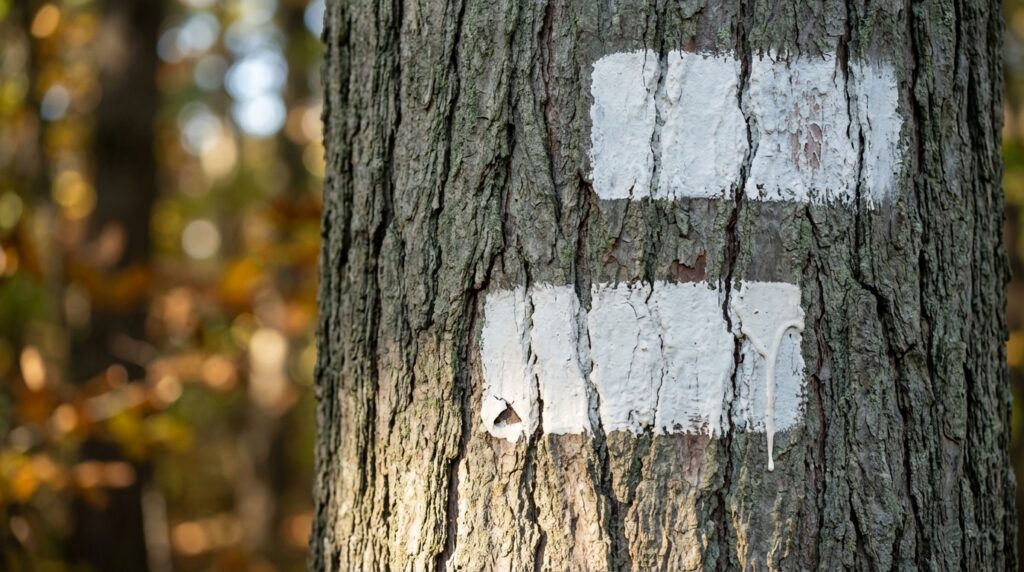
Trail blaze colors and meanings are the trail’s primary language, and most beginners pick them up by accident rather than instruction. That gap shows up at junctions where three paths diverge and only one continues on the correct route.
⚡ Quick Trail Takeaways
- Primary vs Side Trails: White blazes typically indicate primary trunk trails (e.g. Appalachian Trail); blue marks water or side spurs.
- Turn Signal Double Blazes: Two offset blazes signal an abrupt trail turn; the higher blaze indicates the direction of the turn.
- Confirmation Blazes: A single blaze should appear within 50 to 100 feet after any confusing junction or rock field.
Six hikes into regular hiking, I missed a double blaze on a trail in the San Gabriel Mountains. The mark was right there: two white rectangles on a pine tree at shoulder height, the upper one offset to the right. I walked past it and continued straight for about 400 feet before the blazes stopped. I backtracked, found the double blaze, and understood what it had been telling me. I had looked at it and kept walking because nobody had explained that a double blaze signals a turn.
Trail blaze colors and meanings are not fully standardized across the United States. That fact is where this guide starts, because assuming they are leads to exactly the errors that strand beginners at junctions. This covers the eight blaze types you will encounter most often, what each one reliably means, and where the system is less predictable than most trail resources describe.
🥾 Oliver’s Trail Notes & Field Observations
When I tested navigation skills across state forest trail systems, I learned quickly that trail blaze colors follow no single national standard. In my experience, white blazes mark major long-distance paths like the Appalachian Trail, while blue or yellow blazes often designate side routes, bypasses, or water access spurs. Never assume a color means the same thing across different state or national forest boundaries; always cross-check the trailhead sign board.
Trail Blaze Colors and Meanings: The System That’s Not Actually a System
What a trail blaze actually is
A trail blaze is a painted rectangle, typically 2 inches wide and 6 inches tall, placed on trees, rocks, or posts at roughly eye level along a hiking route. That format was formalized on eastern US trails in the early 20th century and was adopted systematically when the Appalachian Trail was established in 1937. The Appalachian Trail Conservancy specifies these dimensions explicitly in their trail maintenance standards, which is why AT blazes look consistent across 2,190 miles through 14 states.
Blazes are placed so you can see the next one from the point of the last one, and confirm the previous one by looking back. When you cannot find the next blaze from where you are standing, that is information. Stop before you take another step.
How trail marker identification works before and during a hike
Trail marker identification is a two-stage skill: the research stage at home and the reading stage on trail. Both matter. At home, look up the specific color convention for the trail you are hiking. AllTrails trail pages list blaze colors in the trail description, land manager websites list them in their trail guides, and a two-minute call to the relevant ranger station provides this for any trail. Do this before you leave home.
On trail, the reading skill comes down to knowing what color the main trail uses, what a side trail or boundary marker looks like in that specific system, and what a direction-change signal looks like. Those three things are the complete vocabulary of most trail systems.
Why the hiking color system has no single governing authority
The hiking color system in the United States has no federal standard. The American Hiking Society provides trail development guidelines and advocates for consistent practice, but it does not mandate specific color meanings across land managers. The USDA Forest Service, the National Park Service, the Bureau of Land Management, and each state parks agency all set their own conventions. This is why the same color can mean main trail on one system and boundary marker on another, and why trail preparation is always trail-specific.
The Part Most Trail Maps Leave Out
Why your last trail’s blaze system doesn’t transfer automatically
The assumption most beginners make, including me for the first dozen hikes, is that trail blaze colors work like traffic lights: universal, standardized, same meaning everywhere. They don’t. Yellow on the Appalachian Trail is associated informally with road walking, a term AT hikers use for road segments connecting trail sections. Yellow on a Pennsylvania state park trail frequently marks the primary hiking route. Red on some New England trail systems marks a main loop. Red on other systems marks a property boundary and is not a trail marker at all.
I did not know the hiking color system had no national standard until a ranger explained why the orange blazes I had been following on a state game lands trail were boundary markers, not a trail route. I had been hiking a property line for half a mile assuming I was on the correct path because the blazes were consistent and painted in the same format as trail blazes. They were consistent: consistently marking where the land manager’s boundary ran. For more information, visit fs.usda.gov.
How to look up the right convention in under two minutes
Every maintained trail system in the United States has its blaze color convention documented somewhere accessible. For National Park Service trails, the specific park’s trail map or website lists the system. For National Forest trails, the district ranger office website or a call to that office provides it. For state parks, the park’s trail page almost always includes blaze color information. AllTrails frequently lists blaze colors in trail descriptions for popular routes.
💡 Trail Tip: Before any new trail, search the trail name plus “blaze colors” or “trail markers.” If the result is unclear, call the ranger station. That two-minute call has never once failed to give a specific, accurate answer.
Rangers answer this question constantly. It is not a silly question. It is the right preparation question.
🥾 Low-Light Blaze Identification
During an autumn dusk descent through forested canyons near Switzer Falls, failing natural light made faded painted markers on oak bark nearly invisible. In my pack, I keep an LED headlamp with a focused spot beam; sweeping the light beam at eye level illuminates reflective trail tags and painted blaze boundaries long before dark-adapted eyes can pick them out.
The 8 Trail Blaze Colors and Meanings You’ll Actually Encounter
| Blaze Color / Marker | Standard Meaning (AT & Eastern US) | Regional / State Park Variations | Required Hiker Action |
|---|---|---|---|
| Single White Blaze | Main Official Trail Route (AT standard) | Primary hiking route in most eastern parks | Continue forward along marked path |
| Single Blue Blaze | Side trail, water source, or shelter spur | Primary trail in certain state systems | Verify trail map before leaving main route |
| Single Yellow Blaze | Connector, horse trail, or road route | Main trail in PA state forests | Confirm local trailhead color key |
| Single Red Blaze | Secondary loop or public trail | Property boundary line / hunting land | Do not follow if no beaten path exists |
| Single Orange Blaze | Boundary line or hunting zone | Multi-use / mountain bike connector | Exercise caution during hunting seasons |
| Stacked Double Blaze (Offset Right) | Immediate Sharp Right Turn | Universal turn indicator across all systems | Stop and scan right for the next marker |
| Stacked Double Blaze (Offset Left) | Immediate Sharp Left Turn | Universal turn indicator across all systems | Stop and scan left for the next marker |
| Rock Cairn (Stacked Stones) | Above-treeline route navigation | Common in Western alpine terrain | Follow line-of-sight from cairn to cairn |
White blazes: the most common main trail marker in the eastern US
White is the most widely used color for primary trail routes in the United States, particularly in the eastern half of the country. Its most consistent application is the Appalachian Trail.
How the AT white blaze system works
The AT white blaze marks the main route from Springer Mountain in Georgia to Katahdin in Maine using 2-by-6-inch white rectangles painted on trees and rocks. The Appalachian Trail Conservancy’s 31 maintaining clubs are responsible for keeping those marks consistent and visible across all 2,190 miles. If you are on the AT following white blazes, you are on the correct route.
White is also used for primary routes on many state and local trail systems outside the AT. That usage is common enough to be a reasonable default assumption, but not universal. Verify for any trail you haven’t hiked before.
Blue blazes: side trails, shelters, and the AT’s alternate system
On the Appalachian Trail, blue blazes mark every shelter access trail, water source spur, and official alternate route. Following blue from an AT white-blaze section takes you off the main route to a shelter or water and back.
What a blue blaze trail means on the AT versus other systems
The term “blue blaze trail” in AT culture means taking a blue-blazed alternate instead of the white-blazed main route, usually because the alternate is shorter or avoids exposed terrain. For a day hiker, a blue blaze trail on the AT means you’ve left the main route for a side destination. Outside the AT, blue does not reliably mean side trail. Some systems use blue as their primary route color. Confirm before you follow it.
Yellow blazes: the most variable color in any trail system
Yellow is the most contextually dependent of the common blaze colors. On Pennsylvania state forest trails, yellow frequently marks the main route. On other systems, it marks horse trails or multi-use connectors. The AT’s informal term “yellow blazing” means road walking and has no connection to a painted yellow blaze.
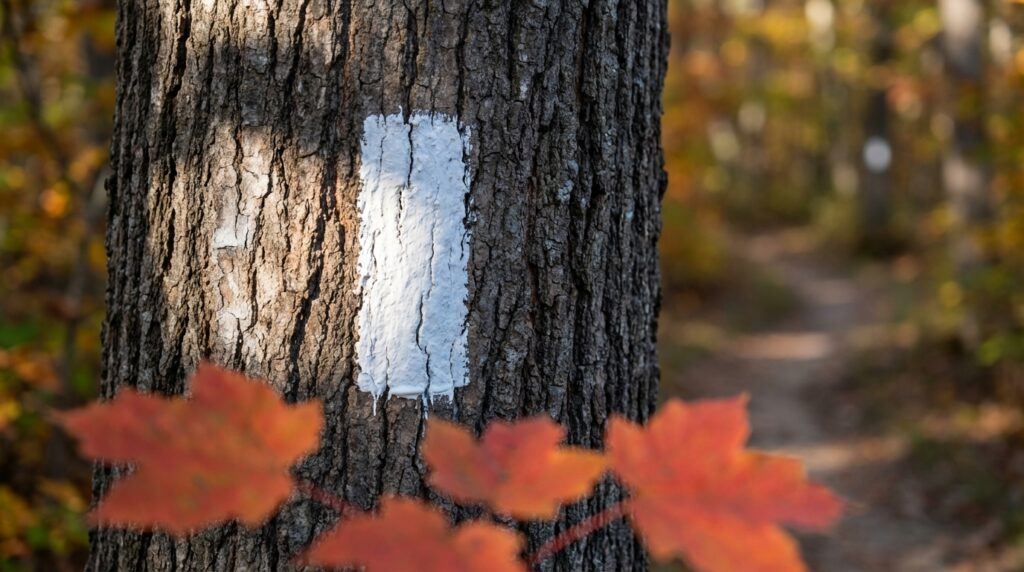
What do yellow blazes mean across different trail systems
What do yellow blazes mean on a specific trail? It depends entirely on that trail’s documentation. Yellow can be a primary route color, a connector, or a horse-trail designation. Treat it as a prompt to check the trail’s blaze key before you start, not as a color with a transferable meaning.
Red blazes: main routes in some systems, boundaries in others
Red is used in two contradictory ways. On some New England and mid-Atlantic state park systems, red marks a main hiking loop. On land adjacent to private property or managed for hunting, red blazes often mark property boundaries, not trails.
The field distinction: boundary blazes run in a straight line regardless of terrain. If red blazes are pulling you through dense brush with no traceable path, you are following a boundary line, not a trail route.
Orange blazes: land boundaries and hunting-area markers
Orange most commonly marks land boundaries and hunting-area edges on game lands, state forests, and private hunting property. These blazes use the same format as trail blazes. They are not trail indicators.
Some trail systems do use orange as a route color, particularly on multi-use or bike trails, but this is regional. When orange blazes appear unexpectedly on an unfamiliar trail, confirm their meaning with the trail’s documentation before treating them as the route.
Green blazes: distance markers and park-specific systems
Green appears as a trail color in fewer systems than any other common blaze color. State parks sometimes use green to mark mileage posts at half-mile or one-mile intervals, regardless of what color marks the main route. A small number of systems use green to designate a specific loop option or difficulty level.
Green is the blaze color where trail-specific research matters most. There is no reliable general-purpose meaning.
Double blazes: the most important mark beginners miss
A double blaze, two rectangles of the same color stacked vertically on the same surface, is a direction-change signal. It is not a painting error. It is not emphasis. It tells you the trail is about to turn.
Reading the stacked double blaze for direction changes
Upper rectangle offset to the right: the trail turns right. Upper rectangle offset to the left: the trail turns left. Upper rectangle centered above the lower: the trail makes a clear change in character or enters a section that requires closer attention, without committing to one turn direction.
My opinion on this is direct: the double blaze is the most important mark on any trail, and the one beginners are most likely to walk right past. When you see two blazes stacked on one surface, stop and look for where the trail turns before taking another step.
Post markers and shaped blazes: when paint is not used
Not all trail systems use painted rectangles. Carsonite posts, diamond-shaped metal markers, and cairns substitute for painted blazes in areas where painting is restricted or rock surfaces do not hold paint well. Western trail systems in particular use post and cairn marking more frequently than painted trees.
The reading principle is the same regardless of format: know what the main route marker looks like before you start, and treat any gap in markers as a reason to pause and verify position before continuing.
Common Mistakes with Trail Blaze Reading
Treating blaze colors as universal rather than trail-specific
The single most common error with trail blaze colors and meanings is transferring the logic from one trail to another without checking. A hiker who learned on the AT that blue means side trail and then follows blue blazes on a Pennsylvania state park trail where blue marks the main route is following correct instinct in the wrong system. The fix is not memorizing a universal color chart, because no universal chart exists. The fix is checking the specific trail’s system before each new hike.
Missing direction-change blazes by not looking for them actively
Direction-change double blazes fail to register when hikers are moving at a comfortable pace and not actively scanning for them. The way to avoid this: look for the next blaze before you need it, not after you’ve passed it. If you’re at a point where two paths look equally plausible, you have probably already walked past a double blaze. Go back 30 to 50 feet and look at the trees at eye height.
Assuming a well-worn path is the correct trail
Use trails, social paths, and old logging roads often look more traveled than the actual marked trail. Trail marker identification, not path appearance, is the reliable guide. If you’re on a well-worn path that hasn’t shown a blaze in the last five to ten minutes, stop and confirm. A busy-looking path with no blazes is not the trail. The trail has blazes.

When the Blazes Stop: What to Do Before You Keep Walking
Stop before taking another step in an uncertain direction. Retrace to the last blaze you’re certain of. From that point, look in all possible directions for the next blaze before moving. If the next blaze isn’t visible, look up (blazes placed high on tall trees are easy to scan past) and look behind you to confirm you’re reading the trail in the right direction.
If you still can’t locate the next blaze, open your offline trail map and verify where the trail should go relative to your GPS position. If you’ve confirmed you’re off the marked trail and can’t find the route, retrace to the last certain point and exit the way you came.
💡 Trail Tip: At every trail junction, look for the blaze before committing to a direction, even when one path looks obviously correct.
The most convincing wrong fork is usually the one where a double blaze told you to turn and you walked straight past it. The blaze is always more reliable than what the path looks like.
Trail Blaze Colors and Meanings: Frequently Asked Questions
What are trail blaze colors and meanings, and why aren’t they standardized?
Trail blaze colors and meanings are the color-coded paint marks that indicate route direction and trail type on hiking trails. No single governing body controls trail marking across all US land managers. The USDA Forest Service, National Park Service, Bureau of Land Management, and state parks agencies each set their own conventions. The result: internally consistent within a trail, not transferable across them. Check the specific trail’s documentation before each hike.
What is the AT white blaze, and why is it different from other trail markers?
The AT white blaze is the official marker for the Appalachian Trail: a 2-by-6-inch white painted rectangle placed at eye height on trees and rocks across the trail’s 2,190-mile route. The Appalachian Trail Conservancy maintains it through a network of 31 maintaining clubs. It is the most consistently documented trail marker in US hiking. Outside the AT, white is common for primary routes but not guaranteed. Trail-specific research still applies.
What is a blue blaze trail, and does it always mean side trail?
On the Appalachian Trail, a blue blaze trail marks a side route: shelter access, water spurs, and official alternates. In AT culture, “blue blazing” means taking an alternate instead of the white-blazed main trail. Outside the AT, blue does not reliably mean side trail. Some trail systems use blue as their primary route color. Before following blue blazes on an unfamiliar trail, confirm what blue designates on that specific system.
What does the hiking color system look like on trails with multiple blaze colors?
On multi-color trails, each color designates a route type: main trail, side trail, horse trail, bike route, or boundary. A typical system might use blue for the main hiking loop, yellow for a connector, and red for equestrian use. The trail’s map or trailhead signage lists what each color means. Read that key at the trailhead. The hiking color system only works if you know the key before you start.
What do yellow blazes mean, and why do they vary so much?
What do yellow blazes mean depends entirely on the trail system. Yellow marks primary routes on some Pennsylvania and New England trails. On others, it designates horse paths or connectors. In AT culture, “yellow blazing” is slang for road walking, unrelated to any painted blaze. Yellow varies because each land manager assigned colors without a national standard. Treat it as a prompt to verify the trail’s blaze key, not as a color with a universal meaning
Learn the System You’re On, Not the System You Wish Existed
Trail blaze colors and meanings follow one rule above all others: they are trail-specific. The preparation habit that resolves most beginner navigation confusion is not memorizing a color chart. It is spending two minutes before each new hike looking up exactly what the blaze colors mean on that specific trail.
White on the AT means you are on the main route. Blue on the AT means you have left it. Double blazes on any trail mean a turn is coming. Beyond those, treat each trail system as its own language with its own key, verify the key before you start, and let the blazes do the rest.
Next Steps
- Right now: Look up your next planned trail and search its name plus “blaze colors” to confirm what color marks the main route before you hike it.
- Before your next hike: Download the trail offline and screenshot every junction shown on the map at trail zoom level. Blazes and screenshots together are your complete navigation kit.
- After your next hike: Note which blaze types you actually encountered and whether any required a second look. That debrief builds trail marker identification faster than any guide.
Related Reads
Hit a junction with a faded splash of paint on a tree and had no clue which way it was even pointing? Here are 8 trail marker blazes worth knowing before you guess wrong at the wrong fork.
Spotted a small stack of rocks on the trail and weren’t sure if it was just someone’s art project or actually important? Here’s what cairns on hiking trails actually mean, and why ignoring one can cost you.
Picked a hiking distance based on what sounded ambitious instead of what your body’s actually ready for? These 5 rules cut through the guesswork so you land on a number that’s genuinely yours.
Scrolled through dozens of “best trails” lists and still had no idea which ones were actually beginner-friendly versus just labeled that way? Here are 15 beginner hikes across the US actually worth trying, no false advertising included.
Glanced at a trailhead sign with a rating system that meant absolutely nothing to you and just shrugged it off? Here’s what those difficulty ratings genuinely mean for someone brand new, no confusing jargon involved.