

The most useful beginner hiking tips are not the ones that sound impressive. They are the ones that prevent the specific, avoidable problems that end hikes early and put people off the trail entirely.
⚡ Quick Trail Takeaways
- Gear Priority: Invest in proper footwear and merino wool socks before spending money on expensive technical outer layers.
- Hydration Formula: Carry a minimum of 0.5 liters per hour in mild weather, scaling to 1.0 liter per hour in temps above 80°F.
- Energy Management: Start climbs 20% slower than you think you need to; sprinting early guarantees exhausted quadriceps.
My first real hike was 7.4 miles in the Blue Ridge foothills of Virginia. I picked it because it was listed as “moderate” on a trail app and the photos looked like something I could handle. I had cotton socks, a half-liter of water, no downloaded map, and a vague plan to turn around “when it felt right.” By mile 4, my feet had blisters on both heels, I was rationing the last of my water, and the trail markers had changed color in a way I hadn’t anticipated and didn’t understand. I made it back. Slowly, uncomfortably, and with a week of foot recovery ahead of me.
Every mistake I made on that hike was preventable with information I simply didn’t have. None of it was complicated. This covers what I wish I knew hiking before that trail.
These beginner hiking tips are ordered by the problems they prevent, not by category. The ones at the start of the list are the ones that affect nearly every first-time hiker. The ones toward the end are the ones most people don’t think about until they need them.
🥾 Oliver’s Trail Notes & Field Observations
On my very first hike up the San Gabriel foothills, I wore cotton denim jeans, carried a single 16-ounce plastic gas station water bottle, and had no map. By mile three, my thighs were chafed raw, my water was gone, and I had no idea how many switchbacks remained. The single most important shift I made was ditching cotton entirely for technical synthetics and carrying a minimum of half a liter of water per hour of planned movement.
What Hiking Actually Demands from a Beginner
Most people starting out hiking underestimate exactly one thing: cumulative load. A 5-mile walk on flat pavement is a different physical experience from a 5-mile trail with 700 feet of elevation gain on uneven terrain. The effort isn’t double; it’s closer to three times, because the terrain engages stabilizing muscles most people haven’t used in meaningful volume since childhood, if ever.
This is not a warning. It is calibration information. The correct response to it is not to choose shorter trails indefinitely, but to start on shorter trails and build deliberately. The American Hiking Society recommends beginning hikers target trails under 4 miles with under 300 feet of elevation gain for their first three to five outings. That range is specific for a reason: it puts you in the zone where you finish feeling capable rather than finished.
The beginner hiking tips in this guide are built around that reality. Starting where you actually are, not where you want to be, is what makes the second hike happen.
What Most First-Timers Get Wrong Going In
The single most consistent mistake beginners make is treating a trail as a test to pass rather than a route to complete safely and enjoyably. That framing, where turning around is failure, where finishing the listed distance is the goal, where slowing down means something went wrong, produces worse hikes and slower development.
My position on this: the first hike is not about the hike. It is about building the evidence base that tells you what hiking actually requires from your specific body, at your current fitness level, in whatever conditions you start in. That evidence base is built from completing hikes at a pace and distance where you finish with energy left. Not from grinding through something too long and expensive in soreness and recovery time.
Most beginner hiking tips focus on gear. Gear matters. But the mindset going in shapes the decisions on trail far more than the pack on your back.
🥾 Ten Essentials in Every Pack
I used to think carrying emergency gear on a well-marked 3-mile trail was paranoid. Then a twisted ankle at sunset on an easy Chantry Flat loop left a hiking companion stranded in dropping temperatures. Because I had a compact headlamp, a warm windbreaker, and a foil emergency bivy in my pack, we waited out assistance comfortably. Never leave the trailhead without the basic essentials, no matter how short the hike appears.
Beginner Hiking Tips: The 10 That Actually Change Your First Hike
Tip 1: Choose a trail that’s shorter than you think you need
The number one piece of starting out hiking advice from everyone who has hiked for more than a year is the same: start shorter. Not because you can’t handle more, but because shorter hikes on varied terrain teach you more per mile than longer hikes where you’re managing exhaustion.
Target 3 to 4 miles with under 400 feet of gain for your first three hikes. You will finish these with capacity left. That leftover capacity is not wasted. It is what makes you want to go back.
Tip 2: Your socks matter more than your shoes for blisters
Most beginner gear advice leads with footwear. Footwear matters. But the most consistent source of blisters on a first hike is cotton socks, not the wrong shoes.
Why wool or synthetic socks prevent what cotton doesn’t
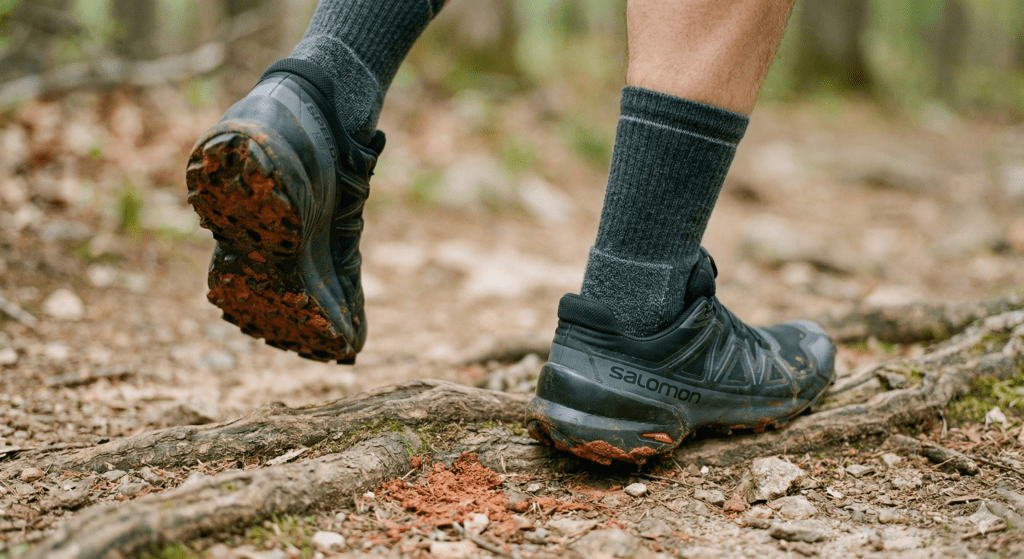
Cotton holds moisture against your skin. On a trail, your feet sweat, the sock gets damp, and friction increases. A wool or synthetic hiking sock wicks that moisture away from your skin and keeps the contact surface drier. The blister prevention is mechanical, not chemical. It removes the moisture that softens skin enough for friction to damage it.
Wool hiking socks cost $18 to $24 a pair. That is not a luxury purchase. It is the single cheapest gear upgrade that produces the most consistent improvement in first-hike comfort. Buy them before the shoes.
Tip 3: Download the trail map before you leave home, not in the parking lot
Cell coverage at trailheads is unreliable. Trailheads inside national forests and parks frequently have one bar or none. If you’re planning to navigate with AllTrails or any map app, download the specific trail offline at home on wifi before you drive anywhere.
Testing it matters too: after downloading, switch your phone to airplane mode and confirm the map loads at trail zoom level. A download that shows as complete sometimes fails to cache the tile levels you actually need on trail. Testing takes 60 seconds. Missing a junction because your map won’t load takes considerably longer.
Tip 4: Tell someone your plan before you leave
Trail name, trailhead location, expected return time, and what to do if you’re not back. This information takes 90 seconds to text and gives someone the ability to alert search and rescue with your specific location if something goes wrong. It is the most underused safety habit among beginners and the one with the highest marginal value per second of effort spent.
The American Hiking Society consistently identifies the pre-hike contact as one of the most protective habits a solo hiker can build. Do it before every hike, including ones you’ve done before.
Tip 5: Water intake is half a liter per hour, not per hike
The default error is treating water as something to drink when thirsty. Thirst lags behind dehydration by 20 to 30 minutes. By the time you’re thirsty on trail, you are already mildly dehydrated, which impairs judgment and accelerates fatigue.
How much water to carry based on conditions
For a 3-mile hike at 70°F: carry at least 1.5 liters. For a 5-mile hike at 85°F: carry at least 2.5 liters and consider an electrolyte supplement for any hike over 90 minutes in heat. These numbers go up with elevation gain and go up further in summer temperatures above 85°F. The calculation is simple: duration in hours multiplied by 0.5 liters, rounded up for heat and exertion.
💡 Trail Tip: Set a reminder on your phone to drink every 20 minutes, especially on your first few hikes when the novelty of the trail makes it easy to forget.
Most beginners drink 60% of what they should because they’re focused on the trail rather than their intake schedule. The reminder costs nothing and prevents the headache that shows up at mile 3.
Tip 6: Your hiking pace is slower than your walking pace, by design
Most beginners start at their regular walking pace and maintain it through the first mile. Trail terrain, elevation change, and the weight of even a light pack slow natural pace by 15 to 30 percent on maintained trails, more on rocky or uneven terrain.
The first hike advice worth internalizing: slow down before you feel like you need to. A conversational pace, where you can speak a full sentence without stopping for breath, is the correct sustainable pace for most beginners on most trails. If you can’t hold a conversation, you’re moving too fast for current conditions.
Tip 7: Turn around at 50% of your time, not 50% of your distance
Trail pace varies across terrain. You move faster on flat sections and slower on climbs. This means reaching the halfway point of a trail by distance does not tell you whether you have enough time to return before dark or before you’re too tired to move well on the descent.
Setting the turnaround time rule before you leave
Calculate your expected total hike time using a pace of 2 miles per hour plus 30 minutes per 1,000 feet of elevation gain. Set an explicit turnaround time, not a distance, before you start. When that time arrives, turn around regardless of where you are on the trail. Write it in your phone. Treat it as fixed.
The descent often takes 70 to 80 percent of the ascent time on maintained trails. On steep terrain, it takes longer. Building the buffer in prevents the situation where you are rushing a rocky descent in fading light because the summit took longer than expected.
Tip 8: The trail markers may be different from the last trail you hiked
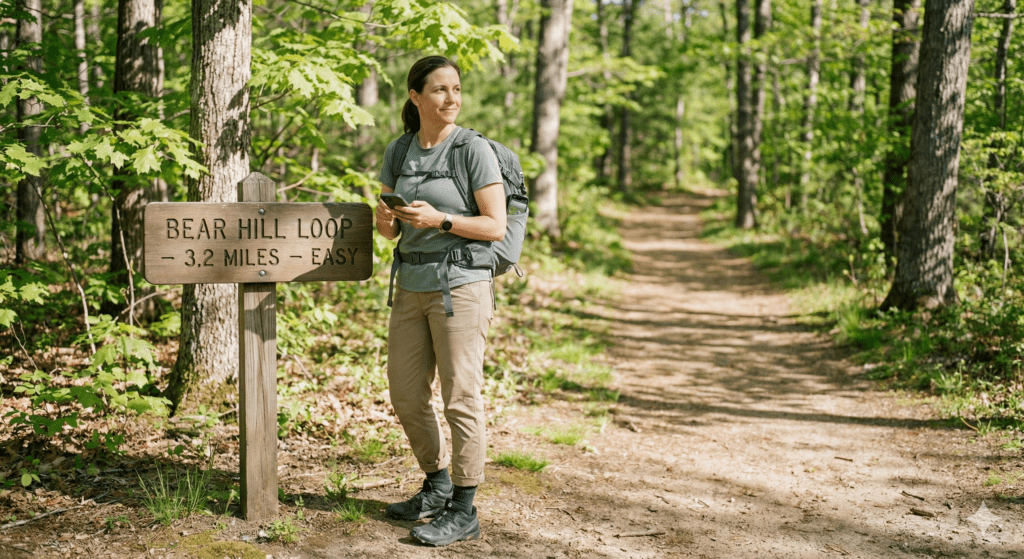
Blaze color conventions are not standardized nationally. White on one trail means main route. White on another may mean something different. Blue on the AT means side trail. Blue on a Pennsylvania state park trail may mark the main route.
Tip 9: Your phone battery will drain faster than at home
Cold temperatures reduce battery performance. GPS tracking and mapping apps consume more charge than regular phone use. Screens at outdoor brightness draw power steadily. On a 3-hour hike with active AllTrails tracking, a phone at 100% at the trailhead may be at 40% to 50% at the return.
The fix: download the map before you leave, screenshot key junctions, and switch to airplane mode for the return leg (your downloaded map still works in airplane mode). Carry a small battery pack if your hike is over 4 hours or the temperature is below 50°F.
Tip 10: You will be slower than you expect. Every beginner is.
This is the most consistent pattern across first hike advice from every experienced hiker: beginners overestimate their pace and underestimate how much terrain variation slows them down. The revision most people make after their first hike is to give themselves more time, not less.
Being slower than expected is not a fitness problem or a preparation failure. It is trail terrain doing exactly what trail terrain does. The adjustment is simple: plan for a pace 20 percent slower than what feels right, and carry 20 percent more time than the trail distance suggests.
Common Mistakes That Beginners Make Repeatedly
Wearing cotton anything. Cotton socks and cotton shirts hold moisture. On a hot day, a wet cotton shirt can accelerate chilling when you stop moving. Wool or synthetic for both.
Starting the hike before reading the trail description. AllTrails ratings are relative to all users, not to beginners. A trail rated “moderate” by AllTrails may be too much elevation gain for someone on their third hike. Read the elevation gain number, not just the distance and rating.
Leaving gear decisions to the day of the hike. The parking lot is not where you discover the map isn’t downloaded, the battery pack was left at home, or the sock situation hasn’t been addressed. All of that needs to happen the night before. The morning of a hike should require no decisions about gear, only about whether you’re going.
Not accounting for the descent in the time budget. The descent looks easy on a profile. On uneven terrain, especially after several miles of hiking, the descent demands the same careful footing as the ascent. Give it the same time in the plan.
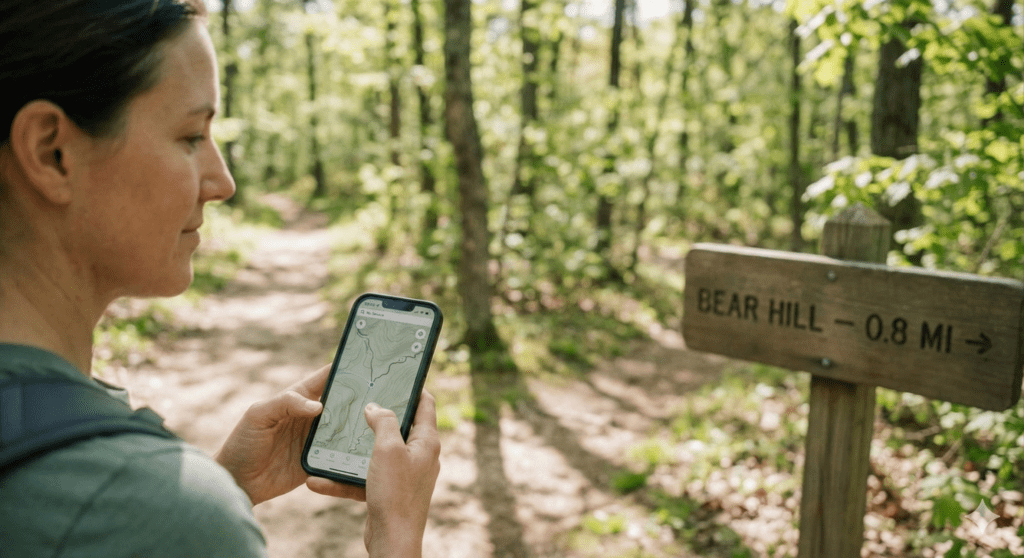
Before You Commit to a Direction You’re Unsure About
Uncertainty on trail is normal and manageable. It becomes a problem when you respond to it by continuing forward rather than stopping to confirm.
The rule that applies to every uncertain moment on every trail: stop before you take another step in a direction you can’t confirm. Check the downloaded map against your current position. Look for the next trail marker from where you are standing before moving. If the next marker isn’t visible and the map doesn’t clarify, retrace to the last point where you were certain.
💡 Trail Tip: At any trail junction where two paths look equally worn, look for the next blaze before committing to a direction, not after.
The most convincing wrong path on any trail is the one that looks well-traveled. Trail blazes, not path appearance, are the reliable guide.
Beginner Hiking Tips: Frequently Asked Questions
What are the most important beginner hiking tips for a first hike?
The three that prevent the most first-hike problems: download the trail map offline before leaving home, wear wool or synthetic socks (not cotton), and set an explicit turnaround time before you start rather than turning around “when it feels right.” Those three address navigation failure, blistering, and the sunk-cost bias that makes people push past the right stopping point. Everything else is useful. Those three are the foundation.
What is the best first hike advice for someone who hasn’t exercised regularly?
Start with a trail under 3 miles and under 300 feet of elevation gain, on a well-marked path rated easy on AllTrails. Walk at a pace where you can hold a full conversation without stopping. Bring more water than you think you need: at least 1.5 liters for a 2-hour hike. The fitness base that makes hiking comfortable builds through hiking, not before it. The first hike’s job is to generate useful information about your current capacity, not to demonstrate it.
What I wish I knew hiking is a common search: what do experienced hikers most often say?
The most consistent answer across experienced hikers is pace. Specifically: starting slower than feels necessary, setting a turnaround time, and building in more time than the trail distance suggests. The second most common is socks: the specific, repeated regret about cotton socks and the easy fix of switching to wool before the next hike. Both of these are simple and specific, which is why they come up so often as advice for novice hikers.
How should someone approach starting out hiking if they’ve never done it before?
Pick one trail, download its map, read its blaze color system, tell someone your plan, bring 1.5 times the water you think you need, and set a turnaround time before you leave the car. Do not bring more gear than a day pack can hold comfortably. Finish that hike with energy left. Then do it again two weeks later on a slightly longer trail. Starting out hiking well is less about preparation detail and more about building the repetition that teaches you what your body and gear actually do on trail.
What are the top 10 hiking tips that apply regardless of trail difficulty?
Start shorter than you think necessary. Wear wool or synthetic socks. Download the trail map offline and test it in airplane mode. Tell someone your plan before you leave. Carry half a liter of water per hour of hiking plus a reserve. Walk at a conversational pace. Turn around at your time midpoint, not distance midpoint. Confirm the blaze system for each new trail. Preserve phone battery with airplane mode on the return. Expect to be 20 percent slower than your estimate and build that into the plan. These top 10 hiking tips apply on a 2-mile local trail and on a 10-mile mountain hike.
The Preparation That Makes Everything Else Work
Beginner hiking tips are only useful if they happen before the hike, not during it. The list above works as a checklist in the 24 hours before any trail: map downloaded, socks confirmed, water calculated, plan communicated, turnaround time set.
That 20-minute pre-hike process prevents every avoidable problem most beginners encounter on their first trails. It does not make hiking easier. It makes the difficulty of hiking the only thing you’re managing, rather than the difficulty plus the consequences of missing something basic.
Next Steps
- Right now: Look up one trail within 30 minutes of home that is under 4 miles and confirm its blaze color system. That trail is your first hike.
- Before your first hike: Buy wool or synthetic socks if you don’t have them, download the trail map, and text someone your plan the night before.
- After your first hike: Note your actual pace versus your expected pace and how much water you used. That data calibrates every hike after it.
For essential hygiene strategies and packing lists for women on the trail, check out our practical guide on hiking on your period.
Related Reads
Watched your phone signal vanish at the exact moment you actually needed the map? Here’s why downloading offline trail maps before you go matters so much, so a dead signal never leaves you stranded on a guess.
Hit that wall where your legs could technically keep moving but your head had already checked out completely? Here are 6 mental tricks for pushing through when hiking gets hard, the kind that actually work mid-trail when quitting feels easier.
Mapped out a distance based on a number a fitness app suggested, without ever checking if it actually matched your own body? These 5 rules cut through that and help you land on something genuinely realistic for where you’re at right now.
Ended up the one quietly fuming halfway through a group hike because nobody could agree on a pace that worked for everyone? Here are 5 rules that keep a group hike moving smoothly, no resentment required.
Thinking about bringing your dog along on a hike but genuinely unsure what you’d actually be signing both of you up for? Here are 10 tips for hiking with a dog as a beginner that go way beyond just packing extra water and a leash.